
How to Allocate a Year End Gifting Budget Across Clients, Partners and Employees

Sign up for our newsletter for trending top content!
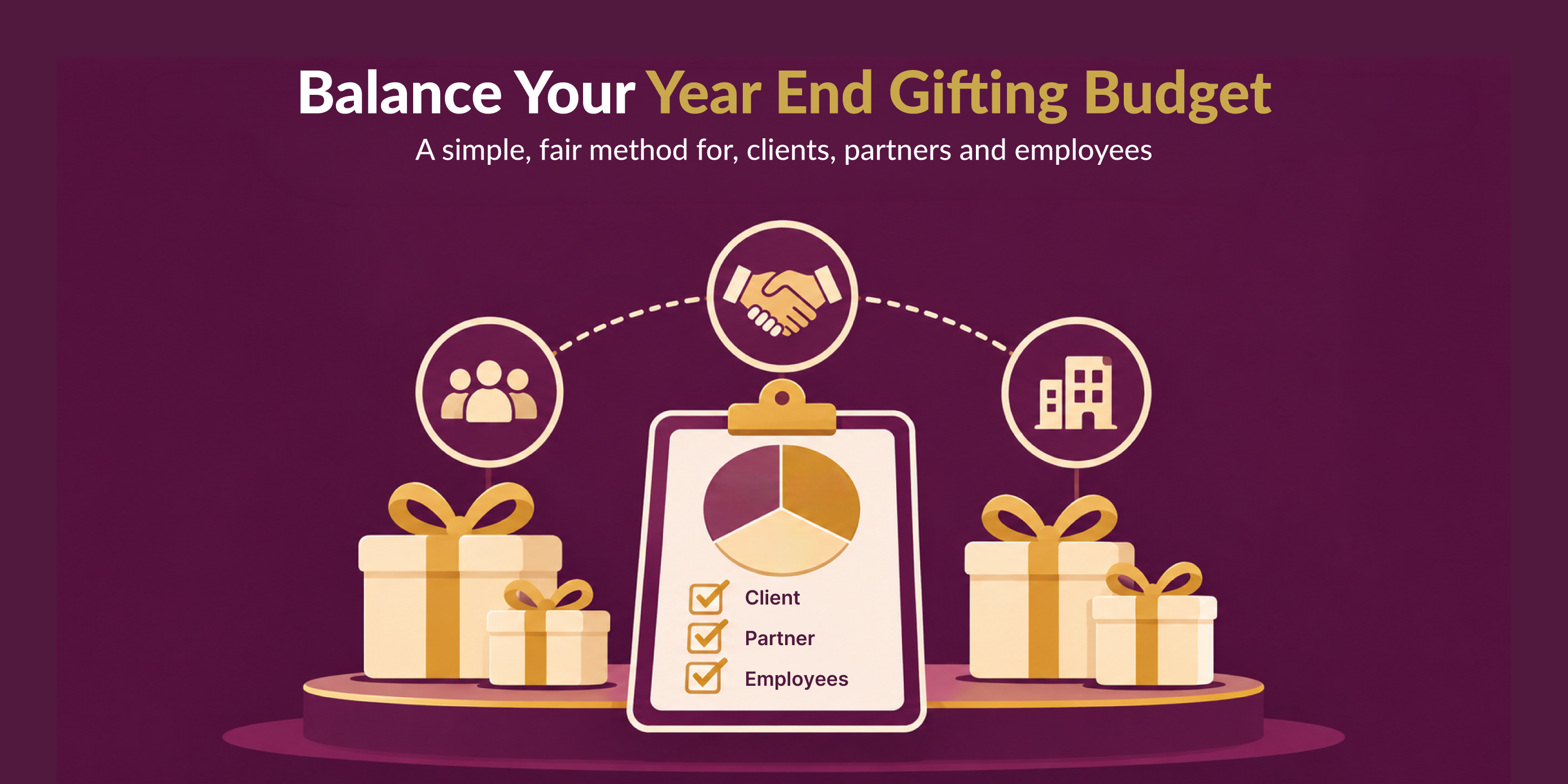
To allocate a year end gifting budget, set aside a reserve for late additions first. Then tier clients and partners by relationship value, count employees by headcount, convert both into points, and divide the remaining money by total points, so every gift reflects the relationship behind it.
Most gifting budgets are settled in one hurried meeting in November. Marketing asks for client gifts, sales asks for partner hampers, and human resources asks for something for the team. Each request sounds reasonable alone.
The difficulty is that nobody compares the requests against one another. A shared method solves this. It gives finance a number to defend, procurement a volume to plan and marketing a reason behind every gift.
This article sets out that method for Indian finance, procurement and marketing leaders. It needs only two inputs, relationship value and headcount, and it protects a reserve so that late additions do not force unfair cuts.
Why a year end gifting budget needs a method rather than a guess
Without a method, the loudest team wins. Client gifts grow because sales asks first, while employee gifts shrink because nobody argues for them. The outcome is uneven and difficult to explain to leadership.
A method also protects relationships. A strategic client who receives the same gift as an occasional contact may feel overlooked. Employees notice in the same way when partners appear to receive more.
Marketing usually owns the relationships, finance owns the money, and procurement owns the supply. When the three work from separate lists, duplicates and gaps appear. One shared list removes both problems.
Finance gains an audit trail, procurement gains early volumes for planning, and marketing gains a defensible reason for each gift. All three need the same inputs, which the following sections define.
Because the Indian financial year runs from April to March, confirm which financial year carries this spending and who owns the budget line before you begin.
Tier clients and partners by relationship value
Begin with one list of every client and partner you intend to thank. Ask the account owner, not the gifting team, to place each name in a tier. Three tiers suit most organisations.
Tier one holds relationships where losing the account would materially harm the business. Tier two holds steady, active relationships. Tier three holds everyone else who deserves acknowledgement.
Judge relationship value on three questions. How much does the relationship contribute to revenue or delivery? How long has it lasted? How much could it grow next year?
Write the criteria down. When a senior leader asks why a name sits in tier two, you can answer with the criteria rather than an opinion.
Resist the urge to place most names in tier one. If everyone is a priority, the weights lose meaning and the top tier absorbs money that other tiers need.
Partners can use the same tiers, or a separate scale if their roles differ greatly. Either way, keep the rules identical for everyone within a group.
Convert tiers and headcount into points
Points let you compare very different groups on one scale. Give each tier a weight that shows how much more its gifts should matter.
A tier one client might carry 5 points and a tier three client 1 point.
Treat the weights as a policy decision rather than a calculation. Leadership may change them, provided the same weights apply to everyone in the group.
Employees are counted by headcount because the aim is fairness, not ranking. Give each employee 1 point, so the employee pool grows in direct proportion to the number of people.
If you wish to recognise tenure, add a small bonus point for long service. Apply it by rule, and publish the rule, so that no employee wonders how gifts were chosen.
Add the points for clients, partners and employees. That total becomes the divisor for the next step.
Set the reserve first, then divide what remains
Decide the reserve before any other allocation. Late additions are common: a client signs in November, a partner changes role, or a team hires new people. Without a reserve, each addition forces cuts elsewhere.
Fix the reserve as a share of the total, and release it only against a written request approved by finance. Size it using your own history of late additions rather than a borrowed rule of thumb.
Agree in advance what happens to any unused reserve. It may return to finance, or it may fund a thank you round in January.
The scenario below is illustrative only. It uses notional units instead of currency, so you can substitute your own figures.
- Assume a total of 1,000 units and a reserve of 100 units, which leaves 900 units to divide.
- Assume 10 tier one clients at 5 points, 20 tier two clients at 3 points and 40 tier three clients at 1 point. Clients therefore hold 150 points.
- Assume 5 strategic partners at 4 points and 15 regular partners at 2 points. Partners therefore hold 50 points.
- Assume 100 employees at 1 point each. Employees hold 100 points, so the grand total is 300 points.
- Divide 900 units by 300 points, which gives 3 units per point. Clients receive 450 units, partners 150 units and employees 300 units.
- A tier one client gift is worth 15 units, a tier two client gift 9 units and a tier three client gift 3 units.
- A strategic partner gift is worth 12 units, a regular partner gift 6 units and an employee gift 3 units.
Check the arithmetic by multiplying each gift value by the number of recipients. The totals match the group allocations exactly.
Review the result against common sense before approving it. If a tier one gift feels too modest for the relationship, adjust the weights, not the individual gifts, and run the calculation again.
Round each gift value to a practical figure, and return any rounding difference to the reserve.
A timeline you can follow from October to January
Work backwards from dispatch, because gift selection, ordering and delivery all need time. The following timeline suits a plan that starts in October.
- In the first week of October, finance confirms the total and sets the reserve.
- By mid October, account owners tier every client and partner, and human resources confirms the headcount.
- By the end of October, marketing converts the points into a value for each gift, and finance approves the allocation.
- In the first week of November, procurement agrees gift selections and quantities with each supplier.
- By mid November, orders are placed and the delivery list is locked, so that dispatch can begin in good time.
- In the first half of December, gifts are dispatched, and the reserve is released only against written requests.
- In the first week of January, finance reconciles actual spend against the allocation and records lessons for next year.
If you are reading this in late November, compress the first three steps into a single week and keep the reserve intact.
Name one owner for every step. Finance owns the total and the reserve, account owners own the tiers, human resources owns the headcount, marketing owns the gift choices, and procurement owns ordering and delivery.
Keep a single shared sheet that records tiers, points, gift values and every release from the reserve. A single record settles most disputes before they begin.
Three mistakes recur. Teams tier too generously, they spend the reserve early, and they choose gifts before the allocation is fixed. Each one is avoided by following the order above.
At the selection step, you will need gifts that suit each tier. Cherishd, the physical gifting product of The Reward Store, offers curated gifts and gift boxes from 500+ Indian brands for employee, client and partner gifting.
Frequently asked questions
How much reserve should I keep for late additions to a gifting budget?
There is no universal figure, and any number quoted without your own history would be a guess. Review how many late additions you handled last year, size the reserve to cover a similar volume, and revisit it annually.
Should employees receive less than clients in a gifting budget?
Not necessarily. Employees are counted by headcount, so the employee pool is often large in total even though each gift is modest. Leadership should set the weights openly, so that the split reflects company values rather than habit.
How do you decide which clients get premium gifts?
Use written criteria: contribution to revenue or delivery, length of the relationship, and potential for growth. Ask account owners to place clients in tiers using those criteria, then let the point weights turn each tier into a gift value.
When should a company finalise its year end gifting plan?
Finalise the allocation by the end of October if you can, because selection, ordering and delivery all need time. If you are starting late, shorten the tiering step and keep the reserve to absorb surprises.
Can one gifting budget cover clients, partners and employees?
Yes, provided each group is measured on a common scale. Points convert relationship value and headcount into one unit, so a single pool can be divided consistently, with finance seeing one total and one set of rules.
Conclusion
A year end gifting budget works best when the rules are agreed before the requests arrive. Tier by relationship value, count employees by headcount, convert both into points and hold a reserve for what nobody can predict.
Once the allocation is settled, Cherishd offers curated gifts and gift boxes from 500+ Indian brands for employee, client and partner gifting.
To discuss your gifting programme, Book a Demo.
Sign up for our newsletter for trending top content!


