
How HR Leaders Can Manage Variable Pay, Agent Commissions, and Freelancer Payouts From One Platform

Sign up for our newsletter for trending top content!
Variable pay has become one of the fastest-growing components of workforce compensation. Mercer reports that organisations continue to increase the use of performance-linked pay structures to drive productivity, retention, and business outcomes. Yet many HR teams still manage sales incentives, agent commissions, freelancer payouts, and contractor payments through disconnected spreadsheets, emails, and manual approvals.
The result is not merely administrative inefficiency. It creates compliance exposure, payment disputes, delayed payouts, and damaged workforce relationships. As organisations expand their use of contractors, gig workers, channel partners, and performance-based compensation models, HR leaders face growing pressure to maintain accuracy without increasing headcount.
This article explores why variable pay administration has become so complex, where traditional processes break down, and how a unified platform can help HR leaders manage commissions, incentives, and freelancer payouts at scale.
The Variable Pay Complexity Problem That HR Leaders Rarely Talk About
Most discussions about compensation focus on salary benchmarking, employee benefits, or performance reviews. Far less attention goes to the operational complexity of managing variable pay across different workforce groups.
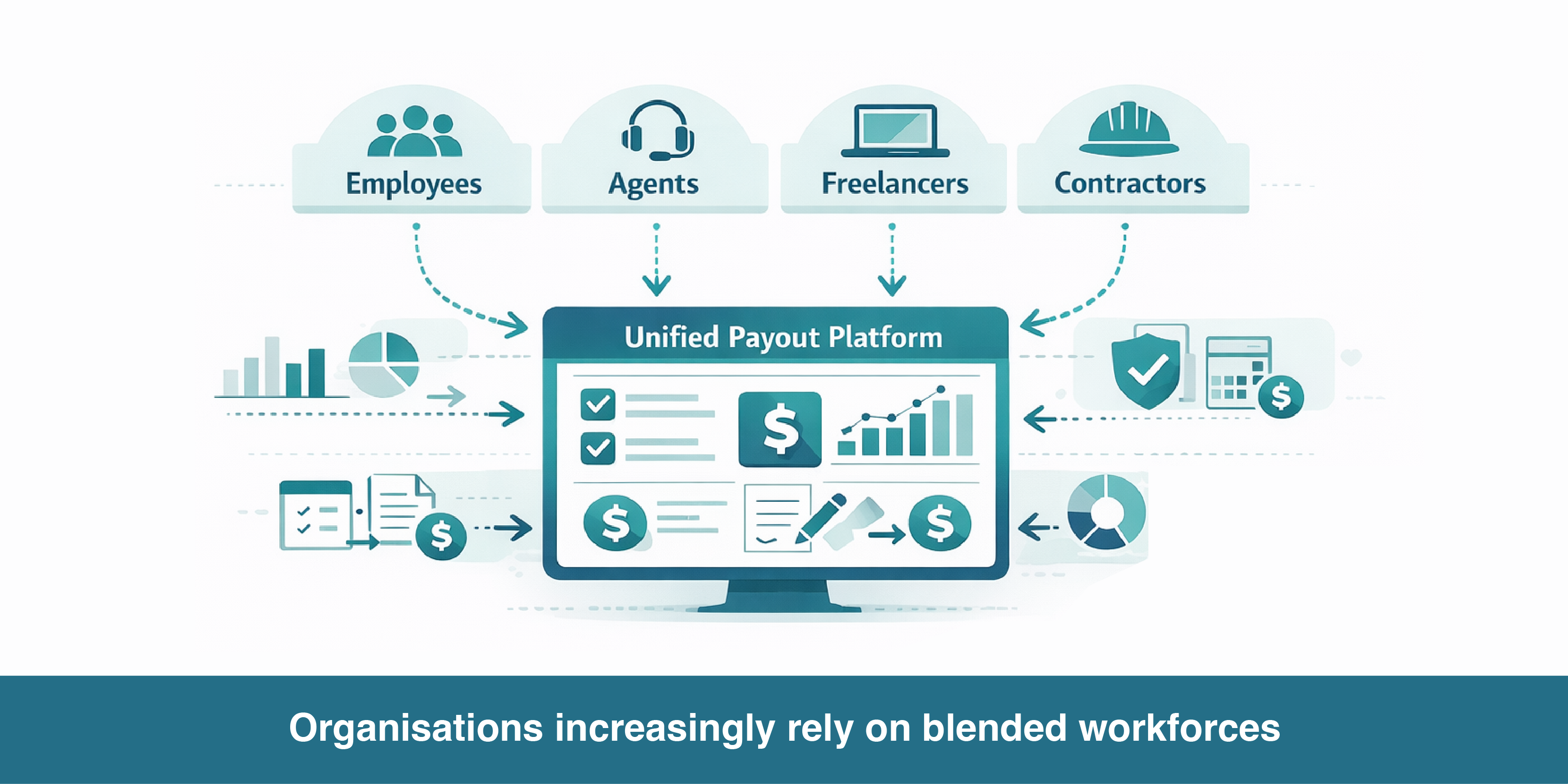
According to Deloitte's Global Human Capital Trends research, organisations increasingly rely on blended workforces that include employees, contractors, freelancers, consultants, and external contributors. Each group often operates under different compensation rules, payout schedules, approval workflows, and tax requirements.
For HR leaders, this creates a hidden administration challenge.
Consider a typical organisation:
- Sales employees receive monthly incentives.
- Regional agents earn commission-based compensation.
- Freelancers submit project-based invoices.
- Contractors receive milestone-linked payments.
-
- Business development representatives qualify for quarterly bonuses.
Each compensation stream requires tracking, validation, approvals, calculations, and payment execution.
The Cost of Fragmentation
Gallup research consistently shows that employees who clearly understand performance expectations and rewards demonstrate higher engagement levels. Delayed or disputed incentive payments weaken trust and reduce motivational impact.
At the same time, finance teams spend significant effort reconciling data from multiple sources. Deloitte reports that administrative complexity remains one of the major barriers preventing organisations from scaling performance-based compensation effectively.
The challenge is not compensation design. The challenge is compensation administration.
When HR leaders manage multiple variable pay models through disconnected systems, complexity grows faster than workforce size.
Why Spreadsheet-Based Commission Tracking Creates a Compliance and Relationship Risk
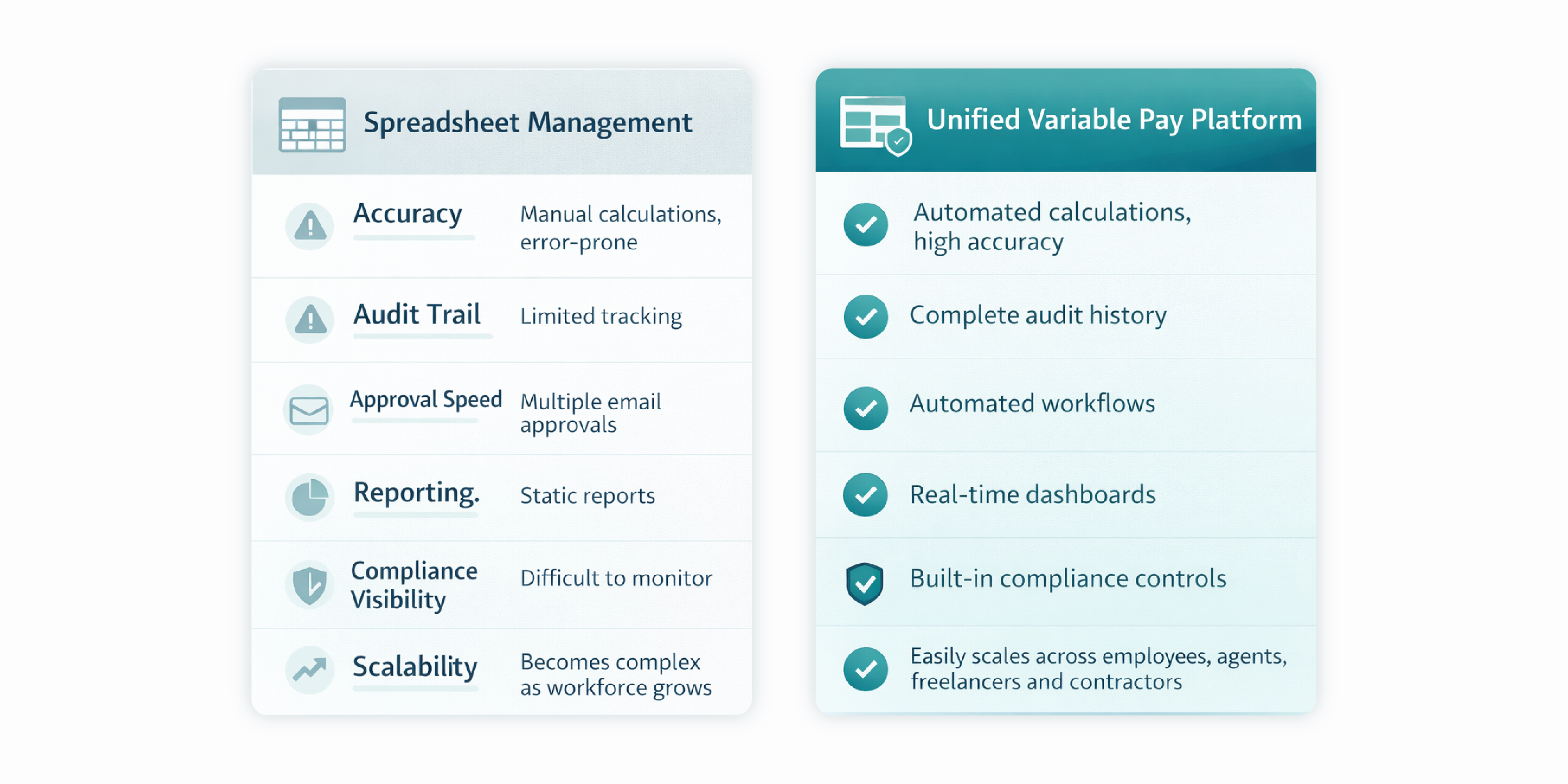
Spreadsheets remain one of the most common tools for commission management. They are familiar, inexpensive, and flexible. However, they introduce significant operational risks as organisations grow.
Research from Gartner has repeatedly highlighted spreadsheet dependency as a source of data quality and governance issues across business functions. A single formula error can affect hundreds of payouts.
For HR leaders, the consequences extend beyond calculation mistakes.
Common Risks of Spreadsheet-Based Commission Management
SHRM research shows that compensation transparency and payment accuracy directly influence employee trust. When workers believe incentive calculations are inaccurate, engagement and retention can suffer.
External stakeholders present an even greater challenge. Agents, consultants, and independent contractors often depend on variable compensation as their primary income source. Delays or disputes can quickly damage long-term business relationships.
This is where automation becomes essential. Rather than relying on multiple spreadsheets, HR leaders increasingly require centralised systems that create a single source of truth for payout calculations, approvals, and payment records.
Internal Sales Incentives vs External DSA and Agent Commissions: The Same Problem, Different Rules
At first glance, employee incentives and agent commissions appear to be separate compensation categories.
In reality, both involve the same core operational challenge: tracking performance, calculating earnings, validating eligibility, and issuing payments accurately.
The difference lies in governance requirements.
Employee Incentives
Employee incentive plans typically involve:
- HR policy alignment
- Performance management integration
- Payroll coordination
- Internal compliance requirements
Agent and DSA Commissions
External commission structures typically involve:
- Contract-specific commission rules
- Territory-based incentives
- Multi-level hierarchies
- Independent payout schedules
- Cross-border payment requirements
According to Aberdeen Group, organisations that automate incentive compensation management achieve higher payment accuracy and significantly lower administrative effort than those using manual processes.
The challenge for HR leaders is that many organisations operate both models simultaneously.
A sales employee may receive quarterly performance bonuses. An external acquisition partner may receive transaction-based commissions. A referral network may operate under separate payout structures.
Managing these groups through different systems creates fragmented reporting, duplicated effort, and inconsistent governance.
Platforms such as Paytives address this challenge by bringing employee incentives, agent commissions, and partner payouts into a unified framework. HR and finance teams gain visibility across all variable compensation models while maintaining separate rules, workflows, and approval structures.
This creates consistency without sacrificing flexibility.
How to Automate Freelancer and Sub-Contractor Payouts Without Growing the Finance Team
The freelance workforce continues to expand globally. NASSCOM research highlights the rapid growth of independent professionals across technology, marketing, consulting, design, and operations functions.
For HR leaders, freelancer management introduces a new administrative burden.
Unlike salaried employees, freelancers often operate under:
- Project-based compensation
- Milestone-linked payments
- Variable billing cycles
- Multiple contracts
- Diverse geographic locations
As freelancer volumes increase, manual processing becomes difficult to sustain.
Where Manual Processes Break Down
A typical payout cycle may involve:
- Work completion validation.
- Manager approval.
- Finance verification.
- Invoice reconciliation.
- Payment processing.
- Payment confirmation.
Each stage introduces potential delays.
McKinsey research on workforce transformation shows that organisations achieve substantial productivity improvements when they automate repetitive administrative workflows. Compensation administration represents a clear opportunity for such automation.
A platform-driven approach allows HR leaders to:
- Define payout rules in advance.
- Automate approval workflows.
- Trigger payment calculations automatically.
- Maintain centralised payout records.
- Track payment status in real time.
Paytives supports these workflows through configurable payout structures, automated calculations, and multi-currency payment capabilities. This allows organisations to scale freelancer and contractor programmes without proportionally increasing HR or finance headcount.
The result is faster payments, lower administrative effort, and improved contractor satisfaction.
What a Unified Variable Pay Platform Does to HR Administrative Burden
Many HR leaders underestimate how much time their teams spend coordinating compensation data.
According to Deloitte, HR functions continue to face growing pressure to improve efficiency while supporting increasingly complex workforce models. Variable compensation administration often consumes resources that could otherwise support talent development, workforce planning, and employee experience initiatives.
Administrative Tasks That Can Be Automated
A unified variable pay platform can automate:
- Performance tracking.
- Commission calculations.
- Approval routing.
- Payout scheduling.
- Payment notifications.
- Reporting and analytics.
Forrester research consistently identifies workflow automation as a major driver of operational efficiency and process consistency.
The benefits extend beyond productivity.
HR leaders gain:
- Greater compensation visibility.
- Faster dispute resolution.
- Improved payout accuracy.
- Better stakeholder experience.
- Reduced dependency on manual intervention.
Organisations looking to modernise workforce reward operations often combine incentive automation with broader recognition and engagement initiatives. For example, employee recognition programmes can integrate with platforms such as ApplaudIQ to strengthen motivation beyond compensation alone.
Similarly, organisations seeking to align customer engagement and partner performance strategies may explore loyalty programme automation through Rekyndl.
When compensation, incentives, recognition, and loyalty operate within connected ecosystems, organisations create stronger behavioural outcomes across employees, partners, and customers.
Building the Audit Trail: What HR and Finance Need for Variable Pay Compliance
Compliance requirements continue to increase across compensation management processes.
Mercer reports that organisations face growing scrutiny regarding compensation governance, payment accuracy, and recordkeeping practices.
Manual systems make compliance significantly harder.
Key Audit Requirements
HR and finance leaders typically require:
- Documented compensation rules.
- Approval histories.
- Payment records.
- Calculation methodologies.
- User access logs.
- Exception reporting.
Without a centralised system, collecting this information often requires manual investigation across spreadsheets, emails, and finance records.
O.C. Tanner research highlights the importance of fairness and transparency in reward administration. Workers are more likely to trust compensation systems when organisations can clearly explain how rewards are earned and calculated.
A structured audit trail supports both compliance and trust.
Modern variable pay platforms maintain detailed records of:
- Rule creation.
- Performance achievement.
- Approval decisions.
- Calculation changes.
- Payment execution.
This reduces regulatory risk while improving organisational transparency.
As workforce models become more complex and global, audit readiness is becoming a core requirement rather than an administrative afterthought.
Frequently Asked Questions
What is variable pay management?
Variable pay management refers to the process of tracking, calculating, approving, and distributing performance-based compensation. This can include sales incentives, bonuses, commissions, freelancer payments, contractor compensation, and partner incentives. Effective management requires accurate calculations, transparent rules, and reliable payment processes.
How can HR leaders reduce commission calculation errors?
HR leaders can reduce errors by replacing manual spreadsheets with automated calculation systems. Automation standardises commission rules, eliminates formula inconsistencies, and creates approval workflows that reduce human error. Centralised reporting also makes discrepancies easier to identify and resolve.
Why do freelancer payouts become difficult to manage at scale?
Freelancers often operate under different contracts, payment schedules, and project structures. As freelancer numbers increase, manual tracking creates bottlenecks and delays. Automated payout workflows help organisations process payments consistently without increasing administrative workload.
Can one platform manage employee incentives and agent commissions?
Yes. Modern variable pay platforms can support multiple compensation structures within a single environment. Paytives, for example, allows organisations to manage employee incentives, agent commissions, partner rewards, and contractor payouts while maintaining separate rules and governance controls.
What should HR and finance look for in a variable pay platform?
Key requirements include automated calculations, approval workflows, audit trails, reporting capabilities, multi-currency support, integration flexibility, and role-based access controls. The platform should support both current compensation models and future workforce expansion plans.
Conclusion
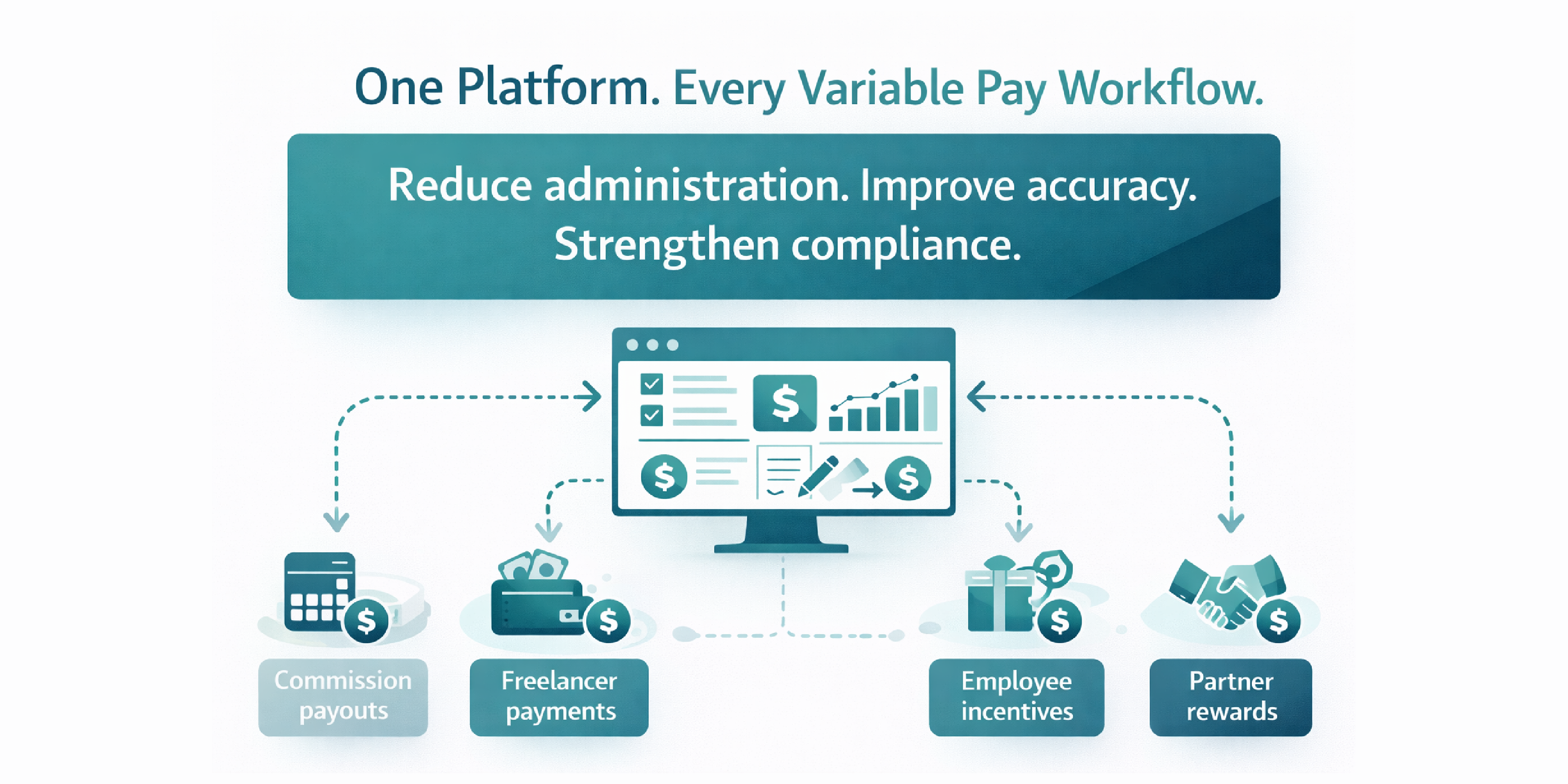
Variable pay administration has evolved far beyond sales commissions and annual bonuses. HR leaders now manage increasingly complex combinations of employee incentives, freelancer payments, contractor compensation, and agent commissions.
Organisations that continue to rely on spreadsheets face growing risks around accuracy, compliance, transparency, and scalability. As workforce models become more distributed and performance-driven, unified variable pay platforms will become a core part of modern HR operations.
See how Paytives gives HR leaders one platform for variable pay, commissions, freelancer payouts, and incentive governance. Explore the solution: https://www.therewardstore.com/paytives/solutions/for-hr-leaders
Sign up for our newsletter for trending top content!


