
How to Build a Total Rewards Strategy That Makes Employee Recognition Central: Not an Afterthought

Sign up for our newsletter for trending top content!
Introduction
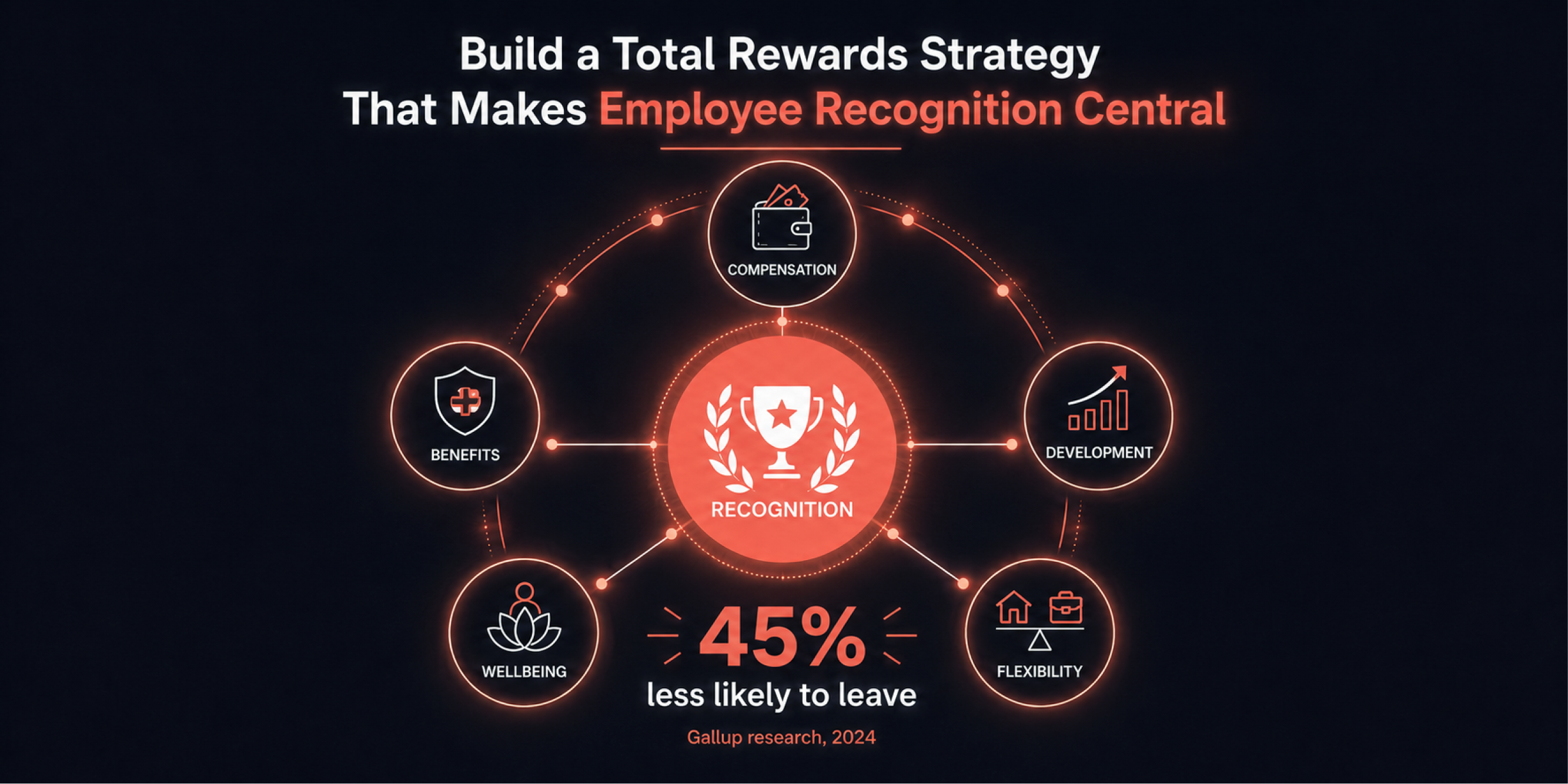
Employees who receive high-quality recognition are 45% less likely to have left their organisation two years later, according to longitudinal research from Gallup. The same research found that employees receiving high-quality recognition were 65% less likely to be actively looking or watching for another job opportunity.
For HR leaders, that makes recognition more than a culture initiative. It is a measurable component of the employee value proposition and a potential lever for retention.
Yet many total rewards strategies still give most of their attention to salary, bonuses and benefits, while recognition sits in a separate programme with limited visibility. SHRM's current total rewards guidance explicitly places recognition alongside compensation, benefits, wellbeing and career development.
This article explains how to make recognition a central part of total rewards, quantify its value, communicate it fairly, segment it by career stage and measure whether it strengthens your EVP.
Why Total Rewards Strategies Usually Underprioritise Recognition Until It Is Too Late
Recognition often loses priority because compensation and benefits have established budgets, governance processes and market benchmarks. Recognition can appear less tangible, particularly when HR measures it through participation rather than business outcomes.
That distinction matters. SHRM identifies recognition as a core component of total rewards and links meaningful recognition with motivation, engagement and retention. Its guidance also recommends assessing rewards according to their impact on attraction, retention and engagement rather than treating every reward element as an isolated benefit.
Gallup's longitudinal research provides a stronger business case. Employees who received high-quality recognition were 45% less likely to have changed organisations two years later. Gallup also estimates replacement costs at around 40% of salary for frontline workers, 80% for technical employees and 200% for managers and leaders.
The strategic mistake
The common mistake is to treat recognition as an annual event rather than an always-on component of the employee experience.
A stronger total rewards strategy asks three questions:
- Which behaviours and outcomes should recognition reinforce?
- Which employee groups receive recognition, how frequently and through which channels?
- Can HR connect recognition activity with retention, engagement and performance data?
SHRM's 2026 guidance reinforces the need to treat total rewards as a strategic mechanism for retention, workforce performance and organisational value.
The implication is straightforward: recognition should enter the total rewards conversation when the strategy is designed, not after attrition exposes a gap.
The Employee Value Proposition: Where Recognition Sits Alongside Compensation, Benefits, and Development
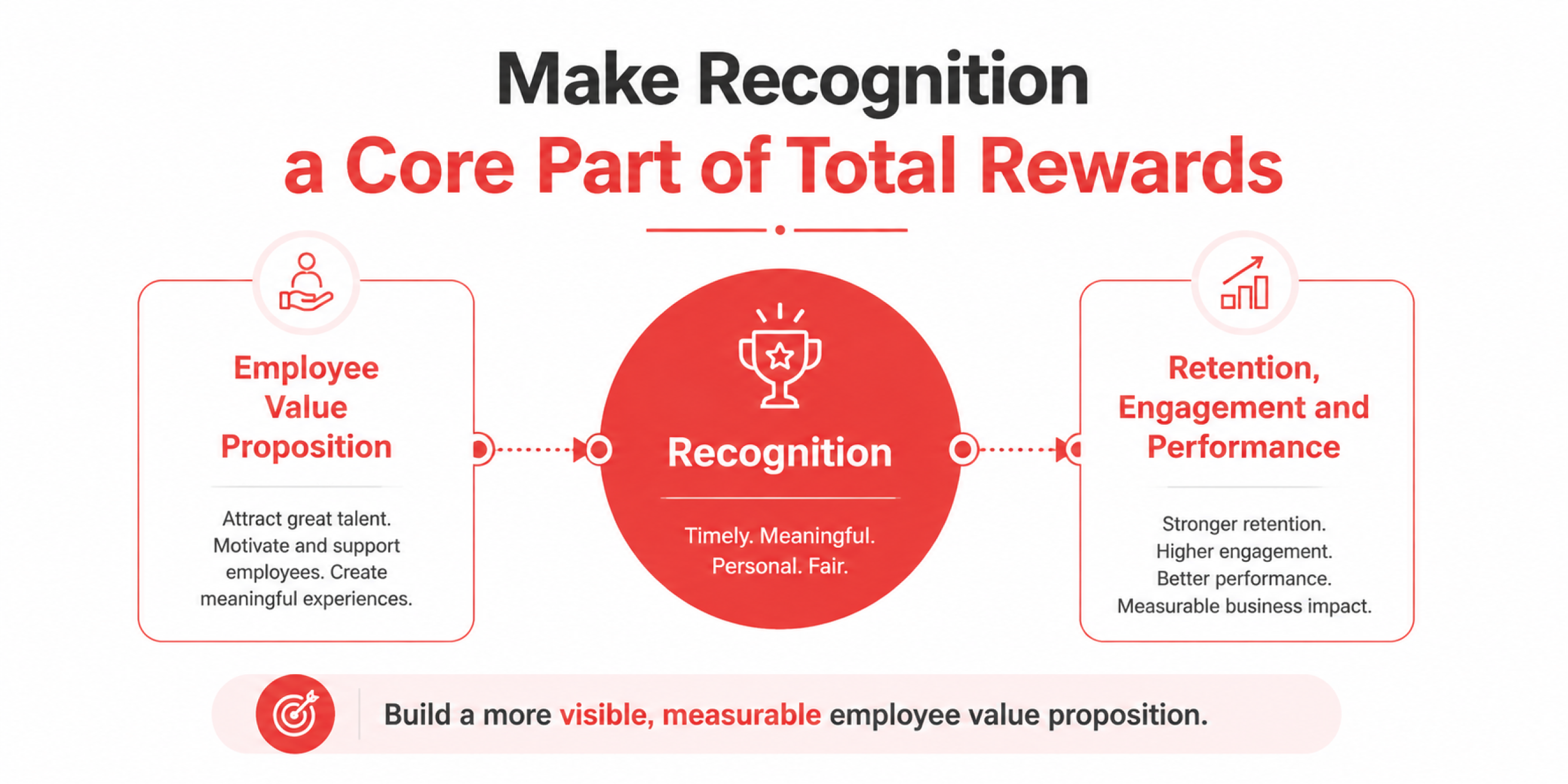
An employee value proposition should explain the complete value of working for an organisation. Compensation answers, "What will I earn?" Benefits answer, "What support do I receive?" Development answers, "How can I grow?" Recognition answers a different but equally important question: "Does the organisation notice and value my contribution?"
SHRM's total rewards framework places compensation, benefits, wellbeing, career development and recognition within the broader employee value proposition. Mercer similarly describes total rewards as extending beyond traditional compensation and benefits to areas such as career management, work design, wellbeing and recognition.
McKinsey's research also supports a broader EVP. Its analysis argues that organisations need differentiated rewards and a clear EVP, while managers should use intrinsic motivators such as recognition and non-financial rewards alongside compensation.
Think of recognition as the connection layer
Recognition does not replace salary, benefits or development. It reinforces them.
Mercer's research shows that one in three organisations do not take a holistic approach to total rewards, considering both tangible and intangible elements.
For HR leaders, this creates an opportunity to position recognition as the visible human layer of the EVP. It turns organisational values and performance expectations into specific moments of appreciation.
How to Quantify the Monetary Equivalent of Recognition So It Sits Credibly in a Total Rewards Framework
Recognition does not need to become another salary component to earn a place in total rewards. Instead, HR should quantify its investment, reach and business effect.
Start with the annual recognition budget. Add platform or administration costs, reward fulfilment costs and programme management time. Then calculate the percentage of employees reached, recognition frequency and average recognition value per employee.
The next step connects recognition with business outcomes. Gallup's research gives HR a useful benchmark: high-quality recognition correlated with a 45% lower likelihood of employees leaving over a two-year period.
HR should not translate that statistic directly into a claimed financial return. Instead, build an organisation-specific model:
Recognition ROI = estimated avoided turnover cost + measurable performance value + productivity impact, divided by recognition investment.
For example, if recognition data identifies a reduction in regrettable attrition among consistently recognised employees, HR can compare the difference with the organisation's estimated replacement cost.
A practical measurement hierarchy
Level 1: Investment
- Annual recognition spend
- Administration cost
- Average reward value
Level 2: Reach
- Percentage of employees recognised
- Recognition frequency
- Manager participation
- Peer participation
Level 3: Outcomes
- Retention among recognised employees
- Engagement scores
- Performance indicators
- Internal mobility
- Absence trends
SHRM recommends evaluating total rewards according to attraction, retention and engagement impact. This gives HR a defensible route from recognition expenditure to business value without pretending every recognition moment has a precise cash equivalent.
Communicating Total Rewards to Employees: How Recognition Visibility Changes Perceived Compensation Fairness
A total rewards strategy only creates perceived value when employees understand what they receive. SHRM highlights communication as an important part of total rewards, while its total rewards statement guidance recommends presenting financial, monetary, intangible and non-financial rewards together.
This matters because employees rarely experience total rewards as a single annual number. They experience salary through payroll, benefits through specific services, development through career opportunities and recognition through day-to-day interactions.
If recognition remains hidden in an HR system, employees can underestimate its contribution to the employment experience.
Mercer also emphasises pay equity, transparency and the expectation that compensation should reflect skills, experience and contribution fairly. Recognition should support that principle rather than undermine it.
Make the total rewards story visible
A strong communication model can show:
- Fixed compensation and variable pay.
- Employer-funded benefits.
- Learning and career development.
- Wellbeing and flexibility.
- Recognition opportunities and reward value.
- How employees earn recognition.
- How recognition connects to organisational values.
For HR leaders, the objective is not to suggest that a recognition reward compensates for weak pay. It is to show the complete employment proposition clearly and consistently.
A digital recognition platform such as ApplaudIQ can support this visibility by bringing milestones, peer recognition, reward value and recognition activity into a structured employee experience. The result is a more complete picture of how the organisation recognises contribution.
How to Segment Total Rewards Packages by Career Stage Without Creating Perceived Inequity
Different career stages can require different total rewards priorities, but segmentation becomes risky when employees interpret different rewards as different levels of organisational respect.
McKinsey's research on worker preferences found that employees across age groups often share many of the same workplace priorities and warned employers against relying on broad generational stereotypes.
The better approach is to segment around career needs and life circumstances, then maintain consistent principles of fairness.
Use a needs based framework
- Early career: prioritise development, mentoring, frequent feedback and recognition for learning and contribution.
- Established professionals: combine recognition with progression opportunities, flexibility and performance linked rewards.
- People leaders: recognise team impact, leadership behaviours, capability building and business outcomes.
- Late career and experienced specialists: emphasise expertise, contribution, knowledge transfer, meaningful recognition and flexible career options.
Mercer recommends considering employee personas, organisational needs, industry standards, cost and employee preferences when designing rewards. Deloitte also argues that organisations need a well-defined EVP and rewards strategy that supports growth, belonging and human sustainability.
The principle should remain constant: different needs, consistent fairness.
That means publishing clear eligibility rules, monitoring recognition distribution and checking whether particular groups systematically receive fewer opportunities to be recognised.
Measuring Total Rewards Effectiveness: Which Metrics Show Whether Your EVP Is Actually Differentiating You
HR leaders need to move beyond participation statistics. A programme can generate thousands of recognition transactions without strengthening retention or employee sentiment.
Deloitte's 2024 Global Human Capital Trends research, based on more than 14,000 business and HR leaders across 95 countries, argues that organisations need to connect human outcomes with business outcomes.
Mercer similarly recommends listening to employees, identifying where the organisation wants its EVP to stand out and engaging employees around the areas that matter most.
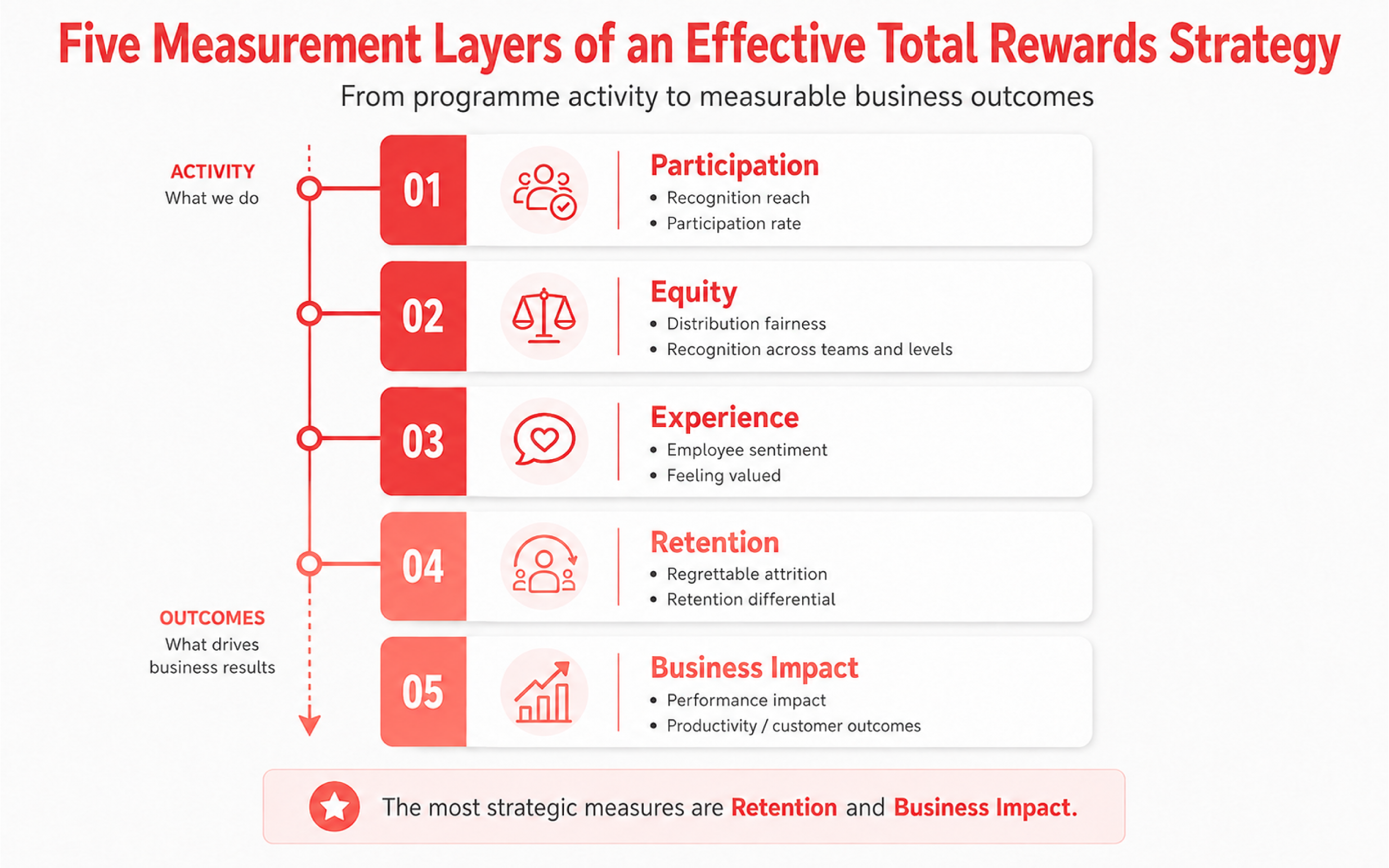
The HR scorecard should include five layers
- Participation: What proportion of employees give and receive recognition?
- Equity: Are recognition opportunities distributed consistently across functions, locations, grades and career stages?
- Experience: Do employees report feeling valued, appreciated and connected?
- Retention: Do recognised employees show stronger retention or lower regrettable attrition?
- Business impact: Does recognition correlate with performance, customer outcomes, productivity or internal mobility?
Gallup's evidence makes retention particularly important. High-quality recognition correlated with substantially lower turnover risk, while the research also found that recognition quality matters, not simply recognition frequency.
This is where HR technology becomes strategically useful. ApplaudIQ can help HR teams structure recognition, automate milestone rewards, support peer recognition and provide visibility into participation and reward activity. Rather than reporting only on programme usage, HR can use the data as one input into a wider total rewards scorecard.
For broader reward ecosystem planning, The Reward Store also supports consumer loyalty programmes through Rekyndl and channel partner incentive programmes through Paytives, demonstrating how reward mechanics can be managed across different stakeholder ecosystems.
Frequently Asked Questions
What is a total rewards strategy?
A total rewards strategy combines compensation, benefits, wellbeing, career development, recognition and other elements of the employee experience into one coherent proposition. SHRM describes total rewards as a holistic approach to attracting, motivating and retaining talent.
How does employee recognition support an employee value proposition?
Recognition shows employees that the organisation notices and values their contribution. Gallup found that employees receiving high-quality recognition were 45% less likely to have left their organisation two years later.
Why should recognition be part of total rewards?
Recognition complements financial rewards by reinforcing belonging, contribution and organisational values. SHRM identifies recognition as an important total rewards component alongside compensation, benefits and development.
When should HR review recognition as part of the total rewards strategy?
HR should review recognition whenever it reviews the broader EVP, particularly during annual reward planning, major workforce changes, retention challenges or changes in business strategy. McKinsey recommends reviewing total rewards when enterprise strategy changes and maintaining a regular review cadence even when strategy remains stable.
Can ApplaudIQ support a total rewards strategy?
Yes. ApplaudIQ can support recognition within a broader total rewards framework through milestone rewards, peer recognition, reward catalogues, integrations and recognition visibility. HR can then connect recognition participation and outcomes with wider EVP, engagement and retention measures.
Conclusion
A strong total rewards strategy does not treat recognition as an optional cultural initiative. It positions recognition alongside compensation, benefits, development and wellbeing, then measures whether employees experience that proposition as valuable, fair and differentiated.
As work becomes more technology enabled, HR will increasingly need reward strategies that combine financial value with visible human recognition. The organisations that make recognition measurable, equitable and consistently visible will be better positioned to strengthen their EVP and retain critical talent.
See how ApplaudIQ fits into a total rewards strategy. Book a demo.
Sign up for our newsletter for trending top content!


