
How to Build Tiered Gift Programmes for Distributors and Dealers

Sign up for our newsletter for trending top content!
A dealer gifting programme works when gold, silver and bronze tiers rest on published, measurable criteria that every partner can see. Define the rules before naming any partner, apply them identically across regions, review them on a fixed calendar, and announce results openly.
What a Fair Dealer Gifting Programme Must Achieve
Consider an illustrative scenario. A manufacturer works with three hundred distributors and dealers, and a regional manager announces the gold gifts at a partner dinner.
Within a week, several partners ask why they were left out. The gifts were not the problem, because the rules behind them were never visible to anyone.
When partners cannot see how a tier was earned, they assume that relationships rather than results decided the outcome. That assumption damages trust faster than any missing gift could.
A fair programme therefore has three jobs. It must reward the behaviour the business values, it must be understood by every partner, and it must give the same answer whoever asks.
Channel sales heads in India manage partners of very different sizes, languages and regions. Comparison between partners is constant and often informal, so consistent rules matter even more.
Agree these five principles with your leadership team before you design the tiers.
- Publish the criteria. Every partner should be able to read exactly what earns each tier.
- Measure what the partner can influence. Use verified sales, payment and reporting records instead of opinion.
- Apply one rulebook everywhere. Regional exceptions weaken trust faster than any single decision.
- Separate the decision from the relationship. The person who manages the account should not be the only person who judges it.
- Review on a fixed calendar. Tiers change only at announced points in the year.
These principles look simple, but the fourth is the one most often skipped. When the same manager nominates, approves and presents, even a fair result can look arranged.
A second reviewer from finance or operations removes that doubt with very little effort.
A Three Gate Framework for Gold, Silver and Bronze Partners
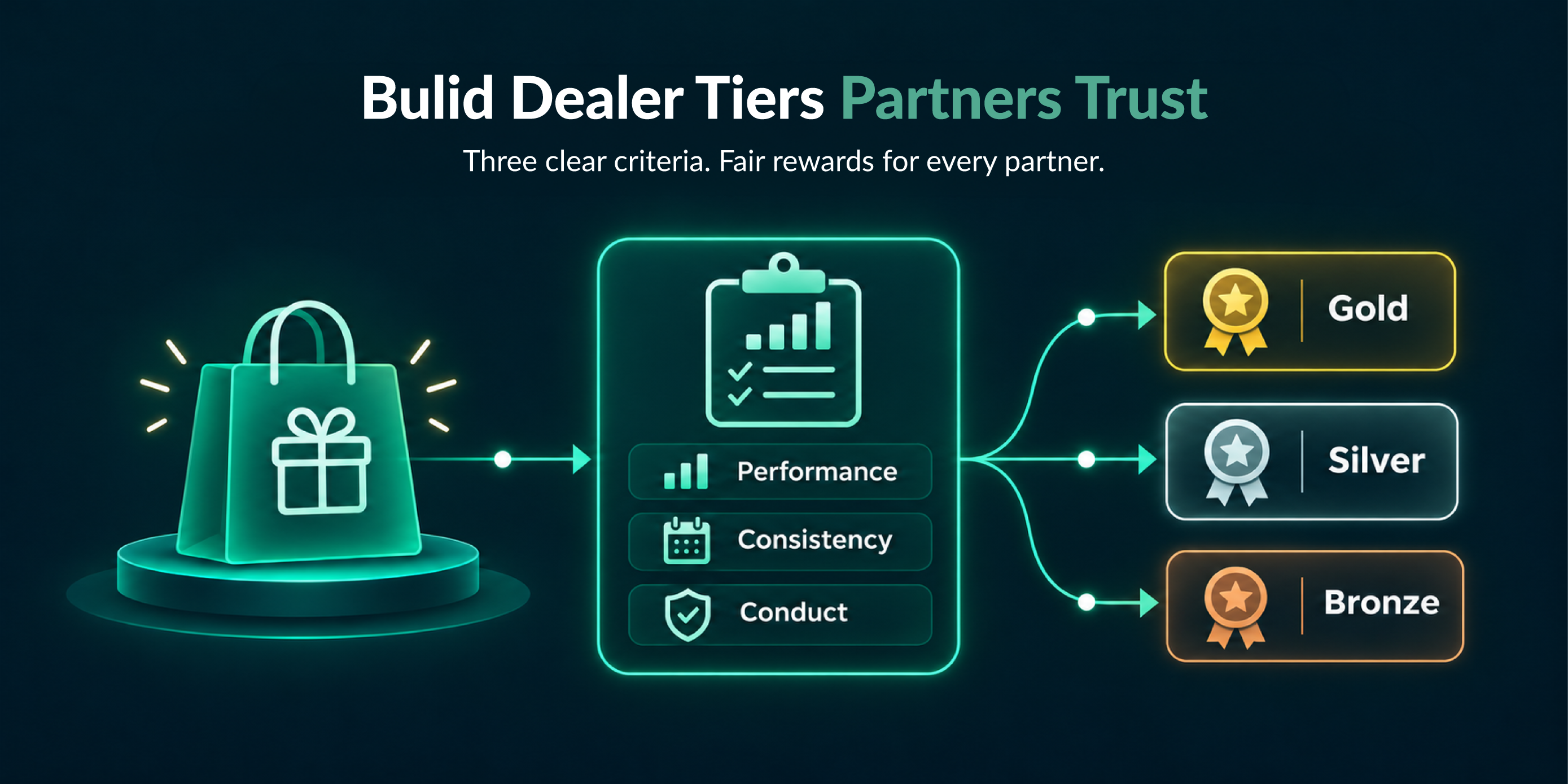
The framework below uses three gates. A partner qualifies for a tier by passing the gates that the tier requires, and the gates are identical for every partner.
Gate one is performance. It compares verified primary sales with the target that was agreed with the partner at the start of the period.
Gate two is consistency. It checks that the partner met payment terms, submitted sales and stock reports on time, and ordered in a regular pattern.
Gate three is conduct. It confirms that the partner followed pricing policy, territory rules and brand guidelines throughout the period.
Conduct works as a gate rather than a score on purpose. A partner who breaks pricing policy should not receive a gift tier, however large the volume.
Use the three gates to define the tiers as follows.
- A gold partner passes all three gates, with performance in the top band that you define.
- A silver partner passes all three gates, with performance in the middle band.
- A bronze partner passes all three gates, with performance in the entry band.
Keep the number of tiers at three. Each extra tier creates another boundary, and every boundary becomes a place where partners argue about who sits just above or below the line.
Define each band with your finance team, using your own historical sales data, so that no figure is borrowed from another business.
Consider an illustrative dealer in a smaller market. Their target reflects the potential of their territory, so reaching the top performance band is realistic for them.
This dealer pays on time, reports every month and follows pricing policy, so the other two gates are passed. The dealer earns gold even though a larger market may sell more in total.
The rule rewards performance against potential rather than geography. That single design choice removes one of the most common complaints in channel programmes.
Partners who do not reach bronze should receive a clear development conversation rather than silence. Silence is the quickest route to suspicion.
Write Eligibility Rules That Prevent Perceptions of Favouritism
Favouritism is usually a perception created by gaps in the rules, not by bad intent. The checklist below closes the most common gaps.
Confirm each of these points before you announce any tier.
- Every partner is measured over the same period and against the same cut off date.
- Every figure comes from a system record that the partner can also verify.
- Targets reflect territory potential, so a dealer in a smaller market can still earn gold.
- New partners follow a written onboarding rule that states when they first become eligible.
- Exceptions go to a panel of at least two approvers, and every decision is recorded in writing.
- Partners receive a short, defined route to query their result within a stated window.
- Tier results are published to all partners at the same time and in the same format.
Write the rules in plain language and share them in the languages your partners use every day. A rule that is not understood cannot be seen as fair.
Review the exceptions panel at the end of each cycle. A rising number of exceptions signals that the rules need rewriting, not that the partners need managing.
Resist the temptation to add a discretionary gift for senior partners outside the tiers. Any gift outside the rules will be remembered by every partner who did not receive it.
Run the Programme on a Clear Annual Timeline
Predictability is part of fairness. The timeline below gives partners the same information at the same moments, so nobody learns a rule after it has been applied.
- Before launch, the leadership team approves the principles, the gates and the band definitions in writing.
- At launch, every partner receives the rulebook and an individual target during the same week.
- Each quarter, partners receive a progress statement that shows where they stand against each gate.
- At the cut off date, the data is frozen and verified by someone outside the sales team.
- Before announcement, each partner hears their own result privately from a named senior contact.
- At announcement, all tiers are published together, and the query window opens.
- After the cycle, the leadership team reviews exceptions and queries, then updates the rulebook for the next period.
Assign a named owner to each step, so that the programme does not depend on one enthusiastic manager. Ownership turns a good intention into a repeatable process.
Quarterly statements matter most. A partner who sees a gap early can act on it, which turns the programme into a motivator rather than a verdict.
Telling partners privately first is a courtesy that costs nothing. Nobody should learn that they sit in a lower tier from a public list.
Choose Gifts That Signal Respect at Every Tier
Gifts should be proportionate across tiers without making any tier feel like a consolation prize. The presentation standard should stay consistent even when the contents differ.
Gold gifts can be more considered and more personal, while bronze gifts should still be well chosen and well presented. A careless bronze gift can cancel the goodwill of the whole programme.
Choose items that partners can use and share with their teams or families. Consider regional, festive and cultural preferences, and ask partners for their preferences where that is practical.
Personalise where possible, for example with the partner name on the card. A personal note from a senior leader adds meaning at every tier.
Delivery matters as much as the contents. A gift that arrives on time, intact and with the right name on it supports the message that the partner matters.
Record what each partner received in each cycle. A simple history prevents repeat gifts and shows whether the standard has stayed consistent over time.
Sourcing is the practical challenge. Cherishd, the physical gifting product of The Reward Store, offers curated gifts and gift boxes from 500+ Indian brands for employee, client and partner gifting.
Frequently Asked Questions
How many tiers should a dealer reward scheme have?
Three tiers suit most channel networks because they are easy to remember and easy to explain. More tiers create small gaps between partners and invite disputes, while fewer tiers do not recognise the full range of partner performance.
How do you decide who qualifies for gold, silver or bronze?
Set written gates for performance, consistency and conduct, and define a band for each tier. A partner qualifies by passing every gate at the band that the tier requires. Use verified system data, and apply the same cut off date to everyone.
How do you avoid favouritism in a distributor reward programme?
Publish the criteria in advance, use verified records, route every exception through a documented panel, and announce all results together. When partners can check the rules and the data themselves, perceptions of favouritism fall away.
What gifts are suitable for distributors and dealers in India?
Choose gifts that are useful, well presented and respectful of regional and festive preferences. Keep the presentation standard consistent across tiers so that bronze partners do not feel overlooked, and add a personal note from a senior leader.
How often should partner tiers be reviewed?
Review tiers once a year for gifting, with a progress statement each quarter so that partners always know where they stand. Changing tiers at unannounced moments is one of the fastest ways to lose partner confidence.
Conclusion
A tiered programme earns trust when its criteria are published, measurable and applied in the same way to every partner. Gold, silver and bronze then record results instead of starting arguments.
Fairness is built before the first gift is chosen, and it is kept alive by discipline in every cycle.
Start with the principles, then the gates, then the checklist and timeline, and only then choose the gifts.
To explore curated physical gifting for your partner tiers, Book a Demo.
Sign up for our newsletter for trending top content!


