
How Telecom Companies Can Build Dealer and Retailer Incentive Programmes That Drive SIM Activation and Data Upsell

Sign up for our newsletter for trending top content!
Introduction
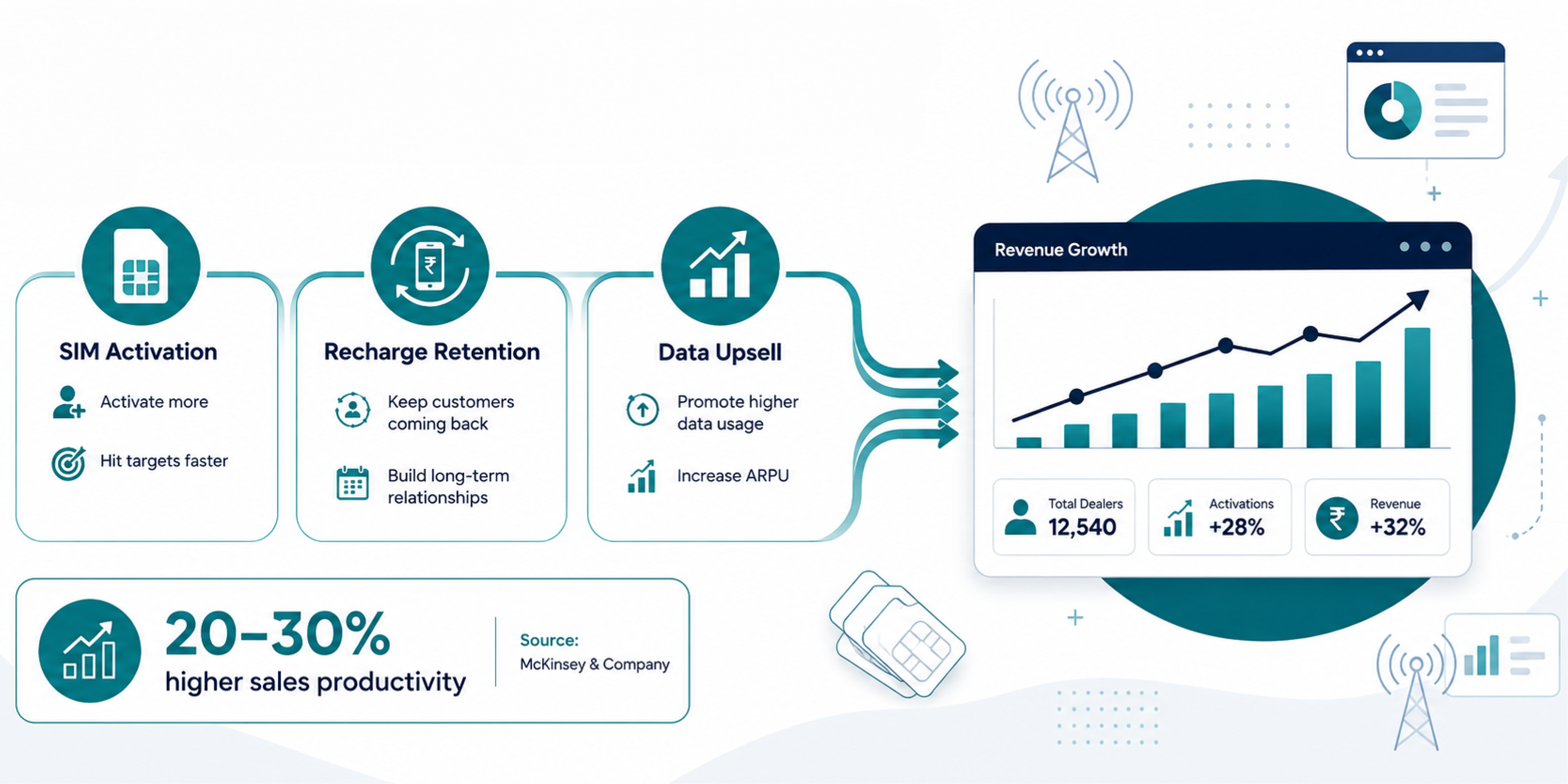
Telecom operators invest heavily in distribution networks, yet many struggle to convert dealer engagement into measurable revenue outcomes. According to research by McKinsey, companies that align frontline incentives with clearly defined commercial objectives can improve sales productivity by 20 to 30 per cent. In telecom, where margins remain under pressure and customer acquisition costs continue to rise, incentive design directly influences activation rates, recharge behaviour and data consumption.
For sales leaders, the challenge extends beyond motivating retailers. They must balance acquisition, retention and monetisation across thousands of dealers operating in vastly different markets. A poorly designed incentive structure can inflate costs, encourage undesirable behaviours and dilute channel loyalty.
This article explores how telecom companies can create dealer and retailer incentive programmes that increase SIM activation, improve recharge consistency and accelerate data upsell while maintaining sustainable economics.
Why Telecom Dealer Incentive Schemes Fail to Move the Metrics That Matter to Revenue Leaders
Many telecom incentive schemes reward volume without distinguishing between high-value behaviours and low-quality outcomes. This creates activity but not necessarily profitable growth.
Research from Deloitte shows that organisations with performance incentives linked directly to business objectives achieve stronger revenue outcomes than those relying primarily on blanket reward structures. Telecom operators often reward gross sales numbers while overlooking activation quality, recharge persistence and customer lifetime value.
Common weaknesses include:
- Uniform incentives across all dealer categories.
- Delayed reward fulfilment cycles.
- Limited visibility into performance progress.
- Lack of differentiation between acquisition and monetisation activities.
- Minimal behavioural reinforcement mechanisms.
Incentives Often Encourage the Wrong Outcomes
When incentives prioritise SIM distribution volume alone, dealers may focus on inventory movement rather than active subscriber generation.
Bain & Company research highlights that companies concentrating on customer lifetime value outperform peers in long-term profitability. In telecom, inactive SIM cards generate acquisition costs without creating recurring revenue streams.
For sales leaders, success depends on identifying the metrics that truly influence commercial performance:
Modern channel incentive platforms such as Paytives enable telecom organisations to assign rewards based on these distinct commercial outcomes instead of treating dealer engagement as a single activity stream.
Telecom operators that connect incentives to revenue-driving behaviours establish stronger channel discipline and achieve greater predictability in sales performance.
SIM Activation vs Recharge vs Data Upsell: Designing Separate Incentive Tracks for Each KPI
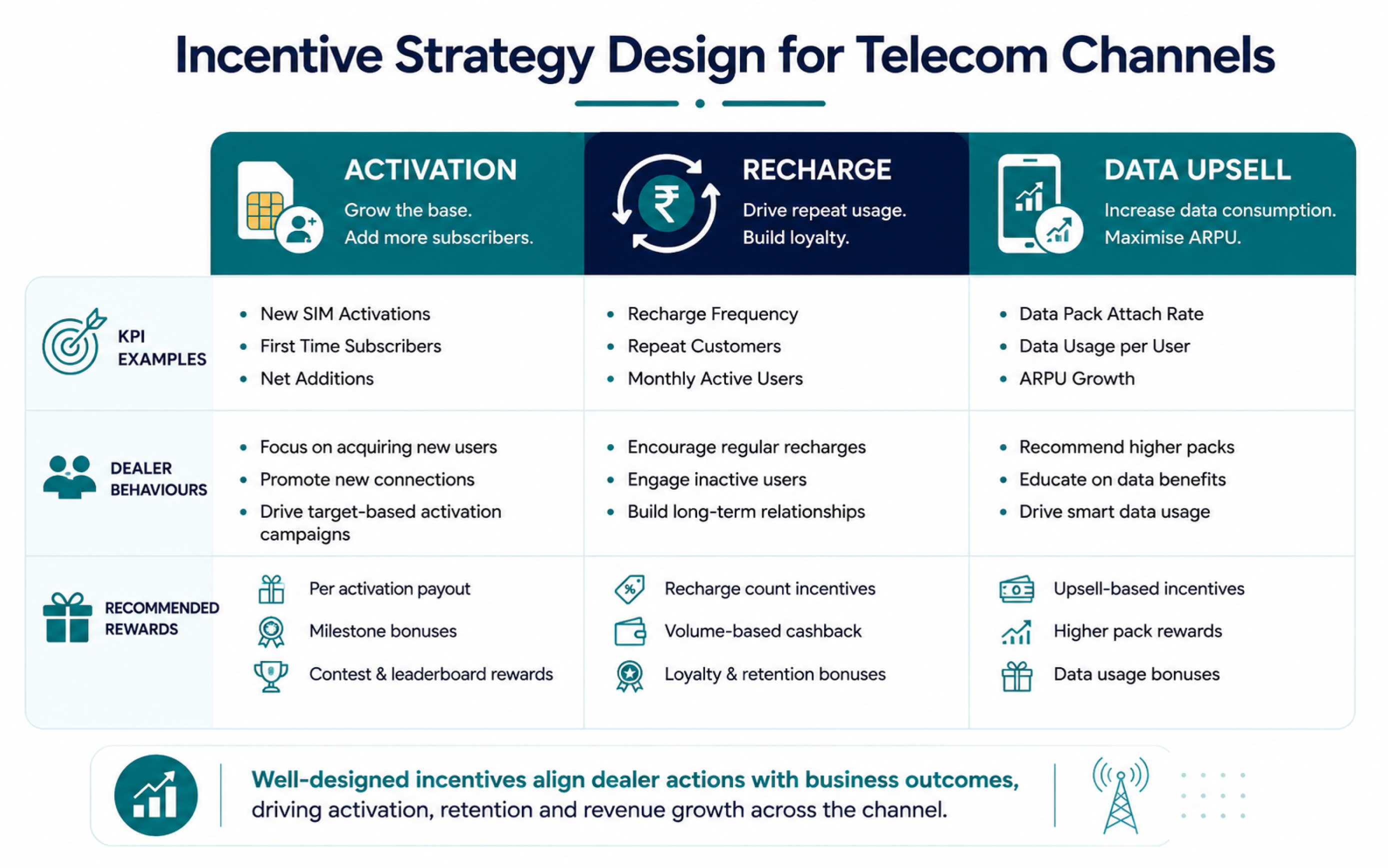
Not all telecom KPIs carry equal commercial value. Activation drives acquisition, recharge sustains engagement and data upsell expands profitability. Combining these objectives within one incentive pool creates confusion and weakens programme effectiveness.
Research by the Incentive Research Foundation (IRF) found that targeted incentive structures outperform broad reward schemes because participants understand exactly which behaviours organisations value most.
Activation Incentives
Activation incentives should reward verified subscriber onboarding rather than SIM issuance.
Metrics may include:
- First-time activation rates.
- Verified KYC completion.
- Time-to-activation targets.
- Territory penetration goals.
Recharge Incentives
Recharge programmes reinforce retention.
Forrester research indicates that retaining customers remains significantly more cost effective than acquiring new ones. Dealers influence recharge frequency through education, reminders and local relationships.
Potential metrics include:
- Thirty-day recharge consistency.
- Average recharge value.
- Multi-month recharge streaks.
- Active subscriber retention.
Data Upsell Incentives
The strongest profit growth opportunities increasingly come from data monetisation.
According to Gartner, organisations that align incentives with strategic product adoption priorities accelerate behavioural shifts within sales ecosystems.
Upsell incentives can reward:
- Migration to larger data plans.
- Family plan adoption.
- Value-added service subscriptions.
- Higher consumption bundles.
Paytives supports multiple incentive tracks simultaneously, allowing telecom companies to reward activation, recharge and upsell objectives without creating competing priorities for channel partners.
Separating KPIs also provides clearer analytics, helping sales leaders understand which incentive investments generate the greatest returns.
How to Incentivise Retailer Shelf Positioning Without Creating Price-War Dynamics
Retail visibility continues to influence purchase decisions despite growing digital adoption.
Research from NielsenIQ consistently shows that product visibility and point-of-sale prominence affect buyer behaviour across retail categories. For telecom operators, shelf positioning determines whether a retailer actively recommends a particular network or merely displays it alongside competitors.
The challenge lies in encouraging advocacy without eroding profitability through excessive discounting.
Reward Behaviours, Not Price Reductions
Sales leaders should focus incentives on activities that improve visibility and customer engagement.
Examples include:
- Branded display compliance.
- Premium counter placement.
- Promotional campaign participation.
- Staff certification completion.
- Customer education initiatives.
McKinsey reports that non-cash incentives often influence motivation more effectively when participants perceive rewards as recognition rather than transactional compensation.
Reward categories may include:
- Gift cards from 5,000+ brands.
- Experiential rewards.
- Hotel bookings.
- Dining experiences.
- Merchandise rewards.
This approach creates differentiation while protecting pricing discipline.
Use Tiered Recognition Models
According to Gallup, employees and partners who receive meaningful recognition demonstrate higher engagement and stronger advocacy behaviours.
Telecom operators can classify retailers into performance tiers:
- Silver.
- Gold.
- Platinum.
- Elite.
Advancement criteria may include:
- Merchandising compliance.
- Activation performance.
- Upsell conversion.
- Training participation.
By recognising achievement levels rather than competing on discounts, operators encourage sustainable dealer commitment while reducing the risk of localised price wars.
Real-Time Dealer Scorecards: What Visibility Into Activation Rates Does to Dealer Motivation
Delayed reporting remains one of the biggest weaknesses in telecom channel management.
A dealer who discovers performance results after month-end loses the opportunity to adjust behaviours during the incentive period.
According to Aberdeen Group, organisations with real-time performance visibility achieve significantly stronger sales execution than companies dependent on static reporting cycles.
Transparency Creates Momentum
Dealer scorecards should provide:
- Activation progress.
- Monthly rankings.
- Target attainment percentages.
- Upsell achievements.
- Pending reward balances.
Gallup research demonstrates that employees who regularly receive performance feedback are substantially more engaged than those who operate without visibility into progress.
The same behavioural principles apply to channel ecosystems.
Sales leaders should ensure dealers can answer three questions instantly:
- Where do I currently rank?
- What action moves me to the next reward tier?
- How much value have I already earned?
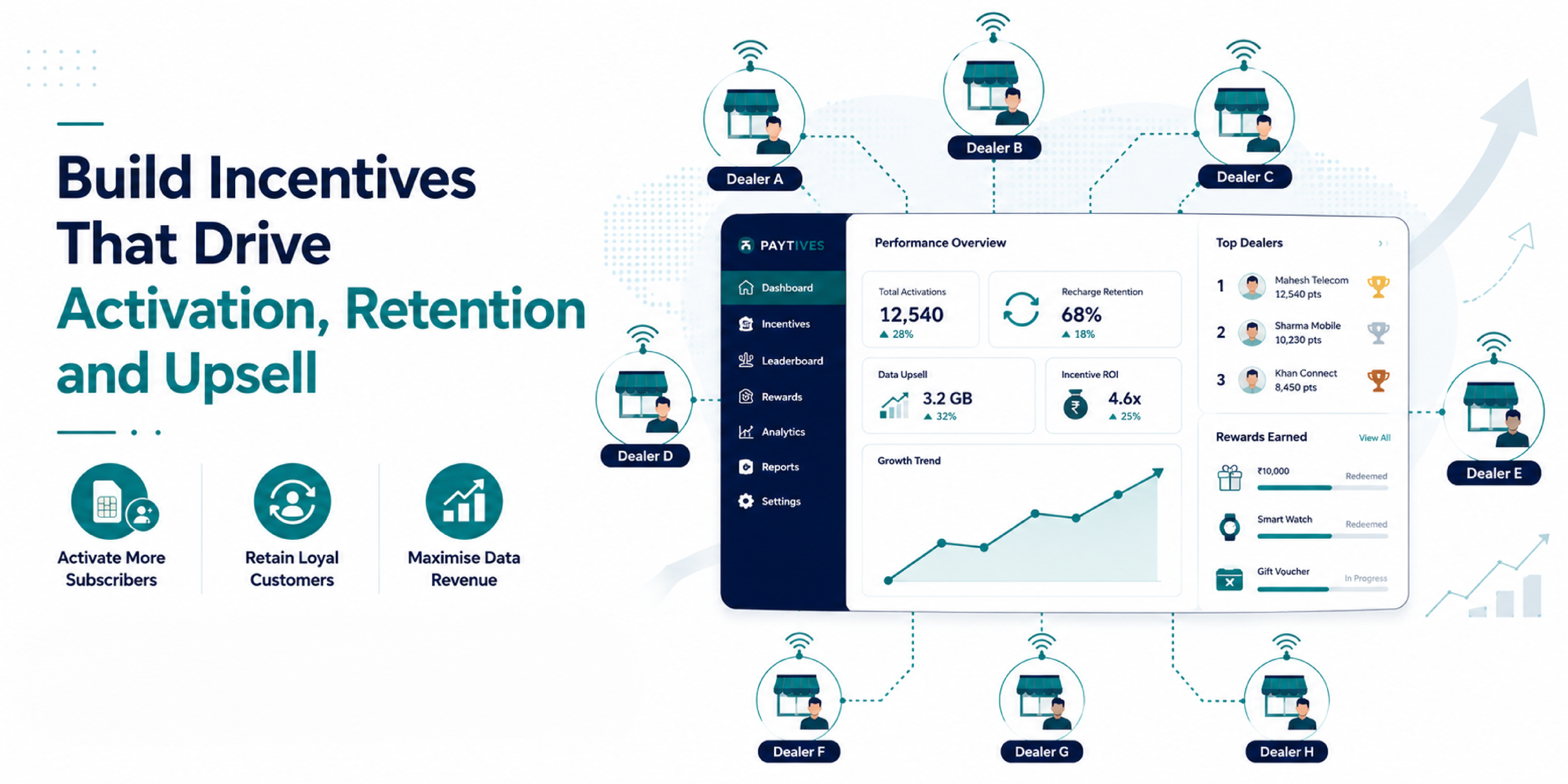
Paytives enables real-time dealer dashboards, automated incentive calculations and leaderboards designed specifically for distributed partner networks.
Dealer motivation increases when progress becomes visible. Competition intensifies, target attainment accelerates and incentive programmes shift from administrative processes into active performance drivers.
Recognition Extends Beyond Financial Rewards
O.C. Tanner research shows that visible recognition strengthens commitment and improves behavioural consistency.
Telecom operators can incorporate:
- Digital badges.
- Achievement certificates.
- Leaderboards.
- Quarterly recognition campaigns.
- Regional champion status.
These mechanisms reinforce momentum without increasing incentive budgets significantly.
Managing Rural vs Urban Dealer Networks: Why One Incentive Structure Cannot Serve Both
Telecom operators often deploy nationwide incentive structures while expecting identical outcomes across highly diverse markets.
This assumption rarely produces optimal results.
Research from Mercer indicates that customised incentive strategies outperform standardised models because they account for environmental and behavioural differences.
Urban dealers face challenges such as:
- Intense competitive density.
- Higher customer expectations.
- Greater focus on data monetisation.
- Faster sales cycles.
Rural dealers frequently encounter:
- Lower subscriber penetration.
- Limited infrastructure.
- Greater dependency on personal relationships.
- Higher acquisition potential.
Designing Segment-Specific Incentive Models
McKinsey research suggests companies that segment commercial strategies based on customer and market characteristics achieve stronger growth outcomes.
Sales leaders should also consider operational realities.
Urban retailers may prefer digital recognition and accelerated rewards.
Rural partners often respond positively to milestone-based campaigns and experiential recognition opportunities.
Paytives supports multi-tier incentive structures, allowing operators to design location-specific reward models while maintaining centralised governance and reporting.
This flexibility becomes increasingly important as telecom companies expand into underserved regions and pursue broader data adoption objectives.
How to Run Concurrent Promotional Campaigns Alongside Steady-State Dealer Incentives
Dealer engagement fluctuates throughout the year.
Festive periods, device launches, seasonal promotions and regional campaigns require additional momentum without disrupting baseline incentive programmes.
Research from the Incentive Research Foundation shows that layered incentive campaigns can improve participation rates when organisations maintain clarity around goals and measurement frameworks.
Maintain Separate Objectives
Sales leaders should distinguish between:
Always-on incentives
Purpose:
- Sustained activation performance.
- Recharge consistency.
- Ongoing dealer engagement.
Promotional campaigns
Purpose:
- Short-term subscriber acquisition.
- New product launches.
- Territory expansion.
- Seasonal demand generation.
Avoid Incentive Fatigue
According to Deloitte, overly complex reward schemes reduce participant engagement because individuals struggle to understand what behaviours matter most.
Promotional campaigns should therefore include:
- Defined timelines.
- Clear eligibility rules.
- Limited KPI sets.
- Visible progress tracking.
- Immediate recognition.
Examples include:
- Thirty-day activation contests.
- Regional growth accelerators.
- Festival recharge drives.
- Data adoption campaigns.
Technology platforms become critical in managing multiple initiatives simultaneously.
Without automation, finance teams face reconciliation challenges, sales managers lose visibility and dealers experience confusion.
Telecom operators increasingly seek platforms capable of managing ongoing incentive structures alongside tactical campaigns without creating administrative complexity. Solutions such as Paytives allow organisations to launch targeted promotions while preserving consistency in long-term dealer engagement strategies.
Frequently Asked Questions
What is a telecom dealer retailer incentive programme?
A telecom dealer retailer incentive programme rewards channel partners for achieving predefined business objectives. These objectives can include SIM activations, recharge frequency, data plan upgrades and merchandising compliance. Effective programmes align incentives with measurable commercial outcomes rather than focusing solely on sales volume.
How do telecom companies increase SIM activation rates through incentives?
Operators can reward verified activations, KYC completion and subscriber retention milestones. According to the Incentive Research Foundation, incentives linked to clearly defined behaviours generate stronger participation and performance improvements. Real-time tracking also encourages dealers to remain focused throughout the campaign period.
Why should activation and data upsell incentives remain separate?
Activation incentives support customer acquisition, while data upsell incentives increase average revenue per user. Combining them often obscures performance measurement and weakens behavioural focus. Separate incentive tracks provide clearer accountability and better insight into return on incentive investment.
How often should telecom operators refresh dealer incentive campaigns?
Most organisations maintain always-on incentive programmes supported by quarterly or seasonal promotional campaigns. The Incentive Research Foundation recommends introducing time-bound campaigns to sustain engagement and reduce participant fatigue. Sales leaders should review programme effectiveness regularly based on activation trends and commercial priorities.
Can Paytives support telecom dealer incentive programmes across multiple regions?
Yes. Paytives enables telecom organisations to manage multi-tier incentive structures, real-time dealer performance tracking, automated reward calculations and global payout capabilities from a single platform. This allows operators to customise incentives for urban and rural markets while maintaining central oversight.
Conclusion
Dealer incentive programmes succeed when they align directly with revenue priorities rather than generic sales activity. Telecom operators that separate activation, recharge and data upsell objectives create stronger behavioural clarity, improve dealer engagement and generate more predictable commercial outcomes.
As telecom competition intensifies and data consumption continues to grow, incentive strategies will increasingly depend on real-time visibility, segmentation and automation. Organisations that modernise channel incentives now will position themselves for stronger market performance in the years ahead.
Explore how Paytives helps telecom operators automate dealer engagement, improve activation outcomes and scale incentive programmes across distributed networks: https://www.therewardstore.com/paytives/solutions/telecom
Sign up for our newsletter for trending top content!


