
How Telecom Operators Can Build B2B Enterprise Channel Incentive Programmes That Drive Business Solution Sales

Sign up for our newsletter for trending top content!
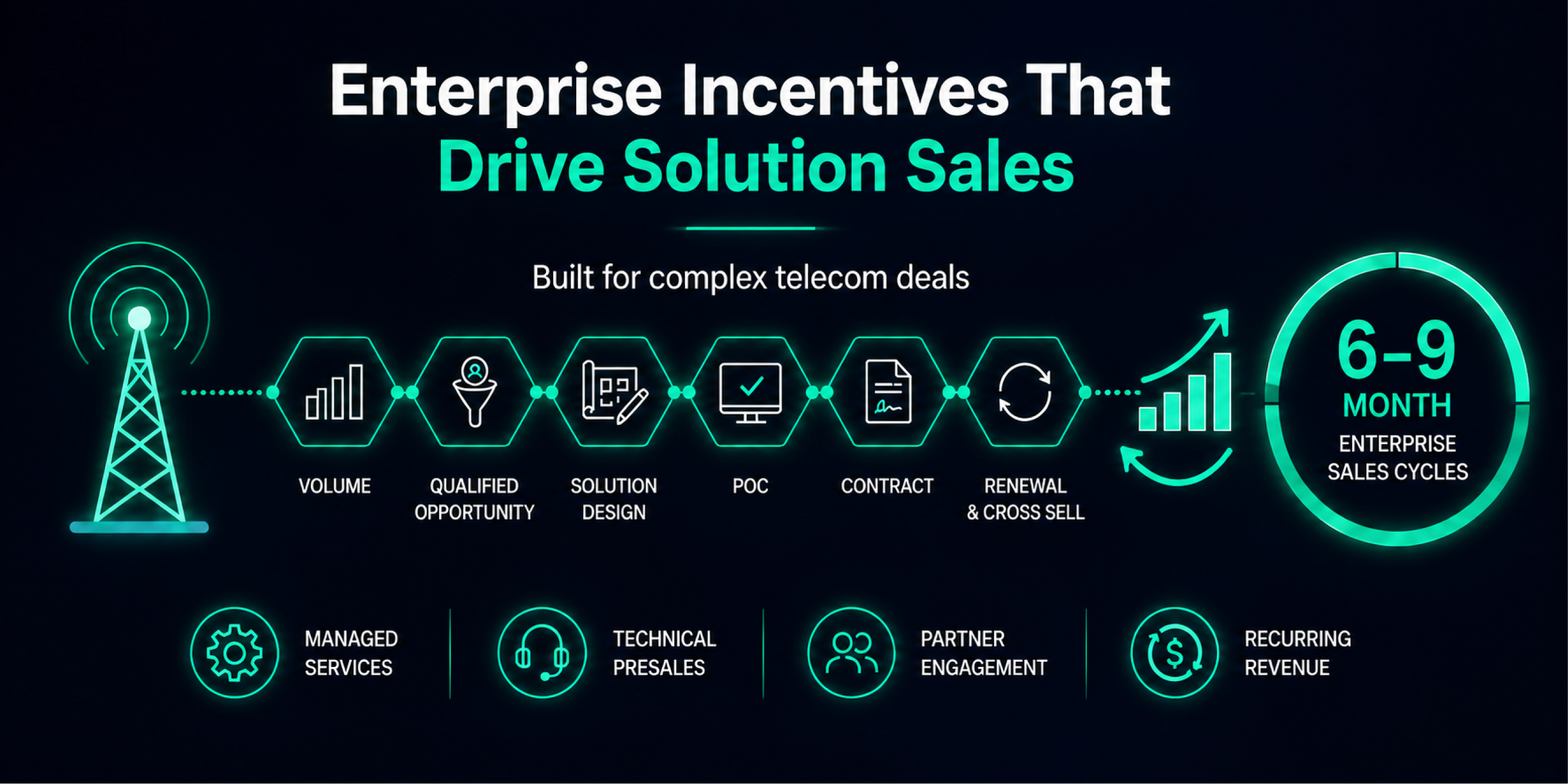
Enterprise telecom sales rarely fail because partners lack access to products. They fail when the incentive structure rewards the wrong behaviour. McKinsey research shows that enterprise telecom customers typically involve larger, more complex deals, with six to nine month sales cycles and customised offers spanning connectivity, managed services and other value-added solutions.
For a Sales Leader, that creates a fundamental channel problem. A programme built around activations, volumes or short-term bookings can encourage partners to chase transactions while under-rewarding the technical discovery, solution design, proof of concept and account development that enterprise deals require.
This guide explains how to build a telecom B2B enterprise channel partner incentive programme around the behaviours that create durable enterprise revenue. It covers solution complexity, long sales cycles, presales effort, market development funds and the metrics that demonstrate commercial return.
Why Telecom B2B Channel Programmes Are Optimised for Consumer Volume Metrics That Mean Nothing in Enterprise
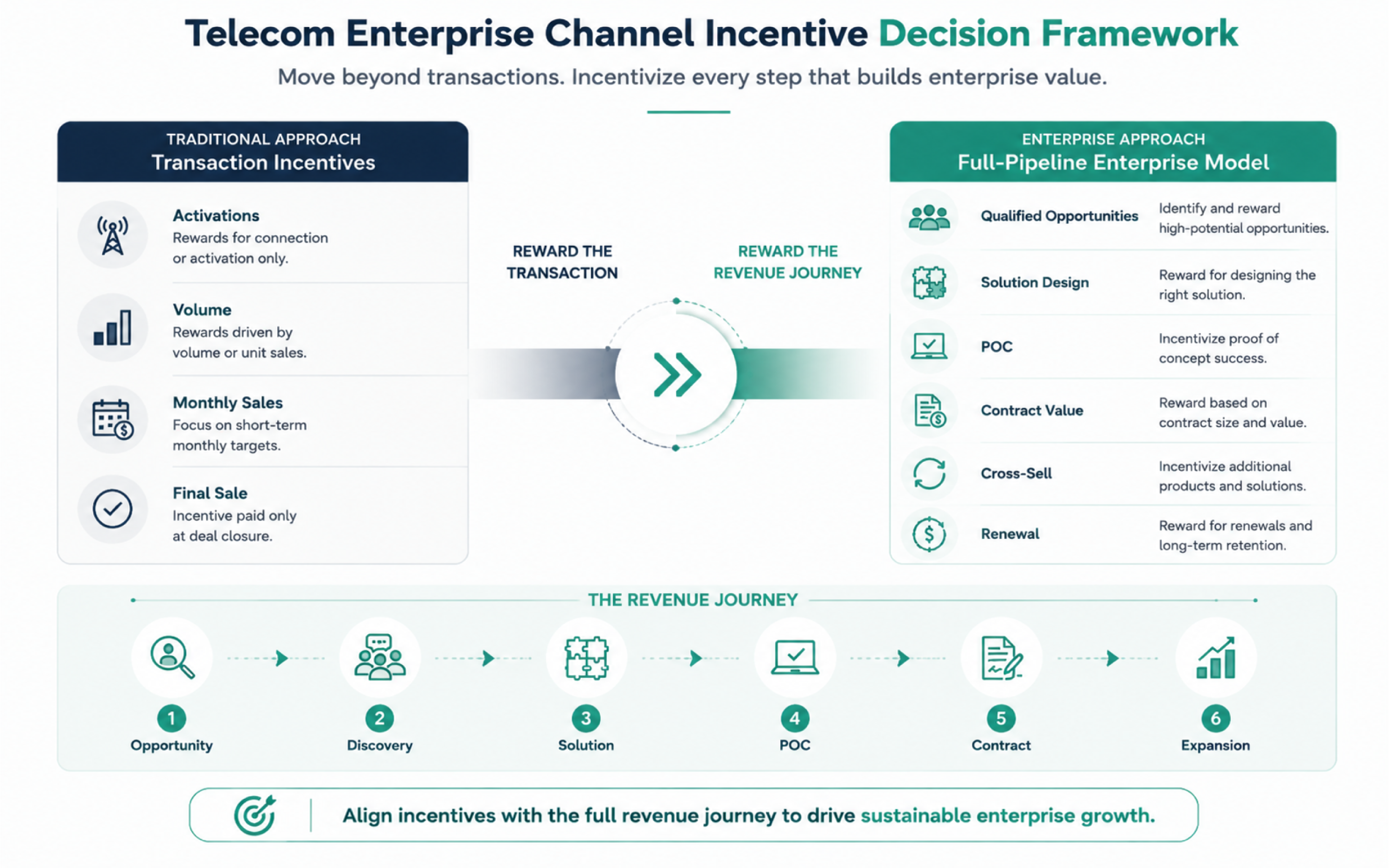
Many telecom channel programmes inherit metrics designed for transactional selling. Activations, gross additions, recharge volumes and monthly sales targets are easy to count, but they do not necessarily measure enterprise value creation.
McKinsey identifies a clear distinction between telecom customer segments. Enterprise customers are fewer in number, significantly larger in value and more likely to require customised solutions, longer sales cycles and multiple value-added services. A partner that generates one strategic managed-services opportunity can therefore create considerably more commercial value than one that generates hundreds of low-value transactions.
The Incentive Research Foundation reinforces this principle. Its 2026 channel research recommends moving beyond transaction-only incentives towards rewards for behaviours across the full pipeline, including opportunity identification, demonstrations, sales enablement and service activities.
Replace volume metrics with enterprise behaviours
A stronger telecom B2B programme should distinguish between:
The objective is not to eliminate sales targets. It is to connect incentives to the behaviours that influence high-value sales outcomes. Research from the International Journal of Productivity and Performance Management similarly separates partner performance into output, activity and capability dimensions, supporting a broader approach to partner measurement.
Enterprise Solution Complexity Incentives: How to Reward Partners for Selling Managed Services, Not Just Connectivity
Enterprise telecom customers increasingly buy solutions rather than standalone connectivity. McKinsey highlights the growing importance of managed services, security, cloud, hosting, professional services and support within B2B telecom propositions.
That changes what the channel needs to do. Partners must identify business problems, qualify stakeholders, bring technical specialists into opportunities and demonstrate how multiple services work together.
A telecom B2B enterprise channel partner incentive programme should therefore reward solution-selling behaviour, not simply the final contract.
Build incentives around solution milestones
A practical structure could reward partners at four stages:
- Opportunity creation: Reward qualified opportunities that meet agreed criteria for customer need, budget, authority and timeline.
- Solution development: Reward validated discovery, technical workshops and solution proposals.
- Proof of value: Reward approved demonstrations or proofs of concept that meet defined requirements.
- Commercial outcome: Apply the largest incentive to profitable contracted revenue, with additional rewards for strategic solution mix.
The IRF's 2026 research supports this full-pipeline model. It found that strong channel programmes reward multiple behaviours rather than concentrating expenditure solely on completed sales.
For Sales Leaders, the critical design principle is controllability. Partners should be rewarded for actions they can genuinely influence, while the largest rewards should remain connected to commercial outcomes. This reduces the risk of paying heavily for activity that never becomes revenue.
Long-Sales-Cycle Incentives: How to Maintain Partner Motivation When Enterprise Deals Take Six to Eighteen Months
A partner cannot remain highly motivated for a year if the only reward arrives after the contract is signed. McKinsey reports six to nine month sales cycles for enterprise telecom customers, while Gartner Digital Markets found that 47% of businesses take six to nine months to finalise software purchases.
Forrester adds another layer of complexity: an average of 13 people can participate in a B2B purchasing decision, while 89% of purchases involve two or more departments. The partner therefore has to sustain effort across multiple stakeholders and decision stages.
The solution is a milestone-based incentive architecture.
A practical long-cycle incentive framework
This structure keeps the partner economically engaged while protecting the operator from paying the full incentive before revenue materialises.
Research from the IRF also highlights the importance of incentive immediacy. Partners need a clear connection between the behaviour they perform and the reward they receive.
A platform such as Paytives for telecom channel incentives can support this approach by automating incentive rules, tracking partner performance and managing payouts against defined milestones.
Presales and Proof-of-Concept Investment: How to Compensate Partners for Technical Engagement Before the Win
Presales activity often determines whether an enterprise telecom opportunity progresses, yet traditional incentive models can treat it as an unrewarded cost of selling.
That creates a predictable problem. If a partner must fund specialist time, technical workshops, demonstrations and proof-of-concept activity without a credible commercial return, it may prioritise opportunities that require less investment.
McKinsey's research into enterprise technology buying shows that customers increasingly expect expertise and support in navigating complex transformation decisions. For telecom operators, partners can become an extension of that technical capability.
Reward investment without rewarding low-quality activity
Presales incentives should use objective qualification criteria. For example:
- Customer requirement formally documented.
Named business and technical stakeholders identified.
- Opportunity registered and approved.
- Technical workshop completed.
- POC acceptance criteria documented.
- POC completed within agreed scope.
- Commercial proposal submitted.
- Opportunity progresses to the next defined stage.
Forrester's research shows that B2B buying processes frequently stall, with internal processes, budgets and multiple departments contributing to delays. That makes stage progression a useful leading indicator, but not a substitute for revenue measurement.
The right model therefore combines activity rewards with outcome gates. A partner might earn an early milestone reward for completing a qualified POC, but receive the largest incentive only when the opportunity converts into contracted revenue.
This approach turns presales expenditure into a measurable investment rather than an invisible partner cost.
How to Design MDF Programmes That Accelerate Enterprise Pipeline Without Creating Compliance Exposure
Market development funds can help partners create demand, but poorly governed MDF can become difficult to track, reconcile and justify. The problem becomes more significant when operators manage multiple partner tiers, geographies, campaigns and approval rules.
The IRF's channel research recommends treating incentive programmes as strategic investments that span marketing, sales enablement and partner management, rather than as isolated payments. Forrester has also identified manual processes and limited automation as barriers to data-driven channel incentive investment.
Use an MDF decision framework
The governance principle is simple: fund an approved commercial objective, not an open-ended partner expense.
Operators should also separate MDF from sales incentives. MDF should create demand or market access, while sales incentives should motivate specific commercial behaviours. Combining the two can make it difficult to understand which investment produced the result.
A centralised platform can strengthen this control by applying rules consistently, maintaining an audit trail and giving Sales, Finance and Channel teams a shared view of programme performance. Paytives is designed for this type of structured channel environment, with configurable incentive rules, partner performance tracking, automated calculations and payout management.
Measuring Telecom B2B Channel ROI: Contract Value, Renewal Rate, and Cross-Sell Attach
A channel programme should not be judged by participation alone. The Sales Leader needs to know whether incentive spend changes partner behaviour and produces incremental commercial value.
The IRF's channel research specifically emphasises programme measurement and ROI estimation, while its case study of a channel incentive programme demonstrates how incentive investment can be assessed against incremental revenue and operating outcomes.
Use a three-layer ROI scorecard
1. Revenue creation
Measure:
- New enterprise contract value.
- Incremental revenue influenced by the programme.
- Average deal value.
- Gross margin contribution.
- Cost per incremental pound of revenue.
2. Revenue quality
Measure:
- Renewal rate.
- Customer retention.
- Cross-sell attach rate.
- Strategic solution mix.
- Revenue from managed services and other higher-value offerings.
3. Partner productivity
Measure:
- Active partner participation.
- Qualified opportunities per partner.
- Opportunity-to-win conversion.
- Sales-cycle progression.
- Presales activity per won opportunity.
Forrester's research shows that B2B buying is becoming more complex, with multiple stakeholders and lengthy purchase processes. That means a dashboard focused only on closed sales gives Sales Leaders a lagging view of programme performance.
The strongest model combines leading indicators, such as qualified opportunities and POC completion, with lagging indicators, such as contract value, renewal and cross-sell.
This creates a practical answer to the core question: Is the incentive programme producing more valuable partner behaviour than the operator would have received without it?
Frequently Asked Questions
What is a telecom B2B enterprise channel partner incentive programme?
It is a structured programme that rewards telecom partners for behaviours and outcomes that contribute to enterprise revenue. These can include opportunity creation, solution development, technical engagement, contract wins, cross-sell and renewals. The IRF recommends extending incentives across the sales pipeline rather than rewarding only completed transactions.
How should telecom operators incentivise partners during long enterprise sales cycles?
Operators should divide incentives across measurable milestones rather than paying only at contract signature. Qualified opportunity creation, discovery, solution design, proof of concept and commercial conversion can each carry defined rewards. This keeps partners engaged while ensuring the largest portion of incentive spend remains tied to revenue outcomes.
Why should telecom channel incentives reward managed services and solution selling?
Enterprise telecom purchases often combine connectivity with managed services, security, cloud, hosting and professional services. McKinsey identifies this complexity as a defining characteristic of enterprise telecom selling. Rewarding solution adoption therefore aligns partner behaviour with higher-value commercial objectives rather than short-term transaction volume.
When should telecom operators use MDF alongside channel incentives?
Use MDF when the objective involves creating demand, generating pipeline or supporting approved market development activity. Sales incentives should remain focused on partner behaviours that directly advance qualified opportunities and revenue. Separating these investment types improves accountability and makes ROI easier to measure.
Can Paytives support a telecom enterprise channel incentive programme?
Yes. Paytives provides configurable incentive programme design, real-time partner performance tracking, automated incentive calculations and payouts, multi-tier structures and global reward delivery. For telecom operators, this can support milestone-based incentives across partners, solutions, geographies and enterprise sales stages.
Conclusion
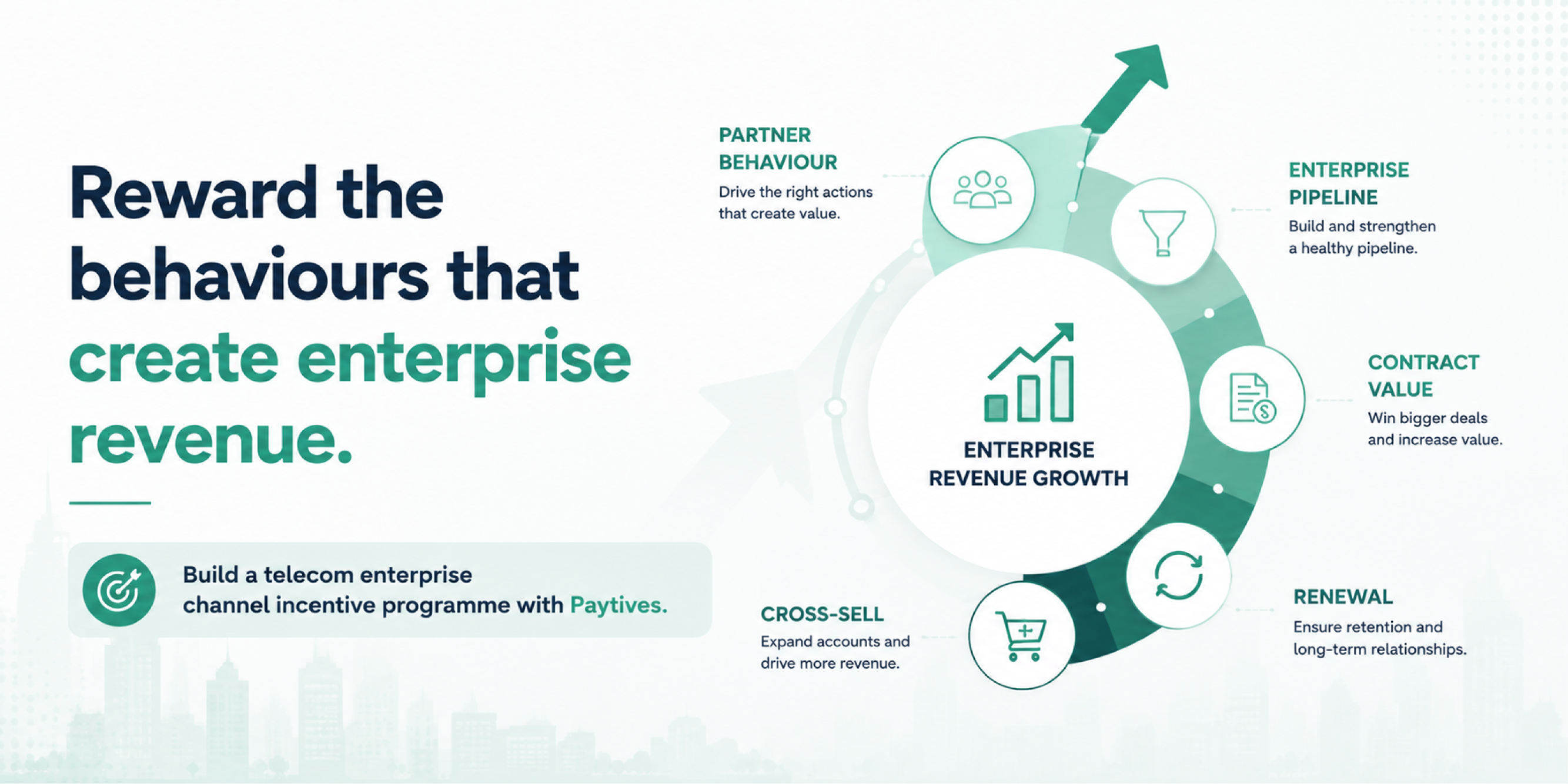
The strongest telecom channel incentive programmes do not simply pay partners more for selling more. They reward the behaviours that make enterprise solution sales possible, from opportunity creation and technical presales to proof of concept, contract expansion and renewal.
As enterprise buying becomes more complex and partner ecosystems become more strategic, Sales Leaders will increasingly need incentive programmes that connect partner activity directly to revenue quality and lifetime account value. See how Paytives manages telecom enterprise channel incentives and book a demo.
See how Paytives manages telecom enterprise channel incentives. Book a demo.
Sign up for our newsletter for trending top content!


