
How to Design a Sales Incentive Plan That Salespeople Actually Trust and That Finance Can Defend


Sign up for our newsletter for trending top content!
A sales incentive plan can be mathematically perfect and still fail. Gartner research has consistently shown that sellers who do not understand how they earn variable pay are significantly less likely to believe the plan is fair, and perceived unfairness directly affects discretionary effort and retention. At the same time, finance leaders face increasing scrutiny over commission accruals, payout accuracy, and auditability.
For HR leaders, this creates a difficult balancing act. The plan must motivate salespeople, withstand finance review, and remain operationally manageable across territories, products, and partner channels. Poorly designed incentives create disputes, shadow calculations, and budget overruns that consume management time and damage trust.
This article explains how to design a sales incentive plan that salespeople can understand, managers can explain, and finance can defend. You will learn practical design principles, governance controls, and communication practices that reduce disputes while improving motivation.
Why Salespeople Lose Confidence in Incentive Plans Even When the Maths Is Correct
Salespeople rarely lose trust because a spreadsheet formula is wrong. They lose trust when they cannot predict their earnings. Gartner has found that transparency and understanding are among the strongest drivers of perceived pay fairness in sales organisations. When reps need a finance analyst to explain their commission statement, confidence declines regardless of payout accuracy.
Three factors typically create this problem:
- Excessive complexity: Multiple modifiers, product weights, and exceptions make earnings impossible to estimate.
- Frequent exceptions: Managers approve one-off adjustments that appear inconsistent across the team.
- Delayed visibility: Reps discover credits, reversals, or clawbacks weeks after the sale closes.
Deloitte’s research on rewards communication shows that employees respond more positively when organisations explain not only what they pay but why they pay it. HR leaders should therefore treat incentive communication as a change-management exercise, not an administrative task.
A practical trust test
Ask a representative seller to calculate their expected payout for a hypothetical deal in under five minutes. If they cannot do it without opening a policy document, the plan is probably too complex.
Platforms such as Paytives help address this by giving sales teams real-time visibility into performance, projected earnings, and payout calculations, reducing the need for manual reconciliation and shadow spreadsheets.
The Simplicity Principle: How to Design Commission Structures That Reps Can Calculate Themselves
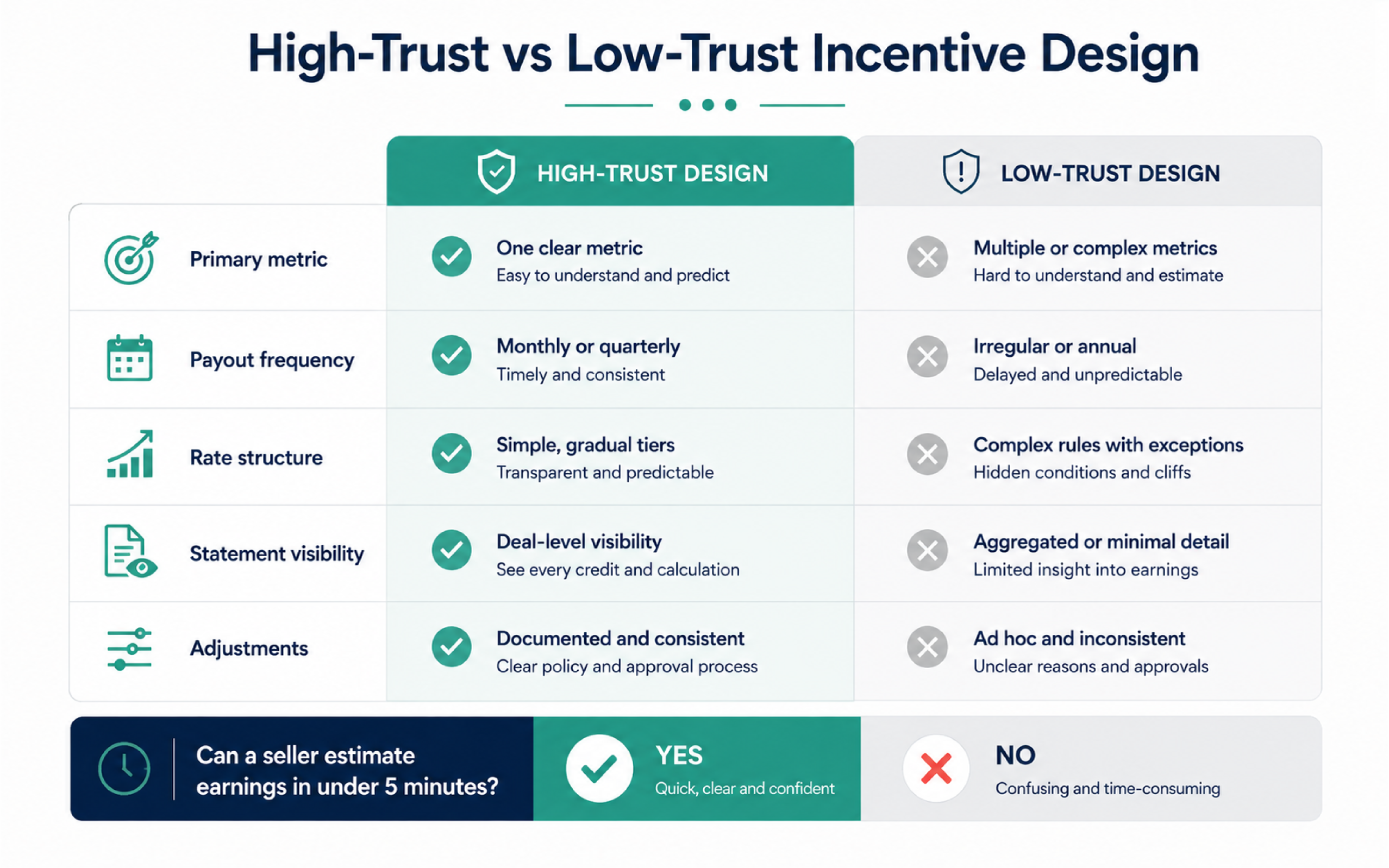
The strongest incentive plans share one characteristic: a seller can estimate earnings mentally. The Incentive Research Foundation (IRF) has repeatedly found that simple reward structures generate higher participation and stronger behavioural response than complicated schemes with numerous conditions.
A useful rule is one primary metric, one quota, one rate. Additional metrics should be limited to strategic priorities that genuinely require differentiated behaviour.
Mercer’s sales compensation research indicates that organisations with fewer plan components generally report lower dispute rates and faster onboarding for new sellers.
Keep the payout statement readable
A good statement should show:
- Deal value.
- Eligible value.
- Applied rate.
- Accelerator band.
- Gross payout.
- Adjustments with reasons.
If a payout statement requires training to interpret, redesign the statement before redesigning the plan.
For HR leaders managing partner or channel sales teams, a centralised incentive administration platform is often more effective than maintaining multiple spreadsheet models. The Reward Store’s Paytives solution was designed specifically for this operational challenge.
Related reading: https://www.therewardstore.com/blogs/channel-partner-incentive-automation
Quota Setting: The Single Biggest Factor in Whether a Sales Incentive Plan Motivates or Demoralises
Quota quality matters more than commission rate. A generous payout formula cannot motivate a team that believes targets are unattainable. According to McKinsey, top-performing sales organisations use data-driven quota setting and regularly test target realism against market potential and historical attainment.
A practical benchmark is to aim for:
- 50–70% of sellers achieving quota,
- 20–30% exceeding quota,
- a small top-performer group earning accelerators.
When fewer than half of sellers achieve target for multiple periods, the organisation should investigate quota calibration before increasing incentive rates.
A quota calibration framework
Use three inputs:
- Historical performance over at least eight quarters.
- Territory opportunity based on addressable market.
- Role capacity such as account load, sales cycle, and product mix.
Gartner recommends documenting the rationale for every quota assignment, especially when territories differ significantly. This documentation becomes essential when employees challenge fairness.
Warning signs of a demotivating quota
- Median attainment below 60%.
- Large unexplained differences between similar territories.
- Frequent quota relief requests.
- High early-tenure attrition among sales hires.
HR leaders should review attainment distribution quarterly with sales and finance rather than waiting for annual plan renewal. Early correction protects both morale and budget predictability.
How to Handle Mid-Year Quota Changes Without Destroying Team Trust
Nothing damages credibility faster than changing targets after sellers have already built their pipeline. SHRM research on employee trust highlights that procedural fairness, meaning the perceived fairness of the process, strongly influences commitment even when outcomes are not ideal.
Mid-year changes are sometimes unavoidable because of acquisitions, territory redesigns, product launches, or economic shocks. The key is to change the plan transparently.
Four rules for fair mid-year adjustments
1. Use a published trigger
Define in advance what events permit a change, such as a territory split, acquisition, or major product withdrawal.
2. Protect earned performance
Never retroactively reduce payout on deals already closed.
3. Recalculate proportionally
Adjust remaining-period quota rather than rewriting the full-year target.
4. Communicate individually
Managers should explain the change one-to-one before the new target takes effect.
Deloitte’s human capital research shows that employees react more positively when organisations explain the business rationale and provide personalised impact analysis.
This is where workflow discipline matters. Paytives can maintain version-controlled incentive plans, approval records, and effective dates, creating a clear audit trail for every quota change and reducing disputes about which plan version applied at the time of sale.
Accelerators and Decelerators: How to Design Variable Rate Structures That Drive Outperformance Without Gaming
Accelerators encourage exceptional performance, but poorly designed accelerators encourage deal timing manipulation. The Incentive Research Foundation warns that steep payout cliffs can distort behaviour near threshold points.
A safer design uses gradual rate progression.
This structure rewards overperformance without creating a single dramatic trigger point.
Add anti-gaming controls
Include:
- revenue recognition alignment,
- customer payment validation where appropriate,
- return or cancellation clawback rules,
- approval for unusual end-of-quarter transactions.
Bain & Company has documented that incentive systems aligned to customer value and profitable growth outperform systems focused solely on short-term volume.
When to use decelerators
Decelerators can discourage low-quality revenue, but use them sparingly. Apply them only to clearly defined conditions such as excessive discounting, negative margin deals, or compliance breaches. Hidden decelerators are among the fastest ways to erode trust because sellers perceive them as arbitrary penalties.
The best accelerator design rewards the behaviour the business wants next year, not merely the revenue it booked last quarter.
The Finance Requirement: What Documentation, Audit Trails, and Accrual Controls Make a Plan Defensible
Finance does not need a motivational speech. It needs evidence. A defensible incentive plan produces consistent calculations, documented approvals, and auditable records. Gartner’s finance transformation research emphasises that manual commission processes create material control risk through spreadsheet errors, inconsistent adjustments, and limited traceability.
Minimum finance control framework
Policy documentation
- Signed plan documents.
- Eligibility rules.
- Effective dates.
- Exception authority matrix.
Calculation controls
- System-generated calculations.
- Locked rate tables.
- Version history.
- Independent review for rule changes.
Accrual controls
- Monthly accrual methodology.
- Reconciliation to payroll.
- Reconciliation to recognised revenue.
- Variance analysis against forecast.
Audit evidence
- Deal-level payout records.
- Approval timestamps.
- Change logs.
- Exportable audit reports.
Aberdeen Group research has shown that organisations using automated incentive management processes generally achieve higher payout accuracy and lower administrative effort than those relying primarily on spreadsheets.
For multinational organisations, finance also needs multi-currency handling, tax treatment consistency, and local compliance records. Paytives supports global payout workflows across multiple countries and currencies, helping HR and finance maintain a single source of truth while scaling incentive programmes internationally.
Related reading: https://www.therewardstore.com/blogs/channel-loyalty-programme-for-dealers-and-distributors
Frequently Asked Questions
What makes a sales incentive plan feel fair to employees?
Employees usually judge fairness by transparency, consistency, and attainability rather than by payout size alone. A fair plan uses clear metrics, published rules, timely statements, and documented exceptions. Managers should be able to explain every payout in plain language. Consistent administration across territories is critical.
How often should we review quotas?
Review quotas at least quarterly, even if you change them annually. Quarterly reviews help identify territory imbalances, market changes, and persistent under-attainment early. HR, sales, and finance should review attainment distribution together. Waiting until year-end often allows demotivation and budget variance to compound.
Should HR own sales incentive design?
HR should co-own governance, fairness, communication, and policy administration, while sales owns commercial strategy and finance owns budget control. The most effective organisations use a cross-functional compensation committee. This reduces unilateral changes and improves accountability. Clear ownership also speeds dispute resolution.
When should we automate incentive administration?
Automation becomes valuable when you manage multiple plans, territories, products, currencies, or partner tiers. Manual spreadsheets struggle with audit trails, version control, and real-time visibility. Platforms such as Paytives provide automated calculations, approval workflows, and payout tracking that reduce administrative effort and improve accuracy. They also create a stronger audit record for finance and internal control teams.
How do we prevent disputes about commission calculations?
Provide deal-level statements, publish calculation rules, maintain approval records for exceptions, and give sellers access to performance data before payroll closes. Encourage managers to review statements with their teams monthly. Most disputes arise from visibility gaps rather than calculation errors. Early review prevents escalation.
Conclusion
A trusted sales incentive plan is not the one with the most sophisticated formula. It is the one that sellers can understand, managers can explain, and finance can audit. Simplicity, realistic quotas, transparent change management, and strong governance create far more value than adding additional payout variables.
As incentive administration becomes more global and data-driven, organisations will increasingly rely on automated platforms that provide real-time visibility, auditability, and policy control across sales and channel teams.
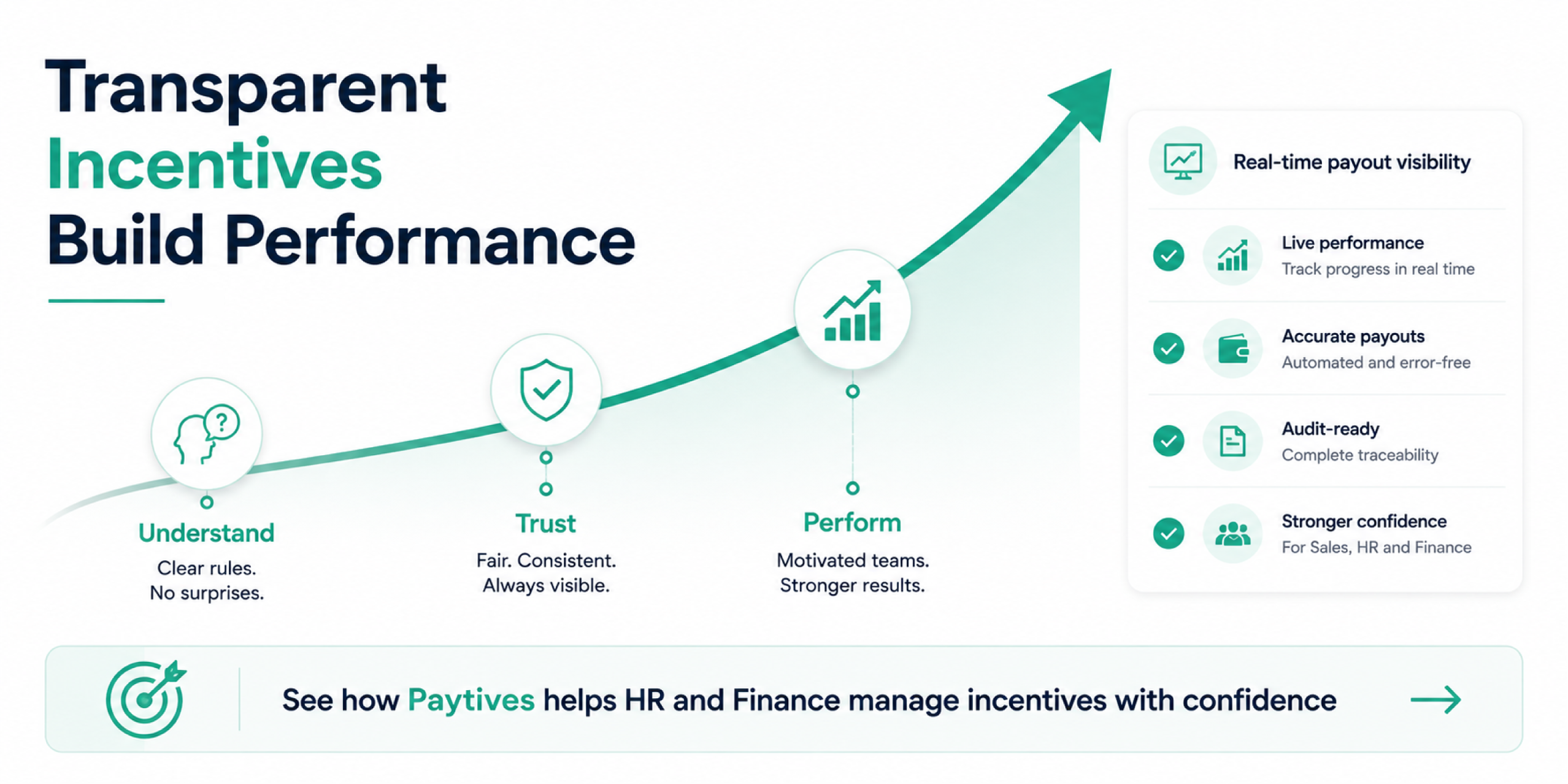
See how Paytives brings transparency and automation to sales incentive plan administration: https://www.therewardstore.com/paytives/overview
Sign up for our newsletter for trending top content!


