
How to Prepare a Redemption Platform for Diwali and Year End Peaks

Sign up for our newsletter for trending top content!
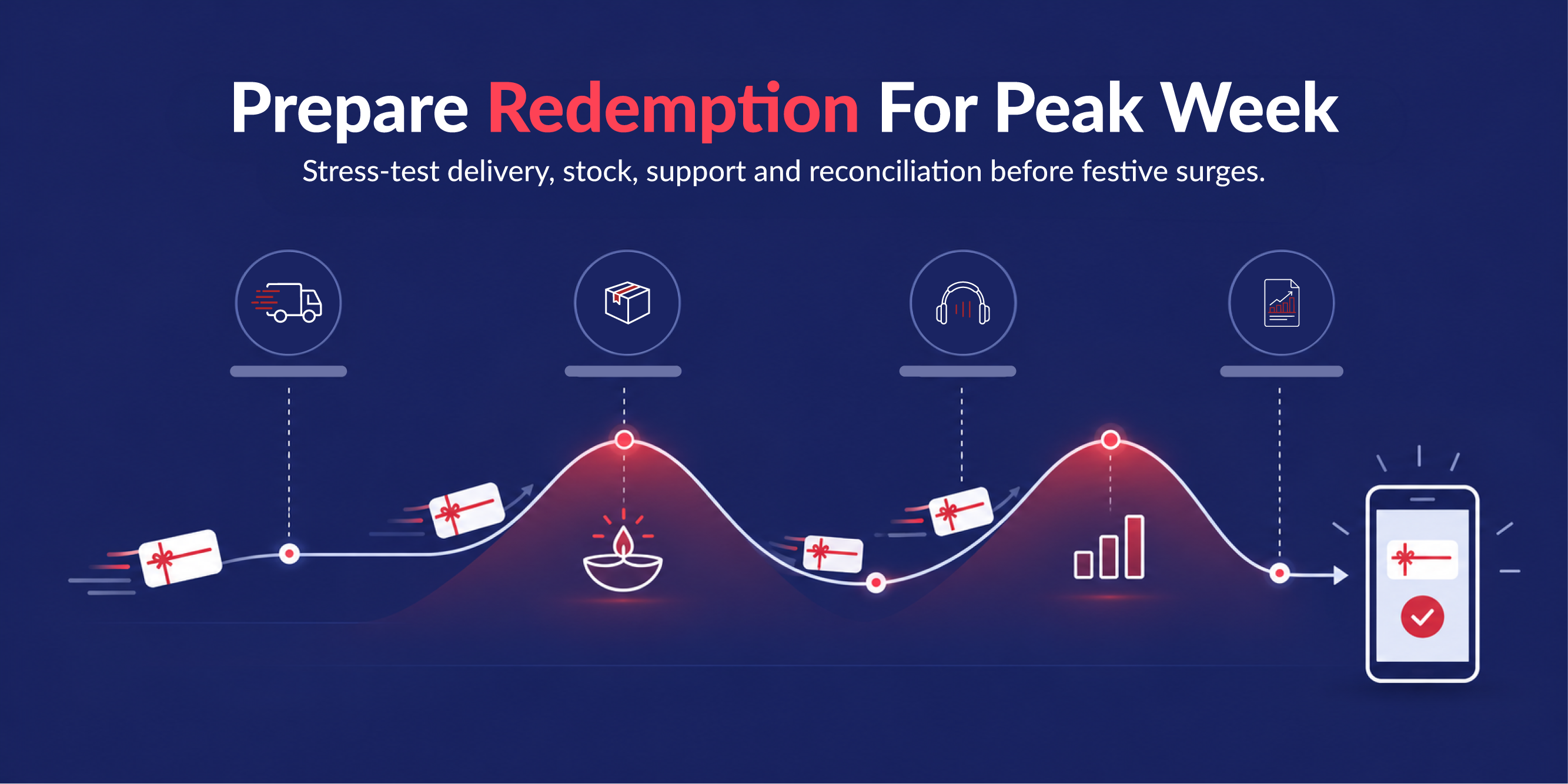
Reward redemption peak season planning is the work of confirming, before the busiest week arrives, that delivery, catalogue stock, member support and finance reconciliation can each carry the full burst of demand. In practice it means testing delivery against a realistic peak, protecting the most requested brands, preparing support and finance controls, and freezing unplanned changes in the final fortnight. For most Indian programmes the decisive weeks fall before Diwali, with a second peak at calendar and financial year end.
Why Redemption Volume Does Not Arrive Evenly
Redemption volume arrives in bursts because members react to the same dates and messages together, so capacity must be planned against the burst and not against a monthly average.
Redemption is the act of exchanging a points or budget balance for a reward. A reward redemption engine is a system that converts that balance into a delivered reward and records the transaction, which makes it the point where every trigger below converges.
What Creates the Spike
Three triggers recur. The first is the festive gifting window, when members want a reward in hand before a specific date. The second is a bulk communication, such as a bonus credit email sent to the whole base, which produces a surge within the hour that follows. The third is a deadline, such as points nearing expiry or an annual incentive budget that lapses at year end, and in India the financial year closes in March.
Ask this diagnostic question first: when did the programme last message its full base, and what did redemptions do in the following hour? The answer shows the real peak, which is a shape of hours and not an average of days.
How Programme Types Peak Differently
Staggering bulk sends across several hours flattens the burst at its source. The cost is that some members hear later than others, which matters when a message carries a deadline, so the send order should follow the order of deadlines and not the order of the database.
Delivery Speed and Reliability Under Peak Load
Delivery holds under peak load when each step between the member request and the delivered voucher is protected against repeated requests, rate limits and silent failure, because a redemption is complete only when the member holds a usable reward.
Voucher delivery is the process of sending a reward code or link to a member by email, SMS or in app message. A webhook is an automated message that one system sends to another when an event occurs, such as a change in delivery status.
Where Delivery Fails Under Load
Automatic retry suits temporary faults only. When the failure is a rejected code, retrying repeats the failure, so the right response is manual review and replacement.
A Worked Scenario
Consider a regional bank that runs a credit card rewards programme and sends a Diwali reminder to its whole cardholder base at ten in the morning. Within the hour, redemptions for one popular online retail gift card climb sharply, the brand system slows and cardholders tap again. Some are debited twice, support receives messages asking where a voucher is, and finance later finds debits without matching deliveries.
The operations head resolves it with three decisions made before the next send: stagger the send across the day, reject repeat requests with an idempotency key, and name a substitute brand to offer when the leading brand slows.
Why Festive Failures Cost More Goodwill
A reward given at a festival has value tied to a date. A late voucher on an ordinary day is an inconvenience, but after the festival it is a gift that never arrived, and the occasion cannot be recovered. Members also redeem for family and colleagues, so one failure reaches several people, and their contact reaches support when it is busiest.
How One Engine Implements These Controls
RedeemStack is a white label reward redemption engine and storefront from The Reward Store. Its delivery function provides instant voucher delivery by email, SMS and in-app, real time tracking, automatic retry when a delivery fails and webhooks for delivery status.
Keeping Popular Brands Available in the Catalogue
Catalogue availability holds through a peak when the small group of brands that attract a disproportionate share of requests is identified in advance, backed by substitutes and protected from unplanned changes.
Catalogue availability is the condition of a listed reward being redeemable at the moment a member asks for it. Members choose familiar names under time pressure, so demand concentrates on a few brands, and a failure in one of them is noticed far more than a failure in a niche item.
Identify the Concentration
Rank the previous festive period redemptions by brand and by hour. For each leading brand, check whether the issuer can supply the volume, whether the denominations suit typical balances, and what the member sees if the item fails. Denomination depth is a common trap, because a brand offered only in large values leaves a member with a modest balance unable to redeem and likely to contact support.
Freeze, and When Not to Freeze
A catalogue freeze is an agreed period in which no listing changes without named approval. Freezing in the final fortnight prevents a rushed edit from breaking a popular listing at the moment of highest volume. A freeze is the wrong choice when a leading brand starts to fail, because a visible failing item turns every attempt into a support contact. The rule should permit removal and substitution at once and block only additions and edits made for convenience.
A Counter Argument
Some operators argue that narrowing the catalogue to a festive shortlist reduces choice, and that choice is the reason members engage. The argument is sound for programmes whose proposition rests on range. A workable compromise keeps the full catalogue visible while placing the protected brands first. A reward redemption engine that publishes catalogue updates by webhook gives the storefront a signal to act on, though the programme must still decide the action.
Support Volume and Member Communication During the Peak
Support volume at peak is driven mainly by members who have redeemed and cannot see what happened next, so the most effective reduction is to show status before the member needs to ask.
Contact deflection is the practice of answering a member question through a self service channel so that it never becomes a support ticket. Uncertainty is the mechanism: a member who receives no confirmation within minutes assumes failure, then contacts support or redeems again, which adds a ticket to the queue and a duplicate to the ledger.
Prepare the Support Desk
Prepare scripts for the commonest failure causes, such as a delayed message, a rejected code and a double debit, and name an escalation owner in operations for each one. Brief the desk on resend rules before the peak, because resending a code to an unverified mobile number or email address is a route for fraud, and the Digital Personal Data Protection Act 2023 governs how member contact details are processed. Plan staffing for the hours after each bulk send and not for the working day as a whole, since contact follows the send within the hour.
Communicate Before and After the Redemption
Tell members the true delivery window for each reward type and show the status on the confirmation screen. A promised window that the programme cannot meet does more damage than a longer window that it can meet. Send a message when a delivery is retried or substituted, because silence is what converts a delay into a complaint.
Reconciling the Peak for Finance
Reconciliation succeeds at peak when every redemption can be traced from points debit to delivered voucher to invoice, and when exceptions are reviewed daily and not at month end.
Reconciliation is a finance process that matches the points or budget debited by the programme against the rewards delivered and the invoices received. At peak volume it breaks because three timestamps drift apart: the debit, the delivery and the invoice.
Where the Breaks Occur
Common breaks are duplicate debits, deliveries that failed after a debit and were refunded late, and redemptions that straddle a period end, where the debit falls in one month and the delivery in the next. Indirect tax and withholding add a further layer. Invoices must meet Goods and Services Tax requirements, and tax deduction at source, including Section 194R of the Income Tax Act for benefits given to business associates, depends on how the incentive is classified. The finance controller and the tax team should confirm treatment before the peak and not during it.
Controls That Catch the Problem
Agree one reconciliation key, which is a transaction reference that appears in the programme ledger, the redemption record and the invoice. Run a daily exception report that lists redemptions still pending beyond a defined window. A reward redemption engine that keeps an audit trail for every transaction gives finance a single record to reconcile against, but the match works only if the issuer ledger stores the same reference. Set the year end cut off date for budget expiry in writing, so that redemptions near the deadline fall in the correct period.
A Peak Redemption Readiness Checklist
A programme is ready for the peak when every item below has a named owner and a recorded result, and the list is ordered by lead time so that the earliest items protect the latest ones.
- Six weeks before the peak, pull redemptions by brand, channel and hour from the previous festive period and rank the brands that carried the most volume.
- Six weeks before, confirm that SMS headers and templates are registered on the TRAI DLT platform and that email sending limits will tolerate a burst.
- Five weeks before, load test the full redemption journey in a sandbox at a realistic burst and not at a flat average.
- Four weeks before, agree a substitute for each protected brand and a rule for who may trigger the substitution.
- Four weeks before, confirm that repeated redemption requests are rejected by an idempotency key or an equivalent control.
- Three weeks before, stagger the member communication schedule so that no single send reaches the whole base within an hour.
- Two weeks before, freeze catalogue additions and edits while keeping removal of failing brands permitted.
- Two weeks before, brief the support desk, publish scripts and name an escalation owner for each failure type.
- One week before, agree the reconciliation key, the daily exception report and the year end cut off rules with the finance controller.
- During the peak, review delivery success, pending redemptions and ticket themes at fixed hours each day and record each decision taken.
Where RedeemStack Fits
A reward redemption engine sits between the programme that issues points or budget and the member who wants a delivered reward. The bank, fintech or HR platform remains the issuer, and the engine acts as the burn layer. RedeemStack, from The Reward Store, converts an existing points or budget balance into a delivered reward. It does not issue points, currency or gift cards, run loyalty tiers or earning logic, fund the rewards or operate the programme.
Its catalogue holds 5,000+ gift cards across 100+ countries, alongside prepaid cards, mobile recharges, utility payments, flights, hotels, gift boxes and experiences. The storefront carries the programme’s own domain, colours, logo and curated catalogue selection. A RESTful API with OAuth 2.0 authentication and webhooks supports integration, and scalable infrastructure supports peak redemption periods.
Frequently Asked Questions
How early should I start preparing a redemption platform for Diwali?
Start six to eight weeks before the expected peak. Load testing, SMS template registration, catalogue decisions and finance sign off each need lead time that cannot be safely compressed into the final fortnight. Begin with redemption data from the previous festive period by brand and hour, then work through delivery, catalogue, support and reconciliation, and agree a change freeze two weeks before the peak.
What causes redemption failures during the Diwali rush?
Failures usually come from third party limits meeting concentrated demand. Brand issuers slow down under their own festive traffic, SMS and email channels throttle or filter sudden volume, and members tap again when a screen is slow, creating duplicate requests. Failures compound because each retry adds load to the component that is already struggling.
How do I stop duplicate redemptions when members keep tapping redeem?
Attach an idempotency key to every redemption request, which is a unique identifier that lets the system recognise a repeated request and return the original result instead of creating a second debit. Also show a clear in progress status on the screen, because members tap again when they receive no confirmation.
What should finance reconcile after a festive redemption peak?
Finance should match each points or budget debit to a delivered reward and to an invoice, using one shared transaction reference. Review duplicate debits, deliveries that failed after a debit, refunds issued late and redemptions that span a period end. Confirm that invoices meet Goods and Services Tax requirements and that tax deduction at source treatment has been agreed.
Should I freeze the rewards catalogue before a festive peak?
Freeze unplanned additions and edits about two weeks before the peak, because a rushed change can break a popular listing when volume is highest. Do not freeze removals. If a leading brand begins to fail, remove or replace it at once, since a visible failing item turns every attempt into a support contact.
How does RedeemStack handle peak redemption periods?
RedeemStack provides scalable infrastructure for peak redemption periods. Vouchers are delivered by email, SMS and in app, with real time tracking and automatic retry when a delivery fails. Webhooks report delivery status, redemption events and catalogue updates. A sandbox is provided for testing the API, and every transaction has an audit trail.
Sign up for our newsletter for trending top content!


