
After Diwali: How Loyalty Programmes Can Keep Festive Shoppers Coming Back

Sign up for our newsletter for trending top content!
A loyalty programme retains festive shoppers by treating the weeks after Diwali as a separate job from the festive sale. It identifies first time buyers from the order record, starts a welcome journey at delivery, offers a reason to buy again at the point the category repeats, and measures the result against a control group that receives none of it. The work is separate because festive buyers were drawn by the occasion and the discount rather than by the brand, so the behaviour that brought them does not repeat on its own.
Why Festive Acquisition and Retention Are Different Jobs
Festive acquisition and post festive retention are different jobs because they act on different motives, run through different channels and are judged by different measures. Festive acquisition is the work of converting demand that the occasion has already created into a first order. Post festive retention is the work of giving a customer a reason to buy again once the occasion has passed and nothing external is creating demand.
Why festive buyers do not repeat on their own
The purchase is usually explained by the occasion rather than by the brand. Gifting, household renewal, bonus payouts and sale pricing push shoppers to buy within a short window, and when the window closes the cause of the purchase closes with it. A deep festive discount adds a second effect, because it sets a reference price in the buyer’s mind and makes the regular price look high afterwards. The buyer then waits for the next sale instead of returning.
Comparing the two jobs
A counter argument worth taking seriously
Some teams argue that the festive cohort should be left alone, because many of its members were never going to return and the effort is wasted. This is partly correct, since a share of the cohort will not repeat whatever is done, and reward budget spent on that share lowers the return on the programme. The answer is to select within the cohort, as the next section describes, and to prove the effect with a control group, as the fifth section describes.
Identifying First Time Festive Buyers
A first time festive buyer should be identified from the order record using a rule fixed before the season ends, and then split by reason for purchase, because gift buyers and self buyers need different treatment. A first time festive buyer is a customer whose first recorded order with the brand falls inside the festive campaign window.
Resolve identity before counting
Identity resolution is the process that matches records across orders, channels and devices to one person. Without it, guest checkouts, changed email addresses and earlier store purchases make existing customers appear new. A normalised mobile number is usually the most stable matching key in India, because people change email addresses more often than numbers. The diagnostic is simple: take a sample of customers flagged as new and search for them in point of sale, app registration and marketplace records. If a visible share has earlier history, the cohort is overstated and every retention figure built on it will be understated.
Separate gift buyers from self buyers
Confirm consent before targeting
The Digital Personal Data Protection Act, 2023 requires a lawful basis for processing personal data, which for marketing is usually consent, so confirm with legal counsel that checkout consent covers promotional messages. Promotional SMS in India must use headers and templates registered on the DLT platform under TRAI rules, and WhatsApp Business messaging requires opt in. A gift recipient has consented to nothing, so recipients should not be added to the journey.
Welcome Journeys Triggered by the First Purchase
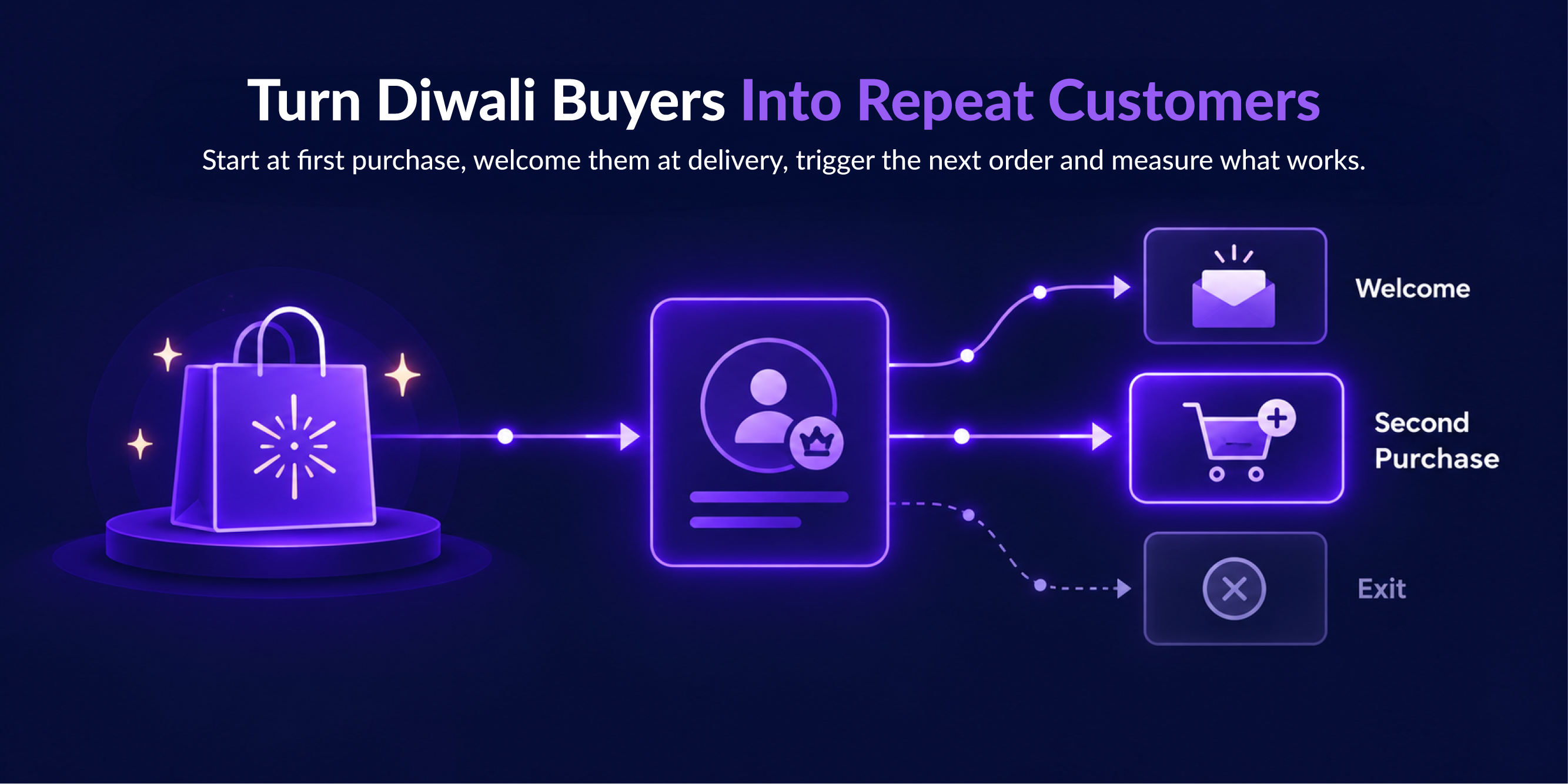
A welcome journey should start at confirmed delivery rather than at order confirmation, and its first message should concern the product just bought rather than another offer. A welcome journey is a sequence of messages that starts automatically on a customer’s first purchase and ends when the customer reaches a defined next state.
Trigger on delivery, not on the order
An entry trigger is an event that places a member into a journey. Returns, cancellations and refused deliveries are most likely in the first days, so a trigger on order confirmation sends offers to customers who may return the item. The experience of using the product also forms the second purchase decision, which is why the first message should help the customer use or care for it.
Define exit conditions before the messages
An exit condition is a rule that removes a member from a journey when an event makes the remaining messages irrelevant or harmful. Typical exits are a return, a cancellation, an open support ticket, an opt out and the second purchase itself. The common failure is checking these only at entry, so a member who raised a complaint on day three still receives a cheerful offer on day ten. Exit conditions must be evaluated before every send.
What the exit rules need from the data
An exit rule can only act on events that reach the journey tool. Rekyndl is a consumer loyalty platform from The Reward Store, built on a real time event engine. Its journey builder offers several entry triggers, exit conditions and real time branching, and support tickets resolve to the same member profile as purchases, which is the data condition the exit rule above depends on.
A sequence to build
- Enter self buyers at confirmed delivery of the first festive order.
- Send a first message about using or caring for the product, with no offer.
- Send a second message that shows the member their programme status, if a programme exists.
- Send the second purchase trigger described in the next section.
- Check exit conditions before every send.
- Move members who finish without a second purchase into the ordinary lifecycle rather than extending the sequence.
Giving Members a Reason to Make a Second Purchase
A second purchase is most likely when the offer arrives as the product runs low or the member is close to a visible milestone, so the trigger should follow the category repurchase interval rather than the marketing calendar. A second purchase trigger is an event or date that prompts a message giving a member a specific reason to buy again.
Choose the trigger type by category
People work harder as a goal gets closer, which is why tier distance and streaks move behaviour. Where points are held pending through a returns window, show the pending balance and the date it becomes spendable, so the member sees that a stake exists. A consumer loyalty platform has to hold pending balances, tier progress and expiry dates against one member profile for these messages to be accurate.
Prefer a reward to a discount
A discount on the second order teaches the buyer to wait for discounts. Points or a category bonus rewards the next purchase without lowering the price. Deal driven buyers may respond only to price, and in that case the offer should be capped and tested against a control group.
When a second purchase push is the wrong choice
For categories with a replacement cycle longer than the festive window, such as furniture, large appliances and jewellery, a second purchase offer in the following weeks asks for something the customer does not need, and it teaches them to ignore messages. Send care, service and registration content instead, ask for a review or referral, and schedule the next sales contact at the replacement cycle.
Measuring Retention Against a Control Group
The only reliable way to know whether retention effort worked is to compare treated members with a randomly chosen group that was deliberately left out. A control group is a randomly selected share of eligible members who are excluded from the retention programme so that their behaviour shows what would have happened anyway. Before and after comparisons mislead, because some festive buyers return regardless and demand shifts with the season, whereas the control group experiences the same sales, competitors and calendar.
Set up the test in this order
- Fix the eligible population using the cohort rule from the second section.
- Randomise at the level of the individual member before any message is sent, and store the flag on the member profile so every channel reads it, whether the messages come from a CRM tool, an email service provider or a consumer loyalty platform.
- Size the control group from the smallest difference worth detecting, because a small group cannot separate a real effect from noise.
- Fix the metric and window in advance: repeat purchase rate within the category repurchase interval, and incremental revenue net of reward cost.
- Run a sample ratio mismatch check, which compares the actual group sizes with the intended split.
- Read the difference rather than the level: incremental repeat purchase rate is the treated rate minus the control rate.
Contamination and peeking
Contamination occurs when paid retargeting, a marketplace campaign or another team’s broadcast reaches control members, so the flag must suppress them everywhere. Peeking occurs when a team stops the test as soon as the result looks favourable. If the cohort is too small for a conclusive result, pool the data with another festival or lengthen the window, and accept that the answer may remain inconclusive.
A worked scenario
A D2C brand selling packaged snacks and gift hampers ran a Diwali campaign. Its CRM lead matched records on mobile number, which removed a visible group of apparent new customers who had bought in earlier months. The remaining first time buyers were split into gift buyers and self buyers using the shipping address and gift message fields, and a random control group was drawn from each before messaging began.
After the repurchase window, self buyers who received the welcome journey and a points based prompt showed a clearly higher repeat rate than their control group, while gift buyers showed no meaningful difference. The CRM lead moved the gift buyer budget to a January occasion campaign. A blended repeat rate would have looked acceptable and hidden that one part of the effort changed nothing.
A Post Diwali Retention Plan
A workable plan has eight steps in a fixed order, because the cohort must be defined before the control group is drawn and the control group must be drawn before the first message.
- Define the festive window by dates and write the first time buyer rule down, so the cohort cannot drift during the season.
- Test identity matching on a sample of flagged customers and correct the cohort before counting anything.
- Tag each buyer as gift or self using shipping address, gift message and category, and exclude gift buyers from the standard journey.
- Confirm marketing consent, registered SMS templates under TRAI rules and WhatsApp opt in.
- Draw the control group at random on the member profile and suppress it in every channel.
- Build the welcome journey to start at delivery, with exit conditions checked before every send.
- Set one second purchase trigger per category, timed to the repurchase interval, and decide in advance what reward it carries.
- Write down the metric, window and reward cost treatment, and read the result only when the window closes.
Whether existing tools are enough
Existing CRM tools may be sufficient if three conditions hold: store, app and online purchases resolve to one profile, points and tiers are already live, and journeys can respond to events in real time. If all three hold, adding a consumer loyalty platform adds integration work without new capability. If one fails, particularly the first, the plan degrades, and the cohort check in step two will show it.
Where Rekyndl Fits
A consumer loyalty platform fits where a retention plan needs one record of each member across channels, rules for earning and expiry, and journeys that respond to events. Within that category, Rekyndl uses a real time event engine that resolves purchases, app sessions, forms and support tickets to one member profile.
Its journey builder has several entry triggers, exit conditions and real time branching. Points can stay pending through a returns or cancellation window and can expire on a fixed date, a rolling window or inactivity, with warning journeys before expiry. The Reward Store builds it for loyalty programme owners and heads of CRM at airlines, hotels, banks, retailers and coalition programmes. It does not run employee recognition programmes, channel or distributor incentive programmes or gift card programmes for retailers.
Frequently Asked Questions
How do I identify first time festive buyers in my CRM?
Define the festive window by dates, then select customers whose first recorded order falls inside it. Before counting, match records on a normalised mobile number across online orders, the app, store point of sale and marketplace data, because guest checkouts and changed email addresses make existing customers look new. Then check a sample of the flagged customers against earlier history to confirm the cohort is not overstated.
When should a welcome journey start for someone who bought during the Diwali sales?
Start the journey at confirmed delivery rather than at order confirmation. Returns and cancellations are most likely in the first days, so earlier messages reach customers who may send the item back, and the product experience forms the second purchase decision. Make the first message about using the product, add exit conditions for returns, open support tickets and opt outs, and keep offers for later messages.
How long should I wait before sending a festive buyer a second purchase offer?
Wait for the category repurchase interval, not a fixed number of days. A food or beauty buyer may need a reminder as stock runs low, while a buyer of furniture or jewellery has no near term need. Derive the interval from your own order history for repeat customers, then place the trigger shortly before the point at which most repeat orders occur.
How do I measure whether my post festive retention campaign actually worked?
Randomly exclude a share of eligible first time buyers before any message is sent, then compare their repeat purchase rate with that of the treated members over a window fixed in advance. The difference is the incremental effect. Subtract reward cost from incremental revenue, check that the group sizes match the intended split, and suppress control members from every other channel to avoid contamination.
Should I offer a discount or loyalty points to bring festive buyers back?
It depends on the buyer. Points or category bonuses protect the price, because they reward the next purchase without lowering what the item costs, so they suit self buyers who bought for an occasion. Deal driven buyers may respond only to a price offer, in which case cap the offer and test it against a control group. A consumer loyalty platform becomes useful when points, expiry and tiers must be tracked across channels.
How do Rekyndl journeys handle win back after a festive peak?
Rekyndl journeys use entry triggers, exit conditions, real time branching and broadcasts. Purchases, app sessions and support tickets resolve to one member profile, so a journey can respond to any of those events. Points can expire on a fixed date, a rolling window or inactivity, and warning journeys run before expiry. A team combines these elements to build its own win back sequence.
Sign up for our newsletter for trending top content!


