
How Retail Chains Can Use Employee Recognition to Reduce Store Staff Attrition and Improve Customer Experience Scores

Sign up for our newsletter for trending top content!
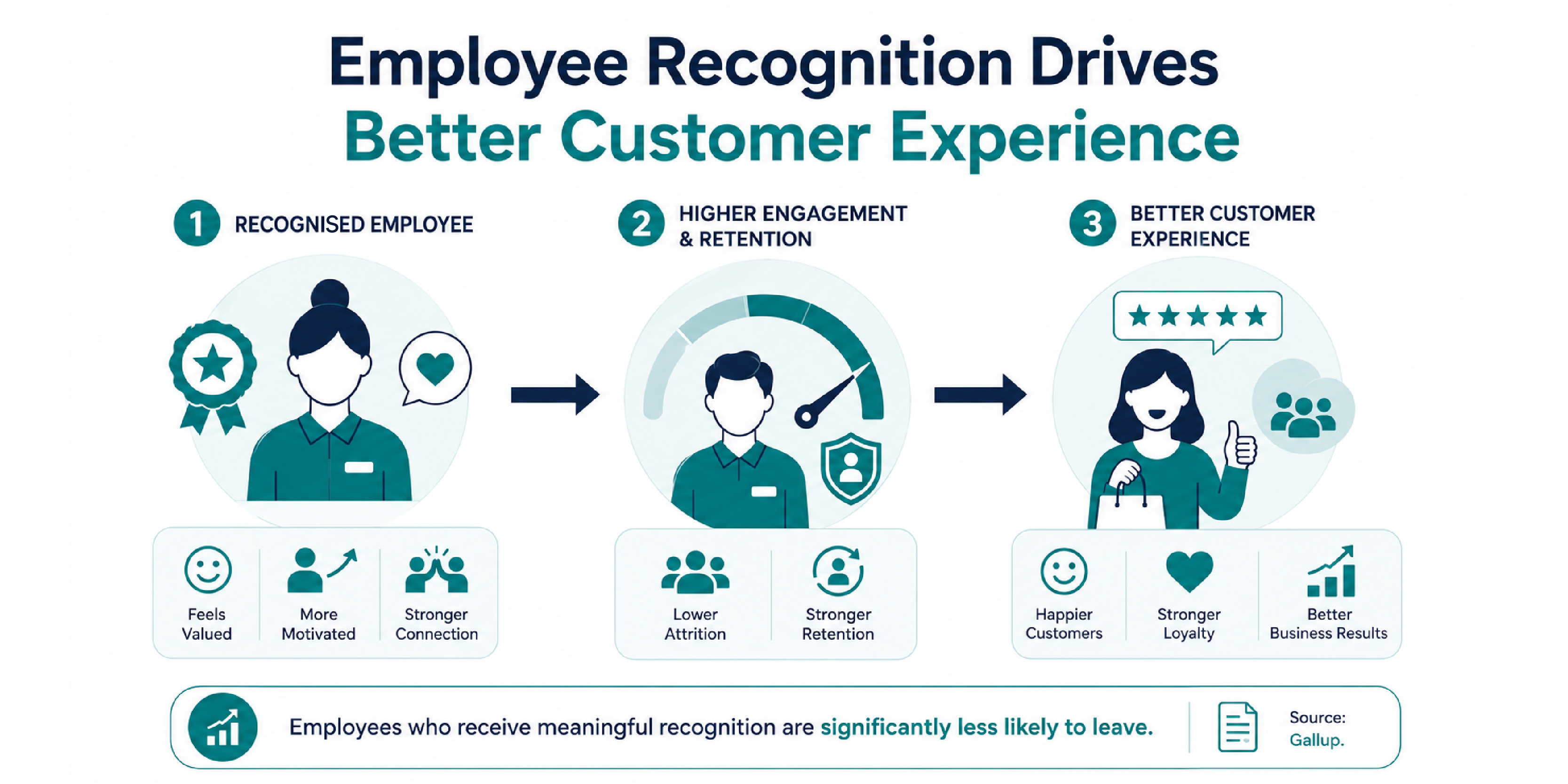
Retail organisations spend millions each year replacing frontline employees, yet many overlook one of the strongest drivers of retention: recognition. According to Gallup, employees who receive meaningful recognition are significantly less likely to leave their organisation, while highly engaged teams deliver stronger customer loyalty, higher productivity and better profitability.
For HR leaders managing hundreds of stores, the challenge extends beyond recognising employees. They must create a consistent recognition culture across geographically dispersed teams without slowing local decision making.
This article explains why store staff engagement remains one of retail's biggest challenges, how recognition influences customer experience scores, and how HR leaders can design scalable recognition programmes that reduce attrition while strengthening performance across every location.
Why Retail Store Staff Have the Lowest Engagement Scores in Any Customer-Facing Industry
Retail employees work in one of the most demanding customer-facing environments. They balance sales targets, stock replenishment, customer complaints, peak trading periods and unpredictable schedules, often with limited opportunities for career progression. These pressures contribute directly to lower engagement and higher employee turnover.
Gallup consistently reports that employee engagement remains significantly lower among frontline workers than many office-based employees. Employees who do not feel recognised or connected to their organisation become more likely to disengage, increasing absenteeism and voluntary resignations. SHRM also identifies recognition as one of the strongest contributors to employee satisfaction and retention, particularly for organisations employing large frontline workforces.
Recognition Must Become Part of Daily Store Operations
Annual awards and long-service certificates rarely influence day-to-day motivation. Retail employees respond more positively when managers acknowledge excellent customer service, teamwork, operational efficiency or problem solving shortly after the achievement occurs.
Recognition also strengthens manager and employee relationships. According to O.C. Tanner's Global Culture Report, employees who regularly receive meaningful recognition develop stronger trust in leadership and demonstrate greater commitment to organisational goals.
For retailers operating hundreds of stores, consistency often becomes the biggest challenge. Some locations develop strong recognition habits, while others depend entirely on individual store managers. A structured platform such as ApplaudIQ helps organisations standardise recognition policies while allowing local managers to celebrate achievements in ways that feel personal.
HR teams maintain governance through configurable workflows, automated milestone recognition, peer-to-peer appreciation, leaderboards and a global rewards catalogue, while store leaders retain flexibility to recognise outstanding performance quickly.
Recognition should become an operational habit rather than an occasional HR initiative. Retailers that achieve this create stronger employee engagement and a more stable frontline workforce.
The Link Between Employee Recognition and Net Promoter Score: What the Research Shows
Customer experience begins with employee experience. Employees who feel valued interact differently with customers, resolve problems faster and represent the organisation more positively during every interaction.
Gallup's workplace research demonstrates that highly engaged business units outperform less engaged teams across customer loyalty, profitability and productivity measures. Bain & Company, creator of the Net Promoter Score framework, also identifies employee engagement as a significant driver of customer advocacy because frontline behaviour directly shapes customer perception.
The relationship becomes especially important in retail, where customers judge the brand through conversations with store associates rather than corporate communications.
Research Linking Recognition and Customer Outcomes
The table highlights a consistent pattern across independent research. Recognition influences employee motivation, which affects service quality, customer satisfaction and commercial performance.
Retail HR leaders should therefore treat recognition as part of their customer experience strategy rather than solely an employee engagement initiative. Every positive customer interaction reflects the motivation, confidence and commitment of the employee delivering that experience.
How to Build a Recognition Programme That Works Across Hundreds of Stores Without Centralising Control
Retail organisations require consistency without removing local flexibility. Employees expect fair recognition standards, while store managers need autonomy to celebrate achievements relevant to their teams.
Many recognition initiatives fail because headquarters controls every decision. Managers wait for approvals, employees receive delayed recognition and participation gradually declines. Gartner recommends empowering frontline managers with simple recognition tools supported by clear governance rather than excessive administrative control.
A Practical Framework for Multi-Store Recognition
Successful retail recognition programmes generally include four components.
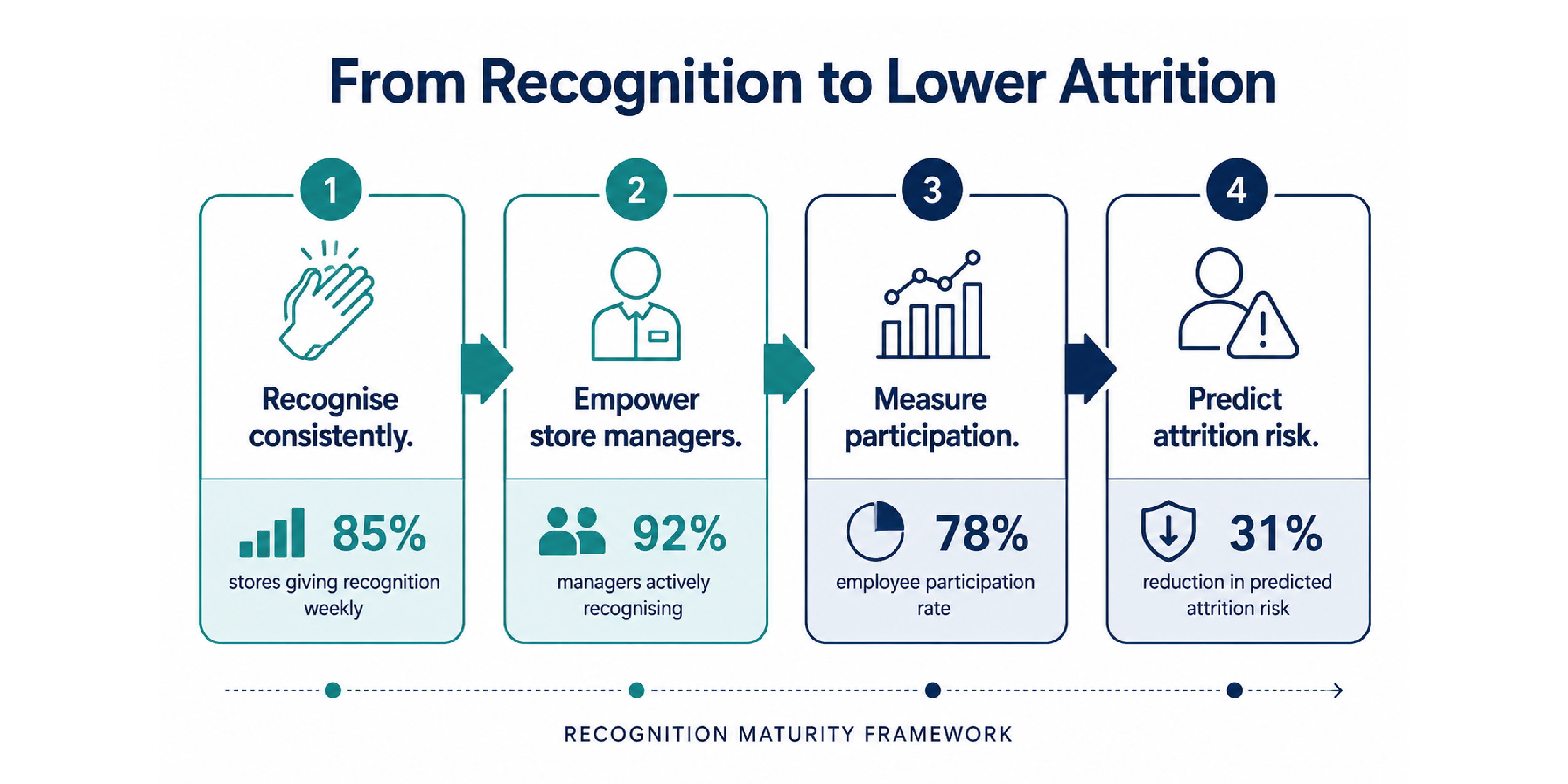
Clear recognition principles. HR defines organisation-wide behaviours that support customer service, teamwork, safety, productivity and company values.
Manager empowerment. Store managers recognise employees immediately using predefined budgets and approval rules.
Peer recognition. Employees acknowledge colleagues who support customers or contribute beyond normal responsibilities. Peer recognition increases participation and reinforces positive workplace culture, according to O.C. Tanner.
Central reporting. HR monitors participation rates, recognition frequency, reward redemption and engagement trends across every store without managing individual recognition events.
ApplaudIQ supports this operating model by combining automated milestone rewards, peer recognition through Cheers, configurable approval workflows, HRMS integration and communication through Microsoft Teams and Slack. HR teams maintain visibility across the organisation while allowing store managers to recognise exceptional performance quickly.
Retailers should also connect recognition with measurable outcomes such as employee retention, mystery shopping scores, customer satisfaction, absenteeism and sales performance. Aberdeen Group has found that organisations using data-driven recognition strategies achieve stronger workforce performance than organisations relying on informal appreciation alone.
Recognition succeeds when governance remains central but appreciation stays local. That balance allows retailers to maintain consistency across hundreds of stores while preserving the personal relationships that motivate frontline employees.
Peak Season Recognition: How to Maintain Appreciation During Diwali, Year-End, and Sale Periods
Retail employees experience their highest workloads during festive seasons, major sales events and year-end trading. Longer shifts, increased customer volumes and greater operational pressure often coincide with the period when managers have the least time to recognise exceptional effort.
This creates a significant risk. Mercer has found that employee wellbeing and recognition become even more important during periods of sustained workload, while Gallup consistently reports that timely recognition helps maintain engagement during high-pressure environments.
Build Recognition into Peak Season Operations
Recognition should not become another manual HR task during busy periods. Instead, retailers should automate key moments while encouraging managers to provide regular, personalised appreciation.
An effective peak season recognition strategy should include:
- Automated milestone rewards for employees completing seasonal campaigns.
- Weekly recognition for outstanding customer service and teamwork.
- Peer-to-peer appreciation to encourage colleagues to celebrate one another.
- Instant recognition for handling difficult customer situations or exceeding sales targets.
- Leaderboards that recognise behaviours aligned with organisational values rather than sales alone.
ApplaudIQ enables retailers to automate milestone rewards while giving store managers the flexibility to recognise employees in real time. Recognition remains visible across teams through the Wall of Appreciation, while configurable reward catalogues ensure employees can choose rewards that suit their preferences across multiple countries.
Importantly, recognition should extend beyond top performers. Deloitte's Human Capital research highlights that inclusive recognition strengthens belonging and reduces the risk of disengagement among employees who consistently contribute behind the scenes. Celebrating teamwork, reliability and customer care creates a healthier culture than rewarding only individual sales performance.
Retailers that maintain recognition during their busiest trading periods often enter the following quarter with stronger morale, lower attrition and more experienced teams.
Digital Recognition for Store Staff: What Channels Work When Employees Do Not Have Corporate Email
Many retail employees rarely access a corporate inbox. Cashiers, warehouse associates, floor staff and delivery teams often rely entirely on mobile devices during and outside working hours. Recognition strategies designed around email therefore fail to reach much of the frontline workforce.
Gartner recommends selecting communication channels that align with employees' daily working habits rather than expecting employees to adapt to corporate systems. The easier recognition becomes, the higher participation rates organisations achieve.
Choosing the Right Recognition Channel
Retail organisations should prioritise channels that employees already use.
ApplaudIQ supports recognition through Microsoft Teams, Slack and mobile-first experiences while integrating with leading HRMS platforms. This ensures employees receive recognition regardless of where they work or whether they have a corporate email account.
Recognition should also remain simple. O.C. Tanner reports that employees value authenticity and speed more than lengthy nomination processes. A short message recognising excellent customer service immediately after a positive customer interaction often creates greater impact than a formal award presented weeks later.
Retailers that remove communication barriers make recognition part of everyday work rather than an occasional event.
How to Use Recognition Data to Identify Stores at Risk of High Attrition Before It Happens
Recognition data provides more than evidence of appreciation. It also acts as an early indicator of organisational health.
Many retailers wait until resignation rates increase before investigating employee engagement. By that stage, replacing experienced employees becomes expensive and customer experience often declines. McKinsey & Company recommends using workforce analytics proactively to identify patterns that predict turnover and disengagement before employees leave.
Metrics HR Leaders Should Monitor
Recognition platforms generate valuable operational insights when combined with HR and business data. HR leaders should regularly review:
- Recognition frequency by store.
- Participation rates among managers and employees.
- Peer-to-peer recognition activity.
- Reward redemption rates.
- Recognition by department or role.
- Correlation between recognition, absenteeism and employee turnover.
- Customer satisfaction or Net Promoter Score trends alongside recognition activity.
Stores showing consistently low recognition participation often experience declining engagement before attrition becomes visible. HR teams can intervene by coaching managers, providing additional resources or reviewing local leadership practices.
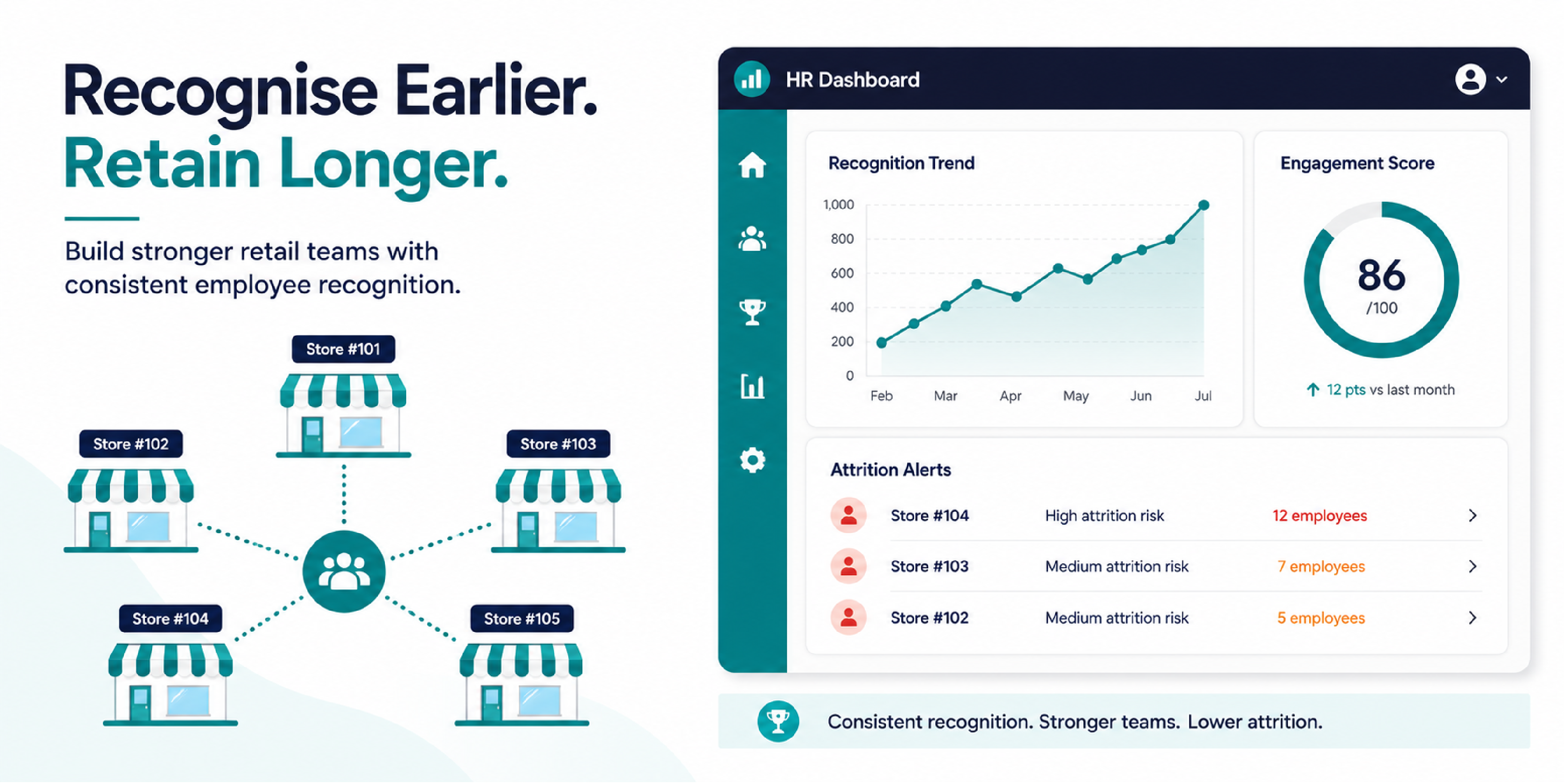
ApplaudIQ consolidates recognition data into organisation-wide dashboards, helping HR leaders compare locations, identify trends and measure programme effectiveness across multiple regions. Combined with HRMS integration, organisations gain a clearer understanding of how recognition influences retention, engagement and customer outcomes.
Recognition should therefore become part of a predictive people strategy rather than a retrospective reward initiative. Retailers that act on workforce insights early reduce recruitment costs while protecting customer experience and operational stability.
Frequently Asked Questions
What is the most effective employee recognition strategy for retail chains?
The most effective strategy combines frequent manager recognition, peer-to-peer appreciation, automated milestone rewards and meaningful reward choices. Recognition should occur throughout the year rather than only during annual awards. Consistency across every store is equally important to ensure employees receive a fair experience regardless of location.
How does employee recognition reduce retail staff attrition?
Recognition increases employees' sense of belonging, motivation and connection with their organisation. Gallup and SHRM research consistently shows that employees who feel appreciated are less likely to seek opportunities elsewhere. Lower attrition also reduces recruitment and training costs while preserving customer service quality.
How can retailers recognise employees who do not have a corporate email address?
Retailers should adopt mobile-first recognition platforms that support SMS, mobile applications and collaboration tools such as Microsoft Teams. Recognition should reach employees through the channels they already use during their working day. This removes communication barriers and encourages higher participation.
Can ApplaudIQ support recognition across multiple retail locations?
Yes. ApplaudIQ enables retail organisations to standardise recognition policies while allowing local managers to recognise employees quickly. Features such as automated milestone rewards, peer recognition, configurable workflows, HRMS integrations, leaderboards and a global rewards catalogue help HR teams manage recognition consistently across hundreds of stores.
When should retailers recognise employees?
Recognition should occur as close as possible to the achievement being recognised. Immediate appreciation reinforces positive behaviour more effectively than delayed awards. Retailers should also maintain structured recognition during peak trading periods such as Diwali, year-end campaigns and major promotional sales.
Conclusion
Employee recognition has become a measurable business strategy rather than simply an engagement initiative. Retail organisations that consistently recognise frontline employees reduce attrition, strengthen customer experience and build more resilient store teams.
As workforce analytics and AI-driven insights continue to evolve, recognition will increasingly help HR leaders predict engagement risks before they affect business performance. Organisations that invest in structured, scalable recognition today will be better positioned to retain talent and deliver exceptional customer experiences tomorrow.
See How ApplaudIQ Helps Retailers Reduce Attrition and Improve Customer Experience
Discover how ApplaudIQ enables retail organisations to automate recognition, strengthen employee engagement and improve customer experience across every store.
Sign up for our newsletter for trending top content!


