
How Rekyndl's Built-In Marketing Automation Turns a Loyalty Programme Into a Customer Retention Engine

Sign up for our newsletter for trending top content!
Introduction
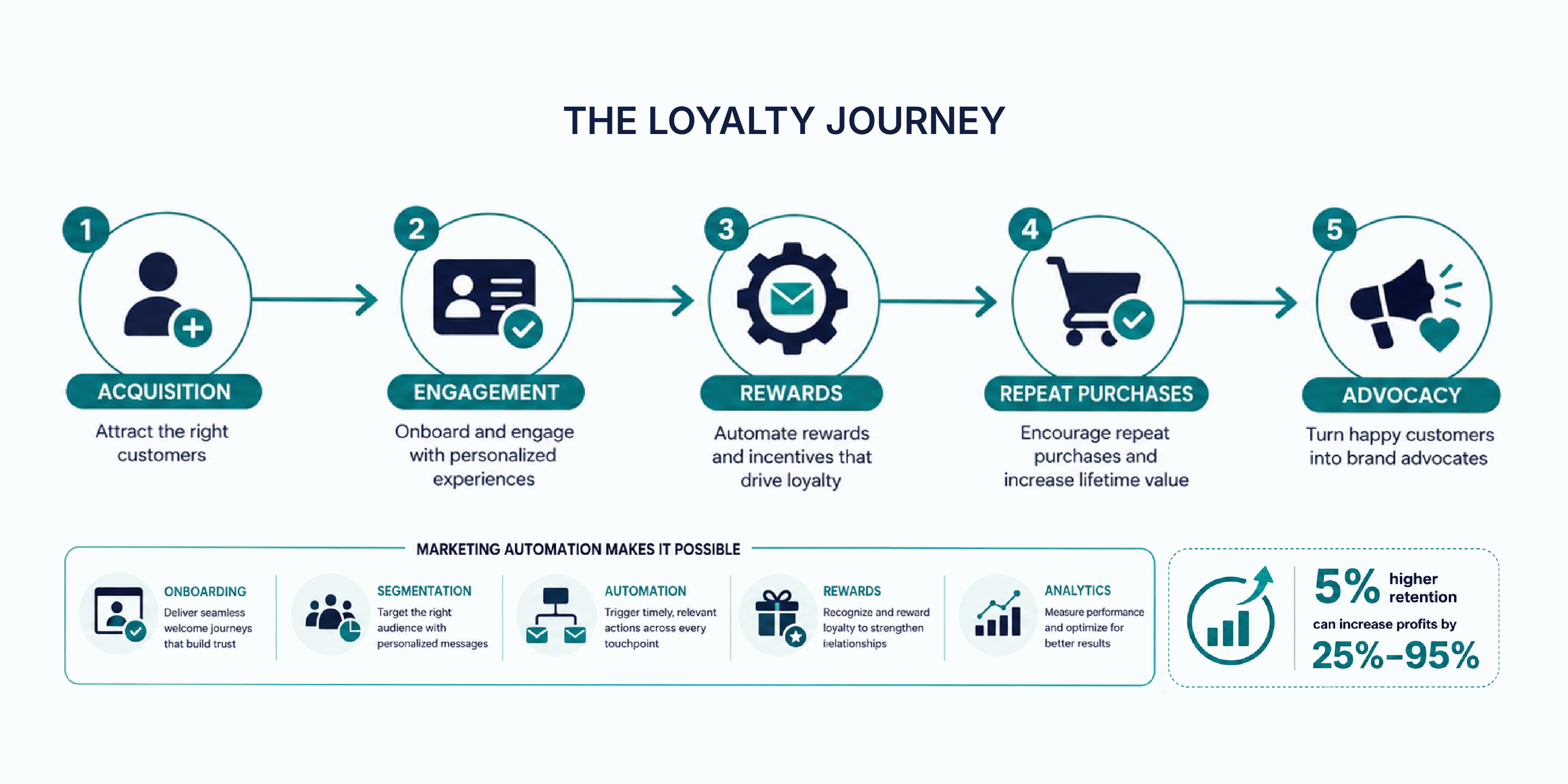
Increasing customer retention by just 5% can boost profits by between 25% and 95%, according to Bain & Company. Yet many organisations continue to operate loyalty programmes that rely heavily on manual campaigns, generic communications, and disconnected customer experiences. The result is lower engagement, declining redemption rates, and missed opportunities to influence customer behaviour.
Marketing leaders increasingly recognise that loyalty is not simply about points accumulation or rewards distribution. It is about creating relevant interactions throughout the customer lifecycle.
This article explores why marketing automation has become essential for modern loyalty programmes, the customer journeys that deliver the greatest impact, and how integrated journey orchestration transforms loyalty initiatives into measurable retention engines. For organisations seeking sustainable growth, failing to automate loyalty engagement can mean higher acquisition costs and reduced customer lifetime value.
Why a Loyalty Platform Without Marketing Automation Is Only Half the Solution
Traditional loyalty programmes often focus on transactional mechanics. Customers earn points, receive occasional offers, and redeem rewards when prompted. However, loyalty without automated engagement leaves significant value untapped.
McKinsey research shows that companies excelling at personalisation generate 40% more revenue from those activities than average performers. Meanwhile, Deloitte reports that emotionally engaged customers are more likely to remain loyal, spend more frequently, and advocate for brands within their networks.
Marketing automation bridges the gap between membership and meaningful engagement. Rather than waiting for customers to initiate interactions, organisations can proactively deliver experiences aligned with behavioural signals.
The limitations of static loyalty programmes
Without automation, loyalty teams frequently encounter challenges such as:
- Generic campaign messaging.
- Inconsistent communications.
- Manual campaign execution.
- Delayed response times.
- Reduced customer relevance.
Forrester research highlights that customers increasingly expect brands to anticipate needs and respond in real time. When organisations fail to do so, engagement deteriorates.
Loyalty versus loyalty activation
This distinction explains why many organisations struggle to improve retention despite investing heavily in loyalty initiatives. Technology alone does not drive outcomes. Timely, personalised activation does.
Marketing automation transforms loyalty from a rewards repository into an always-on customer engagement engine.
The Customer Journeys That Drive the Most Retention: Which Triggers Matter Most
Retention depends on engaging customers at moments that influence decision making. Research from Gartner suggests that contextual interactions significantly increase the likelihood of repeat purchases and sustained participation.
Not all customer journeys deliver equal value. Marketing leaders should prioritise journeys associated with behavioural shifts and lifecycle milestones.
Welcome journeys
The first 30 days often determine long-term engagement. According to Aberdeen Group, organisations with structured onboarding experiences achieve higher customer satisfaction and stronger programme participation.
Typical welcome journeys include:
- Loyalty programme introduction.
- Reward education.
- First purchase encouragement.
- Profile completion incentives.
- Progressive engagement campaigns.
Cart abandonment journeys
For digital businesses, abandoned purchases represent immediate revenue opportunities. Industry studies from Forrester indicate that targeted recovery communications continue to outperform broad promotional campaigns.
Milestone recognition journeys
Customers respond positively when brands acknowledge anniversaries, birthdays, and loyalty achievements. Bain research shows emotional connections remain a key contributor to customer advocacy.
Examples include:
- Membership anniversaries.
- Tier progression celebrations.
- Reward balance reminders.
- Exclusive access invitations.
Win-back campaigns
Dormant customers frequently retain strong purchase intent but require renewed motivation. McKinsey highlights that personalised reactivation campaigns outperform generic promotions substantially.
Marketing teams that automate these interactions can sustain engagement without increasing operational complexity.
Platforms such as Rekyndl enable organisations to configure these journeys once and optimise them continuously, allowing marketing teams to focus on strategy rather than repetitive execution.
How Rekyndl's Journey Builder Works: From Trigger Event to Personalised Reward Delivery
Marketing automation delivers its greatest impact when organisations simplify journey design while maintaining flexibility. Complexity often becomes a barrier to adoption, particularly for lean marketing teams.
Rekyndl addresses this challenge through an integrated loyalty and marketing automation architecture designed around customer behaviour.
Step 1: Trigger identification
Journeys begin with customer events, including:
- Registration completion.
- Purchase activity.
- Reward redemption.
- QR code interaction.
- Birthday recognition.
- Tier upgrades.
- Inactivity periods.
These behavioural indicators create opportunities for immediate engagement.
Step 2: Journey orchestration
Marketing teams can define workflows through an intuitive journey builder.
Possible actions include:
- Sending communications.
- Awarding points.
- Unlocking badges.
- Delivering rewards.
- Assigning customers to segments.
- Triggering follow-up campaigns.
Forrester research indicates that organisations capable of orchestrating interactions across multiple touchpoints achieve stronger customer retention performance.
Step 3: Reward delivery
Personalisation becomes increasingly important as loyalty programmes mature.
Customers may receive:
- Gift cards from 5,000+ brands.
- Hotel bookings.
- Flight bookings.
- Dining experiences.
- Merchandise rewards.
- Experiential benefits.
Rather than relying on manual fulfilment, automated delivery ensures rewards arrive at the moment customers feel most engaged.
Step 4: Continuous optimisation
Performance monitoring enables marketers to refine journeys based on actual customer behaviour.
Metrics such as redemption rates, conversion performance, participation levels, and engagement trends provide ongoing insight.
Because Rekyndl combines loyalty operations and marketing automation within a single environment, marketers gain a clearer understanding of how customer actions influence retention outcomes.
Customer Segmentation in Rekyndl: How to Deliver the Right Offer to the Right Segment at the Right Time
Segmentation remains one of the strongest predictors of loyalty programme success.
McKinsey reports that customers increasingly expect personalised experiences tailored to their preferences and behaviours. Organisations unable to meet these expectations risk losing relevance.
Traditional segmentation approaches often depend on static demographic criteria. Modern loyalty strategies require far richer customer intelligence.
Behavioural segmentation
Examples include:
- Frequency of purchase.
- Redemption behaviour.
- Average transaction value.
- Preferred reward categories.
- Digital engagement patterns.
Behavioural segmentation provides marketers with a dynamic understanding of customer intent.
Lifecycle segmentation
Customers move through distinct phases:
- New members.
- Active participants.
- High-value advocates.
- At-risk customers.
- Dormant customers.
Different lifecycle stages require different communication strategies.
Value-based segmentation
Not every customer contributes equally to business performance.
According to Bain, increasing customer lifetime value requires targeted investment focused on customers demonstrating the greatest long-term potential.
Rekyndl enables marketing teams to combine behavioural, transactional, and engagement signals to create highly relevant segments.
Examples include:
- Members with high engagement but low redemption.
- Frequent buyers approaching tier thresholds.
- Customers inactive for 60 days.
- Members likely to respond to experiential rewards.
The result is improved relevance, stronger campaign efficiency, and better utilisation of loyalty budgets.
Multi-Channel Delivery: How Rekyndl Reaches Customers Across Email, SMS, Push, and In-App
Customer attention spans continue to decline while communication channels expand. Organisations must reach customers through preferred channels while maintaining consistency.
Gartner research suggests that customers interacting across multiple channels demonstrate stronger engagement and higher retention potential than single-channel users.
Marketing leaders therefore require orchestration capabilities that support channel flexibility.
Email communications
Email remains highly effective for:
- Welcome sequences.
- Educational content.
- Reward balance updates.
- Tier progression notifications.
- Reactivation campaigns.
SMS engagement
SMS supports time-sensitive communications including:
- Redemption reminders.
- Limited-time offers.
- Event invitations.
- Transaction alerts.
Push notifications
Push notifications provide immediacy without overwhelming inboxes.
Typical use cases include:
- Point expiry alerts.
- Reward availability updates.
- Gamification activities.
- Achievement recognition.
In-app experiences
Integrated experiences strengthen loyalty engagement because customers interact directly within the brand ecosystem.
According to Deloitte, brands delivering connected experiences improve customer satisfaction while increasing loyalty participation rates.
Rekyndl centralises communication orchestration across email, SMS, push notifications, in-app messaging, and in-store interactions. This enables marketing teams to maintain message consistency while adapting delivery according to customer preferences.
The outcome is a more connected customer experience that strengthens loyalty programme effectiveness over time.
How to Measure the ROI of Each Automated Journey: The Metrics That Show What Is Working
Marketing leaders increasingly face pressure to justify loyalty investments through measurable outcomes.
According to Gartner, proving the financial contribution of customer engagement initiatives remains one of the top priorities for marketing executives.
Automation provides clearer attribution because every customer action becomes measurable.
Core loyalty automation metrics
Questions marketers should ask
- Which journeys generate the highest incremental revenue?
- Which segments respond best to personalised offers?
- How quickly do new members become active participants?
- Which communication channels perform best?
- What incentives produce repeat engagement?
Forrester research indicates that organisations adopting data-driven customer engagement practices achieve stronger retention outcomes and improved marketing efficiency.
Measuring loyalty automation consistently allows teams to shift investment toward journeys producing the greatest business impact.
The objective is not simply to automate campaigns. It is to create a measurable system that continuously strengthens customer relationships.
Frequently Asked Questions
What is a loyalty programme marketing automation customer journey builder?
A loyalty programme marketing automation customer journey builder enables marketers to create automated workflows based on customer behaviours, transactions, milestones, and engagement patterns. It removes manual intervention and ensures customers receive timely, relevant communications. Organisations use these tools to improve retention, engagement, and customer lifetime value.
Why does marketing automation improve customer retention?
Automation ensures brands communicate at moments that influence behaviour. Gartner and McKinsey research consistently show that relevance and personalisation improve customer engagement outcomes. Trigger-based journeys increase the likelihood that customers remain active participants within loyalty programmes.
How does customer segmentation support loyalty programme performance?
Segmentation enables organisations to tailor messaging, rewards, and experiences to customer preferences and behaviours. Rather than sending identical campaigns to every member, marketers can create highly relevant experiences. This typically improves conversion rates, redemption activity, and programme participation.
How does Rekyndl support loyalty marketing automation?
Rekyndl combines loyalty management, customer segmentation, journey orchestration, gamification, and reward fulfilment within a single platform. Marketing teams can design automated journeys for onboarding, cart abandonment, birthdays, inactivity periods, and milestone recognition. This helps organisations scale customer engagement while maintaining relevance.
When should companies implement automated loyalty journeys?
Businesses should consider automation when loyalty programmes grow beyond manual campaign management. Indicators include declining engagement, increasing customer acquisition costs, low redemption rates, or limited visibility into customer behaviour. Automation supports sustainable growth by improving operational efficiency and customer relevance.
Conclusion
Retention rarely depends on rewards alone. It depends on delivering the right experience at the right moment through channels customers already use. Marketing automation transforms loyalty programmes from static membership schemes into active retention systems that continuously influence behaviour.
As customer expectations continue to rise, loyalty strategies will increasingly depend on intelligent orchestration, behavioural segmentation, and real-time engagement. Organisations that invest early in these capabilities will position themselves for stronger long-term growth.
See Rekyndl's marketing automation in action and explore how automated customer journeys can increase loyalty participation, retention, and lifetime value.
Sign up for our newsletter for trending top content!


