
Manager Led Recognition in December: A Playbook for Reducing January Attrition

Sign up for our newsletter for trending top content!
Managers can reduce January attrition by recognising people specifically, visibly and with an eye on the year ahead. A simple weekly routine through December keeps that recognition honest, spreads it across the whole team and gives each person a reason to see a future with you.
Consider an illustrative scenario. A manager in Bengaluru leads a team of eight. One analyst spent the year quietly fixing a recurring reporting error, and nobody said so. In the first week of January, that analyst resigns.
Nothing dramatic happened in December. The silence was the problem. The end of the year invites reflection, and a person who feels unnoticed may begin to wonder whether another employer would notice more.
December is also a crowded month. Targets close, leave is planned and appraisal discussions approach. Recognition is often the task a manager postpones, yet it is one of the few tasks entirely within a manager's control.
This playbook is written for people managers and HR leaders in India. It sets out three principles and a four week timeline that you can begin on the first working day of December.
Three principles that make December recognition count
Every action in this playbook rests on three principles. Each one addresses a common reason that recognition is forgotten within a day.
Principle one: be specific
Specific recognition names the action, the result and who benefited. A phrase such as "good job" is pleasant and soon forgotten. A sentence about what the person did and what changed is remembered for much longer.
Compare that with this sentence: "You rebuilt the weekly report, so the finance team stopped chasing us and everyone got time back."
Test every note with three questions. Could it be sent to anyone else on the team? Does it name a result? Would the person recognise their own work in it?
Principle two: be visible
Visible recognition shows the team what good work looks like and tells the person that their contribution mattered beyond a private chat. Some people prefer a quiet word, so ask before you announce.
Practical settings include a team meeting, a team channel, a note copied to a senior leader and a line in the appraisal record.
Principle three: look ahead
Looking ahead links today's thanks to next year. Recognition that mentions a larger responsibility or a skill to build answers the question many people quietly ask in December, which is what comes next for me here.
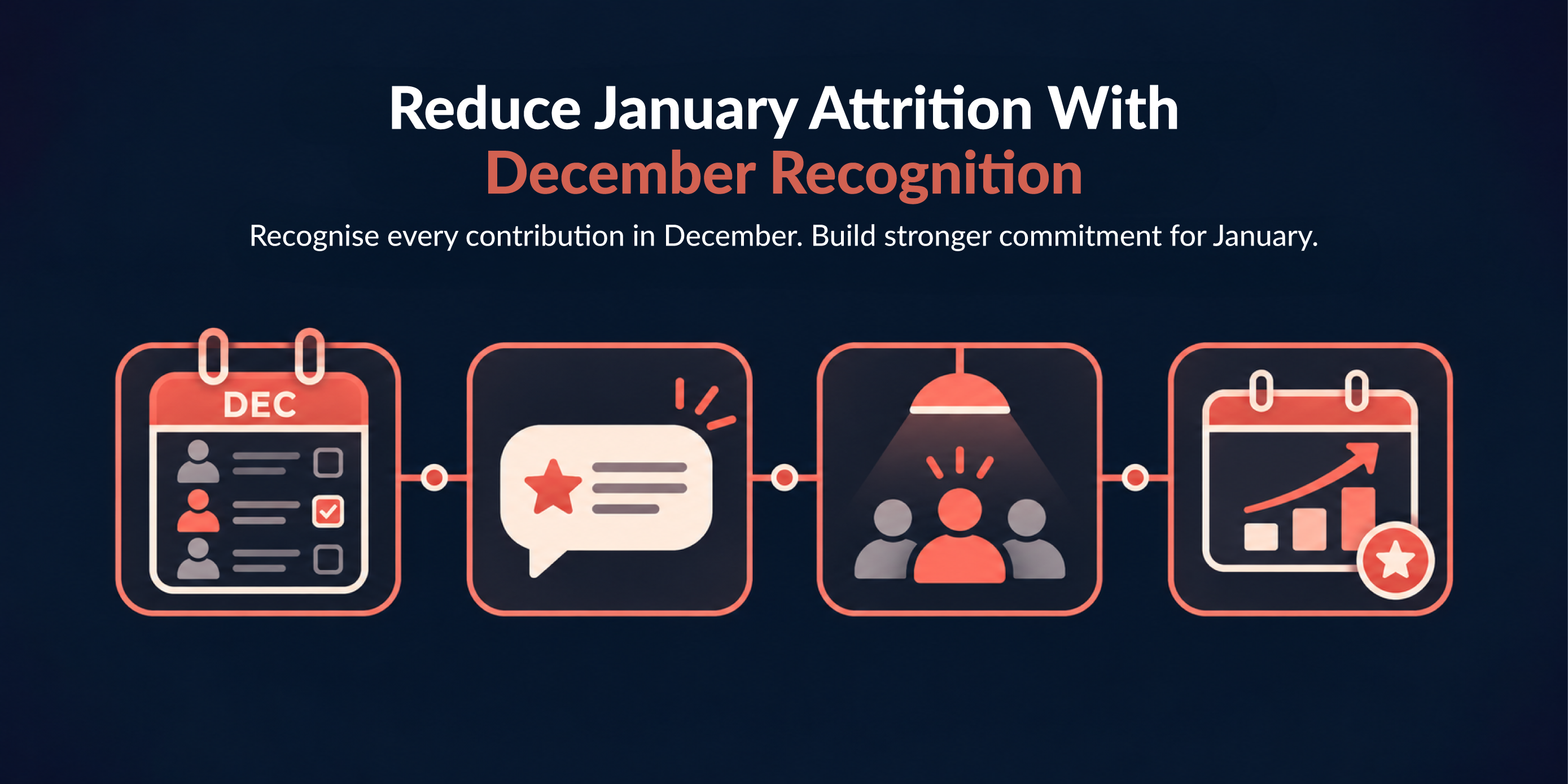
A four week December timeline you can use immediately
Treat this timeline as a working checklist. Each week has one focus and three actions. Block thirty minutes in your calendar for each week today.
Week one: build your recognition map
- List every person on your team and write down two specific contributions each of them made this year.
- Note who has been recognised openly in the last six months and who has not.
- Choose the three people whose work has gone most unnoticed, and plan to recognise them first.
Recent and visible work is easy to remember, while steady background work is easily missed. Writing the list down corrects that bias before you begin.
Week two: recognise specifically and openly
- Send each of those three people a written note that names the action, the result and the effect on the team.
- With their consent, share one contribution in a team meeting or team channel so that colleagues can see it.
- Ask each person how they prefer to be recognised, because preferences differ widely.
A written note can be reread, forwarded and remembered long after a spoken remark has faded, so make the written note the centre of this week.
Week three: look ahead together
- Hold a private conversation with each team member about what they would like to learn or lead next year.
- Connect your recognition to that ambition, for example by offering a stretch task or an introduction to a senior colleague.
- Write down one commitment you will keep in January and share it with the person.
This week connects appreciation to retention. It shows that you are thinking about the next year of each person's career and not only the year that has just ended.
Week four: close the year and set the rhythm
- Thank the whole team and name at least one contribution from every member, so that nobody is left out.
- Invite colleagues to add their own appreciation, so that recognition does not depend on you alone.
- Set a recurring monthly reminder so that the habit continues through January and beyond.
Peer appreciation also takes pressure off you. It shows the team that recognition belongs to everyone and that it is not a favour handed down from one person.
Many teams are thinly staffed in the last week of December. If that is true for you, complete weeks one to three before leave begins and hold the closing thanks in the first week of January.
A message you can adapt
Use this structure for a written note: name the action, state the result, say who benefited and add one sentence about the future.
Priya, you rebuilt the weekly reporting process in August, and the finance team has stopped chasing us for numbers since then. I would like you to lead the same review for the new vendor process next year.
How HR leaders can support managers
Share this timeline with people managers in the first days of December. Offer a short briefing on specific recognition, and check that every team has a plan before the festive break begins.
Ask each manager to share one recognition story at the first review meeting in January. That request signals that the habit continues after December and that leadership is watching for it.
Adjusting the plan for your team
Shift based teams, field teams and hybrid teams need different settings. Recognise people during a handover or a shift briefing, in a written message they can read later, or on a call where everyone joins.
The principle stays the same everywhere. Be specific about the work, make it visible in a way that suits the person, and connect it to what comes next.
Conversations that help reduce January attrition before it starts
Recognition opens the door, but a conversation keeps people in the room. Add three short questions to the December discussions you already plan to hold.
Choose a calm moment for these questions rather than the last minutes of a review meeting. People answer honestly when they do not feel rushed.
- What part of your work this year are you most proud of?
- What would you like to do more of next year?
- What one change would make this team a better place to work in January?
Listen without defending. Write down what you hear, and report back within a week on what you can change and what you cannot.
Never promise a promotion, increment or title that you do not control. An honest explanation of limits earns more respect than a vague yes.
If someone tells you they are considering a move, thank them for their candour and involve your HR partner early. Avoid making a hurried counter promise that you cannot keep.
Mistakes to avoid and signs that it is working
Watch for these five patterns, because each one can undo the effort you put into the timeline.
- Some managers praise effort in general terms, which leaves the person unsure what to repeat.
- Others save every thank you for a single end of year meeting, which makes it feel like a ritual.
- A few recognise the same two or three people each time, which can leave quieter contributors feeling invisible.
- Some managers expect everyone to enjoy public praise, although many people find it uncomfortable.
- A manager may recognise warmly in December and then fall silent in January, which weakens the whole effort.
These signs are observations rather than measurements, so treat them as prompts for further conversation.
- Colleagues begin to recognise one another without being asked.
- People refer to their own recognition when they discuss next year's goals.
- Team members volunteer for the stretch tasks you discussed.
- Quieter contributors start to share their work more openly.
Where a recognition platform can support the manager routine
A manual routine works well for a small team. As teams grow or spread across locations, managers often want one shared place to record recognition and reward it.
ApplaudIQ is the employee recognition and rewards platform from The Reward Store. Managers and peers use it to recognise employees and reward them.
The playbook above works with or without a platform. The habit matters more than the tool.
Frequently asked questions
How can managers reduce employee attrition in January?
Managers can lower resignations early in the year by recognising specific contributions in December, sharing that recognition openly where the person is comfortable, and holding a forward looking conversation about next year. Following through in January matters as much as the December effort.
Why do employees resign in January?
There is no single cause, and every organisation differs. Appraisal outcomes, bonus timing, a fresh look at career goals and a feeling of being unnoticed can each play a part. Asking your own team directly gives you more reliable answers than any general rule.
What should a manager say when recognising an employee?
Name the specific action, describe the result it produced and explain who benefited. Then add one sentence about what it means for the person's future in the team. Keep the tone sincere and avoid generic phrases such as great work.
Is public recognition better than private recognition?
Neither is always better. Public recognition shows the team what good work looks like, while private recognition suits people who dislike attention. Ask each person which they prefer, and use a mix across the team.
How often should managers recognise their team?
Regular recognition works better than a single annual moment. A sensible starting point is one specific note to someone each week, adjusted to the size of your team. Consistency matters more than the exact frequency.
Conclusion
December gives you four weeks to show each person that their work was seen and that their future is being considered. Start with the three people whose work has gone most unnoticed, and keep going into January.
Teams that wish to put this routine on a platform can see how managers and peers use ApplaudIQ to recognise and reward employees.
Sign up for our newsletter for trending top content!


