
How to Reduce Attrition During Appraisal Season: A Recognition Strategy for HR Leaders

Sign up for our newsletter for trending top content!
Employees who receive high-quality recognition are 45% less likely to leave their organisation over a two-year period, according to Gallup research. Yet appraisal season often concentrates performance ratings, pay decisions, promotion expectations and career conversations into a few emotionally charged weeks.
For HR leaders asking how to reduce employee attrition during appraisal season, compensation alone is rarely a complete answer. Employees also judge whether their contribution was visible, whether decisions were fair and whether the organisation still offers them a meaningful future.
This article explains how a structured recognition strategy can reduce post-appraisal attrition risk. It covers expectation gaps, perceived fairness, peer recognition, milestone awards and recognition data. The objective is practical: help HR leaders protect valuable talent before a disappointing appraisal outcome becomes a resignation.
Why Appraisal Season Is the Highest-Risk Period for Employee Attrition
Appraisal season brings several employment decisions into a single moment. Employees compare their rating, salary increase, bonus and promotion outcome against what they expected, what colleagues received and what they believe the external labour market may offer.
That concentration creates retention risk. SHRM identifies job satisfaction, organisational commitment and the employee's available alternatives as important factors in voluntary turnover. Gallup also reports that employees who do not feel adequately recognised are twice as likely to say they will leave within the next year. When an appraisal disappoints an employee who already feels overlooked, the review can become a trigger rather than the underlying cause.
HR leaders should therefore treat appraisal season as a retention window, not merely a performance-management deadline. The critical period begins before ratings are communicated and continues for several weeks afterwards.
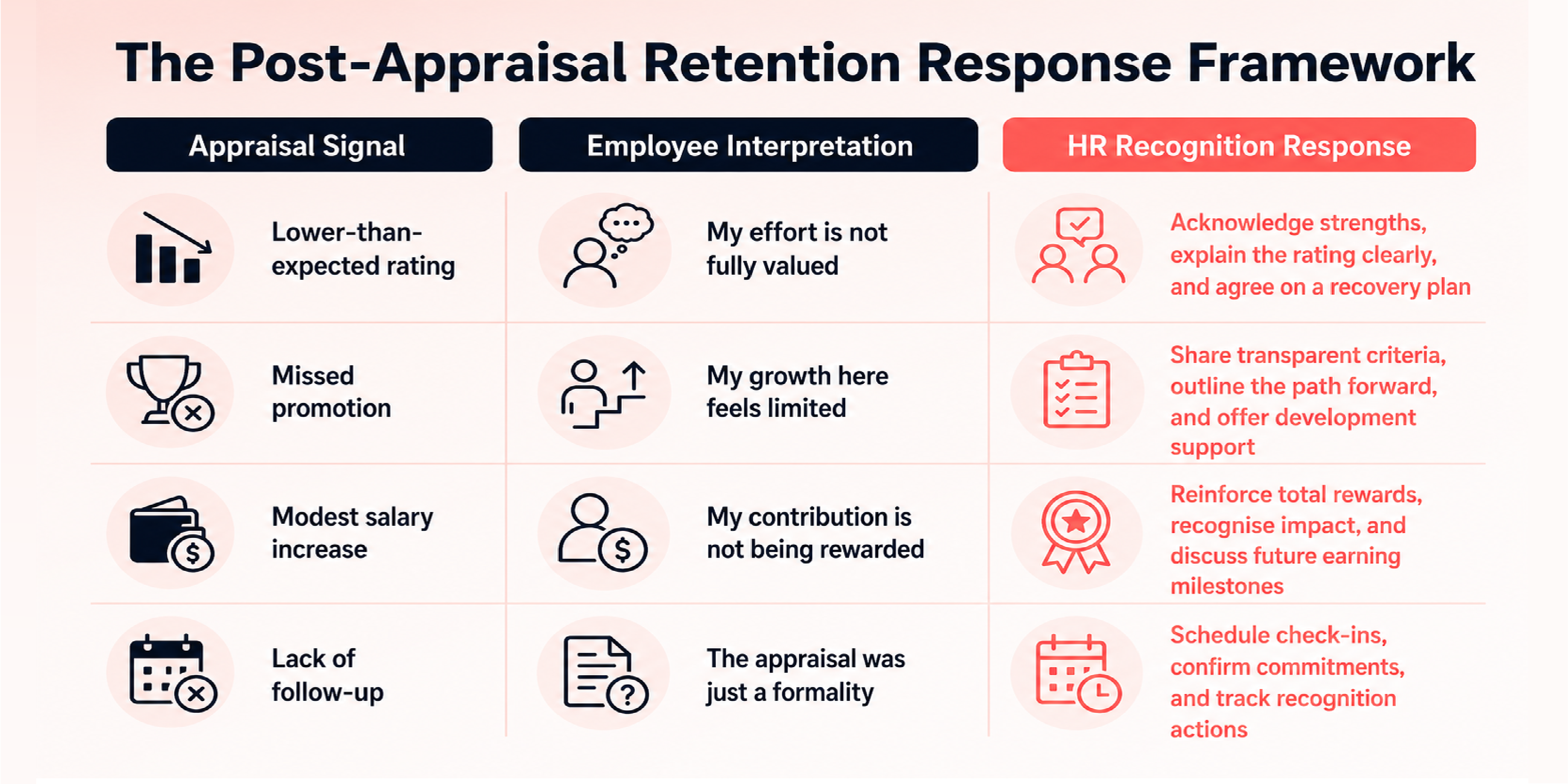
A useful risk model is:
Recognition cannot correct an unfair appraisal. It can, however, prevent a fair but disappointing outcome from being interpreted as organisational indifference.
The Expectation Gap: Why Appraisal Outcomes Trigger Departure Decisions Even When Ratings Are Fair
Employees experience appraisal outcomes through comparison, not through rating methodology alone. A technically defensible decision can still feel unfair when the employee expected a promotion, assumed strong performance would produce a larger increase or cannot see how the organisation reached its conclusion.
Mercer's analysis of merit processes illustrates why clarity matters. Its 2024 analysis found that nearly one-third of annual non-promotion-related pay changes were not connected directly to merit, with factors such as pay equity adjustments and other interventions influencing outcomes. Without clear communication, employees can easily interpret a complex compensation decision as a judgement on their individual value.
Deloitte's research on performance management also highlights the importance of identifying and reducing sources of bias. Fairness depends not only on the final rating but also on whether employees trust the process that produced it.
HR leaders can reduce the expectation gap by separating four conversations: performance, pay, promotion and recognition. They influence one another, but they do not mean the same thing.
An employee may perform strongly without receiving an immediate promotion because no suitable role exists. Another may receive a moderate salary increase because of budget constraints despite delivering valuable work. Recognition gives HR and managers a way to acknowledge contribution without making promises about compensation or progression.
The principle is simple: explain the outcome, recognise the contribution and define what happens next. When employees understand all three, disappointment has less room to become disengagement.
How Recognition Before, During, and After Appraisal Changes Employee Perception of Fairness
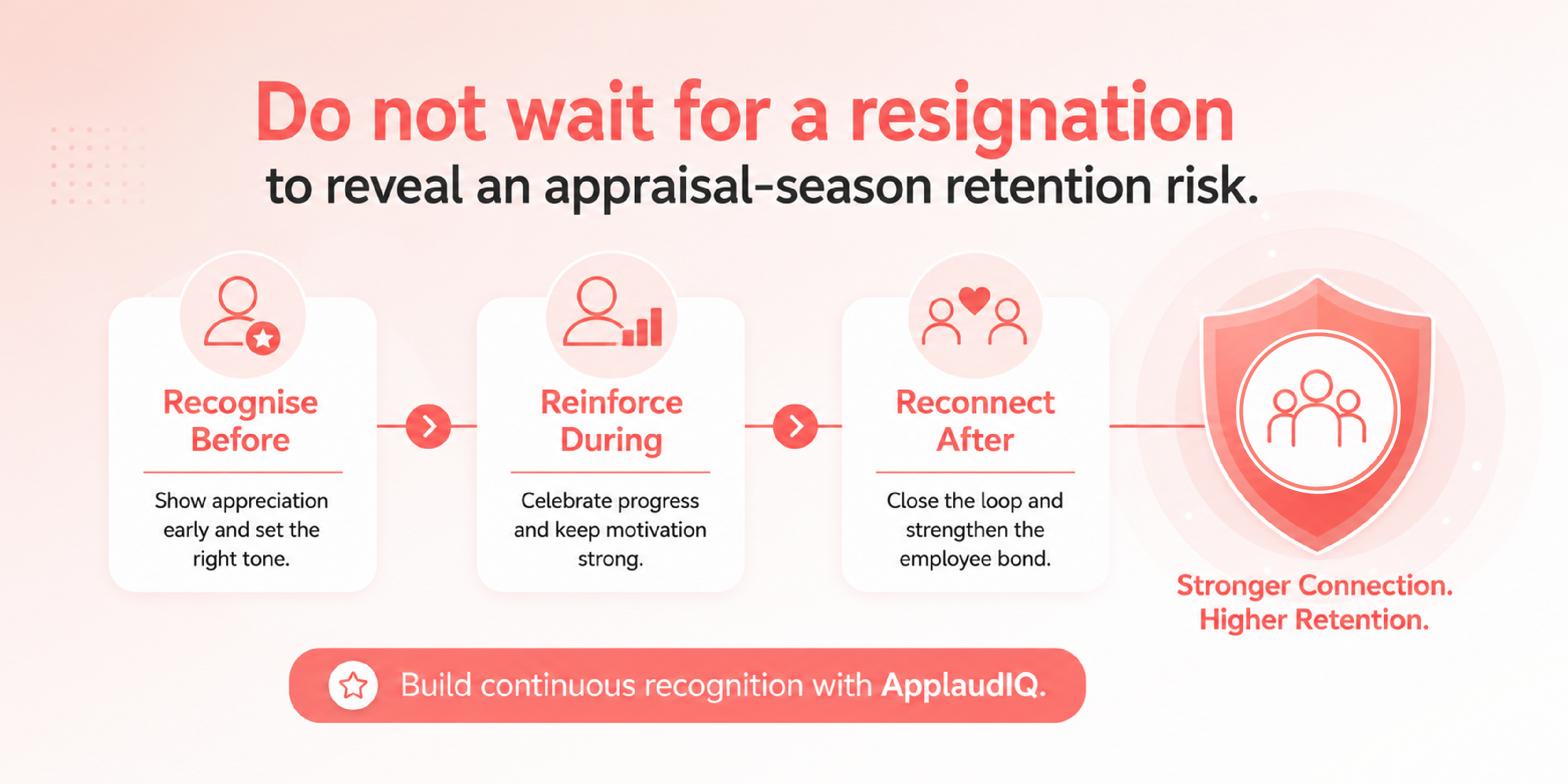
Recognition works best around appraisal season when HR treats it as a continuous employee experience rather than a consolation offered after disappointing news. Gallup's longitudinal research found that employees receiving high-quality recognition were 45% less likely to leave over two years. Deloitte also associates recognition with stronger engagement and lower turnover.
Before appraisal, managers should recognise meaningful contributions as they happen. This creates a visible record of performance and reduces dependence on recency bias when review discussions begin.
During appraisal, managers should connect recognition to specific achievements, behaviours and organisational values. A rating becomes easier to understand when the employee can see that their contribution has been noticed, even if the final outcome falls below expectations.
After appraisal, recognition should continue. Employees who miss a promotion or receive a smaller increase often watch subsequent management behaviour closely. Silence can reinforce disappointment. Timely recognition for new achievements signals that the appraisal was one decision point, not a permanent judgement.
This is where a structured system such as ApplaudIQ can help HR teams create consistency. Automated milestone recognition, peer-to-peer Cheers, manager-led awards, tiered rewards and a Wall of Appreciation can keep contribution visible throughout the year rather than concentrating appreciation around the annual review.
The objective is not to use rewards to distract employees from difficult outcomes. It is to build enough evidence of appreciation that one appraisal conversation does not define the entire employee experience.
Peer Recognition During Appraisal Season: Why Visibility From Colleagues Softens the Blow of a Missed Promotion
Managers see only part of an employee's contribution. This becomes particularly important in organisations where work crosses functions, geographies and reporting lines.
Deloitte has reported that 65% of work is organised around cross-functional, team-based structures. In these environments, a line manager may not directly observe the collaboration, problem-solving and informal leadership that colleagues experience every day. Peer recognition adds another source of evidence about contribution.
Gallup's recognition research also finds that employees who strongly agree they receive valuable performance feedback from people they work with are five times as likely to be engaged. This suggests that workplace validation carries greater weight when it comes from multiple credible sources rather than from one annual conversation.
Peer recognition becomes especially valuable when an employee misses a promotion. The promotion decision may remain unchanged, but visible appreciation from colleagues can counter the conclusion that the employee's work has gone unnoticed.
HR leaders should encourage recognition that is specific rather than generic. "Great job" has limited value. "Your support helped the team complete the client migration ahead of schedule" creates evidence of impact.
Platforms such as ApplaudIQ can make this contribution visible through peer-to-peer Cheers and a shared Wall of Appreciation. HR teams can also explore how recognition preferences differ across workforce groups in this guide to managing employee recognition across generations.
Peer recognition should complement managerial accountability, not replace it. The strongest appraisal experience combines formal evaluation with broader evidence of how an employee contributes to the organisation.
Milestone and Tenure Awards Around Appraisal Time: The Timing Effect on Retention
Timing changes the meaning of recognition. An anniversary message delivered months late feels administrative. Recognition delivered close to a meaningful contribution or career milestone feels connected to the employee's actual experience.
O.C. Tanner's recognition guidance recommends recognising employees early and often and integrating appreciation throughout the employee experience. Deloitte similarly argues that intentional, consistent recognition can strengthen workforce resilience during periods of workplace pressure.
Appraisal season gives HR leaders an opportunity to coordinate recognition with employee milestones, but the two processes should remain distinct. A tenure award should celebrate the employee's relationship with the organisation. A performance award should acknowledge contribution. An appraisal should evaluate results and development. Combining everything into one transaction weakens the meaning of each.
The timing principle is particularly important for employees receiving disappointing appraisal outcomes. If a work anniversary falls near the review cycle, recognising it properly can reinforce a longer narrative: "Your contribution here matters", rather than allowing one rating to dominate the employee's perception of their career.
HR teams can automate milestone recognition while retaining personalisation. ApplaudIQ, for example, supports automated milestone rewards and access to a global catalogue that includes gift cards from 5,000+ brands, flight bookings, hotel bookings, dining vouchers and experiential rewards.
HR leaders should not use milestone rewards to compensate for unclear appraisal decisions. Instead, they should ensure that employees receive the right recognition for the right reason, at the right moment. For additional appraisal-focused practices, see The Reward Store's guide to keeping employees engaged during appraisal time.
How to Use Recognition Data to Identify Employees Likely to Leave Post-Appraisal: Before They Do
Recognition data can act as an early-warning signal when HR analyses patterns rather than individual events. SHRM reports that organisations already use people analytics most frequently for employee retention and turnover, at 82%, showing how central predictive workforce insight has become to HR decision-making.
The most useful approach combines recognition activity with other authorised workforce indicators. HR teams can monitor employees who received a disappointing appraisal outcome alongside signals such as declining recognition frequency, reduced peer interaction, falling participation in recognition activity, missed milestones or sudden changes in engagement.
No single signal proves that an employee intends to leave. HR should therefore use recognition data to prioritise human conversations, not to label employees as flight risks.
A practical framework is to ask three questions:
- Visibility: Has this employee's contribution been recognised consistently during the past six to twelve months?
- Change: Has their recognition activity or participation declined noticeably after appraisal?
- Context: Did the employee also receive a lower-than-expected rating, miss a promotion or raise concerns about career progression?
When multiple signals appear together, managers can intervene with a career conversation, clearer feedback or appropriate recognition before disengagement deepens.
Gallup's findings strengthen the case for this approach. Well-recognised employees show substantially lower turnover, while employees who receive valuable feedback from colleagues show markedly stronger engagement. Recognition data therefore offers HR more than a record of rewards distributed. Used responsibly and in context, it can reveal where the employee experience may be weakening before resignation data confirms the problem.
Frequently Asked Questions
What is the best way to reduce employee attrition during appraisal season?
Start before appraisal results are announced. Maintain continuous recognition, communicate performance criteria clearly, separate pay and promotion decisions from acknowledgement of contribution, and schedule post-appraisal career conversations for employees with disappointing outcomes. Gallup's research indicates that high-quality recognition has a measurable relationship with lower employee turnover.
How does employee recognition reduce post-appraisal attrition?
Recognition helps employees see that the organisation notices and values their contribution, even when a specific rating, salary increase or promotion does not meet expectations. Gallup found that employees who do not feel adequately recognised are twice as likely to say they intend to quit within the following year. Recognition works best when it remains specific, timely and continuous rather than appearing only after a difficult appraisal.
Why do employees resign after receiving a fair appraisal?
Employees judge fairness through expectations, comparison, communication and trust, not solely through formal rating criteria. A fair decision can still trigger dissatisfaction when an employee expected a different outcome or cannot understand how management reached it. Deloitte's work on performance-management bias reinforces the importance of transparent processes and credible decision-making.
When should HR increase recognition around appraisal season?
HR should strengthen recognition before, during and after the appraisal cycle. Before the review, recognition creates an evidence trail of contribution. During and after the review, it reinforces visibility and helps employees understand that one appraisal outcome does not erase their broader value to the organisation.
Can ApplaudIQ help HR teams reduce appraisal-season attrition?
ApplaudIQ helps HR teams create structured, continuous recognition through peer-to-peer Cheers, milestone automation, manager-led awards, tiered rewards, leaderboards and a Wall of Appreciation. Integrations with HRMS and workplace collaboration systems can help organisations embed recognition into existing employee workflows. This gives HR a more consistent way to recognise contribution throughout the year rather than relying on appraisal conversations alone.
Conclusion
Appraisal-season attrition rarely begins on the day an employee receives a disappointing rating. It develops when unmet expectations combine with weak recognition, unclear communication and uncertainty about future growth. HR leaders can reduce that risk by making recognition continuous, specific and visible before, during and after reviews.
As performance management moves towards continuous feedback and richer people analytics, recognition data will become increasingly valuable in identifying retention risks earlier. The next step is to connect recognition with the moments when employees are deciding whether their future still belongs with the organisation.
See how ApplaudIQ helps HR leaders reduce post-appraisal attrition. Build a recognition strategy that keeps valuable employees connected before and after appraisal season.
Sign up for our newsletter for trending top content!


