
How to Spot Employees Who Are Likely to Resign Using Recognition Data

Sign up for our newsletter for trending top content!
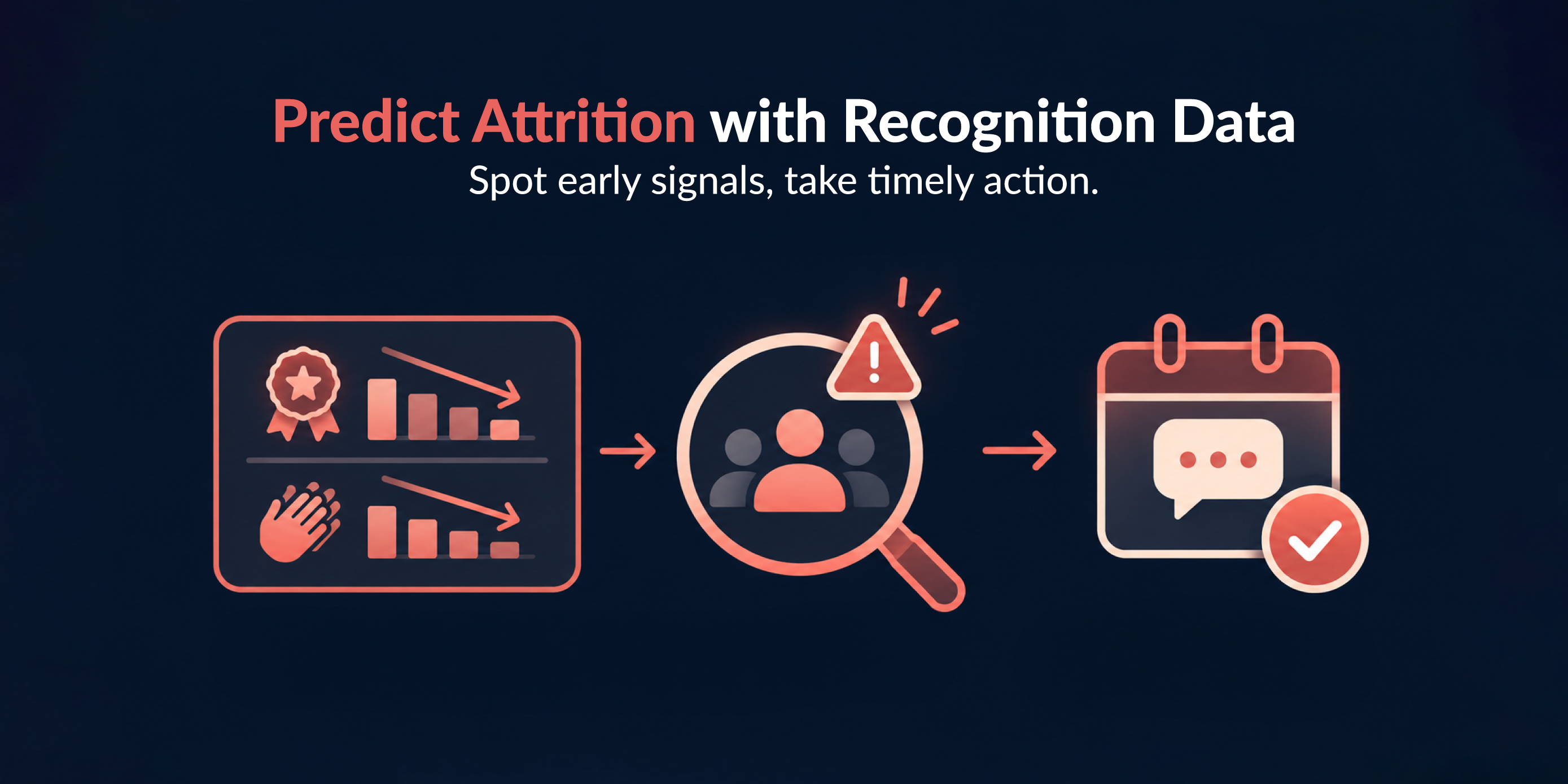
You can predict employee resignation risk by tracking how much recognition each person receives and gives over time. A sustained fall in either, especially both together, often signals disengagement before a resignation arrives. Treat the pattern as a prompt for a conversation, not as a verdict.
Consider an illustrative scenario. A senior analyst on a Bengaluru team thanks colleagues regularly and is thanked in return. Over one quarter, both streams of appreciation fade quietly. Nobody notices until the resignation email arrives.
Most HR teams review attrition after it happens. Recognition data offers an earlier view, because the way people give and receive appreciation often shifts as their engagement shifts.
This article is written for HR analytics professionals and HR business partners in India. It explains which recognition signals to track, how to review them, and how to act without damaging trust.
Why Recognition Activity Changes Before People Resign
Recognition is a small and frequent behaviour, which makes it sensitive to change. Annual surveys capture sentiment once a year, while recognition activity records how people behave week after week.
When an employee starts to disengage, two things often happen quietly. They stop noticing and celebrating the work of others, and the people around them stop noticing theirs.
Neither change is dramatic. A person who gives fewer thanks rarely announces it, and a manager who forgets to recognise someone rarely realises that it has happened.
Consider the two directions separately. Recognition received reflects how others see the employee, while recognition given reflects how the employee sees others. Each tells a different story.
That quiet quality is exactly why the data is useful. Behavioural traces can appear before formal signals such as notice periods, low engagement scores or visible frustration.
A sudden change is rarely the only clue. More often the data shows a gradual slope over several weeks, which is why trends matter more than single data points.
Distributed teams add a further reason to watch closely. When colleagues work across offices, cities and shifts, a manager cannot easily see how appreciation flows without data to guide them.
None of this proves that someone will leave. It shows where attention is most needed, and attention is often what an employee has been missing.
Four Recognition Signals Worth Tracking for Every Employee
Each signal below compares a person with their own earlier pattern, not with a company average. Individual baselines matter because some people are naturally quieter than others.
Signal one is a decline in recognition received. If an employee receives noticeably less appreciation than in previous months, ask whether their contribution has become less visible or less valued.
Signal two is a decline in recognition given. A person who stops thanking peers may be withdrawing from team life, which can come before withdrawing from the organisation.
Signal three is a gap between the two. An employee who still gives recognition but receives none may feel unseen, while one who receives it but gives none may feel detached.
Signal four is a narrowing of source. If recognition once came from several peers and managers and now comes from only one person, the employee may be losing connection with the wider team.
Each signal also has a healthy opposite. A rise in recognition given, or a wider circle of people recognising the employee, is a useful sign that engagement is holding steady.
Taken together, the four signals describe direction rather than level. A steady and quiet employee is very different from a previously active one who has gone silent.
Add context before drawing conclusions. Leave, project cycles, quarter end pressure and festive periods across Indian workplaces can all reduce recognition activity without any link to an intention to resign.
A Four Stage Timeline for Reviewing the Signals
Use this timeline as a starting point, and adjust the windows after you compare the pattern with your own exits. The windows below are suggestions, not validated thresholds.
Stage one is the baseline, in weeks one to four. Record how much recognition each person gives and receives, and from how many different people, so that every employee has a personal reference point.
You only need simple counts to begin. Track recognitions given, recognitions received and the number of distinct people on each side, for each employee, by week.
Keep the first version simple. A spreadsheet with weekly counts and a short notes column is enough to test whether the method fits your organisation before you invest in anything larger.
Stage two is the flag, in weeks five to eight. Mark any employee whose given or received recognition has fallen clearly below their own baseline for a sustained period, rather than for one week.
Stage three is the context check, in weeks nine and ten. The HR business partner reviews flagged names with the manager, looking for leave, role changes, workload spikes or recent disagreements that explain the change.
Stage four is the check in, in weeks eleven and twelve. The manager holds a supportive conversation with each employee whose pattern remains unexplained, and records what was learned.
Assign ownership clearly. HR analytics prepares the list, the HR business partner provides context, and the line manager holds the conversation.
Document each outcome, including flags that turned out to be harmless. Those cases teach you which patterns to ignore, and they protect employees from being watched more closely than necessary.
Repeat the cycle every quarter. Over time, compare flagged employees with actual exits, so that your thresholds improve using your own evidence.
Be careful with small teams. In a team of only a few people, one absent colleague can change the numbers sharply, so judge trends across several weeks.
Can Recognition Data Predict Employee Resignation Reliably?
Not on its own, and it is worth being honest about that. Recognition data raises the probability that something has changed, but it cannot reveal the reason or guarantee an outcome.
Some employees leave without any change in recognition, and some go quiet and stay for years. Treat every flag as a hypothesis to test, not as a prediction to act on.
Combine recognition patterns with other signals you already hold, such as engagement survey comments, internal mobility requests and exit interview themes. Agreement between sources is more persuasive than any single source.
Fairness also matters. Review the data for bias, for example whether some teams, locations or roles receive less recognition because of how managers behave rather than how people perform.
Treat the data as sensitive from the first day. Recognition records describe relationships between named people, so restrict dashboards and exports, and avoid sharing individual names beyond the small group that acts on them.
Be open with employees about what is analysed and why. Share the purpose, limit access to people who need it, and follow the data protection obligations that apply to your organisation.
Never use a flag in performance decisions or disciplinary action. The purpose is early support, and using it against people would end the honest recognition on which the data depends.
Turning Early Signals Into Retention Conversations
A flag is only useful if it leads to a good conversation. Managers should ask open questions about workload, growth and how valued the person feels, and then listen without defending.
Start with the person, not the data. Saying that you noticed they seem less involved is gentler and more effective than saying that a dashboard flagged them.
A manager might open by saying that they value the contribution of the employee and would like to hear how the work is going. Specific words matter more than polished ones.
Then act on what you hear. That may mean adjusting workload, clarifying a growth path or simply recognising work that has gone unnoticed.
Follow up visibly. After the conversation, agree one or two actions with the employee, note a date to revisit them, and check whether recognition patterns recover over the following weeks.
Recovery is not guaranteed, and that is acceptable. Some employees will still choose to move on, but a respectful conversation leaves the relationship in better shape either way.
Recognition itself is also part of the response. Specific and timely appreciation from a manager or peer tells an employee that their work is seen, which can address one possible cause of disengagement.
Consistent recognition needs a consistent place to happen. ApplaudIQ is the employee recognition and rewards platform from The Reward Store, where managers and peers recognise employees and reward them.
Whatever tool you use, make recognition easy and visible for both managers and peers, because the quality of your signals depends on the amount of honest recognition behind them.
Frequently Asked Questions
Can recognition data really show who is about to resign?
It can show who may be disengaging, which is an earlier and more useful question. A sustained fall in recognition given or received is a warning sign, not proof, so confirm it through a conversation and other evidence.
What are the early warning signs that an employee is about to quit?
Common signs include withdrawing from team conversations, giving and receiving less appreciation, skipping optional events and showing less initiative. Any single sign is weak, so look for several signs persisting together over time.
How often should HR review employee recognition data?
A monthly look at trends and a quarterly review of flagged individuals suits many teams. Reviewing weekly invites noise, while reviewing once a year misses the early window that makes these signals valuable.
Is it ethical to monitor employee recognition activity?
It can be, provided you are transparent, limit access and use the insight only to offer support. Employees should know what is analysed and why, and the data should never feed disciplinary decisions.
What should a manager do when recognition drops for a team member?
Start with a private and supportive conversation rather than an accusation. Ask about workload and growth, listen carefully, then recognise their recent work specifically and follow up within a few weeks.
Conclusion
Recognition data cannot read minds, but it can show when someone has stopped being seen or has stopped seeing others. Those changes are small, early and easy to miss without a method.
Set personal baselines, watch four signals, review on a steady cycle and treat every flag as the start of a conversation. That approach gives HR teams time to act before a resignation is final.
To see how ApplaudIQ lets managers and peers recognise and reward employees, Book a Demo.
Sign up for our newsletter for trending top content!


