
New Year Office Merchandise: How to Plan, Brand and Deliver Before January

Sign up for our newsletter for trending top content!
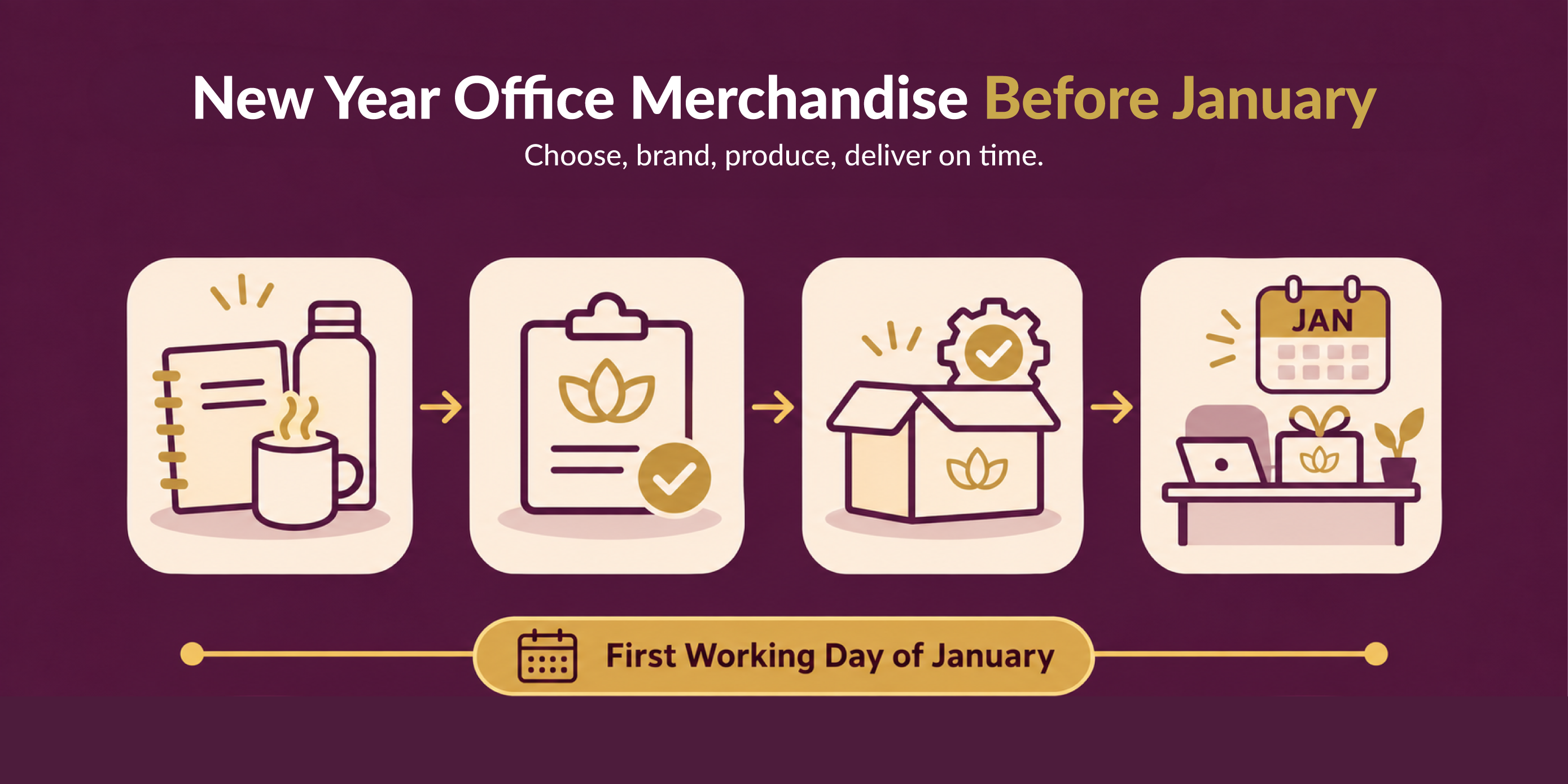
Plan new year office merchandise by working backwards from the first working day of January. Choose useful items early, approve branded artwork before production, order samples, confirm lead times in writing, and schedule delivery to every location with a buffer so that every employee finds their item on the desk.
This guide is for HR and admin heads in India who plan staff gifts for the start of the year. It ends with a timeline that you can use today.
Why new year office merchandise needs an early start
The first working day of January is a fixed date, and every other task in your plan depends on it. Merchandise that arrives after the first week feels like an afterthought rather than a welcome.
Year end is also a demanding period for suppliers, couriers and your own colleagues. Production slots can fill quickly, approvals slow down when leaders are on leave, and small delays compound across the schedule.
Consider an illustrative scenario. An HR head with 300 employees across two offices plans a desk item for the first working day, but artwork approval stalls while two senior leaders are away.
That single delay pushes production, dispatch and delivery back as well. The gifts then reach desks after the year has already begun, and the gesture loses its timing.
The lesson is that an approval delay never stays small. Every later step is scheduled behind it, which is why this plan begins with the end date and moves backwards.
Define success before you begin. For most offices it means every employee, in every location, receives a correctly branded item on or before the first working day, with no errors and no complaints.
Choose items that employees will actually use
Start with the purpose of the gift. A welcome for the new year, a thank you for the year that has passed and a team identity item each call for a different kind of object.
Set a budget for each person before you shortlist anything, and keep a small reserve for late joiners and replacements. A clear limit keeps the shortlist realistic and speeds up approval.
Practical items usually earn a place on the desk. Notebooks, planners, desk organisers, bottles and mugs are familiar choices because employees can use them on every working day.
Apply these four checks before you shortlist any item.
- Check usefulness by asking whether an employee would use the item within the first week.
- Check durability by asking whether the item will still look good after months of daily use.
- Check fit by asking whether the item suits every role, age group and working pattern in your organisation.
- Check transport by asking whether the item can be packed safely for delivery to several cities.
Be careful with items that depend on size or personal taste. Clothing needs accurate sizes from every employee, and scented or food products can exclude colleagues with different cultural or dietary preferences.
Include hybrid and remote colleagues from the start. Their items need a delivery address, a contact number and a delivery window, and collecting these details takes longer than most teams expect.
Request a physical sample of your preferred item. Photographs can hide weak stitching, uneven colour and poor packaging, and a sample protects you from a wrong bulk order.
Brand the merchandise without delaying production
Branding should make the item feel considered rather than crowded. A small logo, a single colour and a short line of text usually reproduce well on most materials.
Keep the message simple. A short new year greeting or the company name reads as warm, whereas a long slogan can look like advertising rather than appreciation.
Collect the final artwork before you contact suppliers. Ask your brand team for the logo in vector format, the approved colour references and any rules about spacing and background.
Different methods suit different materials. Screen printing, embossing, laser engraving and embroidery each have limits on detail, colour count and surface type, so ask every supplier which method it recommends.
Check colour accuracy with a printed swatch. Colours on a screen often differ from colours on fabric, paper or metal, so approve the colour on the actual material.
Ask whether the supplier can reproduce your logo clearly at the size of the item. A fine detail that looks sharp on a presentation can disappear on a small bottle or pen.
Approve a digital proof and, wherever possible, a physical sample before bulk production begins. Record the approval in writing, together with the name of the person who signed it off.
Appoint a single approver for artwork. When several leaders each request a small change, the artwork cycle repeats for every request, and the delivery date moves with it.
If you plan to personalise items with employee names, collect and verify the spellings early. One data file, checked by HR, prevents reprints and awkward errors.
Plan production lead times with a backward timeline
Lead time is the total time from a confirmed order to goods in your hands. It includes artwork approval, sampling, production, quality checks, packing and transit.
Lead times differ by item, branding method and quantity, so this guide does not quote a standard figure. Ask every supplier for a written schedule, and ask what happens if a step slips.
Ask every shortlisted supplier the following questions before you place an order.
- What is the written lead time for my item, branding method and quantity?
- Will you provide a digital proof and a physical sample before bulk production?
- What happens to the schedule if I request a change after approval?
- How will you pack, label and ship items to several locations?
- Who is my named contact if something goes wrong during production?
Keep the written answers in one shared folder. If a delay occurs, you will know which commitment was missed and can decide quickly whether to switch suppliers or adjust the plan.
Use the timeline below as a planning template. Each step is counted back from the first working day of January, and you should adjust the gaps to match the written commitments of your suppliers.
- Eight weeks before the first working day, confirm the purpose, the headcount and every delivery location.
- Seven weeks before, shortlist items and request samples from at least two suppliers.
- Six weeks before, approve one item, one sample and the final artwork in writing.
- Five weeks before, place the order and obtain a written production and dispatch schedule.
- Three weeks before, review a finished sample or quality report and approve dispatch.
- Two weeks before, confirm delivery addresses, courier details, receiving contacts and a buffer of working days.
Production runs between steps four and five in this template. Use that period to monitor progress, answer supplier queries quickly and prepare your delivery sheet.
If fewer than eight weeks remain, keep every step but decide faster. Never remove the sample or the proof approval, because correcting an error after production takes longer than reviewing a proof.
Plan delivery so every desk is covered
Decide first whether items will go to each office, to a central point or to home addresses. Each route has a different transit time, a different risk of loss and a different workload for your team.
Prepare a delivery sheet with the name, location, address, contact number and receiving hours for every recipient. Check it against HR records, because addresses change after transfers and new joinings.
Split large orders by location and ask each supplier to label cartons by city and floor. Clear labels allow your admin team to distribute items quickly on the day.
Allow a buffer of working days before the first working day. Courier networks can be busy at year end, and regional holidays in January can slow deliveries in some cities.
Choose a delivery date that lets you inspect the cartons before distribution. Count the units, open a few boxes and photograph any damage on the day of receipt so that any claim is supported.
Plan a simple distribution routine for the first working day. Assign one person to each floor or location, keep a signed handover list and hold spare items for late joiners.
Remember colleagues who are on leave or travelling that day. Store their items safely and send a short message so that nobody feels overlooked.
Tell employees in advance that something is coming. A short message on the last working day of December builds anticipation, and it reminds colleagues to update their address details.
After distribution, note what worked. Record the issues, the supplier performance and any employee feedback, so that the plan for next year starts with real information.
Frequently asked questions
When should an office order merchandise for the new year in India?
Begin planning about eight weeks before the first working day of January. Confirm items, approve artwork and place the order early enough to allow sampling, production and delivery with a buffer. Ask suppliers for written lead times.
What are good corporate gifts for employees at the start of the year?
Practical items such as notebooks, planners, desk organisers, bottles and mugs suit most offices because employees use them daily. Match the item to your purpose, workforce and locations, and confirm a physical sample before ordering in bulk.
How long does branded merchandise take to produce?
The time depends on the item, the branding method and the quantity, so no single figure applies. Ask each supplier for a written schedule covering approval, production, quality checks and dispatch, and add a buffer beyond it.
How do I deliver gifts to employees in several cities?
Prepare one delivery sheet with names, addresses and contact numbers, then split the order by location and ask for labelled cartons. Decide early between office and home delivery, and confirm receiving hours with a local contact.
Where can I find curated gift boxes from Indian brands for staff and clients?
Cherishd, the physical gifting product of The Reward Store, offers curated gifts and gift boxes from 500+ Indian brands for employee, client and partner gifting. Compare any option against your purpose, locations and timeline before you decide.
Start early and let the timeline lead
New year merchandise works best when the plan begins with the first working day and moves backwards. Item choice, branding approvals, lead times and delivery sit on one timeline, and each step needs a named owner.
If you are considering curated gifts for employees, clients or partners, Cherishd is one option to evaluate. Book a Demo to talk through your gifting plans.
Sign up for our newsletter for trending top content!


