
Fresh Start Merchandise: Building a New Year Kit Employees Will Use

Sign up for our newsletter for trending top content!
A new year employee kit gets used when every item solves a recurring problem in the working day, connects clearly to a company goal and arrives when it is relevant. Ask employees what they need, choose fewer and better items, and test each one before ordering.
Picture an illustrative scenario. An HR team shares new kits in early January. By March, one employee still carries the bottle every day, while the desk ornament from the same box sits forgotten in a drawer.
The difference rarely comes down to enthusiasm on the day. It comes down to whether each item has a job. This guide helps HR and internal communications teams in India give every item one.
Why do so many new year kits end up in drawers?
Kits often fail because they are designed around the unboxing moment. A box can look impressive in a launch photograph and still offer very little to the person who has to find space for it.
Another common cause is duplication. Many employees already own a mug, a diary and a bag. A new version has to be noticeably better or more useful before it replaces the one they already trust.
Poor fit also matters. Apparel in the wrong size, accessories that do not suit a device and edible items that ignore dietary preferences can leave people with something they cannot comfortably use.
Branding can create a quieter problem. A very large logo or a dated campaign slogan may turn a practical object into something an employee hesitates to carry outside the office.
Finally, timing and context are easy to miss. When a box arrives without explanation, or long after the annual kickoff, employees may see it as leftover merchandise rather than the start of something.
Which items in a new year employee kit earn daily use?
No item suits every workforce. The strongest candidates support habits that already exist, so start by mapping a normal day for office, hybrid, remote, field and shift employees before you open any catalogue.
Choose drinkware that suits the commute and the desk.
A reusable bottle or insulated tumbler can serve people throughout the day. Check that the lid seals well, the size fits a bag and the inside is easy to clean.
Climate varies widely across India. Employees who travel in summer heat may value a bottle that keeps water cool, while office teams in colder locations may prefer a tumbler that keeps tea warm.
Give people a notebook they can plan with.
A notebook earns its place when people enjoy writing in it. Look for paper that resists bleeding, a binding that opens flat and pages that are not crowded with company messages.
Undated pages are a sensible choice because they remain useful whenever work begins. A short goals page at the front can add relevance without turning the whole notebook into a corporate manual.
Remove small daily frustrations with desk and technology accessories.
Cable organisers, laptop stands, phone holders and charging accessories can remove everyday irritations. Confirm compatibility with the devices people use, and involve your information technology and safety teams before choosing anything electrical.
Treat bags and apparel with extra care.
A well made backpack can help commuting and hybrid employees. Prioritise comfortable straps, sensible compartments and weather protection, particularly for people who travel during the monsoon.
Clothing needs accurate sizing, comfortable fabric and a design people would happily wear. Offer a size chart, allow exchanges where your supplier permits them and consider an alternative for anyone who prefers not to receive apparel.
Be selective with food, decorative pieces and novelty items.
Snacks can add warmth to a launch, although they are consumed quickly. Check ingredients, allergens, shelf life and dietary preferences. Decorative and novelty items should pass the same usefulness test as everything else.
How can you link the kit to company goals for the year?
Begin with no more than three priorities that employees can influence. A kit cannot explain an entire strategy, and a crowded insert card is likely to be read quickly and then set aside.
Check your planning calendar too. Many Indian organisations set goals for a financial year that begins in April. A January kit can therefore support a final quarter push or preview the priorities ahead.
For each priority, name a behaviour and then choose an item that supports it. This creates a clear chain from goal to action, and it stops teams from forcing a theme onto unrelated merchandise.
Consider these illustrative pairings:
- If the goal is sharper customer focus, a notebook can include a weekly prompt that asks what a customer needed and what the team changed.
- If the goal is continuous learning, a learning journal can sit alongside time that managers protect for study.
- If the goal is healthier working routines, a bottle can accompany meeting norms that include proper breaks.
- If the goal is better collaboration, a set of planning cards can help teams agree owners and next steps during shared sessions.
The object is only a cue. A learning journal means little when nobody has time to learn, so every pairing needs a matching action from leaders and managers.
Internal communications teams can add a short card that names the goal, explains why it matters and suggests one first step. Write it in plain language that works across roles and locations.
Managers can then bring the goal into an early team meeting. Invite people to describe how it affects their own work, which turns a company message into a practical conversation.
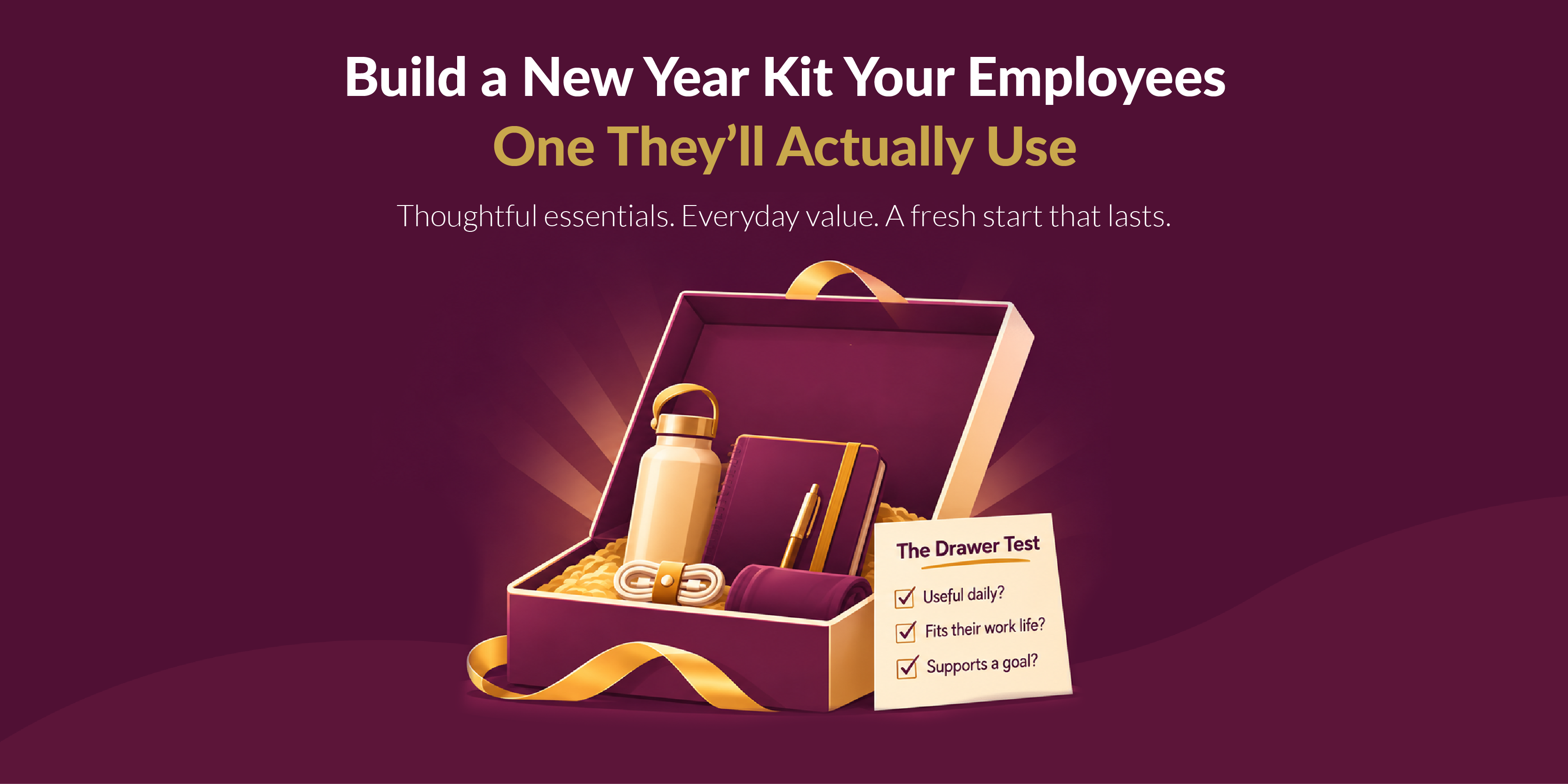
Run the Drawer Test before you approve any item.
The Drawer Test is a simple checklist for your shortlist. Gather samples, invite a small mix of employees from different roles and ask these questions about each item:
- Would most recipients use this item at least once a week?
- Does it solve a problem that employees have actually described?
- Does it suit the places and conditions in which recipients work?
- Is the quality good enough that you would happily choose this item for yourself?
- Can you explain in one sentence why it belongs in this particular kit?
Give one point for every confident yes. Keep items that score four or five, redesign or retest items that score three, and remove anything that scores two or lower.
Treat a clear safety, accessibility or dietary concern as an immediate stop, whatever the total score. A popular item still fails if some recipients cannot use it safely or comfortably.
For illustration, a sturdy bottle might score five for a commuting team. A branded desk ornament might score only one because its purpose is easy to explain but its usefulness is difficult to show.
Next, test the box as a whole. Remove any item that repeats another item's job. A smaller kit with a clear purpose is usually easier to explain, carry and store than a crowded one.
Record why each item survived. These notes help HR answer questions, give internal communications a ready story and provide a useful starting point when the next kit is planned.
Plan the rollout backwards from the day employees open the box.
Choose the opening date first, then work backwards. Confirm every lead time with your supplier, and leave room for sample approval, corrections, public holidays and deliveries to employees outside your main offices.
Complete these checks before sourcing.
- Ask employees which items they use, which they already own and which they would rather avoid.
- Confirm your priorities, recipient groups, ownership and approval process.
- Decide where employees may choose between options.
Complete these checks before ordering.
- Apply the Drawer Test to physical samples.
- Check logo size, print quality, packaging strength and replacement terms.
- Reduce unnecessary packaging and ask suppliers what materials they use.
Complete these checks before dispatch.
- Verify sizes, addresses and contact details, and collect only the personal information that delivery requires.
- Give employees a named contact for damaged, missing or unsuitable items.
- Prepare manager notes and an announcement that explains the purpose of the kit.
Follow through after employees receive the box.
Run a short pulse check after people have had time to use the items. Ask what they still use, what they have stopped using and why. Offer anonymous responses where possible.
Compare answers by work pattern and location. A laptop stand may delight remote employees while offering little to field teams, which suggests that a shared core with relevant options could work better next time.
What do people ask about new year kits for employees?
What should a new year employee kit include?
Include a few useful items that fit your employees’ routines, such as drinkware, a notebook or a practical bag. Add a short note that connects the contents to a company goal.
How do you make employee kits useful?
Ask employees about their daily problems, shortlist items that solve them and test physical samples. Remove duplicates, offer choice where preferences differ and gather feedback after people have used the kit.
How can a new year kit support company goals?
Select a small number of priorities, define one behaviour for each and choose items that prompt it. Managers should then discuss the behaviour and give employees the time or support required.
Should remote employees receive the same new year kit?
Remote employees should receive an equally thoughtful kit, although the contents may differ. Keep a shared core, adapt items to working conditions and verify delivery details early so that nobody feels like an afterthought.
When should HR start planning new year kits?
Start before the festive period becomes busy. Work backwards from your opening date and confirm supplier lead times, allowing room for employee feedback, sample approval, address checks, delivery and replacements.
Where should your team start this year?
Start with the working day, then choose the box. Listen to employees, link each item to a meaningful action and apply the Drawer Test before approval. After delivery, learn from what people keep using.
If curated gifting would help your team, Cherishd is the physical gifting product of The Reward Store. It offers curated gifts and gift boxes from 500+ Indian brands for employee, client and partner gifting.
To discuss your gifting plans, Book a Demo.
Get our latest articles in your inbox
Latest articles

The Reward Store is a rewards infrastructure company headquartered in Bengaluru, India, and part of the Vananam Group. It helps businesses run employee recognition, channel partner incentives, customer loyalty, gift card issuance, voucher programmes and corporate gifting from one connected platform, through ApplaudIQ, Rekyndl, Paytives, RedeemStack, Orchestro and Reward Factory.


