
How Can Sales Leaders Migrate Manual Incentives to Automation Without Disrupting Partners?

Sign up for our newsletter for trending top content!
Introduction
The Incentive Research Foundation reports that non-cash channel programmes are used by 43% of businesses, and selected case studies have shown total revenue increases of 32%, market share gains of 30% and net operating income rising to 19% of revenue. Those outcomes depend on incentive design and execution discipline, both of which become difficult when sales teams run partner incentives through spreadsheets, email approvals and manual payout files.
For sales leaders, the migration from manual incentives to automation is not an IT clean-up exercise. It is a channel performance decision. This article explains why manual incentive management breaks down, how to migrate from spreadsheet incentives to a platform, what data to prepare, how long migration usually takes and how Paytives helps teams automate incentives, payouts and partner reward journeys.
Why Do Manual Incentive Processes Break Down as Channel Programmes Scale?
Manual incentive processes break down when partner count, product rules, claim volume and payout variations increase. A spreadsheet may work for one small campaign, but it becomes fragile when teams manage dealers, distributors, sales promoters, regional targets, product-level incentives and multi-stage approvals.
Forrester describes channel incentives as tools used to improve indirect sales performance, orchestrate partner behaviour and build channel loyalty. A manual process weakens that purpose because sales leaders cannot reliably see which partners participate, which claims are pending and which rewards drive performance while the programme is active.
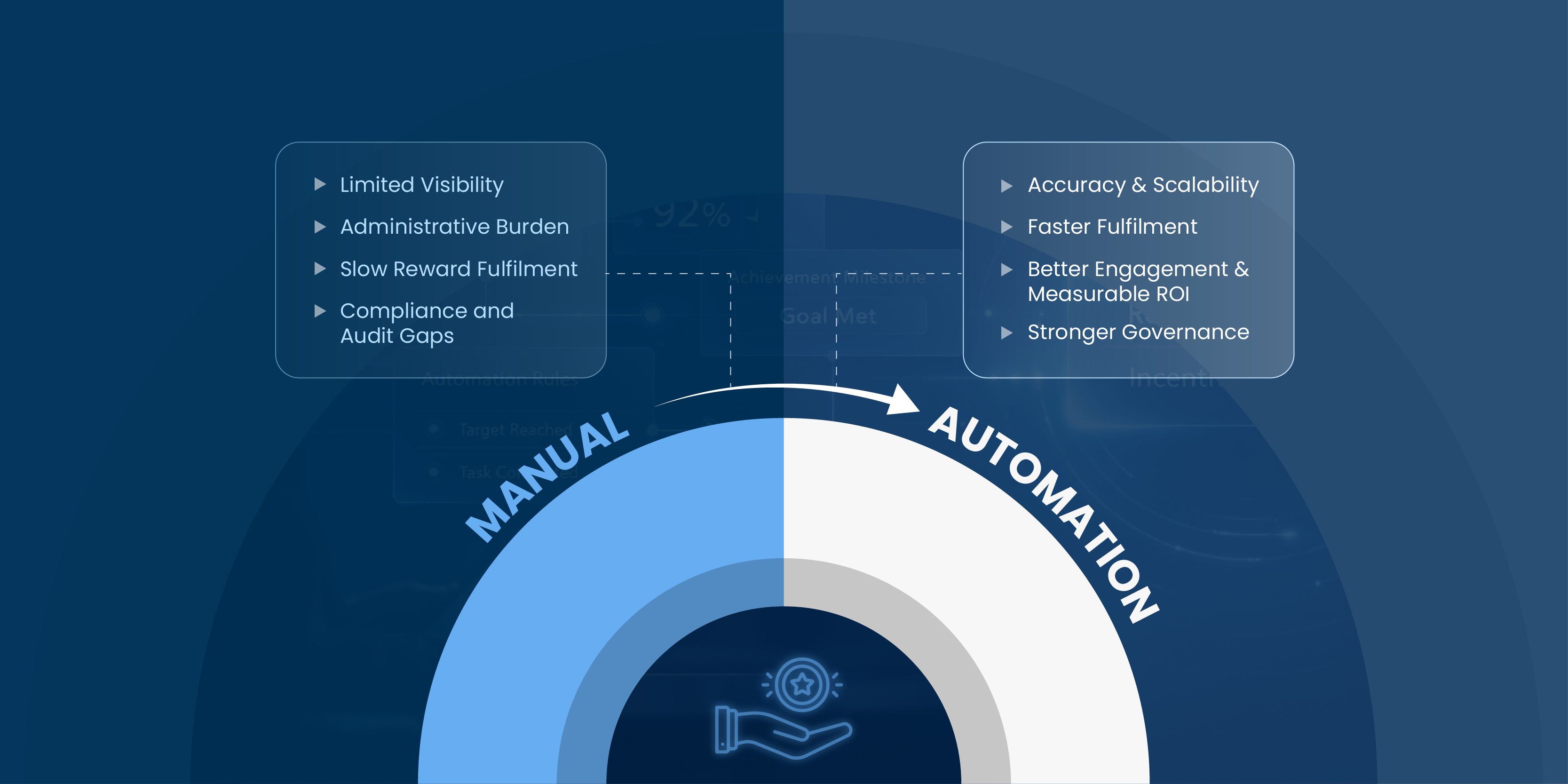
Manual Incentives vs Automated Incentives
McKinsey states that incentives should persuade sellers towards behaviours that support the go-to-market strategy. Manual administration makes that persuasion harder because partners lose trust when rules, approvals or payouts feel unclear.
When Should Sales Leaders Migrate Manual Incentives to Automation?
Sales leaders should migrate manual incentives to automation when incentive administration starts slowing partner performance, payout accuracy or management visibility. The strongest trigger is not company size alone. It is operational complexity.
A manual process becomes risky when the organisation runs multiple campaigns, uses different incentive rules by partner tier, processes frequent claims or needs finance-ready payout reporting. Bain’s channel partner research asks whether suppliers have the right incentives and support in place to help partners succeed. That question applies directly to migration: if the process creates friction, the incentive may not receive partner attention.
Migration Trigger Checklist
Sales leaders should migrate before manual errors damage partner trust. A delayed payout or disputed claim can weaken the next campaign before it starts.
How Do You Migrate from Spreadsheet Incentives to a Platform?
Sales leaders should migrate from spreadsheet incentives to a platform through a phased process: audit, clean, configure, pilot, launch and optimise. The goal is not to recreate old spreadsheets inside new software. The goal is to simplify rules, improve visibility and build a reliable partner experience.
Spreadsheet-to-Platform Migration Plan
Forrester’s channel incentive guidance emphasises the design, tracking and distribution of incentives across partner ecosystems. Migration should therefore include both programme rules and partner communication, not only data upload.
A practical first move is to migrate one high-value incentive campaign. This gives the sales team proof, reduces adoption risk and creates a model for wider rollout.
What Data Should You Migrate Before Automating Incentives?
Sales leaders should migrate only the data needed to run, validate and measure incentives. Poor data quality creates poor automation. Before migration, teams should clean partner records, eligibility rules, product mappings, historical claims, approval owners and payout references.
Incentive Data Migration Checklist
McKinsey’s sales incentive research highlights the importance of using incentives to direct behaviour towards the go-to-market strategy. Clean data matters because the platform must know which partner, product and behaviour should qualify for each incentive.
Sales leaders should not migrate every historical spreadsheet without review. Archive what is needed for audit, but migrate what is needed for future execution.
How Long Does Incentive Automation Migration Take?
Incentive automation migration can take a few weeks for a focused campaign and longer for complex, multi-region programmes. The timeline depends on partner data quality, number of incentive rules, approval complexity, payout requirements, integration needs and internal decision speed.
A realistic migration should separate platform onboarding from full operating maturity. Sales teams can launch a pilot before every historical process has been standardised.
Migration Timeline Guide
Bain’s channel work stresses data-driven partner prioritisation and support for partners with stronger growth potential. Migration should follow the same principle. Start with the partner segments and incentive programmes that can create the highest commercial impact.
Sales leaders should avoid rushing data preparation. A fast platform launch with poor partner data can create more disputes than the spreadsheet process it replaced.
What Features Should an Incentive Automation Platform Include?
An incentive automation platform should help sales teams configure rules, manage claims, track approvals, automate payout workflows, offer reward choice and report ROI. A basic reward issuing tool is not enough when channel incentives affect partner trust and commercial performance.
Incentive Automation Feature Checklist
Forrester states that channel incentives help orchestrate partner behaviour and improve indirect sales performance. The platform should therefore track behaviour as well as rewards.
A strong system should answer five questions quickly: who qualifies, what did they do, what did they earn, where is the payout and what value did the programme create?
How Can Paytives Help Sales Teams Automate Partner Incentives?
Paytives helps sales leaders move from manual incentive tracking to structured partner incentive and payout management. Through Paytives, teams can manage dealer incentives, distributor payouts, sales promoter rewards, partner campaigns, milestone rewards and target-based programmes.
Paytives can support migration from manual incentives by helping teams structure:
- Partner incentive rules.
- Campaign eligibility.
- Claim and approval workflows.
- Partner payout visibility.
- Reward redemption journeys.
- Performance dashboards.
- Milestone and tier-based incentives.
- Channel partner programme reporting.
The Reward Store’s integrated storefront gives Paytives-powered programmes access to gift cards from 5,000+ brands, flight bookings, hotel bookings, dining, golf, sports, experiences, merchandise, bus bookings and concierge services.
The strategic value is control. Paytives helps sales leaders reduce manual friction, improve partner experience and make incentive performance easier to measure.
What Mistakes Should Sales Leaders Avoid During Migration?
Sales leaders should avoid treating incentive automation as a simple data upload. Migration is a chance to improve partner experience, rule clarity and ROI reporting.
Common Migration Mistakes
Mistake 1: Migrating messy data without cleansing.
Duplicate partner records and inconsistent product codes create disputes.
Mistake 2: Rebuilding old spreadsheet logic exactly.
Automation should simplify incentive rules, not preserve every workaround.
Mistake 3: Launching without a pilot.
A pilot helps reveal rule gaps, approval delays and partner onboarding issues.
Mistake 4: Ignoring finance and compliance.
Payout workflows need audit trails, approval controls and reporting.
Mistake 5: Under-communicating with partners.
Partners need clear instructions on eligibility, claims, payout status and reward access.
Mistake 6: Measuring only adoption.
A successful migration should improve claim speed, payout accuracy, partner participation and ROI visibility.
The Incentive Research Foundation links channel programme success to effective design, fairness and connection. Migration should protect those qualities by making the platform easier for partners to understand and trust.
Frequently Asked Questions
How do you migrate from spreadsheet incentives to a platform?
Start by auditing current incentive schemes, cleaning partner data, standardising rules and identifying one pilot campaign. Then configure eligibility, claims, approvals, payouts and dashboards before launching to a broader partner group.
What data should be migrated for incentive automation?
Migrate partner master data, contact details, eligibility rules, product mappings, targets, historical claims, payout references, campaign budgets and reward redemption data. Archive old files for audit, but migrate only the data needed for future execution.
How long does it take to migrate manual incentives to automation?
Migration timing depends on campaign complexity, data quality, approval workflows, partner count and integration needs. A focused pilot can move faster than a full multi-region programme, but sales leaders should allow enough time for data cleansing and partner communication.
What tools should sales leaders use for incentive automation?
Sales leaders should use a platform that manages partner segmentation, campaign rules, claim workflows, approvals, payouts, reward redemption and performance dashboards. The tool should support commercial reporting, not only reward distribution.
Can Paytives help with incentive automation onboarding?
Yes. Paytives helps sales teams structure partner incentives, campaign workflows, payout visibility and reward journeys. It supports dealer, distributor, sales promoter and channel partner incentive use cases.
Why is automation better than spreadsheet-based incentive management?
Automation improves visibility, reduces manual errors, speeds claim and payout workflows, supports partner communication and enables stronger ROI reporting. Spreadsheets can work for small campaigns, but they struggle when rules, partners and payouts scale.
Conclusion
Migrating manual incentives to automation helps sales leaders replace spreadsheet risk with structured incentive execution. The strongest migration starts with clean data, clear rules, a focused pilot, partner communication and finance-ready reporting. McKinsey, Forrester, Bain and the Incentive Research Foundation all support the same principle: incentives work when they guide partner behaviour and operate with discipline.
The future of channel incentive management will be more automated, transparent and performance-led. Sales leaders who migrate carefully will improve partner trust, payout accuracy and incentive ROI.
Ready to move partner incentives out of spreadsheets?
Explore how Paytives helps sales leaders automate channel incentives, payout workflows, reward journeys and performance visibility across partner networks.
Explore Paytives for Incentive Automation
Sign up for our newsletter for trending top content!


