
How to Build a Manager Enablement Programme That Makes Recognition a Weekly Habit

Sign up for our newsletter for trending top content!
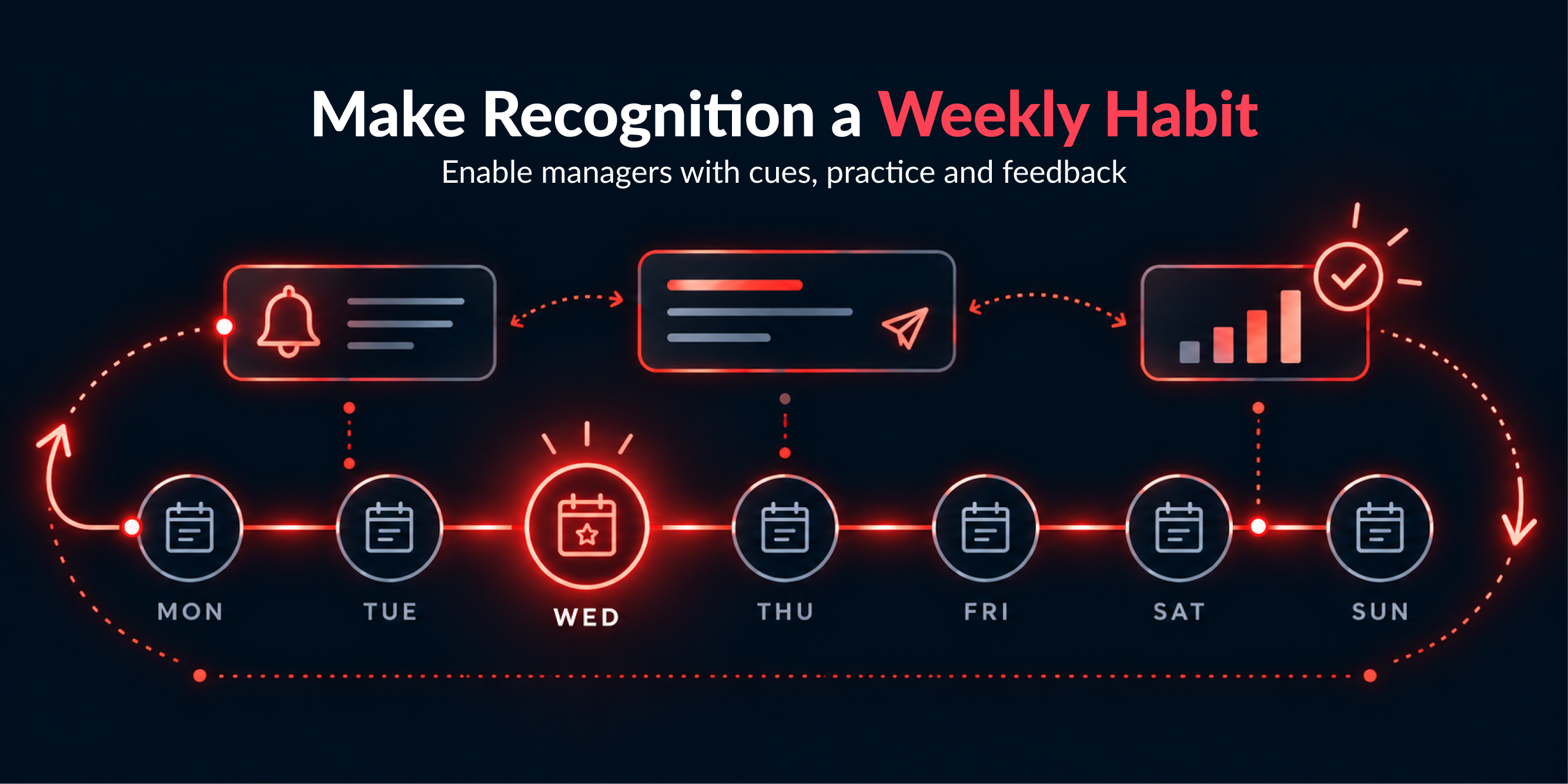
A manager enablement programme makes recognition a weekly habit by attaching a small, specific prompt to a moment that already exists in the manager's week, by teaching a clear standard for what good recognition looks like, and by giving managers feedback on their own activity that they experience as coaching. The employee recognition platform supplies the means to act, but the habit comes from the cue, the routine and the feedback that surround it. A programme that provides only a login has designed the means and left the behaviour to chance.
Why Manager Behaviour Is the Single Biggest Variable in Recognition Success
Manager behaviour is the largest variable because a manager decides, repeatedly, whether to notice something and say it, and no system setting can make that decision. Peer recognition adds volume, but it does not replace the person who allocates work, writes the review and shapes how the team is regarded. Recognition from that person carries information that a colleague cannot.
Manager enablement is a structured set of cues, practice and feedback that equips line managers to perform one specific behaviour consistently. It differs from manager training, which transfers knowledge once.
Where launches lose managers
The usual launch delivers a login, a webinar and an announcement. In Kirkpatrick terms, this produces some learning at Level 2 and almost nothing at Level 3, which is behaviour on the job. Behaviour then fails for three separable reasons. The manager has no trigger, the manager is unsure what to write, or the manager fears recognising people unevenly. Each reason needs a different remedy, and one generic training session addresses none of them well.
A diagnostic question before designing anything
Ask a sample of managers to describe the last time they intended to recognise someone and did not. The answers sort into the three causes. If most describe forgetting, build cues. If most describe not knowing what to say, build writing practice. If most describe fairness, agree what counts as recognisable work. Skipping this step produces a programme that solves the least common problem.
Designing a Cue, Routine and Reward Loop for Busy Managers
Design the loop around an event that already occurs in the manager's week, make the routine small enough to finish on the spot, and ensure the manager perceives a reward within days. A habit loop is a three part pattern, described by Charles Duhigg, in which a cue triggers a routine and the routine is followed by a reward. An implementation intention is a plan in the form "when this happens, I will do that" that converts an intention into action by removing the decision about when.
The loop in five decisions
- Choose an anchor cue that already occurs weekly, such as the close of a one to one meeting, the Monday planning huddle or the Friday handover.
- Limit the routine to one named person, one specific observation and one message.
- Place the routine where the cue occurs, not in a separate system the manager must remember to open.
- Define a reward the manager can perceive, such as the recipient's reply or a senior leader acknowledging the message. A leaderboard rarely works as the reward, because it ranks the manager instead of confirming that the behaviour matters.
- Name an owner who checks after four weeks whether the cue still fires.
Decision three is where tooling matters. ApplaudIQ is an employee recognition and rewards platform from The Reward Store. It integrates natively with Slack and Microsoft Teams, so recognition happens inside existing collaboration tools. A manager who has just agreed a handover in a Teams channel can recognise the colleague in the same window instead of remembering later. The integration removes one step from the routine, but it does not create the cue, which the programme owner must still design.
Choosing the cue
The counter argument, and where weekly is the wrong choice
The strongest objection is that scheduled recognition feels mechanical. The schedule governs only when a manager looks for something worth noting; the words remain personal. Weekly recognition is the wrong choice for managers with very large spans of control and for teams on rotating shifts, because a weekly message to every person is arithmetically impossible and produces thin, generic text. Use a rotation instead, in which each person is recognised on a defined cycle, and keep the weekly habit at one recognition per manager.
What Good Recognition Writing Looks Like and How to Teach It
Good recognition writing names the specific act, states its effect and links it to a standard the organisation values, in the manager's own voice. A recognition message is a short written statement that tells a person what they did and why it mattered to others. Specificity is the mechanism. A detailed message proves the manager observed the work, whereas a generic message could have been sent to anyone and is read that way.
A worked example
Weak: "Great job on the depot audit, well done." The recipient learns nothing they can repeat.
Strong: "Priya, you rewrote the handover checklist after the missed delivery on Thursday, and the evening team used it unchanged on Friday. That is the ownership we want across every depot." This names the act, the effect and the standard.
Teaching it
Teach through editing. Give managers anonymised weak messages and ask them to rewrite each one using three prompts: what did the person do, what changed because of it, and what does it show about how we work. Editing builds the skill faster than a presentation because the manager performs it. Offer sentence starters at first and retire them after a few weeks. The trade off is that starters lift novices while pulling every message towards uniformity, and recipients who compare messages notice.
Two failure modes
Managers recognise what they see, which disadvantages remote, part time and night shift staff. Add a standing prompt: "Whose work did I not see this week?" In multilingual organisations, allow managers to write in the language the recipient uses, since recognition in a second language often reads as stiff.
Using Manager Coverage Data to Coach Rather Than to Police
Treat coverage data as a diagnostic of the system around the manager, not as a verdict on the manager. Manager coverage is the share of a manager's direct reports who received recognition from that manager in a given period. An employee recognition platform holds the records from which coverage is calculated, but it cannot explain why a figure is low. Policing produces gaming, such as rapid, short messages sent to meet a count. Coaching asks what got in the way.
Reading the patterns
A worked scenario
Consider a regional logistics operator whose depot supervisors each lead a shift team. Three weeks after launch, with the cue set at the Monday planning huddle, coverage data showed day shift supervisors active and night shift supervisors almost silent. The tempting reading was disengagement. The Head of Learning and Development instead asked what the night supervisors' week looked like and found that they do not attend Monday huddles. The cue had never reached them. Moving it to the shift handover brought them into the same routine.
Controls that keep coaching honest
Show each manager their own data first and in private. Do not publish league tables. Pair every coverage figure with a sampled review of message quality. Recognition records are personal data about employees and managers, so document the purpose and lawful basis under GDPR, tell managers who can see what, and consult any works council where local law requires it.
The Enablement Assets Worth Building and the Ones That Get Ignored
Build assets that a manager uses at the moment of acting, and skip assets that ask for time at the moment of learning.
Assets that get used
- A cue card: half a page stating the team's chosen cue, the one sentence routine and the three writing prompts.
- An example bank: strong messages drawn from the organisation's own work, anonymised where necessary and grouped by situation.
- A manager scorecard: a one page summary that shows a manager their own recognition activity against a few agreed indicators. Limit it to four, such as coverage, spread across the team, sampled specificity and timeliness. Draw the figures from the records of the employee recognition platform, and agree definitions with HR before the first release so that coverage means the same in every team. Deliver it through the manager's one to one with their own leader, not through the learning management system.
Assets that get ignored
Long handbooks, recorded webinars and generic online modules all require the manager to find time and recall content at the moment the cue occurs, which is when attention is scarcest. A dashboard fails for a different reason. A number without a named next step invites defensiveness instead of action.
A Twelve Week Manager Enablement Calendar
Run the programme in three phases: set up and practise in weeks one to four, feed back in weeks five to eight, and consolidate in weeks nine to twelve. The calendar assumes the diagnostic from the first section is complete.
Where ApplaudIQ Fits in a Manager Enablement Programme
An employee recognition platform is the system in which recognition is given, recorded and rewarded, and a manager enablement programme depends on one. ApplaudIQ provides peer to peer recognition, manager led awards and milestone celebrations in one platform. It integrates natively with Slack and Microsoft Teams, so recognition happens inside existing collaboration tools. Monetary and non monetary reward options can be attached to recognition, and HR teams have programme administration, reporting and recognition records. It does not run consumer loyalty programmes or channel or distributor incentive programmes, does not issue gift cards to retailers or brands, and does not operate a redemption engine. It is intended for CHROs, HR directors, HR technology leads and internal communications leads in organisations large enough that recognition cannot be run manually.
Frequently Asked Questions
How often should a manager recognise their team?
A manager should recognise at least one direct report every week, so the whole team is covered across a cycle instead of every person weekly. The weekly cadence is the habit, and the rotation decides who. Managers with very large teams or shift patterns should use a defined rotation, because forcing a weekly message to everyone produces thin, generic recognition.
How do I train managers to write better recognition messages?
Teach a three part sentence that names the act, its effect and the standard it shows, then practise on real examples. Have managers rewrite weak messages in pairs, since editing builds the skill faster than listening to a presentation. Offer sentence starters at the beginning and retire them after a few weeks so messages do not become uniform.
What should a manager recognition scorecard include?
A scorecard should show no more than four indicators: coverage of direct reports, spread across the team, specificity in a sampled set of messages, and timeliness relative to the event recognised. It should reach the manager privately before anyone else sees it, and it should be discussed in a one to one meeting rather than sent as an attachment.
How can HR use recognition data without managers feeling monitored?
Show each manager their own data first and in private, explain what HR and senior leaders can see, and document the purpose and lawful basis under GDPR. Ask what got in the way instead of asking why a number is low. An employee recognition platform records activity, but interpretation belongs in a coaching conversation, not a league table.
Why do managers stop recognising people after the first few weeks?
The cue weakens. A launch announcement is a single event, and without a recurring trigger tied to the manager's existing week, other work displaces the routine. Managers also stop when nobody responds to their effort. Reinforce the cue weekly and make sure the manager's own leader notices and acknowledges the recognition given.
Does recognition have to be spontaneous to feel genuine?
No. Genuineness comes from specificity and accuracy, not from timing. A scheduled prompt governs when a manager looks for something worth recognising, and it does not dictate the words. A manager who notes an event during the week and writes about it on Friday produces recognition that the recipient experiences as observed, which is what makes it credible.
How does ApplaudIQ differ from an employee engagement survey tool?
ApplaudIQ provides peer to peer recognition, manager led awards and milestone celebrations in one platform, with native Slack and Microsoft Teams integration, monetary and non monetary rewards attached to recognition, and programme administration, reporting and recognition records for HR teams. Its subject is recognising and rewarding people. An employee engagement survey tool is software that asks employees structured questions about their experience of work, which is a different purpose.
Sign up for our newsletter for trending top content!


