
How to Connect Your Loyalty Programme to a Referral Programme and Cut Customer Acquisition Costs

Sign up for our newsletter for trending top content!
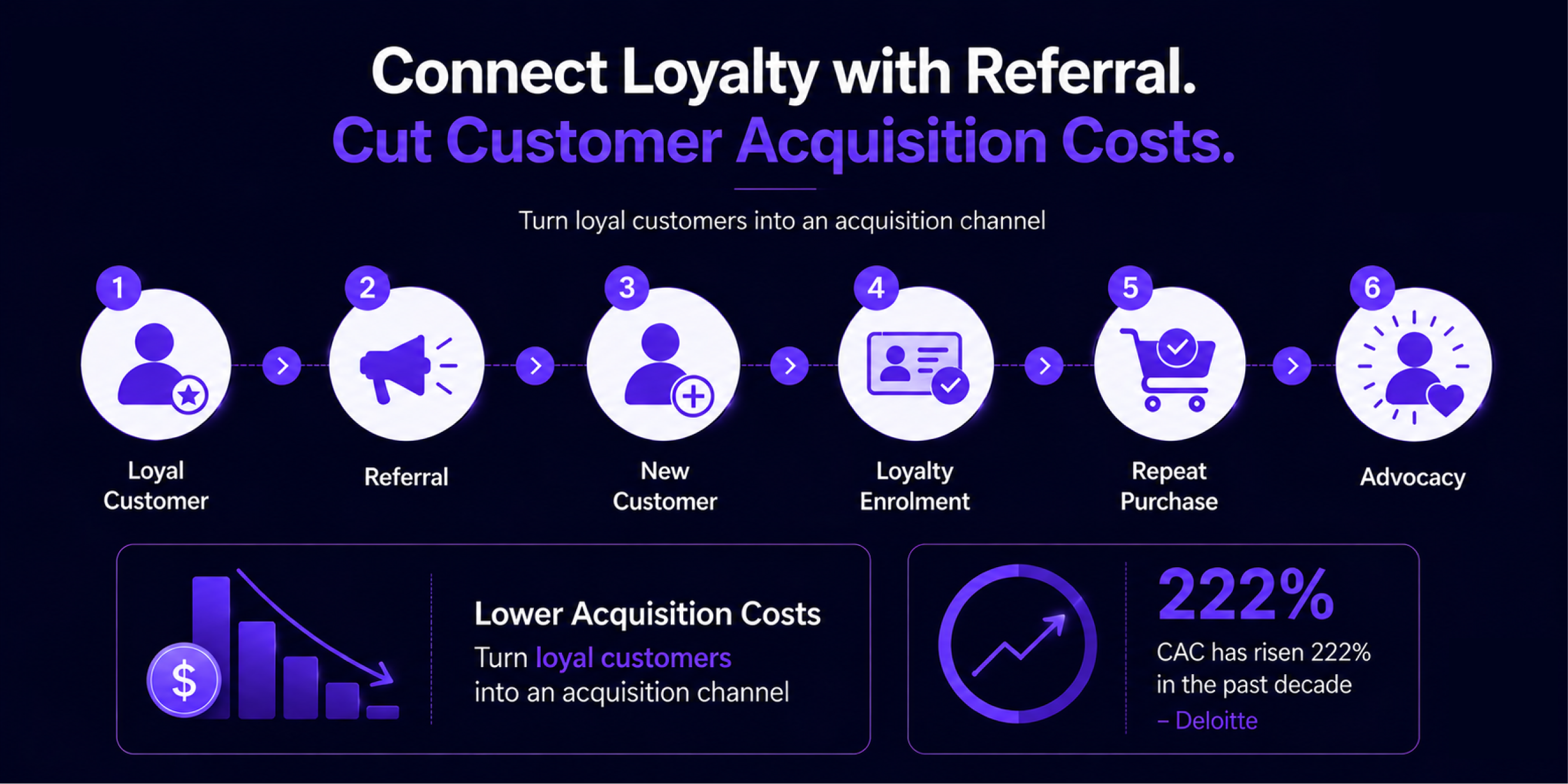
Customer acquisition costs have risen 222% over the past decade, according to Deloitte, putting greater pressure on retail and e-commerce marketers to make every acquisition channel more productive. Yet many brands still operate loyalty and referral programmes as separate marketing activities. That disconnect leaves acquisition value sitting inside the existing customer base instead of turning loyal customers into an active acquisition channel.
For Marketing Leaders, the opportunity is to connect referral behaviour directly to loyalty mechanics. This means identifying high-value advocates, rewarding successful referrals, using tier status to increase motivation, controlling fraud, and measuring whether referred customers deliver stronger lifetime value than customers acquired through paid channels.
This guide explains how to build that loyalty programme referral programme integration, what metrics matter, and how a connected model can reduce CAC without relying on increasingly expensive media.
Why Referral Programmes and Loyalty Programmes Are Usually Disconnected, and What That Costs in CAC
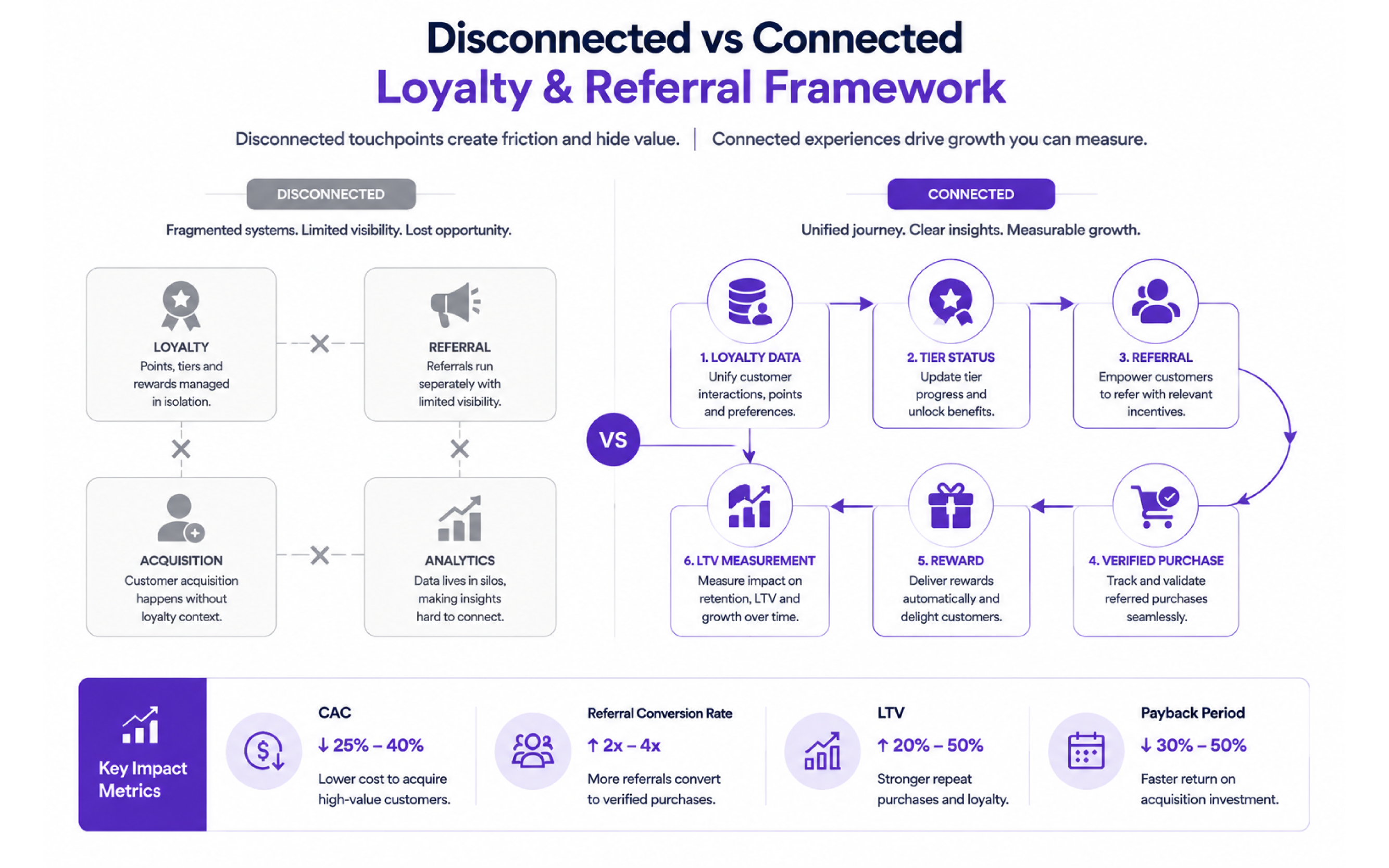
Loyalty programmes typically focus on retention, repeat purchases and rewards, while referral programmes sit within acquisition or performance marketing. The result is a fragmented customer journey: one system knows who the best customers are, while another asks customers to refer without using that insight.
Forrester found that 54% of marketers surveyed already embedded referral programmes within broader customer loyalty programmes, while 38% operated referral programmes separately. Its research also identifies lower acquisition cost and access to higher-value prospects as key benefits of referrals.
The commercial cost of keeping them separate
A disconnected model creates three avoidable problems:
- Poor advocate targeting: Marketing teams may ask inactive members to refer instead of prioritising highly engaged customers.
- Weak personalisation: Referral incentives often ignore tier, purchase history, category preference or customer value.
- Fragmented measurement: Acquisition teams measure referral conversion, while loyalty teams measure engagement, making the true CAC and LTV impact difficult to establish.
McKinsey recommends using customer data to identify customers who generate value and influence broader sales, rather than relying on basic frequency metrics alone.
A connected model therefore treats referral as a loyalty behaviour. The customer earns recognition for advocacy, the new customer enters a structured onboarding journey, and both behaviours feed the same customer data layer.
This approach also aligns with Forrester's view that loyalty should influence acquisition as well as retention and advocacy across the customer lifecycle.
The Refer-and-Earn Mechanic: How to Design Referral Rewards That Motivate Both Referrer and Referee
A strong refer-and-earn mechanic should create a clear value exchange for both sides. The referrer needs a reason to recommend the brand, while the referee needs enough immediate value to complete the first meaningful action.
McKinsey reports that effective referral programmes can generate 20% to 30% of new customers within weeks of launch in some businesses. It also recommends tracking the number of customers who refer, referrals per customer, referral conversion and new-customer satisfaction.
The design should therefore start with the desired behaviour, not the reward.
A practical referral design framework
The Incentive Federation states that effective incentive programmes should encourage a defined action from a defined audience and produce measurable outcomes.
For retail brands, this means avoiding a blanket incentive that pays the same amount for every referral. A high-value advocate may justify a stronger reward, while a low-frequency member may need a simpler activation incentive first.
With Rekyndl, brands can define referral earning rules alongside purchase, review, social engagement and milestone actions, then connect those behaviours to a broader loyalty programme.
How Tier Status Changes Referral Motivation, and Why Your Top-Tier Members Are Your Best Acquisition Channel
Not every loyalty member has the same acquisition value. Tier status can help Marketing Leaders identify customers who demonstrate the behaviours most likely to produce valuable referrals.
McKinsey found that active loyalty members spend more than inactive enrolled members, while redeemers spend 25% more than enrolled but inactive members. The finding reinforces a broader principle: engagement quality matters more than membership volume.
That makes tier progression useful for referral strategy. A customer who purchases frequently, redeems rewards, engages with campaigns and maintains a high tier has already demonstrated commitment. Asking that customer to advocate is more commercially rational than sending a generic referral message to the entire database.
Who should receive which referral treatment?
Deloitte's 2025 loyalty research found that 72% of consumers say loyalty programmes make them more likely to spend with their preferred brand, while 56% report increasing their spending because of the programme.
The implication is straightforward: tier status should not only unlock better redemption value. It can also determine who receives advocacy opportunities, how referral rewards are structured and how aggressively the brand invests in each acquisition source.
For Marketing Leaders, this turns loyalty status into an acquisition signal rather than a retention-only metric.
Fraud Prevention in Loyalty-Linked Referral Programmes: The Guardrails That Protect Without Killing Participation
Referral incentives create a financial obligation, so fraud controls must sit inside programme design rather than appear as an afterthought. The challenge is to prevent duplicate accounts, self-referrals, incentive abuse and suspicious activity without adding so much friction that genuine customers abandon the process.
Deloitte identifies account takeover, fictitious point creation, internal fraud and other forms of loyalty misuse as material risks. It also emphasises the need to balance fraud losses, operating costs and the member experience.
Use progressive controls
Start with low-friction controls for normal behaviour, then increase scrutiny when risk signals appear.
Recommended guardrails include:
- Unique referral identifiers: Tie every referral to a specific member and campaign.
- Verified qualification: Release the reward only after the referred customer completes a defined purchase or activation.
- Duplicate detection: Check account, device, contact and transaction signals for suspicious patterns.
- Reward limits: Set monthly or campaign-level referral thresholds.
- Delayed high-value rewards: Apply additional verification where referral value exceeds normal customer economics.
- Exception monitoring: Flag abnormal referral volumes, repeated payment details or unusual account creation patterns.
The goal is not to eliminate every suspicious event. It is to protect programme economics while keeping the legitimate customer journey short.
Rekyndl's broader loyalty architecture supports defined earning rules, customer segmentation and automated journeys, giving Marketing Leaders a framework for applying qualification logic consistently rather than managing referral rewards manually.
Deloitte's fraud research makes the commercial point clearly: stronger controls can protect both financial value and customer trust when brands design them around the member experience.
How to Track Referral-Sourced Customer LTV vs Acquisition-Sourced LTV
Referral CAC alone does not tell you whether the channel creates profitable customers. Marketing Leaders should compare referral-sourced LTV with LTV from paid, organic, partnership and other acquisition channels.
Deloitte recommends using granular customer data to identify high-value customers and predictive signals that support retention and profitability decisions. McKinsey similarly recommends analysing customer value across the lifecycle rather than evaluating loyalty activity through membership numbers alone.
Track each referred customer from the initial referral through at least the first 90, 180 and 365 days.
The measurement model
Referral CAC = Total referral programme cost ÷ New customers acquired through referrals
Include referral rewards, campaign costs, technology costs and operational costs.
Referral LTV = Gross margin contribution from referred customers over the chosen period
Then compare:
- First-purchase conversion rate
- Second-purchase rate
- Purchase frequency
- Average order value
- Gross margin
- Reward cost
- Retention rate
- 90-day, 180-day and 365-day LTV
- Payback period
Forrester notes that referred prospects can share interests, values and behaviours with the loyal customers who refer them, making referrals particularly useful for reaching potentially higher-value audiences.
The key is to use matched cohorts where possible. Compare customers acquired through referrals with customers acquired through other channels during the same period, with similar product, geography and customer characteristics. This gives Marketing Leaders a more credible view of incremental value than simply comparing average customer revenue.
For more on using loyalty data for customer intelligence and segmentation, see The Reward Store's guide to loyalty programme data, analytics and customer intelligence.
Measuring Loyalty-Referral Integration ROI: CAC Reduction, Referral Conversion Rate, and LTV Uplift
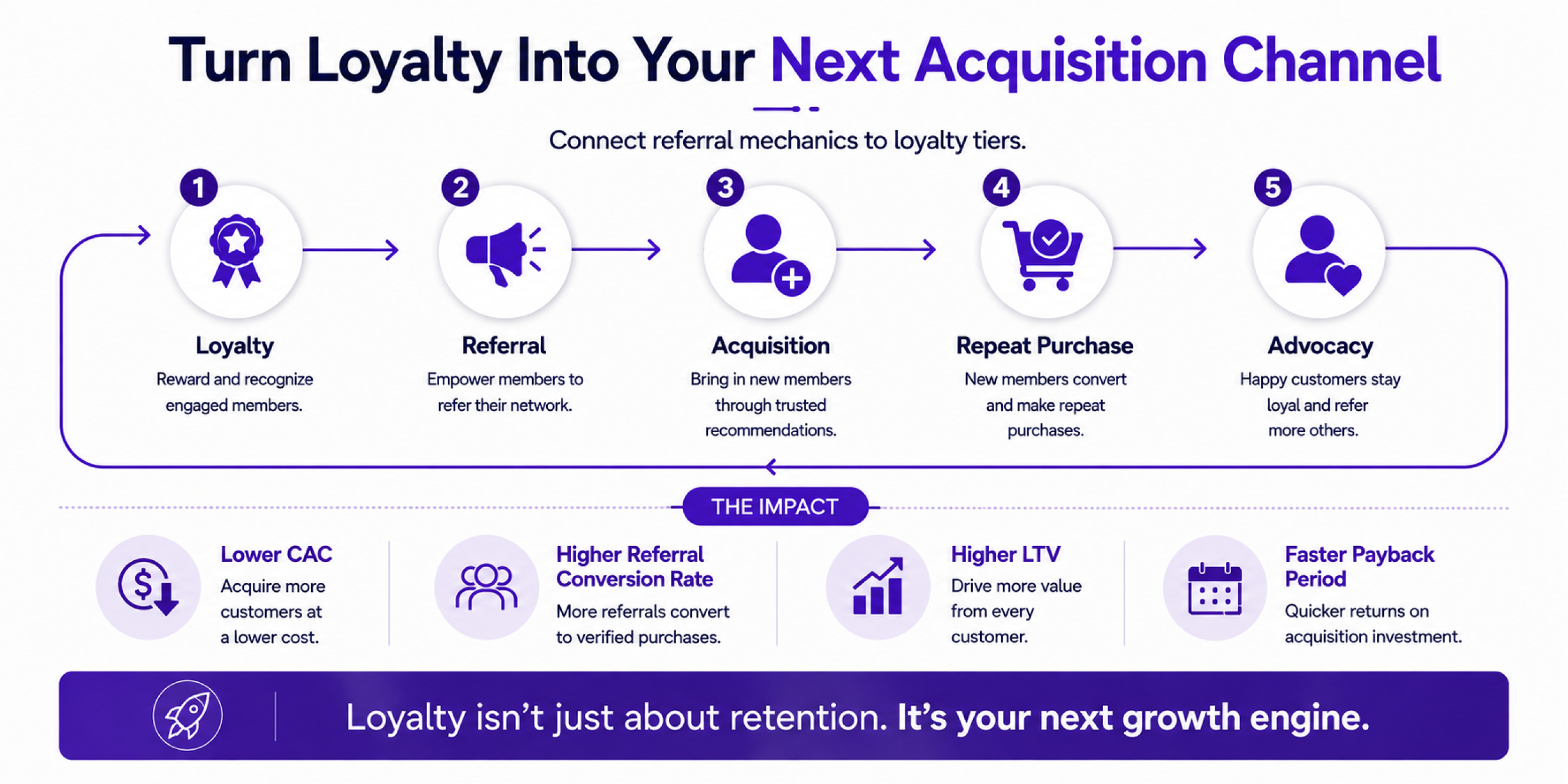
The strongest loyalty programme referral programme integration creates a measurable loop:
Loyal customer → Referral → New customer → First purchase → Loyalty enrolment → Repeat purchase → Advocacy
Forrester's research supports this lifecycle approach, identifying loyalty as relevant across discovery, acquisition, participation and advocacy rather than only after purchase.
Marketing Leaders should build the measurement framework around three commercial outcomes.
1. CAC reduction
Calculate total acquisition cost before and after introducing referrals into the loyalty programme.
CAC reduction % = (Baseline CAC minus Referral CAC) ÷ Baseline CAC × 100
Do not count reward cost as zero. Include every programme expense.
2. Referral conversion rate
Measure both referral-to-registration and referral-to-purchase conversion.
Referral conversion rate = Qualified referred customers ÷ Total qualified referral leads × 100
McKinsey specifically recommends tracking referral volume and conversion at customer level.
3. LTV uplift
Compare the LTV of referral-sourced customers with a suitable control group.
LTV uplift % = (Referral customer LTV minus Control customer LTV) ÷ Control customer LTV × 100
Deloitte's research shows that customer experience and relationship quality can influence both spend and lifetime value, reinforcing why acquisition quality should sit alongside acquisition volume.
A useful executive dashboard should therefore show CAC, referral conversion, reward cost, repeat purchase, retention, LTV and payback period together. For a wider view of retail loyalty strategy, see Rekyndl's retail and e-commerce loyalty solution.
The objective is not simply to generate more referrals. It is to create a lower-cost acquisition channel that produces customers with stronger economics over time.
Frequently Asked Questions
What is loyalty programme referral programme integration?
Loyalty programme referral programme integration connects customer advocacy directly to loyalty earning, tiers, rewards and customer journeys. Instead of running referral activity as a separate acquisition campaign, brands use loyalty data to identify advocates and reward successful referrals. Forrester found that 54% of surveyed marketers had already embedded referral programmes within broader loyalty programmes.
How can a referral programme reduce customer acquisition costs?
A referral programme can reduce CAC by shifting part of acquisition from paid media towards existing customers who recommend the brand. McKinsey found that effective referral programmes can generate 20% to 30% of new customers in some cases. The real commercial test is whether referral CAC remains lower after accounting for rewards, technology and operational costs.
Why should loyalty tiers influence referral rewards?
Loyalty tiers provide a practical way to differentiate customers according to engagement and value. Higher-tier customers often demonstrate stronger purchase and redemption behaviour, making them useful candidates for advocacy. McKinsey's research shows that highly engaged redeemers spend more than inactive enrolled members.
Can Rekyndl connect referrals with loyalty programme mechanics?
Yes. Rekyndl supports loyalty earning rules for behaviours such as referrals, reviews, social engagement, purchases and milestones, alongside customer segmentation, tiered rewards and automated journeys. This allows Marketing Leaders to manage referral behaviour as part of a broader customer lifecycle strategy rather than as an isolated campaign.
When should a retailer introduce referral rewards?
Retailers should introduce referral rewards after customers have experienced enough value to make a credible recommendation. The best trigger depends on the business, but useful signals include a completed purchase, repeat purchase, reward redemption, high satisfaction or tier progression. Forrester recommends using loyalty across the customer lifecycle, including advocacy and referral, rather than waiting until a customer reaches a generic campaign audience.
Conclusion
The most effective referral strategy does not treat referrals as a standalone acquisition tactic. It connects customer advocacy to loyalty data, tier status, relevant rewards, automated journeys and LTV measurement, creating a repeatable acquisition loop that can reduce CAC while improving customer quality.
As retail loyalty becomes increasingly data-led, Marketing Leaders will move from rewarding transactions to orchestrating customer behaviours across acquisition, retention and advocacy. The next step is to build referral mechanics directly into the loyalty experience.
See how Rekyndl's referral mechanics connect to loyalty programme tiers. Explore Rekyndl's loyalty features.
Sign up for our newsletter for trending top content!


