
How to Build a Redemption Catalogue That Makes Customers Want to Earn Points Not Just Collect Them

Sign up for our newsletter for trending top content!
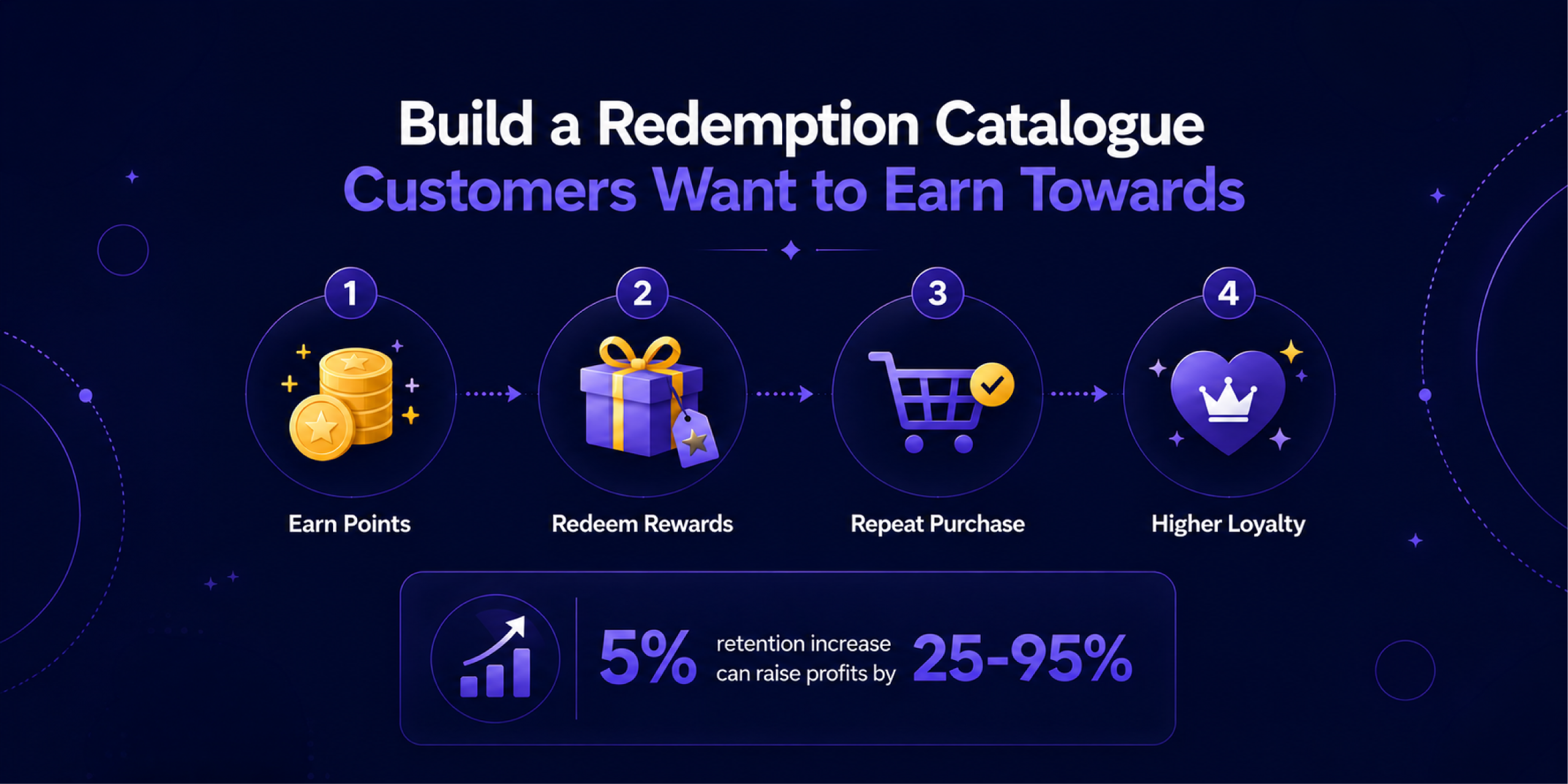
Bain & Company found that increasing customer retention by just 5% can raise profits by 25% to 95%. Yet many loyalty programmes struggle with a simpler problem: customers accumulate points but rarely redeem them. High breakage may look attractive in accounting terms, but it often signals low emotional engagement and weak programme relevance.
For marketing leaders, the redemption catalogue is not an operational detail. It is the moment customers decide whether your programme feels valuable enough to change their behaviour. A catalogue that inspires action increases purchase frequency, repeat visits, and advocacy; a catalogue that frustrates customers quietly erodes loyalty over time.
This article explains how to design a redemption catalogue that customers actively want to earn towards. You will learn how to balance aspiration with accessibility, weight reward categories effectively, personalise redemption options, and measure catalogue health using practical loyalty metrics.
Why Most Loyalty Points Go Unredeemed and What That Tells You About Your Catalogue
Low redemption rates rarely mean customers do not like rewards. They usually mean customers do not see rewards that feel achievable, relevant, or worth the effort. McKinsey research shows that loyalty members engage more when programmes create a clear value exchange and reduce friction in earning and redemption.
Three catalogue problems appear repeatedly:
- Unreachable thresholds: Customers need months or years to earn meaningful rewards.
- Poor category fit: Rewards do not match customer interests or life stage.
- Choice overload: Too many similar options create decision fatigue.
Gartner has consistently reported that excessive choice can reduce customer action when people struggle to compare alternatives. A catalogue with 2,000 poorly organised items may perform worse than one with 200 highly relevant options.
A quick diagnostic
Ask these questions:
- Can a new customer redeem something meaningful within the first 30 days?
- Do your top three customer segments each see clearly relevant rewards?
- Are your most redeemed items prominently surfaced?
If the answer to any of these is no, the catalogue is likely suppressing engagement.
Platforms such as Rekyndl help marketing teams address this by combining earning rules, segmentation, and redemption storefronts in one environment, making it easier to align rewards with customer behaviour rather than managing static catalogues manually.
For a broader view of loyalty engagement mechanics, see The Reward Store’s guide to customer loyalty strategy: https://www.therewardstore.com/blogs/customer-loyalty-strategy-engagement.
The Aspiration vs Accessibility Balance: How to Design a Catalogue That Motivates All Spend Levels
A strong catalogue does two jobs at once. It gives occasional customers an easy early win and gives high-value customers something exciting to work towards. Deloitte’s consumer loyalty research highlights that emotional rewards and status-oriented benefits often drive stronger long-term engagement than purely transactional discounts.
Think of your catalogue as a pyramid:
The 70-20-10 rule
Many successful programmes use a practical mix:
- 70% accessible rewards: digital vouchers, dining offers, small experiences.
- 20% mid-tier rewards: premium merchandise, wellness packages, family activities.
- 10% aspirational rewards: travel, exclusive events, concierge-led experiences.
This structure ensures most members redeem regularly while still seeing premium possibilities. Bain’s loyalty research shows that frequent smaller redemptions can reinforce habit formation and increase repeat interaction with the brand.
A useful benchmark is that a typical customer should reach an entry-level reward after one to three purchase cycles. If the first reward requires six or more transactions, motivation drops sharply.
For marketers designing new programmes, Rekyndl’s loyalty programme builder allows point thresholds and category mixes to be adjusted by segment and campaign, reducing the need for one-size-fits-all reward economics. Explore the feature set here: https://www.therewardstore.com/rekyndl/features.
Gift Cards, Experiences, Merchandise, and Travel: How to Weight Your Catalogue Across Reward Categories
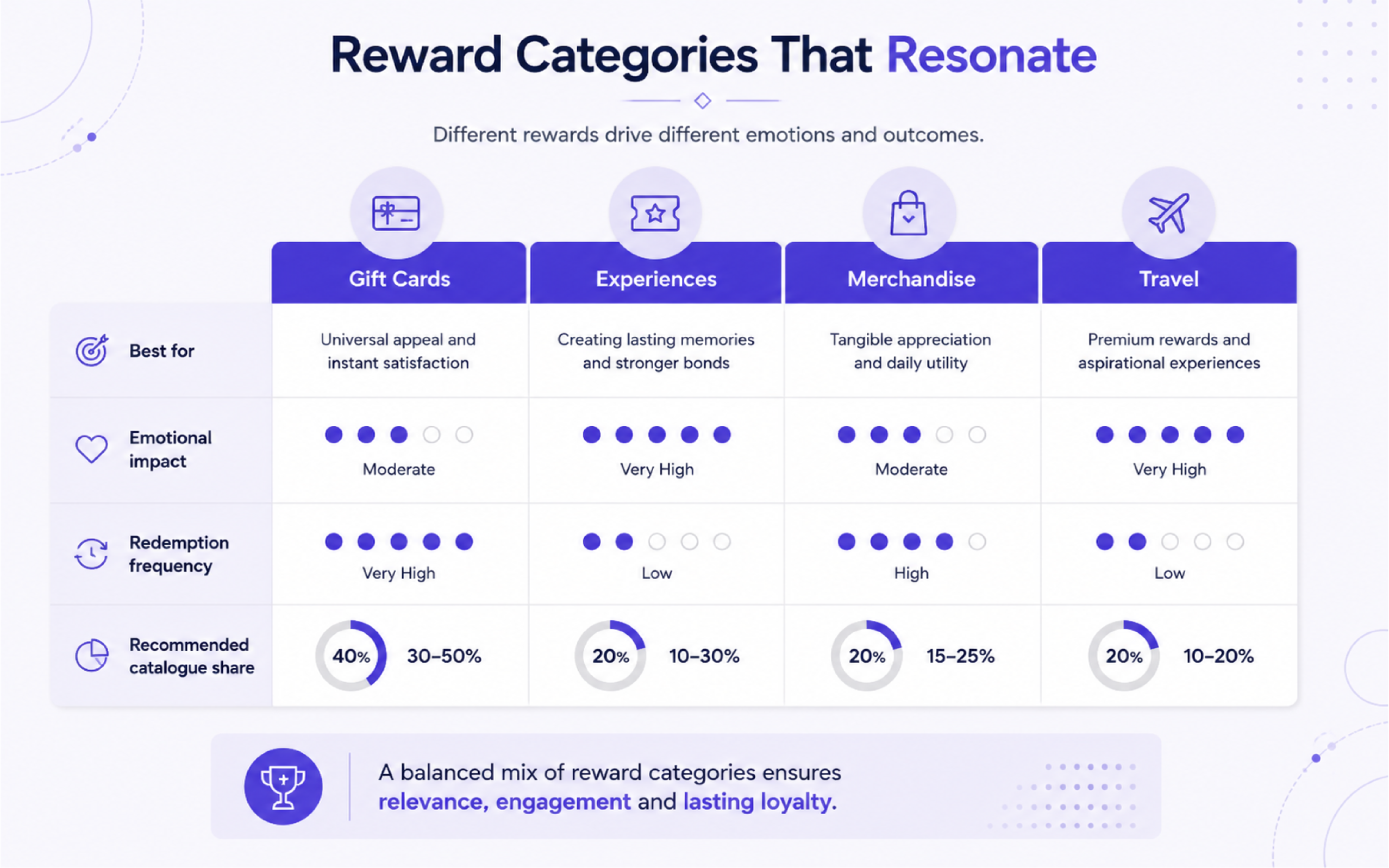
Not all reward categories drive the same behaviour. McKinsey’s research on customer experience shows that memorable experiences create stronger emotional recall than equivalent cash value, while practical rewards tend to drive higher redemption frequency.
A balanced catalogue usually performs better than a catalogue dominated by a single category.
What customers typically want
- Gift cards: flexibility and immediate utility.
- Experiences: uniqueness and social shareability.
- Merchandise: ownership and perceived value.
- Travel: milestone achievement and status signalling.
Bain has found that emotionally differentiated loyalty benefits are harder for competitors to replicate than simple monetary incentives. That is why many leading consumer programmes combine practical rewards with occasional premium experiences.
The Reward Store’s catalogue spans gift cards, hotel bookings, flight bookings, dining, sports, experiences, and concierge services, which makes it possible to maintain this balance without managing multiple reward vendors.
Avoid over-indexing on merchandise unless it has proven demand. Physical rewards introduce inventory, fulfilment, and return complexity that digital and experiential rewards often avoid.
How Often Should You Refresh Your Redemption Catalogue and What Happens When You Don’t
A stale catalogue sends a subtle signal that the programme itself is not evolving. Forrester’s customer experience research has repeatedly shown that perceived freshness influences repeat engagement across digital commerce environments.
A practical refresh cadence:
- Monthly: add or rotate promotional rewards.
- Quarterly: review category performance and remove underperformers.
- Biannually: introduce new experience themes and seasonal collections.
- Annually: conduct a full catalogue strategy review.
Warning signs of catalogue fatigue
- Redemption rate declines for two consecutive quarters.
- The same five rewards account for most redemptions.
- Search usage rises while conversion falls.
- Customer support queries about reward relevance increase.
Seasonality matters. Travel demand, dining preferences, wellness trends, and family spending patterns shift throughout the year. Marketing teams that align catalogue rotations with these moments create more reasons to redeem.
Rekyndl supports catalogue updates alongside campaign automation, allowing marketers to launch seasonal redemption collections and promote them through email, SMS, push, in-app, or in-store channels from a single platform.
If you are planning a seasonal engagement push, The Reward Store’s article on loyalty campaign timing and customer engagement offers additional planning ideas: https://www.therewardstore.com/blogs/loyalty-campaign-timing-customer-engagement.
Personalised Catalogue Views: How to Show Different Customers Different Redemption Options Based on Their Profile
Personalisation is no longer optional. McKinsey reports that consumers increasingly expect organisations to tailor interactions to their preferences and behaviour, and companies that personalise effectively often see meaningful revenue uplift.
Showing every customer the same catalogue ignores valuable first-party data. A better approach is to prioritise rewards most likely to convert.
Segment examples
Effective personalisation uses:
- Purchase history.
- Redemption history.
- Geographic location.
- Loyalty tier.
- Engagement recency.
- Declared interests.
The goal is not to hide the full catalogue permanently. The goal is to surface the most relevant options first. Gartner research on customer experience personalisation shows that relevance improves engagement when organisations use customer data responsibly and transparently.
Rekyndl combines segmentation with an integrated redemption storefront, enabling different customer groups to see different featured rewards without maintaining separate loyalty programmes.
Measuring Redemption Catalogue Health: Breakage Rate, Redemption Frequency, and Category Preference Data
Marketing leaders need a dashboard that treats redemption as a growth metric, not just a liability metric. The Incentive Research Foundation recommends monitoring redemption behaviour continuously because it provides a direct signal of reward relevance.
Track these five metrics
Interpreting the data
- High breakage + low engagement: catalogue relevance problem.
- Low breakage + low repeat purchase: rewards may be too transactional.
- High concentration in one category: broaden discovery and merchandising.
- Long time to first redemption: reduce entry thresholds.
Bain’s loyalty economics research shows that active redeemers often exhibit higher retention and spend than non-redeemers, making redemption behaviour a leading indicator of programme health.
Create a quarterly catalogue health review involving marketing, CRM, analytics, and finance. Decisions should include category expansion, threshold changes, merchandising updates, and personalisation rules.
For organisations operating across regions, The Reward Store’s multi-country reward catalogue and analytics capabilities can simplify cross-market reporting and category performance analysis.
Frequently Asked Questions
What is the ideal size for a loyalty redemption catalogue?
There is no universal number, but most organisations perform better with a curated catalogue than an unlimited one. Start with enough breadth to cover major customer segments and expand only when data shows unmet demand. Focus on relevance, discoverability, and redemption performance rather than raw item count.
How quickly should customers be able to redeem their first reward?
Aim for a meaningful first redemption within one to three purchase cycles or within 30 days of joining. Early redemption creates a psychological reward loop and increases the likelihood of future engagement. Long waiting periods reduce programme momentum.
Should every customer see the same rewards?
Usually not. Personalised catalogue views improve relevance by surfacing rewards that match purchase history, geography, loyalty tier, and engagement behaviour. Customers can still access the full catalogue, but prioritised recommendations increase redemption likelihood.
How does Rekyndl support catalogue personalisation?
Rekyndl combines customer segmentation, behavioural data, and an integrated redemption storefront to display different featured rewards to different customer groups. Marketing teams can create targeted reward collections for new customers, high-value members, regional audiences, or reactivation campaigns without running separate loyalty programmes.
Is a high breakage rate a sign of a successful programme?
Not necessarily. Moderate breakage is normal, but persistently high breakage often indicates that customers do not find rewards relevant or achievable. Healthy programmes typically show active redemption, repeat redemption, and strong customer engagement alongside sustainable economics.
Conclusion
Customers do not become loyal because points accumulate in an account. They become loyal when they can see a reward that feels relevant, achievable, and worth earning. The strongest redemption catalogues balance aspiration with accessibility, refresh regularly, personalise discovery, and measure engagement with the same rigour used for acquisition metrics.
As loyalty programmes become more data-driven, catalogue design will increasingly resemble product merchandising rather than reward administration. Marketing leaders who optimise redemption now will build stronger retention and higher customer lifetime value over the next decade.
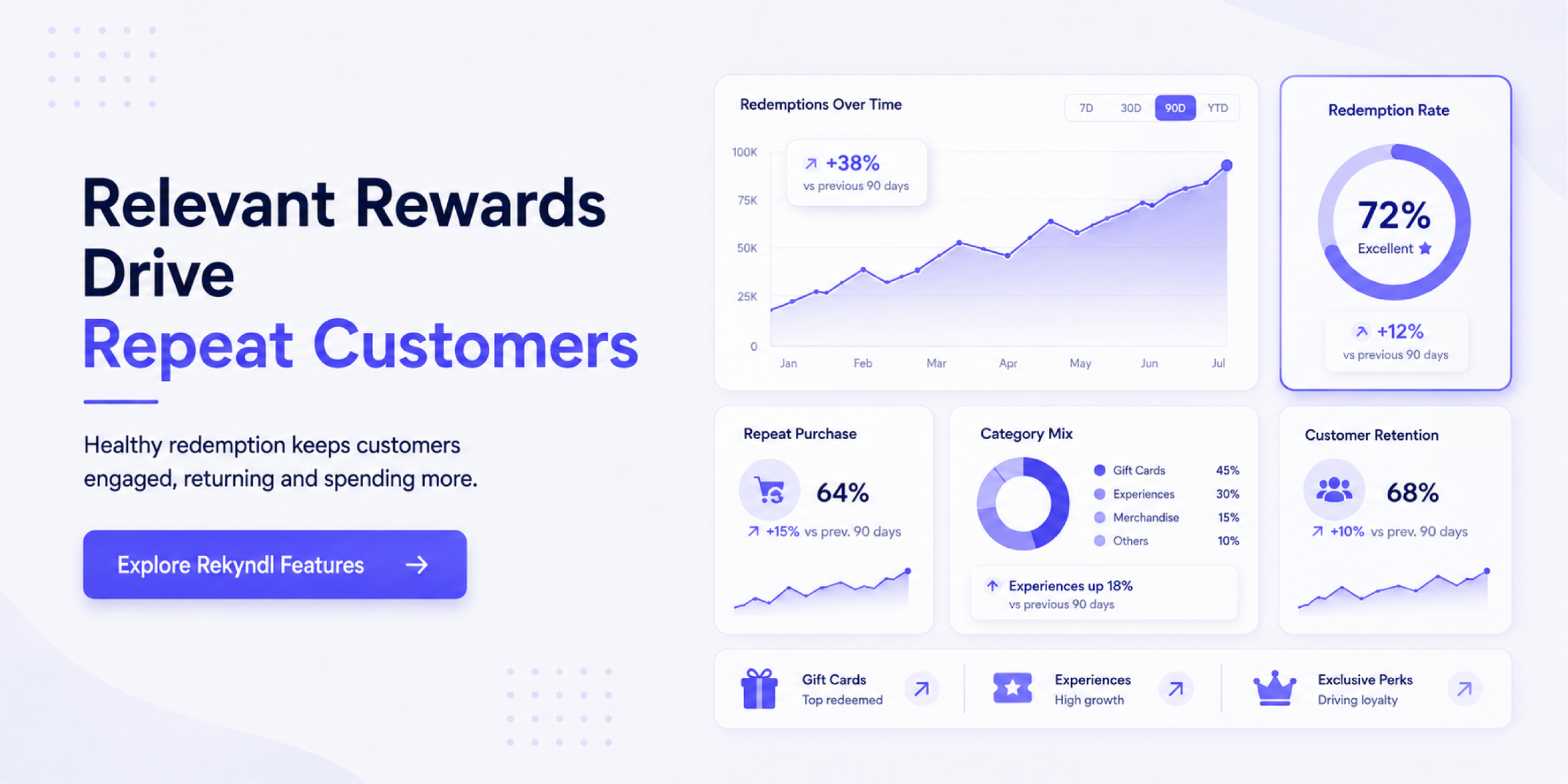
See how Rekyndl’s integrated redemption storefront helps you design personalised loyalty catalogues with gift cards, travel, dining, experiences, and more across 120+ countries. Explore the features: https://www.therewardstore.com/rekyndl/features
Sign up for our newsletter for trending top content!


