
How to Build a Win-Back Campaign Inside Your Loyalty Programme That Reactivates Lapsed Customers

Sign up for our newsletter for trending top content!
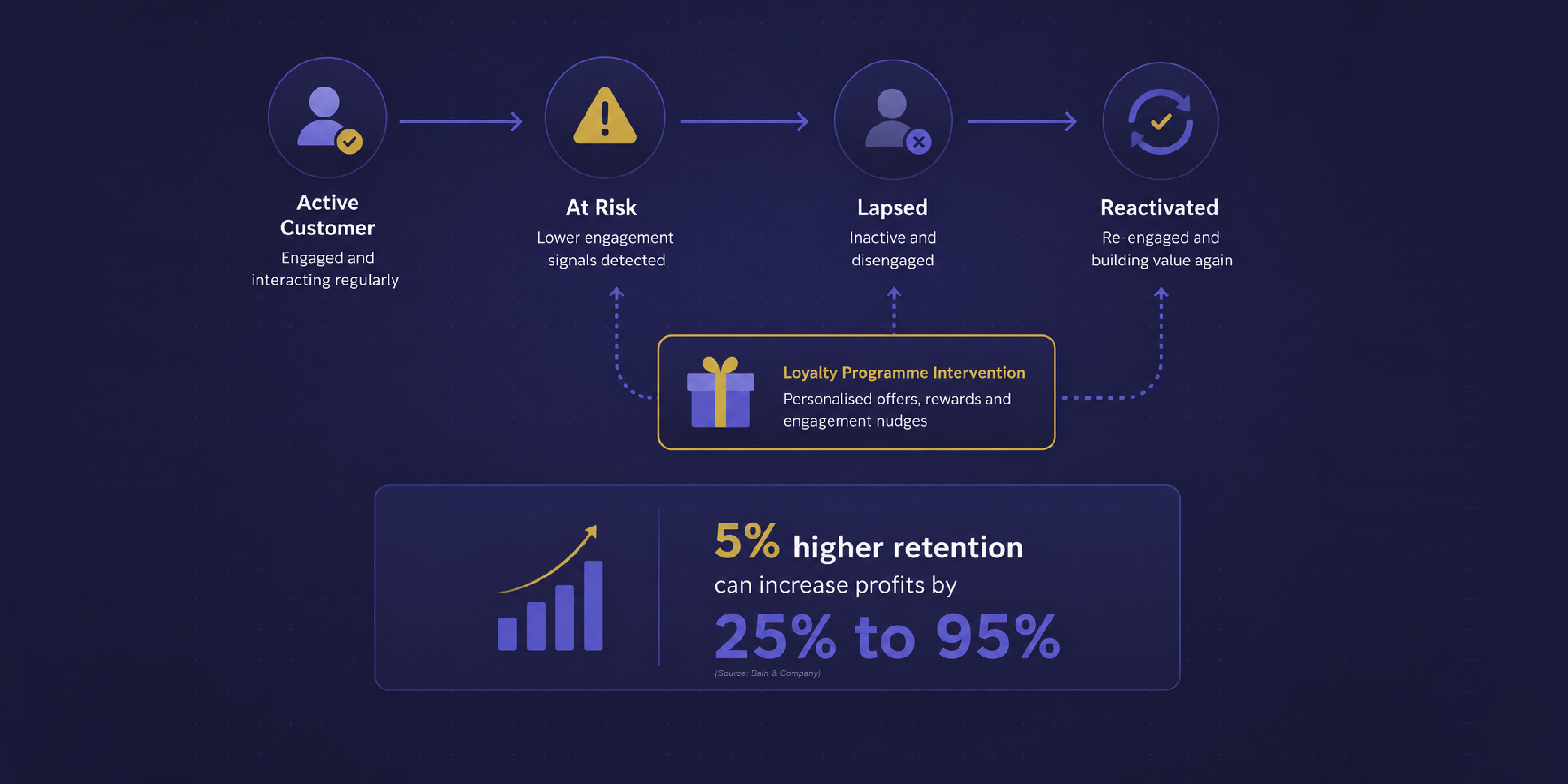
Increasing customer retention by just 5% can increase profits by 25% to 95%, according to Bain & Company. For retail and e-commerce Marketing Leaders, that makes customer inactivity more than an engagement problem. It represents revenue that may still be recoverable.
An effective win-back campaign for loyalty programme lapsed customers identifies when valuable customers are drifting away, determines why their behaviour has changed, and activates the right combination of message, channel and reward.
This article explains how to define win-back windows, segment lapsed customers, design behavioural triggers, calculate incentives, orchestrate multi-touch journeys and measure recovered customer value. The objective is not simply to generate another transaction. It is to restore profitable purchasing behaviour before inactivity becomes permanent churn.
How Long Before a Customer Is Truly Lost, and What the Data Says About Win-Back Windows
There is no universal number of days after which a customer becomes lapsed. A customer who normally buys every fortnight may show meaningful churn risk after 45 days, while a customer in a low-frequency category may remain healthy despite six months without a purchase.
The right win-back window therefore starts with each customer's expected purchase cycle. McKinsey's work on customer lifetime value supports using customer-level data to identify valuable customers and direct retention investment more precisely. This is more useful than applying one arbitrary inactivity threshold to an entire customer base.
Marketing Leaders should establish three behavioural states:
The thresholds should vary by category, purchase frequency, average order value and customer value. A retailer selling frequently purchased products may test 30, 60 and 90-day windows. Businesses with longer purchase cycles should use wider intervals.
The principle is simple: do not wait until every customer meets the same definition of "lost". Modern win-back programmes should detect deviation from expected behaviour early enough for marketing intervention to influence the next purchase.
Segmenting Lapsed Customers: Why a Single Win-Back Offer Is Guaranteed to Underperform
A customer who purchased once during a promotion should not receive the same win-back journey as a high-value loyalty member with a two-year purchasing history. Their commercial value, relationship with the brand and likely reasons for inactivity differ significantly.
McKinsey reports that effective personalisation can reduce customer acquisition costs by as much as 50%, increase revenue by 5% to 15%, and improve marketing ROI by 10% to 30%. Although these figures cover personalisation more broadly, the principle has direct relevance to win-back campaigns: differentiated customer treatment creates more opportunities to match the intervention to the individual.
Marketing Leaders should segment lapsed customers using four dimensions:
- Recency: How long has the customer been inactive?
- Frequency: How often did the customer purchase before lapsing?
- Value: What revenue, margin or lifetime value did the customer generate?
- Engagement: Does the customer still open messages, browse products, check points or interact with the loyalty programme?
A high-value customer who recently lapsed may justify a premium experiential reward or accelerated points opportunity. A promotion-driven, low-frequency customer may receive a smaller, time-limited incentive. An inactive customer who still browses may need relevance rather than a larger discount.
This is where a loyalty platform can turn segmentation into execution. Rekyndl's loyalty and marketing automation capabilities allow marketers to build customer segments and connect them with automated journeys, gamification and redemption experiences rather than managing isolated campaigns manually.
Designing Win-Back Triggers: What Events and Time Delays Should Activate a Re-engagement Journey
The strongest win-back campaigns respond to behavioural signals, not simply a calendar date.
An inactivity threshold remains useful, but Marketing Leaders should combine elapsed time with changes in customer behaviour. McKinsey's research on personalisation emphasises the value of using customer signals to create more relevant interactions, while its loyalty research recommends targeted communications and mechanisms that encourage earning and redemption.
Useful win-back triggers include:
- No purchase within the customer's expected repurchase window.
- A sharp decline in purchase frequency.
- Repeated browsing without conversion.
- An unused loyalty balance approaching expiry.
- Movement from frequent purchaser to inactive customer.
- A missed expected purchase following a historically predictable pattern.
- Continued message engagement without a transaction.
Trigger logic should also include suppression rules. A customer with an unresolved service issue should not automatically receive a cheerful promotional message. Similarly, a customer who has already returned to purchase should exit the win-back journey immediately.
Rekyndl can connect customer segmentation with automated journey logic across email, SMS, push, in-app and in-store touchpoints. This allows Marketing Leaders to create event-based journeys in which customer behaviour determines the next action.
The broader opportunity is to move from "send a campaign after 90 days" to "intervene when this customer's behaviour indicates an abnormal risk of lapse". That distinction can make win-back activity both earlier and more relevant.
The Win-Back Reward Calculus: How Much Incentive Is Enough Without Training Customers to Lapse Deliberately
.png)
The largest incentive does not automatically produce the best win-back campaign. If customers learn that inactivity consistently generates better offers than loyalty, the programme can unintentionally reward the behaviour it wants to prevent.
McKinsey argues that loyalty and pricing should work as part of an integrated customer value proposition rather than operating independently. Its loyalty research also recommends using mechanisms such as bonuses, challenges and easier redemption to encourage engagement, rather than relying solely on price reductions.
Marketing Leaders can use a simple decision framework:
Maximum rational incentive = expected recovered contribution value × probability of incremental reactivation
Suppose a lapsed customer could generate £300 in expected future contribution if successfully reactivated. If analysis suggests that a targeted intervention creates a 20% incremental probability of reactivation, the expected incremental value is £60. The total campaign and reward cost should sit comfortably below that amount.
The incentive itself can then reflect customer value and lapse risk. Options include bonus points, accelerated earning opportunities, tier-related benefits, dining vouchers, travel rewards, experiential rewards or access to a broader rewards catalogue.
Crucially, marketers should maintain control groups. If 12% of customers return without receiving an incentive and 18% return after receiving one, the campaign's incremental lift is six percentage points, not 18%.
Reward generosity should therefore follow expected incremental value. The goal is profitable behavioural change, not the highest possible redemption rate.
Multi-Touch Win-Back Sequences: How Many Contacts, Across Which Channels, Over What Timeline
One message rarely provides enough evidence to judge whether a customer can be reactivated. Equally, an endless stream of "we miss you" communications can increase fatigue and weaken brand perception.
McKinsey defines omnichannel marketing around an integrated, customer-centred experience across touchpoints rather than disconnected channel activity. That principle matters in win-back campaigns because each contact should respond to what happened after the previous one.
A practical sequence might run for two to four weeks:
Touch 1, Day 0: Remind the customer of relevant loyalty value, available points, benefits or previously demonstrated interests.
Touch 2, Day 3 to 7: Introduce personalised recommendations, a challenge, bonus earning opportunity or other reason to return.
Touch 3, Day 7 to 14: Add a targeted reward where the customer's expected value justifies the investment.
Touch 4, Day 14 to 28: Send a final reactivation message, then move persistent non-responders into a lower-frequency communication segment.
The channel should reflect both consent and demonstrated customer behaviour. Email may carry detailed content. SMS can support time-sensitive messages. Push and in-app communications can reach customers already interacting with digital properties. In-store touchpoints can recognise returning loyalty members.
Marketing Leaders should also coordinate win-back activity with the wider customer journey. This guide to loyalty marketing automation explains how connected customer journeys can turn loyalty data into ongoing retention activity rather than isolated campaign bursts.
How to Measure Win-Back Campaign ROI: Reactivation Rate, Recovered LTV, and Cost-Per-Reactivation
Open rates and clicks can diagnose campaign performance, but they do not prove that a win-back strategy creates profitable growth.
Bain's research demonstrates the significant economic value that improved customer retention can create, while McKinsey recommends using customer lifetime value to direct investment towards customers who can generate the greatest long-term returns. Together, these principles point towards a value-based measurement model for win-back campaigns.
Marketing Leaders should track three core measures.
Reactivation rate measures the percentage of targeted lapsed customers who complete the defined return behaviour within a specified period.
Cost per reactivation divides total campaign costs, including reward costs, media, messaging and operational expenses, by the number of incrementally reactivated customers.
Recovered lifetime value estimates the future contribution generated after reactivation. This metric matters because two campaigns with identical reactivation rates can produce very different commercial outcomes.
The strongest measurement design also includes a holdout group. Without one, marketers risk attributing natural customer returns to the campaign.
For example, if the exposed group records a 15% reactivation rate while the control group records 9%, the incremental reactivation rate is six percentage points. Marketing should calculate ROI against that incremental gain.
Teams can also monitor repeat purchase after reactivation, reward cost as a percentage of recovered margin and time to second purchase. Explore how loyalty programmes can drive measurable customer engagement for a broader view of the relationship between loyalty design, engagement and repeat revenue.
Frequently Asked Questions
What is a win-back campaign in a loyalty programme?
A win-back campaign is a targeted journey designed to reactivate customers whose purchasing or engagement behaviour indicates that they have lapsed or are at risk of lapsing. It uses customer data, communications and, where commercially appropriate, rewards to encourage renewed activity. The most effective campaigns define reactivation as a measurable behaviour, such as a completed purchase, rather than an email open.
When should you start a win-back campaign for lapsed customers?
Start the journey when a customer moves meaningfully beyond their expected purchase interval, rather than using one universal inactivity period. A frequent retail customer may require intervention after several weeks, while a lower-frequency customer may need several months. Analyse historical repurchase patterns by segment before setting trigger windows.
How many messages should a win-back campaign include?
For many retail and e-commerce journeys, three to four coordinated contacts provide a practical testing framework. The sequence should move from relevance and reminders towards stronger incentives only when necessary. Customers should leave the journey immediately when they reactivate, and persistent non-responders should eventually move into lower-frequency communications.
Why should loyalty programme members receive different win-back offers?
Customers differ in historical value, purchase frequency, engagement and likelihood of returning without an incentive. Giving every lapsed customer the same offer can overspend on customers who would return anyway while underinvesting in valuable relationships. Segmentation allows Marketing Leaders to align reward cost with expected incremental customer value.
Can Rekyndl automate win-back campaigns for lapsed customers?
Yes. Rekyndl combines customer segmentation, automated journey building, loyalty mechanics and multi-channel communication capabilities to support behavioural win-back journeys. Marketing teams can create rules around inactivity and customer behaviour, then connect those triggers with targeted engagement and redemption experiences.
Conclusion
An effective win-back strategy starts before a valuable customer becomes permanently inactive. Marketing Leaders need behavioural lapse definitions, customer-level segmentation, intelligent triggers, controlled reward economics and measurement based on incremental recovered value, not vanity metrics.
The next generation of loyalty programmes will increasingly use customer signals to determine when, where and how reactivation happens. Brands that build this capability into their loyalty infrastructure can turn customer inactivity into a measurable retention opportunity.
.png)
See how Rekyndl automates targeted win-back journeys that help reactivate lapsed customers and protect customer lifetime value. Explore Rekyndl's win-back and marketing automation capabilities.
Sign up for our newsletter for trending top content!


