
How to Design a Welcome Journey That Activates New Loyalty Programme Members in the First 30 Days

.png)
Sign up for our newsletter for trending top content!
A member who joins your loyalty programme but does nothing in the first month is far less likely to become a profitable repeat customer. Bain & Company has shown that increasing customer retention by as little as 5% can increase profits by 25% to 95%, making early engagement a material revenue lever rather than a marketing metric. Yet many programmes focus heavily on acquisition and treat onboarding as a confirmation email.
For Marketing Leaders, the first 30 days determine whether a new member forms a repeat engagement habit or becomes dormant. This article explains how to design a structured welcome journey that increases first-earn activity, accelerates first redemption, and improves 30-day retention. You will learn the touchpoints, rewards, channel strategy, and measurement framework that create meaningful early activation, along with practical ways to automate the journey at scale.
Why 40% of New Loyalty Programme Members Never Make a Second Redemption and What Triggers That Drop-Off
The steepest decline in loyalty engagement usually occurs immediately after enrolment. Members join because a checkout prompt, campaign, or offer captures their attention, but they often receive little guidance on what to do next. Bain & Company identifies convenience and perceived value as primary drivers of repeat customer behaviour, while Gartner research consistently shows that friction in customer journeys reduces ongoing engagement.
Three triggers typically cause early abandonment:
- Delayed reward gratification: Members do not see progress quickly enough.
- Unclear value proposition: Benefits remain abstract rather than tangible.
- Communication silence: The brand fails to reinforce behaviour during the critical first days.
The first-week risk window
Forrester has found that onboarding experiences strongly influence long-term customer engagement because early interactions shape expectations for future value. When a member receives only a registration confirmation, the programme competes with every other brand message in their inbox.
A useful diagnostic is to ask whether a new member can answer these three questions within 24 hours:
- What do I gain from joining?
- How do I earn my first reward?
- What should I do next?
If any answer is unclear, activation risk rises sharply. Marketing teams should therefore treat onboarding as a behavioural journey, not an administrative workflow. The objective is not merely registration completion; it is the creation of a repeat participation habit before attention fades.
The Welcome Journey Architecture: What Touchpoints, Rewards, and Messages Drive Early Activation
High-performing loyalty programmes follow a structured onboarding sequence rather than sending isolated campaigns. McKinsey research on personalisation shows that relevant, timely interactions can significantly improve customer engagement and commercial outcomes.
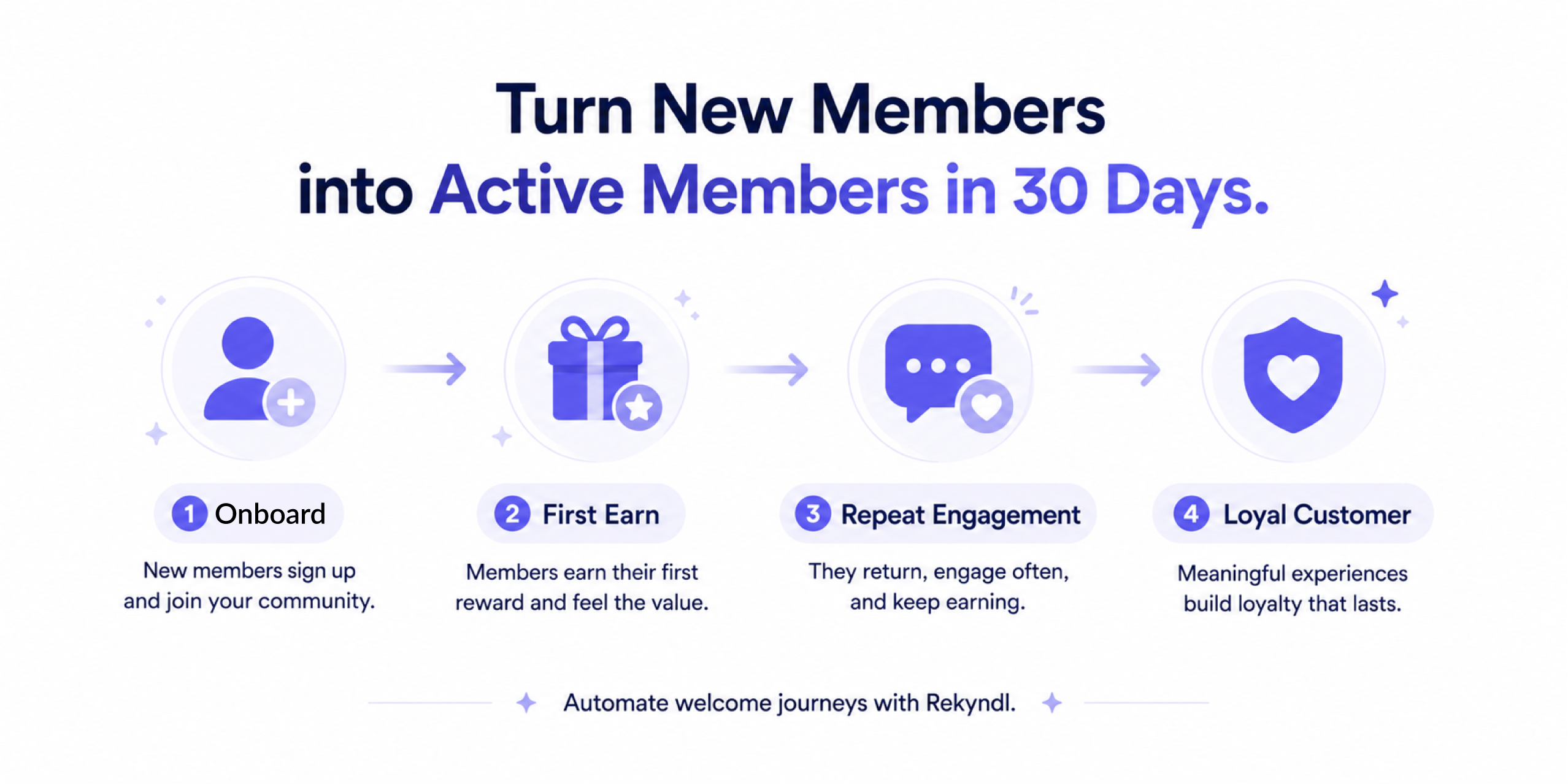
A practical architecture for the first 30 days looks like this:
Build around one primary action
Gartner recommends reducing choice overload in digital journeys. Each touchpoint should therefore promote one primary action rather than multiple competing offers.
For example, a welcome email should focus on profile completion, while a Day 3 message should focus on earning the first points. This sequencing increases completion rates because members make one decision at a time.
Platforms such as Rekyndl support this approach through automated journey builders that trigger messages based on member behaviour, profile status, and engagement milestones. Automation ensures consistent delivery across large member bases while preserving relevance.
For a deeper view of automated loyalty orchestration, see The Reward Store’s Rekyndl feature overview: https://www.therewardstore.com/rekyndl/features.
How to Design a First-Earn Experience That Creates the Habit of Point Accumulation
Behavioural economists have long observed that small early wins increase the likelihood of repeated action. The Endowed Progress Effect, documented in consumer behaviour research, shows that people accelerate participation when they perceive progress toward a goal. Deloitte has also highlighted the importance of immediate reinforcement in customer engagement programmes.
Design principles for the first earn
The first earn should be:
- Achievable within minutes
- Clearly visible
- Meaningful enough to notice
- Connected to a repeatable behaviour
Examples include completing a profile, making a first purchase, scanning a QR code in-store, or engaging with a brand experience.
Show progress visually
Members respond strongly to visible advancement. A progress bar, points balance, or “You are 20% toward your first reward” message creates momentum. Gartner research on digital engagement indicates that visual progress indicators improve task completion in customer journeys.
A useful target is to enable the first earn within 24 hours of enrolment. The longer the delay, the greater the probability of dormancy.
Rekyndl’s gamification capabilities, including QR-based actions, badges, and milestone tracking, help marketing teams create low-friction first-earn experiences without requiring complex development work.
You can also explore related loyalty engagement strategies in The Reward Store’s loyalty insights blog: https://www.therewardstore.com/blogs.
Onboarding Communication Across Channels: Email, SMS, Push, and In-App in the First Two Weeks
Channel orchestration matters as much as message content. McKinsey has found that customers expect consistent experiences across digital and physical touchpoints, while Gartner emphasises that excessive messaging reduces engagement and increases opt-outs.
Recommended first-two-week cadence
Keep messages short and action-oriented
An SMS should contain a single instruction, such as “Complete your profile to unlock your welcome reward.” Email can carry richer content, including benefit categories, earning examples, and redemption guidance.
Coordinate, do not duplicate
If a member completes the desired action after an SMS, suppress the follow-up reminder email. Behaviour-triggered suppression prevents message fatigue and improves relevance.
Rekyndl enables multi-channel journey orchestration from a single workflow, allowing marketing teams to coordinate email, SMS, push, and in-app communication without maintaining separate campaign logic for each channel.
For broader customer engagement automation strategies, see The Reward Store’s Rekyndl platform page: https://www.therewardstore.com/rekyndl/features.
How to Use Early Profile Data to Personalise Welcome Rewards From Day One
Personalisation does not require a large customer data platform. McKinsey reports that consumers are more likely to engage with brands that provide relevant recommendations, and even a small number of declared preferences can materially improve response rates.
Collect only high-value onboarding data
Ask for information that directly influences reward relevance:
- Preferred reward categories
- Travel frequency
- Shopping channel preference
- Birthday month
- Location or region
Match rewards to stated interests
A member who selects travel-related interests should see travel-oriented earning examples, while a member who prefers dining should see dining-related redemption possibilities. Relevance increases perceived value immediately.
Progressive profiling works better than long forms
Gartner recommends progressive data collection because lengthy registration forms increase abandonment. Capture two or three fields at enrolment, then request additional preferences over subsequent interactions.
A simple decision framework is:
Rekyndl can trigger different welcome journeys automatically based on these early profile attributes, enabling personalisation from Day 1 without manual campaign segmentation.
Measuring Welcome Journey Effectiveness: Activation Rate, First-Earn Rate, and 30-Day Retention as Success Metrics
Many loyalty teams track enrolments and open rates, but those metrics do not reveal whether onboarding creates active members. Bain & Company recommends focusing on behavioural outcomes that correlate with long-term value.
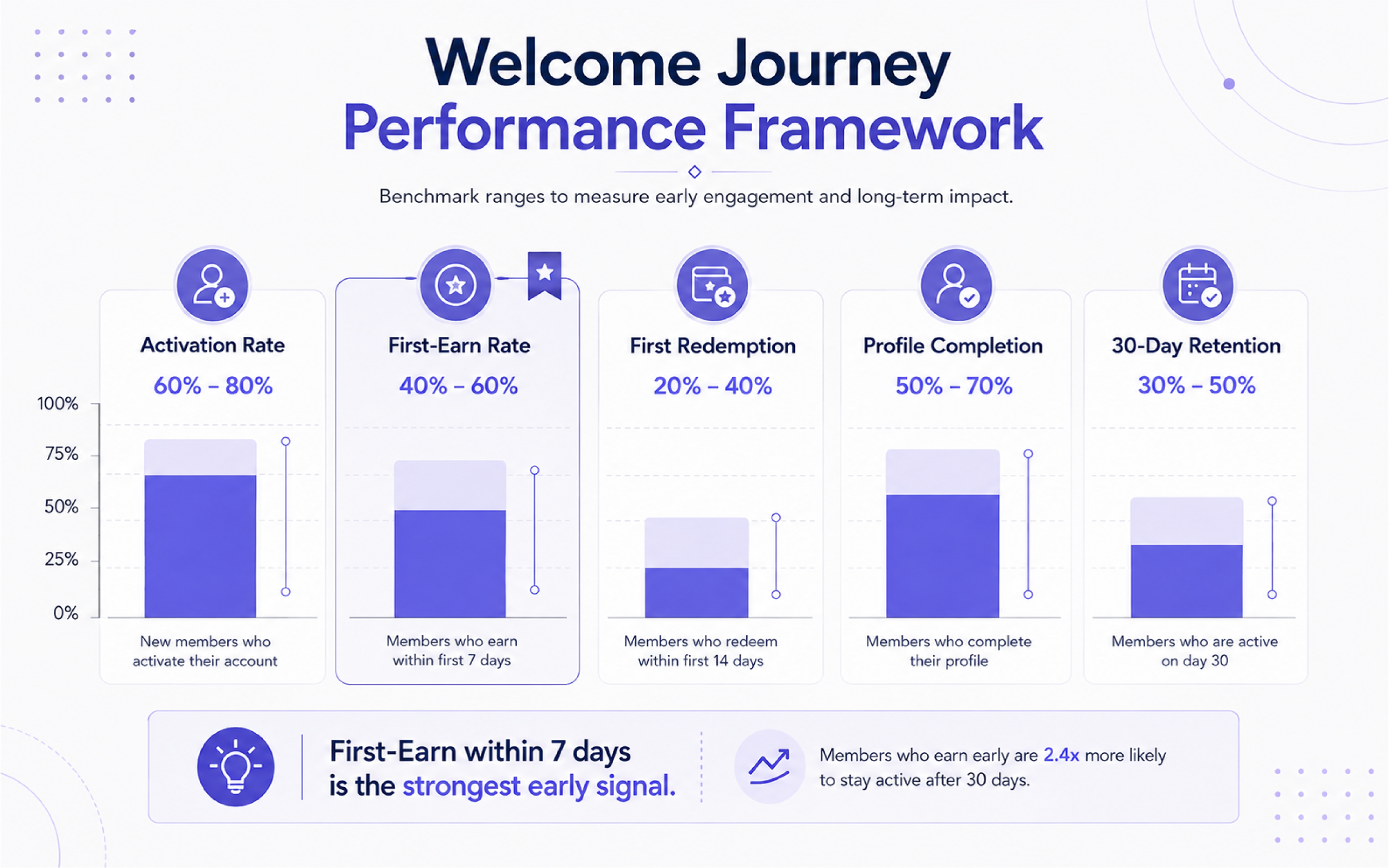
Core onboarding KPIs
Benchmarks vary by industry, but these ranges provide a useful starting point for consumer loyalty programmes.
Measure time-to-value
Track the number of hours from enrolment to first earn. Reducing this interval often produces larger retention gains than increasing welcome reward value.
Run controlled experiments
Test one variable at a time:
- Reward value
- Message timing
- Channel sequence
- Subject line
- Progress indicator design
Forrester recommends continuous journey optimisation because customer behaviour changes over time. A quarterly onboarding review should examine drop-off points, channel contribution, and cohort retention trends.
When these metrics improve together, the welcome journey is creating habit formation rather than temporary promotional activity.
Frequently Asked Questions
What is a loyalty programme welcome journey?
A loyalty programme welcome journey is the sequence of communications, rewards, and actions that a new member experiences during the first days and weeks after joining. Its purpose is to guide the member toward a first earn, first redemption, and repeat engagement. The journey typically includes email, SMS, push, and in-app touchpoints triggered by member behaviour.
How long should a new member onboarding journey last?
Most successful loyalty onboarding journeys run for 30 days. The first 7 days focus on activation and first earn, while Days 8 to 30 reinforce value, introduce additional benefits, and encourage a second qualifying action. Extending the journey beyond 30 days is useful only if engagement remains high.
What is the most important metric for loyalty onboarding?
The most predictive metric is usually first-earn rate within the first 7 days. Early earning indicates that the member understands the programme and has taken a meaningful action. Activation rate and 30-day retention should be reviewed alongside first-earn rate to assess long-term impact.
How many welcome messages should we send in the first month?
For most B2C programmes, 5 to 8 coordinated messages across all channels is sufficient. Focus on relevance and behavioural triggers rather than volume. Suppress reminders once the member completes the target action to avoid fatigue.
Can Rekyndl automate the entire welcome journey?
Yes. Rekyndl includes a journey builder that can automate enrolment triggers, profile-completion nudges, first-earn reminders, milestone messages, and retention campaigns across email, SMS, push, and in-app channels. This allows marketing teams to scale personalised onboarding without manual campaign management.
Conclusion
The first 30 days determine whether a loyalty programme gains an active member or a dormant record. Brands that deliver immediate value, enable a fast first earn, personalise early interactions, and measure behavioural outcomes consistently achieve stronger activation and retention. As loyalty programmes become more data-driven, onboarding will increasingly operate as an adaptive journey that changes in real time based on member behaviour.
The opportunity for Marketing Leaders is clear: redesign onboarding as a conversion journey, not an administrative process.
See how Rekyndl’s journey builder automates welcome journeys that drive first-earn and 30-day activation. Book a demo: https://www.therewardstore.com/rekyndl/features
Sign up for our newsletter for trending top content!


