
How to Use Gamification in Loyalty Programmes: A Decision Guide for Marketing and CX Leaders

Sign up for our newsletter for trending top content!
Introduction
Brands invest millions in loyalty programmes each year, yet many struggle to sustain meaningful customer engagement. Research from McKinsey & Company shows that well designed personalisation and engagement strategies can significantly improve customer satisfaction and revenue growth, while Bain & Company consistently reports that increasing customer retention delivers substantially higher long term profitability than continually acquiring new customers. These findings highlight a simple reality. Loyalty programmes only create value when customers actively participate.
Gamification provides a practical way to encourage that participation, but not every mechanic produces the same outcome. QR code challenges, spin the wheel rewards, badges, leaderboards and progress tracking each influence customer behaviour differently. Marketing and customer experience leaders therefore need a structured approach rather than adding features because competitors have done so.
This guide explains when each gamification mechanic works best, where it creates unnecessary friction, and how organisations can select the right combination to improve participation, retention and customer lifetime value.
Why Gamification Works. And Why Most Loyalty Gamification Fails Within Six Months
Many loyalty initiatives begin with strong adoption before engagement gradually declines. The issue rarely lies with gamification itself. Instead, organisations often deploy mechanics that reward short term activity without reinforcing long term customer habits.
Behavioural research from Deloitte shows that customers respond positively when brands create experiences that combine recognition, achievement and tangible value. Similarly, research published by Gartner suggests that successful digital engagement depends on reducing customer effort while providing meaningful reasons to return.
Customers respond to progress, not novelty
Many organisations introduce a spin mechanic or digital badge at launch and expect engagement to remain high indefinitely. Novelty creates an initial spike, but customers soon lose interest when every interaction feels identical.
Successful loyalty programmes instead create continuous progression through:
- Progressive milestones.
- Personalised challenges.
- Variable reward opportunities.
- Seasonal campaigns.
- Achievement recognition.
Each interaction builds naturally on previous behaviour, giving customers a clear reason to return.
Rewards should reinforce behaviour
Behavioural psychology demonstrates that immediate positive reinforcement strengthens habits more effectively than delayed recognition.
According to research from Forrester, loyalty programmes perform better when customers understand exactly how their actions contribute towards future value.
This means every mechanic should support a measurable business objective.
Instead of asking, "Which game mechanic should we launch?", marketing leaders should ask, "Which customer behaviour do we want to increase?"
Platforms such as Rekyndl support this strategic approach by allowing organisations to combine loyalty rules, customer segmentation and automated journeys with gamification mechanics, ensuring every interaction aligns with a defined commercial objective rather than becoming a standalone campaign.
QR Code Mechanics: When They Drive Engagement and When They Create Friction
QR codes have evolved from simple payment tools into powerful engagement triggers. They connect physical and digital experiences with minimal technology investment, making them particularly valuable for retailers, hospitality brands, consumer goods manufacturers and event organisers.
According to GS1, the rapid adoption of QR technology is transforming how consumers access product information, promotions and digital services. Research from Deloitte also indicates that customers increasingly expect connected digital experiences throughout their purchasing journey.
When QR mechanics perform well
QR based gamification succeeds when scanning creates immediate value.
Effective examples include:
- Product authentication with instant loyalty points.
- In store treasure hunts.
- Event check ins.
- Location specific challenges.
- Interactive educational campaigns.
The customer performs one action and immediately receives feedback, reinforcing participation.
When QR codes create unnecessary friction
Many programmes fail because scanning becomes an additional administrative task rather than an enjoyable experience.
Common problems include:
- Multiple redirects before registration.
- Mandatory form completion before participation.
- Slow mobile experiences.
- Rewards that lack perceived value.
- Requiring repeated scans without meaningful progression.
Every additional step increases abandonment risk. Research from Baymard Institute consistently shows that unnecessary friction reduces completion rates across digital customer journeys.
Marketing leaders should therefore evaluate every QR interaction using one simple question.
Does the customer receive immediate value within seconds of scanning?
If the answer is no, the experience needs redesigning before launch. QR mechanics should remove friction from loyalty participation, not introduce it.
Spin the Wheel and Instant Win. How Surprise Rewards Change Customer Emotional Response
Spin the Wheel and instant win mechanics remain among the most popular forms of loyalty gamification because they combine anticipation with immediate gratification. However, their success depends less on the prize itself and more on the emotional experience they create.
Research from McKinsey & Company highlights that delight occurs when joy and surprise intersect. Even a single well designed moment of delight can positively influence customer loyalty and purchase intent for six to nine months. Similarly, Forrester found that customers value loyalty programmes that balance financial rewards with experiential benefits, creating positive emotions rather than purely transactional relationships.
Design for anticipation, not constant rewards
Many organisations make the mistake of allowing customers to spin after every purchase. Predictability quickly removes excitement and turns the mechanic into another routine transaction.
Higher engagement typically comes from linking spins to meaningful milestones such as:
- Completing a product challenge.
- Reaching a spending threshold.
- Referring a new customer.
- Participating in seasonal campaigns.
- Trying a new product category.
This approach encourages customers to complete valuable behaviours before earning the opportunity to play.
Within Rekyndl, marketers can automate these triggers through customer journeys, segmentation rules and campaign workflows. Instead of offering identical rewards to every participant, organisations can tailor eligibility based on customer value, lifecycle stage or purchasing behaviour.
Most importantly, every participant should receive something of value, even if it is a small reward. Perceived fairness encourages repeat participation, while repeated disappointment often results in customer disengagement.
Badges and Progress Bars. How Visible Achievement Structures Change Long Term Loyalty Behaviour
Financial incentives attract attention, but recognition builds emotional commitment. That distinction explains why badges, progress bars and status levels continue to play a central role in successful loyalty programmes.
Research from McKinsey & Company found that visible recognition creates emotional connections that traditional discounts alone cannot achieve. In one example, recognising loyal customers through digital badges increased share of wallet by 37 per cent despite offering little additional monetary value.
Progress indicators work because they make advancement visible. Customers understand where they stand today and what they need to do next.
Effective achievement structures include:
- Bronze, Silver and Gold membership levels.
- Progress towards exclusive experiences.
- Community contribution badges.
- Sustainability achievements.
- Anniversary milestones.
Each achievement communicates progress rather than simply recording transactions.
Recognition creates identity
Customers increasingly want loyalty programmes to acknowledge who they are rather than only what they buy. Research from Forrester shows that consumers value personalised status, exclusive treatment and recognition alongside financial rewards.
This principle explains the continued success of programmes such as Marriott Bonvoy and World of Hyatt, where visible status communicates progression throughout the customer journey instead of rewarding isolated purchases.
Marketing leaders should therefore design badge systems that reinforce valuable customer behaviours over months and years. Badges lose credibility when every action earns another achievement. Customers should feel they have genuinely earned recognition.
Leaderboards in Consumer Loyalty. When Competition Helps and When It Drives Disengagement
Leaderboards can create excitement, increase participation and encourage repeat engagement. They can also discourage the majority of customers if designed without careful consideration.
Research published in Information Systems Research demonstrates that badges and leaderboards encourage participation through social comparison and achievement, but their effectiveness varies significantly across customer groups. Likewise, McKinsey notes that public recognition can strengthen emotional engagement by making loyalty visible within a customer's wider community.
When leaderboards work well
Leaderboards perform best when participants believe they have a realistic chance of improving their position.
Suitable use cases include:
- Local community competitions.
- Monthly challenges.
- Fitness campaigns.
- Sustainability initiatives.
- Referral contests.
Frequent resets allow new participants to compete without feeling permanently disadvantaged.
When leaderboards reduce engagement
Problems arise when the same small group dominates rankings indefinitely. New customers often conclude that catching up is impossible and simply stop participating.
Marketing leaders should therefore consider alternatives such as:
Rather than asking customers to compete against everyone, organisations should help them compete against peers with similar purchasing patterns or lifecycle stages.
This balanced approach supports healthy competition while ensuring that loyalty remains inclusive. The objective is sustained participation across the entire customer base, not temporary engagement from a small group of highly active customers.
A Decision Framework for Choosing the Right Gamification Mechanics for Your Customer Segment
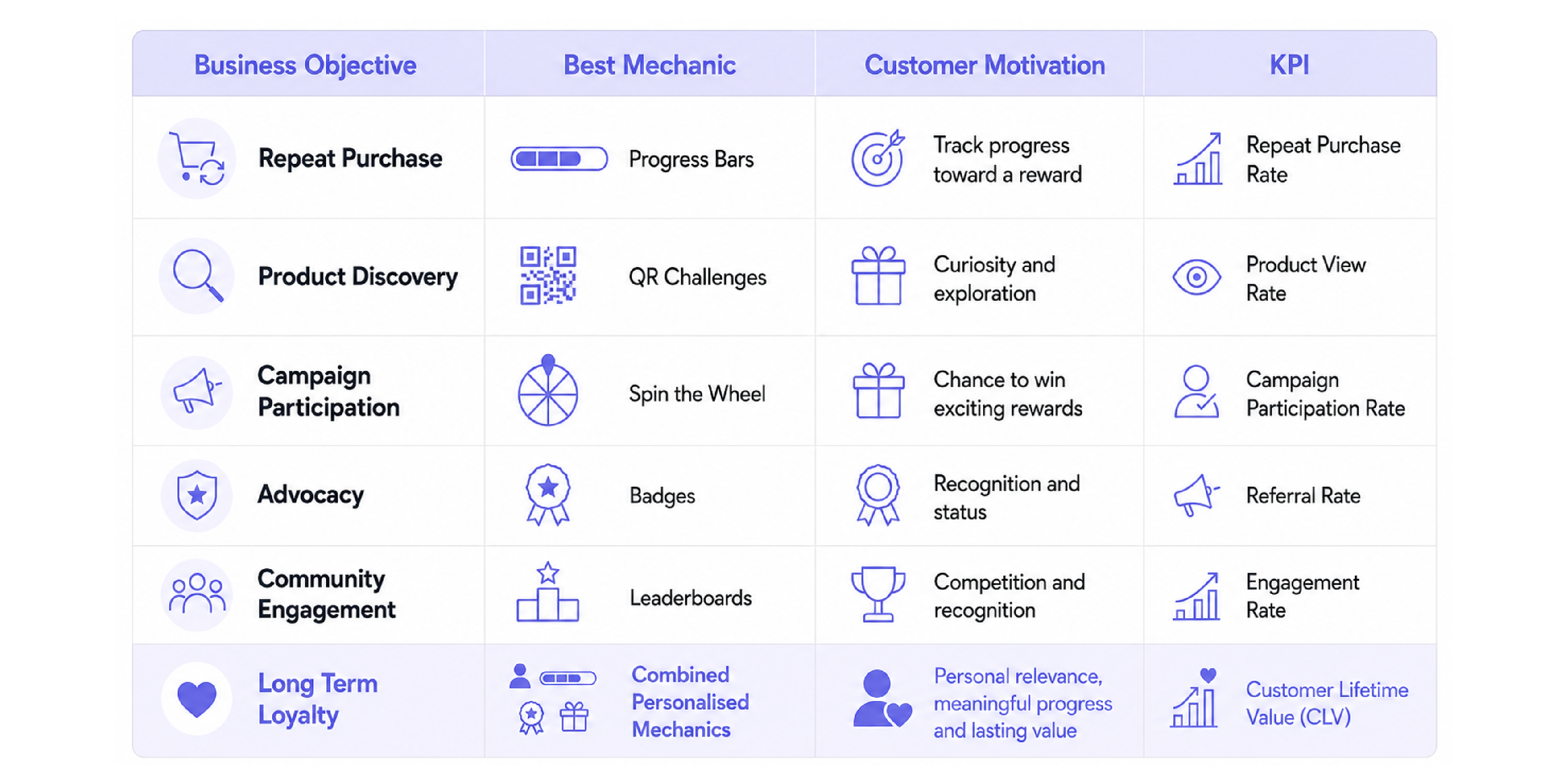
Selecting the right gamification mechanic starts with understanding customer motivation rather than following market trends. Research from Bain & Company consistently shows that loyalty programmes create the greatest commercial value when they encourage behaviours that strengthen long term customer relationships, rather than simply rewarding transactions. Likewise, Gartner advises organisations to align digital engagement initiatives with measurable business outcomes instead of adopting features without a defined objective.
Senior marketing leaders should therefore assess each mechanic against four questions.
- What customer behaviour do we want to encourage?
- What level of effort will customers accept?
- Does this mechanic reinforce long term habits or only short term activity?
- Can we measure commercial impact beyond engagement metrics?
The following framework provides a practical starting point.
No single mechanic suits every audience. A younger digital first customer base may respond positively to competitive experiences, while premium customers often place greater value on exclusivity, recognition and personalised rewards.
This is where an integrated platform such as Rekyndl becomes valuable. Marketing teams can combine QR based challenges, automated journeys, gamified missions, personalised offers and an integrated redemption storefront within one platform. Rather than launching isolated campaigns, organisations can create a connected loyalty experience that evolves alongside customer behaviour.
The most effective loyalty programmes do not ask which feature is most exciting. They ask which experience is most likely to change customer behaviour in a measurable way.
Frequently Asked Questions
What is the best gamification mechanic for a loyalty programme?
There is no universal answer. The most effective mechanic depends on the behaviour you want to encourage. Progress bars work well for repeat purchases, while QR code challenges suit location based campaigns and instant win mechanics can increase campaign participation. Successful programmes often combine several mechanics instead of relying on one.
How do QR codes improve customer loyalty?
QR codes connect physical and digital experiences with minimal effort. Customers can scan packaging, in store displays or event materials to unlock points, missions or exclusive rewards. The experience succeeds when the reward is immediate and the process requires very few steps.
Why do many loyalty gamification initiatives lose engagement?
Many programmes focus on short term excitement instead of long term behavioural change. Customers quickly lose interest if every interaction feels repetitive or if rewards lack relevance. Regularly introducing new missions, personalised offers and visible progression helps maintain engagement over time.
Can gamification increase customer lifetime value?
Yes. Research from Bain & Company and McKinsey & Company demonstrates that improving customer retention and encouraging repeat engagement contributes directly to higher customer lifetime value. Gamification supports this objective by making desirable behaviours more rewarding and easier to repeat.
How does Rekyndl support loyalty programme gamification?
Rekyndl enables organisations to build personalised loyalty journeys using QR code campaigns, Spin the Wheel promotions, badges, customer segmentation, automated marketing journeys and an integrated redemption storefront. Marketing teams can launch, manage and measure these experiences from a single platform while aligning every mechanic with commercial objectives.
Conclusion
Gamification succeeds when it encourages meaningful customer behaviours rather than simply adding entertainment to a loyalty programme. The most effective organisations align every mechanic with a measurable business objective, reduce customer effort and continuously adapt experiences based on behavioural data.
As customer expectations continue to evolve, loyalty programmes will become increasingly personalised, automated and behaviour driven. Marketing leaders who build flexible engagement strategies today will be better positioned to strengthen retention, increase customer lifetime value and create lasting competitive advantage.
.png)
Explore Rekyndl's Gamification Capabilities
Discover how Rekyndl helps marketing teams design QR code campaigns, personalised customer journeys, Spin the Wheel promotions, badges, automated rewards and integrated redemption experiences that drive measurable loyalty outcomes.
Sign up for our newsletter for trending top content!


