
Why Do Loyalty Programmes Fail During the First Year?

Sign up for our newsletter for trending top content!
Introduction
Launching a loyalty programme is only the beginning. Sustaining customer engagement during the first year determines whether the programme becomes a strategic growth engine or an underperforming marketing initiative. According to Bain & Company, increasing customer retention by just 5 per cent can increase profits by 25 to 95 per cent, making early programme success a critical commercial priority. Yet many loyalty programmes struggle to maintain participation after launch because they focus on enrolment instead of long-term engagement.
This guide explores why loyalty programmes lose momentum during their first year, the most common programme design mistakes, how Marketing Leaders can improve early adoption and retention, and the strategies that create sustainable customer loyalty from day one.
Why Do Loyalty Programmes Fail During the First Year?
Many organisations measure success by the number of customers who join a loyalty programme. However, enrolment alone does not indicate meaningful engagement. Programmes fail when members do not understand the value proposition, struggle to earn meaningful rewards, or lose interest before reaching their first redemption.
According to Forrester, customer loyalty depends on consistently delivering valuable experiences rather than simply offering transactional incentives. If customers cannot quickly see tangible benefits, participation often declines within the first few months.
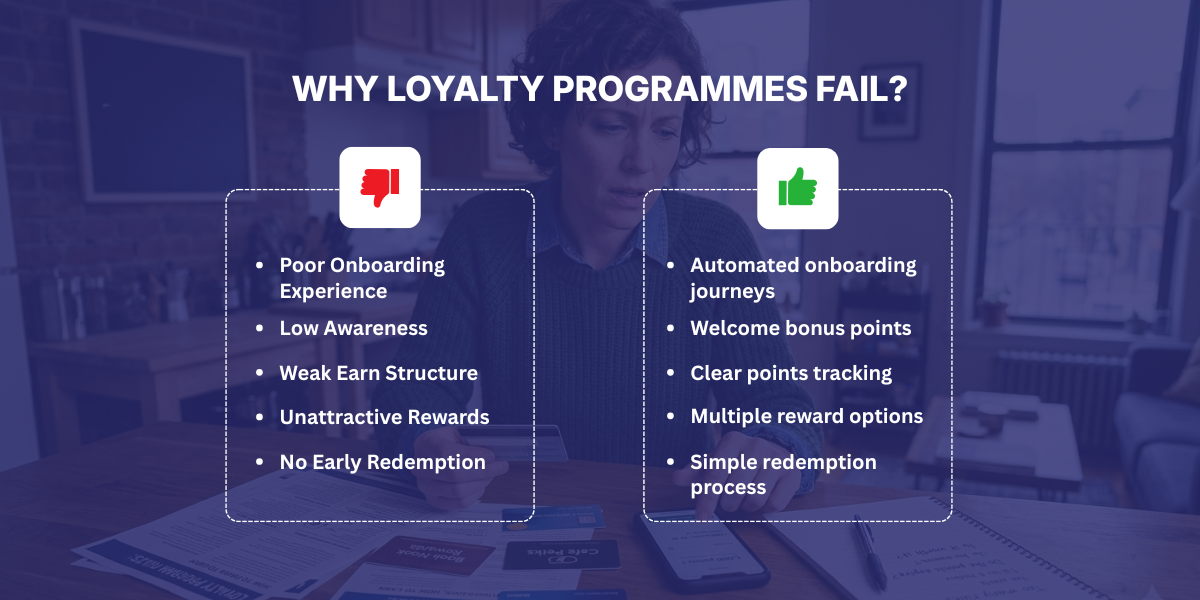
Common first-year challenges include:
- Unclear programme value.
- Complex earning rules.
- Slow reward accumulation.
- Limited redemption options.
- Poor onboarding journeys.
- Inconsistent customer communication.
Marketing Leaders should therefore treat the first year as an optimisation period rather than a completed implementation. Early customer behaviour provides valuable insights into engagement barriers, allowing organisations to refine programme design before participation declines significantly.
What Are the Most Common Programme Design Mistakes?
Programme design directly influences long-term participation. Customers expect loyalty programmes to be simple, relevant, and rewarding. When programmes become difficult to understand or provide limited perceived value, engagement decreases.
According to McKinsey, personalisation improves customer satisfaction because relevant experiences reduce friction and strengthen emotional connection. Loyalty programmes should apply the same principle by tailoring rewards and communications to customer preferences.
Common design mistakes include:
Marketing Leaders should also avoid designing programmes around internal processes instead of customer behaviour. A successful loyalty programme should make it easy for members to understand how they earn rewards, what they can redeem, and why continued participation benefits them.
How Should Marketing Leaders Build a Successful First-Year Strategy?
Strong first-year performance depends on continuous engagement rather than a successful launch alone. Marketing Leaders should build programmes that guide customers from enrolment to first redemption as quickly as possible while reinforcing value throughout the customer journey.
A practical first-year framework includes:
According to Deloitte, organisations that continuously improve customer experiences create stronger loyalty because they adapt programmes based on customer behaviour rather than assumptions. Loyalty programmes should therefore evolve throughout the first year using redemption data, campaign performance, and customer feedback.
Marketing Leaders should also introduce new campaigns, seasonal promotions, and personalised reward recommendations to maintain momentum after launch. Continuous optimisation helps prevent early disengagement while encouraging long-term participation.
The most successful first-year loyalty strategies focus on building customer habits rather than simply increasing membership numbers.
How Does Rekyndl Support Successful Loyalty Programme Implementation?
Launching a loyalty programme successfully requires more than technology. Marketing Leaders need a platform that supports onboarding, customer engagement, personalisation, analytics, and continuous optimisation throughout the programme lifecycle.
According to McKinsey, organisations that use customer data to personalise experiences achieve stronger engagement and higher customer satisfaction. Loyalty platforms should therefore help brands respond to customer behaviour in real time rather than relying on static campaigns.
Rekyndl supports successful implementation by enabling organisations to:
Customers can redeem rewards across a broad catalogue that includes gift cards from more than 5,000 brands, hotel bookings, flight bookings, dining vouchers, sports experiences, golf experiences, merchandise, bus bookings, concierge services, and curated experiences. This variety enables organisations to deliver rewards that remain relevant throughout the customer lifecycle while reducing programme fatigue.
What Framework Should Marketing Leaders Use to Reduce Early Programme Churn?
Preventing churn requires proactive engagement rather than reactive retention campaigns. Marketing Leaders should identify points where customers typically lose interest and design interventions before disengagement occurs.
A practical churn prevention framework includes:
According to Forrester, organisations that continuously optimise customer experiences achieve higher retention because they remove friction before it affects loyalty. Early intervention helps maintain customer momentum during the critical first year.
Regular campaign testing, customer feedback, and behavioural analytics also enable Marketing Leaders to refine communications, improve reward relevance, and sustain participation.
Which Metrics Predict Long Term Loyalty Success?
Programme performance should be measured using behavioural indicators rather than enrolment numbers alone. High registration volumes have limited value if customers never engage or redeem rewards.
Marketing Leaders should monitor:
According to Bain & Company, long-term customer profitability depends on sustained engagement rather than one-time transactions. These metrics help organisations identify opportunities to improve programme performance before participation declines.
Combining behavioural analytics with customer feedback provides a more complete understanding of programme effectiveness and supports continuous optimisation.
Frequently Asked Questions
Why do most loyalty programmes fail in year one?
Most loyalty programmes lose momentum because customers do not experience value quickly enough. Complicated earning rules, limited reward choice, weak onboarding, and infrequent communication often reduce participation during the first year.
What are the top loyalty programme design mistakes?
Common mistakes include delaying the first reward, offering limited redemption options, failing to personalise communications, creating complex programme rules, and measuring success only through enrolment rather than engagement.
How do you prevent early programme churn?
Marketing Leaders should encourage early earning opportunities, simplify redemption, personalise customer journeys, monitor behavioural data, and optimise campaigns continuously. Early engagement is often the strongest predictor of long-term participation.
Can Rekyndl support loyalty programme implementation?
Yes. Rekyndl supports programme implementation through automated customer journeys, behaviour-based campaigns, personalisation, analytics, tier management, and an integrated rewards catalogue designed to improve long-term customer engagement.
When should loyalty programmes be reviewed after launch?
Programme performance should be monitored continuously, with detailed reviews conducted monthly during the first year. Regular optimisation helps organisations improve engagement, reduce churn, and adapt to changing customer expectations.
Conclusion
The first year determines whether a loyalty programme becomes a sustainable competitive advantage or an underused marketing initiative. By simplifying programme design, encouraging early engagement, personalising customer experiences, and continuously refining performance through analytics, Marketing Leaders can build loyalty programmes that retain members well beyond launch.
As customer expectations continue to evolve, organisations that prioritise continuous optimisation will be best positioned to create lasting customer relationships.
Discover how Rekyndl helps organisations launch, manage, and optimise loyalty programmes through automated customer journeys, personalisation, analytics, and an integrated rewards ecosystem that keeps customers engaged from day one.
Sign up for our newsletter for trending top content!


