
How to Turn Your Loyalty Programme Into an Always-On Customer Intelligence Engine

Sign up for our newsletter for trending top content!
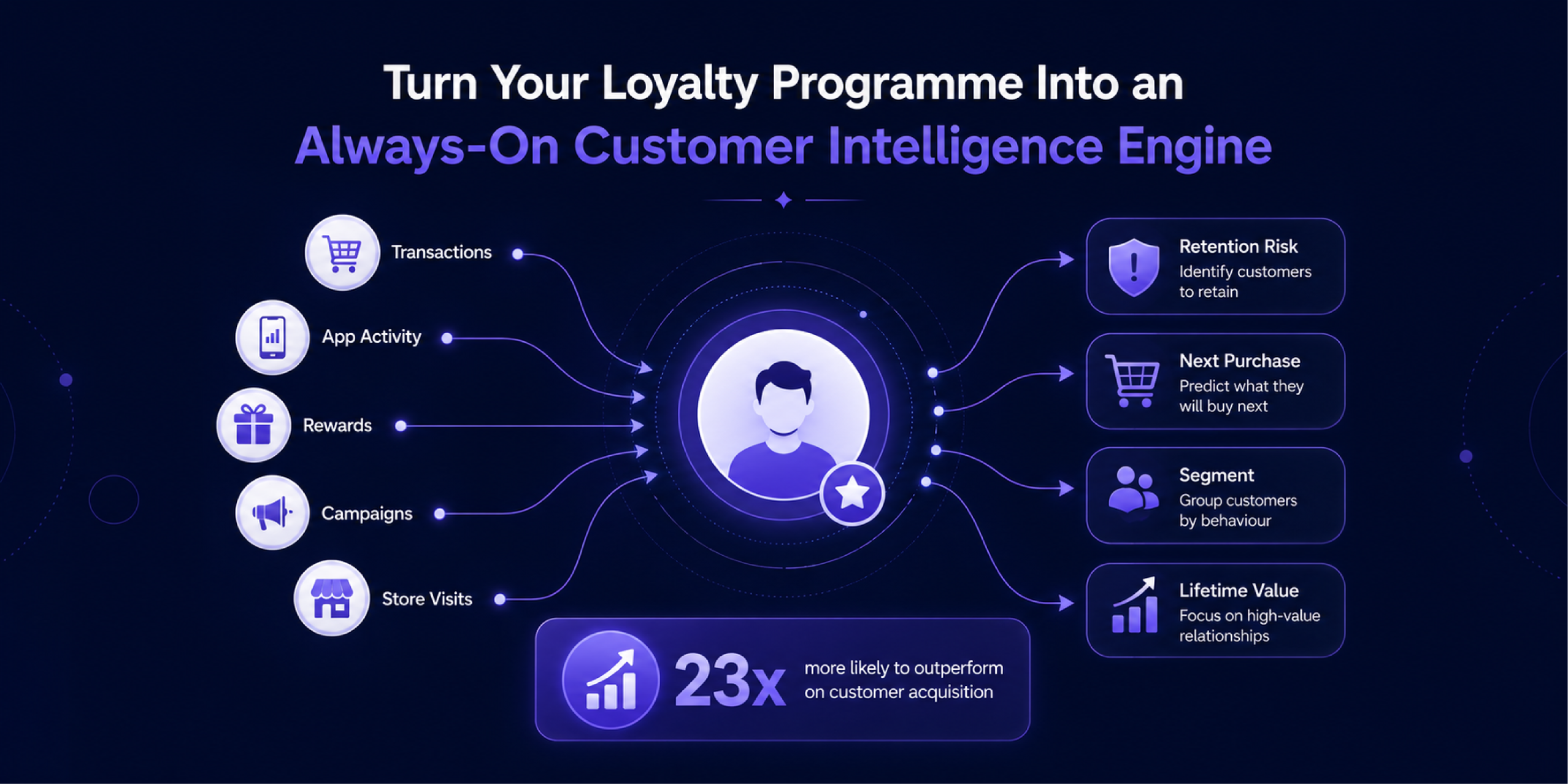
A McKinsey study found that companies using customer analytics extensively are 23 times more likely to outperform competitors in customer acquisition and 19 times more likely to achieve above-average profitability. Yet many loyalty programmes still function as little more than digital stamp cards. They collect transaction data, reward redemptions, and campaign responses, but rarely convert those signals into actionable customer intelligence.
For Marketing Leaders, this gap creates a measurable cost: irrelevant campaigns, slower decision-making, and missed revenue opportunities. Loyalty data already contains behavioural patterns that can reveal customer value, churn risk, product affinity, and future purchase intent.
The challenge is not collecting more data; it is structuring, analysing, and activating the data you already have. This article explains how to transform a loyalty programme into an always-on customer intelligence engine that continuously generates insights, powers segmentation, and informs both marketing and product strategy.
Why Loyalty Programmes Collect Customer Data That Most Brands Never Actually Use
Most loyalty programmes capture far more data than marketing teams actively analyse. Every purchase, redemption, visit, app interaction, and campaign response creates a behavioural signal. According to Gartner, organisations often use only a fraction of the customer data they collect for decision-making, leaving significant commercial value untapped.
The problem usually begins with programme design. Many brands optimise for enrolment volume rather than insight quality. They ask for demographic details during sign-up, then fail to connect those details with transactional and engagement behaviour. McKinsey reports that companies generating the highest returns from customer analytics integrate behavioural, transactional, and interaction data into a unified customer view.
Three operational barriers appear repeatedly:
- Siloed systems: Loyalty, e-commerce, CRM, and customer service data remain disconnected.
- Delayed reporting: Teams review monthly dashboards instead of daily behavioural changes.
- Campaign-centric thinking: Data analysis starts only when a campaign is planned.
A modern loyalty platform should continuously consolidate customer interactions and surface insights automatically. This is where platforms such as Rekyndl become valuable. By combining loyalty data with marketing automation and customer engagement workflows, marketing teams can move from retrospective reporting to ongoing behavioural intelligence.
The commercial impact is substantial. Bain & Company found that increasing customer retention by 5% can increase profits by 25% to 95%, depending on the industry. Retention improvements become far more achievable when brands identify behavioural changes before customers disengage.
The Four Customer Insights a Well-Designed Loyalty Programme Generates Automatically
A well-designed loyalty programme should generate four categories of customer intelligence without requiring manual analysis. Deloitte’s research on customer engagement shows that organisations that use behavioural data effectively achieve stronger customer advocacy and higher lifetime value.
1. Purchase frequency trends
Track how often customers transact and how that frequency changes over time. A decline in purchase cadence often signals churn risk weeks before a customer stops buying altogether.
2. Category affinity
Analyse which product categories customers repeatedly choose together. This reveals cross-sell opportunities and helps merchandising teams understand emerging preferences.
3. Reward preference signals
Redemption choices indicate what customers value most: convenience, experiences, travel, dining, or merchandise. These preferences often predict future purchasing behaviour more accurately than stated survey responses.
4. Engagement responsiveness
Measure how customers react to email, SMS, push notifications, in-app offers, and in-store prompts. Forrester has found that contextually relevant engagement significantly improves customer response rates compared with generic campaigns.
When these insights update continuously, the loyalty programme becomes an operational intelligence layer rather than a static rewards database.
How to Build Customer Segments From Loyalty Data That Actually Predict Behaviour
Many brands still segment customers by age, gender, or geography. Those variables describe customers; they rarely predict what customers will do next. McKinsey has shown that behaviour-based segmentation produces materially stronger marketing performance than demographic segmentation alone.
Start with three predictive dimensions:
Recency
How recently did the customer purchase?
Frequency
How often does the customer purchase?
Monetary value
How much does the customer spend?
This RFM foundation remains effective because it captures actual customer behaviour. Enhance it with engagement signals such as app usage, redemption activity, and response to promotions.
The critical step is automation. Static quarterly segmentation quickly becomes outdated. Rekyndl supports dynamic segmentation, allowing customers to move between segments automatically as their behaviour changes. Gartner emphasises that real-time customer segmentation improves campaign relevance and reduces wasted marketing spend.
Predictive segmentation also improves measurement. Instead of asking whether a campaign performed well overall, marketing teams can evaluate whether it changed behaviour within a specific segment, such as at-risk customers or new members.
Using Loyalty Data to Inform Product Decisions, Not Just Marketing Campaigns
Loyalty data becomes far more valuable when product and merchandising teams use it alongside marketing. Customer transactions reveal unmet demand, emerging preferences, and declining product relevance. Deloitte’s consumer research highlights that behavioural data often identifies preference shifts earlier than traditional market research.
Consider three product intelligence applications:
- Feature prioritisation: Frequent repeat purchases of a product variant indicate strong market fit.
- Assortment optimisation: Low repeat purchase rates may signal poor product-market fit.
- Bundle design: Basket analysis reveals products customers naturally purchase together.
Suppose loyalty members repeatedly buy premium accessories alongside a core product. That pattern may justify a bundled offering, dedicated merchandising space, or a subscription package.
Bain & Company has found that companies with strong customer-centric operating models align product, marketing, and service decisions around shared customer insight. Loyalty data provides that shared evidence base.
Marketing teams should establish a monthly “customer intelligence review” with product leaders. Discuss:
- Fastest-growing categories among loyalty members.
- Categories with falling repeat purchase rates.
- Emerging high-value customer cohorts.
- Reward redemption trends that suggest changing customer priorities.
This practice turns loyalty analytics into a cross-functional growth tool rather than a marketing reporting exercise.
How Real-Time Loyalty Analytics Change the Speed at Which Marketing Teams Can React to Behaviour Shifts
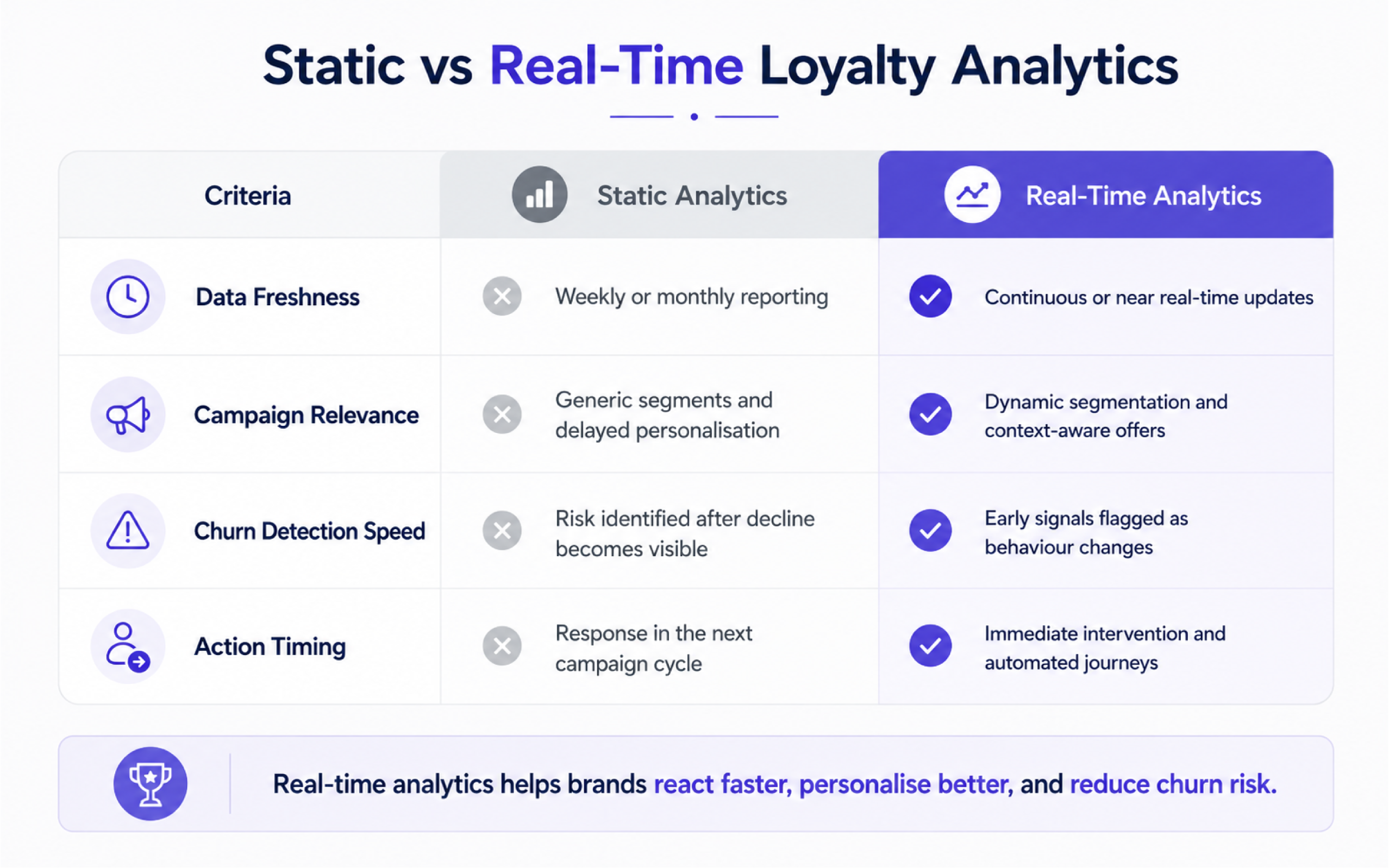
Traditional marketing reporting cycles often run weekly or monthly. Customer behaviour changes daily. Gartner has identified decision latency as a major barrier to marketing effectiveness, particularly in digitally active customer bases.
Real-time loyalty analytics reduce that latency by surfacing behavioural shifts as they occur. Examples include:
- Sudden decline in purchase frequency.
- Spike in browsing without purchase.
- Abandoned cart after reward eligibility.
- Increased engagement with a specific category.
- High redemption activity following a campaign.
The operational difference is significant.
Forrester research shows that timely, context-aware engagement materially improves customer response compared with delayed outreach.
With an integrated loyalty and marketing automation platform, teams can trigger actions automatically. A customer whose purchase frequency drops below a defined threshold can enter a win-back journey immediately. A customer who reaches a spend milestone can receive a personalised reward within minutes.
This speed matters most during market volatility. When customer preferences shift because of pricing changes, seasonality, or economic conditions, brands with real-time loyalty intelligence detect the change first and adapt campaigns before competitors recognise the trend.
Privacy-First Loyalty Data: How to Use Customer Intelligence Without Crossing Consent Boundaries
Customer intelligence is valuable only when customers trust how their data is used. Deloitte’s privacy research shows that consumers are significantly more willing to share data when organisations communicate clear value in exchange for that data.
A privacy-first loyalty strategy should follow four principles:
Collect only what supports a defined use case
Avoid gathering demographic fields that do not influence personalisation, service, or programme operations.
Make consent specific
Separate consent for loyalty membership, marketing communications, and data-driven personalisation.
Provide visible customer value
Customers are more likely to maintain data-sharing permissions when they receive relevant rewards, personalised offers, and improved service.
Enable easy preference management
Allow members to update communication preferences, channels, and consent settings without friction.
McKinsey has reported that organisations that build strong customer trust around data practices achieve higher engagement and retention. Privacy therefore becomes a growth enabler, not merely a compliance requirement.
Rekyndl supports permission-based engagement workflows, helping brands activate loyalty insights while respecting customer consent preferences across channels.
Marketing Leaders should treat privacy metrics with the same seriousness as campaign metrics. Monitor consent rates, preference updates, opt-out trends, and customer trust indicators alongside revenue and retention performance.
Frequently Asked Questions
What is loyalty programme data analytics?
Loyalty programme data analytics is the process of analysing member transactions, engagement activity, reward redemptions, and campaign responses to identify customer behaviour patterns. The goal is to improve retention, personalisation, customer lifetime value, and marketing effectiveness. Unlike basic reporting, analytics focuses on predicting future behaviour and triggering actions automatically.
How does customer segmentation improve loyalty programme performance?
Segmentation allows brands to tailor offers, rewards, and communication based on actual customer behaviour rather than broad demographic assumptions. Behaviour-based segments typically achieve higher engagement and conversion rates because they reflect purchase intent and value. Dynamic segmentation also helps marketing teams prioritise high-risk and high-value customers.
Can loyalty data support product and merchandising decisions?
Yes. Loyalty transactions reveal category affinity, repeat purchase behaviour, and emerging demand trends. Product teams can use these insights to prioritise features, optimise assortments, design bundles, and identify declining product relevance earlier than traditional market research.
How often should loyalty customer segments be updated?
For most consumer businesses, segments should update continuously or at least daily. Monthly segmentation can miss important behavioural changes such as churn risk or increased purchase intent. Real-time or near-real-time updates enable faster and more relevant customer engagement.
How does Rekyndl help with customer intelligence and segmentation?
Rekyndl combines loyalty programme management, customer segmentation, behavioural analytics, and marketing automation in a single platform. It can automatically move customers between segments as their behaviour changes and trigger personalised journeys across email, SMS, push notifications, and in-app channels. This helps marketing teams act on loyalty insights without manual data processing.
Conclusion
A loyalty programme becomes strategically valuable when it stops acting like a rewards database and starts acting like a customer intelligence engine. The same interactions that fund rewards can reveal churn risk, product affinity, emerging demand, and future customer value in near real time.
Over the next few years, the competitive advantage will shift toward brands that combine loyalty data, behavioural analytics, and automated activation into a single operating system for customer growth. Marketing teams that build this capability now will make faster decisions, personalise with greater precision, and retain more profitable customers.
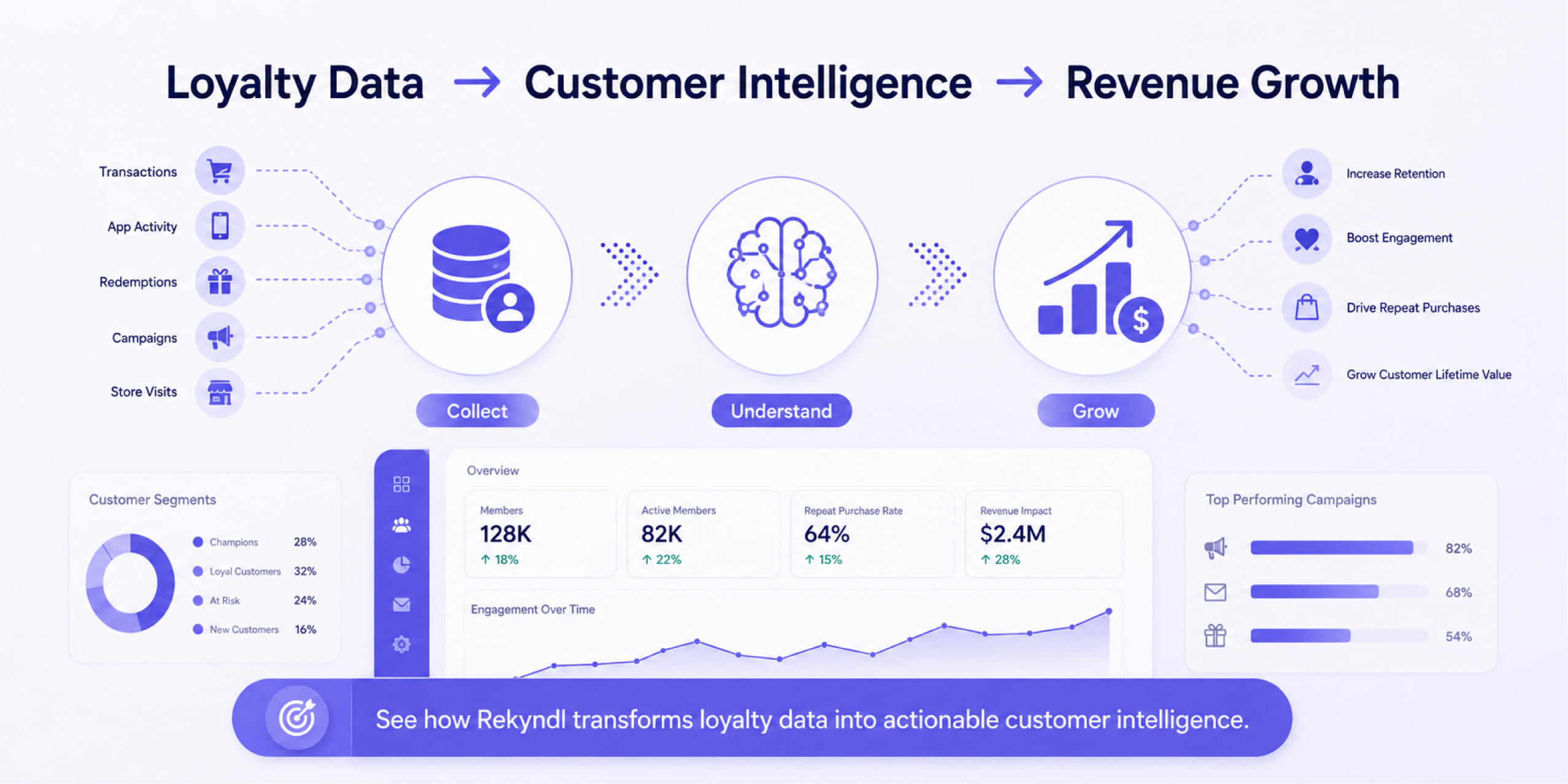
See how Rekyndl turns loyalty data into actionable customer intelligence. Book a demo: https://www.therewardstore.com/rekyndl/features
Sign up for our newsletter for trending top content!


