
How to Use Loyalty Rewards to Recover Abandoned Carts and Convert Intent Into Purchase

Sign up for our newsletter for trending top content!
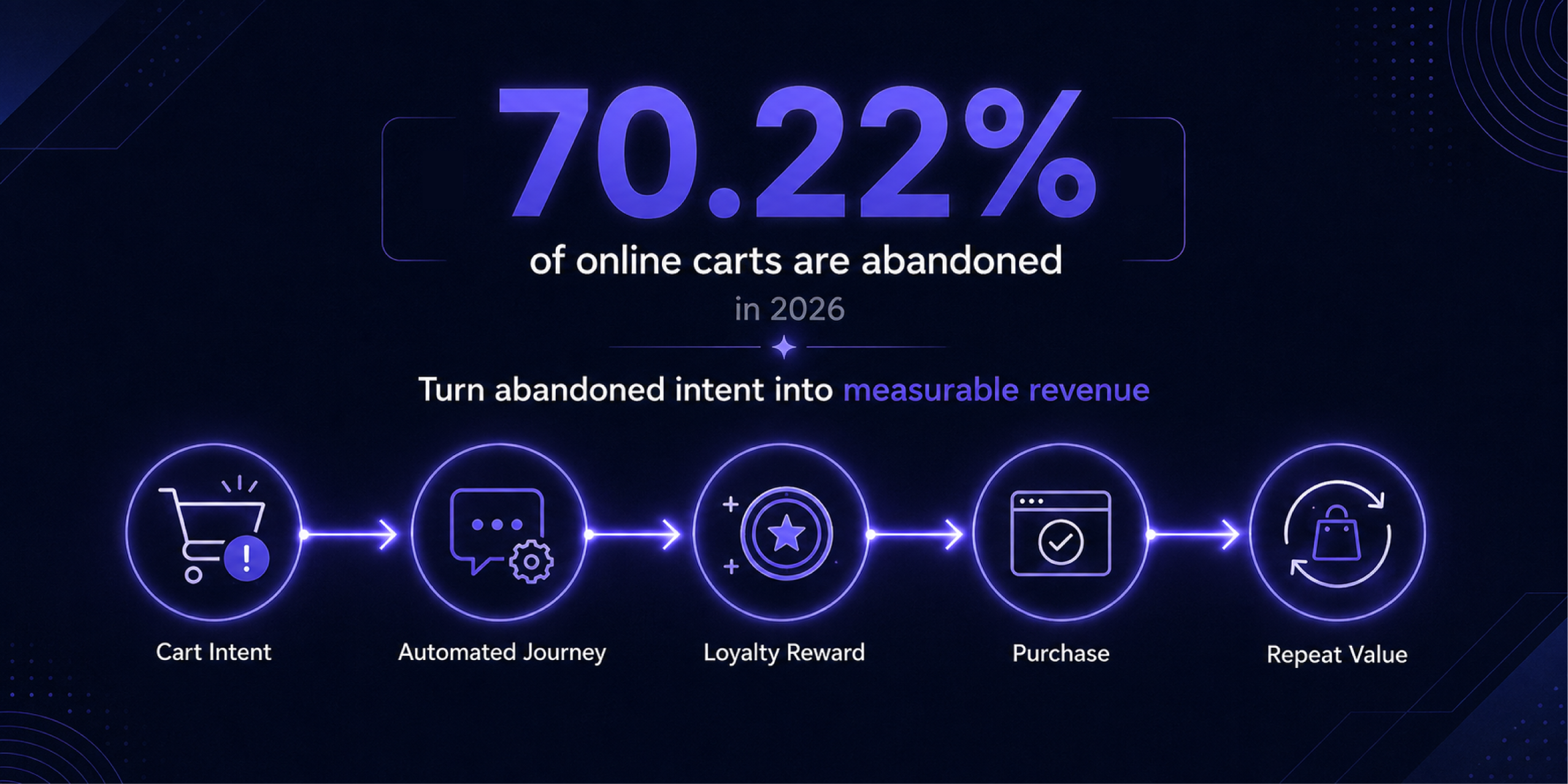
Baymard Institute puts the average online cart abandonment rate at 70.22% in 2026. That means most visitors who add a product to their cart still leave without completing the transaction.
For Marketing Leaders, the problem is not simply lost orders. It is wasted acquisition spend, weaker conversion efficiency and missed opportunities to turn high-intent visitors into repeat customers. A recovery strategy that relies on increasingly large discounts can also put pressure on margin and condition customers to wait for an offer.
The better approach is to connect cart recovery to a loyalty programme. This article explains how to use points, personalised rewards, customer tiers and automated journeys to recover abandoned carts without making discounting the centre of your retention strategy.
Why Discount-Led Cart Recovery Trains Customers to Abandon Deliberately and What to Do Instead
Discounts can recover demand, but they should not become the default response to every abandoned cart. Deloitte's 2025 Consumer Loyalty Program Survey found that 72% of consumers said loyalty programmes make them more likely to spend with their preferred brand, while 56% said programmes increase their spending. The research also found that loyalty value extends beyond price, with consumers responding to ongoing benefits, personalised experiences and relevant programme features.
The strategic risk is straightforward: if customers repeatedly receive a better price after abandoning a basket, some will learn that waiting has value. This is a behavioural inference rather than a universal rule, but it creates a strong case for separating cart recovery from blanket discounting.
Replace price reduction with earned value
A loyalty reward changes the message from "come back for a cheaper price" to "complete this purchase and increase your programme value". That distinction matters because the reward can reinforce both the immediate transaction and the future relationship.
McKinsey found that leading loyalty programmes can increase annual revenue from customers who redeem points by 15% to 25%, through higher purchase frequency or basket size.
A practical recovery offer might therefore include:
- Bonus points for completing the abandoned purchase.
- A higher points multiplier on selected categories.
- Additional points for reaching a basket threshold.
- Tier progress linked to the purchase.
- Access to experiential rewards rather than another price cut.
For Marketing Leaders, the objective is not to remove incentives. It is to make the incentive create more than one commercial outcome.
Points as a Cart Recovery Mechanic: The Psychology of Why Earning Beats Saving
Points can make cart recovery more effective because they frame the purchase as progress rather than simply a cost. The customer does not only see money leaving their account. They see an opportunity to earn value that can be used later.
McKinsey's loyalty research identifies bonus points, challenges, games and targeted reminders as mechanisms that can increase earning activity. Its 2026 Australian Consumer Loyalty Survey also found that consumers increasingly favour immediate reinforcement, visible progress and rewards that can be earned and redeemed quickly.
That makes points particularly useful when a customer has already demonstrated intent by adding products to a basket.
Make the reward close to the behaviour
A cart recovery reward should have a clear connection with the action you want:
Add to cart → abandon → receive reminder → complete purchase → earn bonus points → redeem later.
The reward should also feel attainable. Deloitte's 2024 Consumer Loyalty Survey found that 86% of respondents considered financial rewards, simplicity and ease of use important or very important attributes of a loyalty programme. Four in five consumers also valued flexibility in earning and redeeming rewards.
This means points should not disappear into a complicated programme structure. Show the customer what they will earn, when they will receive it and what they can do with it.
The redemption experience matters too. McKinsey found that simplifying redemption and providing more options can strengthen loyalty programme value.
The result is a recovery mechanism that reinforces the current purchase while creating a reason to return.
Sequencing Your Cart Abandonment Journey: How Many Touches, Over What Timeline, With What Reward
There is no universal number of messages or fixed timetable that guarantees cart recovery. The right sequence depends on purchase frequency, product consideration time, basket value and customer behaviour. Marketing Leaders should therefore treat timing as a testable journey variable rather than a permanent rule.
A practical starting framework is:
The first message should focus on the basket and any friction that may have prevented completion. The second can introduce the loyalty value. The third should use stronger motivation only where the expected customer value justifies it.
McKinsey recommends defining the specific behaviour a loyalty programme should drive and then designing incentives around that behaviour. Deloitte similarly highlights personalised, flexible loyalty experiences as important to sustained engagement.
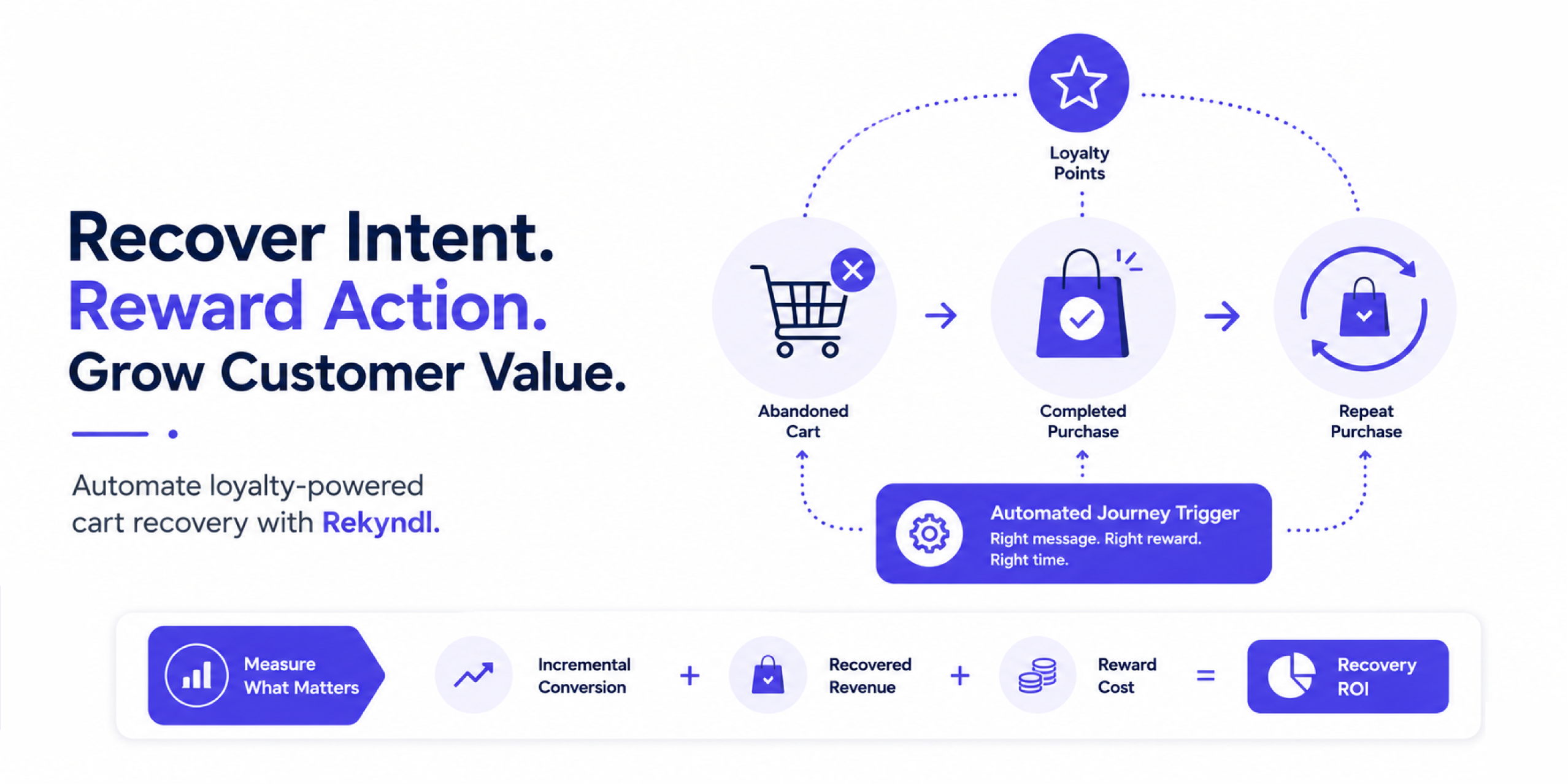
Rekyndl can support this model by combining customer segmentation, journey automation and loyalty rewards within the same customer lifecycle. Marketing teams can build event-triggered journeys rather than manually coordinating each campaign.
For a broader view of loyalty journey design, see How Rekyndl's Built-In Marketing Automation Turns a Loyalty Programme Into a Customer Retention Engine.
How to Personalise Cart Recovery Rewards Based on Cart Value and Customer Tier
A £30 cart from a new customer should not necessarily receive the same recovery incentive as a £300 cart from a high-value loyalty member. Treating both customers identically can waste reward budget and underinvest in customers with greater potential lifetime value.
McKinsey's research shows that companies that excel at personalisation generate 40% more revenue from personalisation than average players. It also found that 71% of consumers expect personalised interactions, while 76% become frustrated when brands fail to provide them.
A useful decision framework is:
The important principle is to reward incremental behaviour, not simply customer presence.
For example, a customer close to a loyalty tier threshold could receive bonus points that help them reach the next tier. A high-margin category could receive a multiplier. A price-sensitive segment could receive a lower-cost points incentive rather than a direct discount.
Deloitte's 2025 research found that personalised experiences are increasingly important, particularly among younger loyalty members, while McKinsey recommends using customer analytics to tailor incentives to specific behaviours.
For Marketing Leaders, this turns cart recovery from a blanket campaign into a controlled investment based on customer value, behaviour and expected return.
Double Points Campaigns vs Fixed Bonus Points: Which Format Drives Higher Recovery Rates
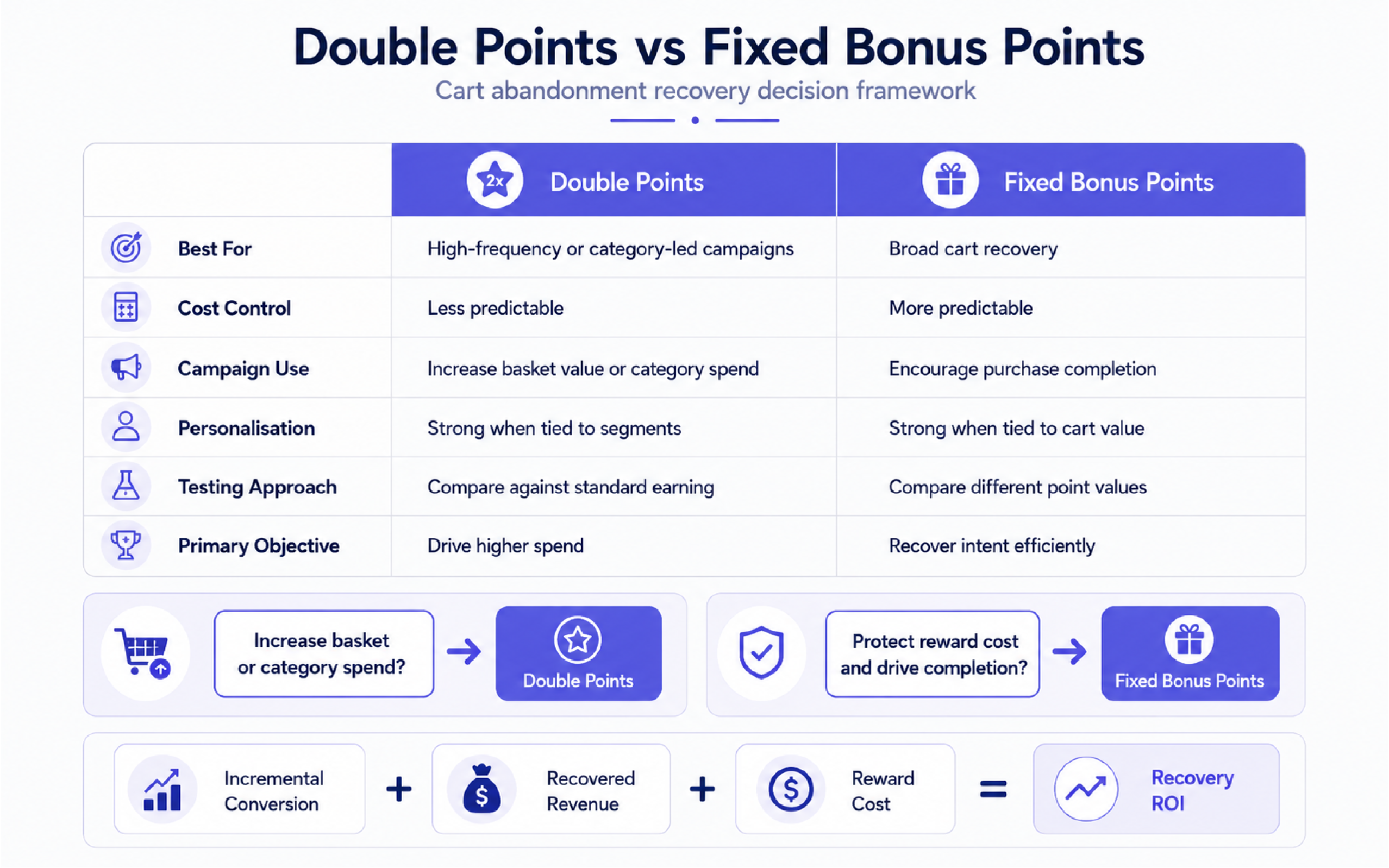
Neither format is universally superior. The right choice depends on the customer, the basket economics and the behaviour the campaign needs to change.
McKinsey identifies bonus points and multipliers as effective loyalty mechanics, while its research also stresses that incentives should connect directly to a defined business objective.
Use this framework when deciding between the two:
Choose double points when you want customers to increase spend, purchase a priority category or respond to a time-bound campaign.
Choose fixed bonus points when you want tighter control over reward cost and need a simple recovery incentive across different basket sizes.
The key measurement is not which offer produces the highest gross recovery rate. It is which offer produces the highest incremental profit after reward cost.
Deloitte's loyalty research reinforces the importance of balancing meaningful financial rewards with programme profitability and customer relevance.
A controlled A/B test should compare the reward format against a no-reward recovery journey and measure incremental conversion, recovered revenue, average order value and reward cost.
Measuring Cart Recovery ROI: Recovered Revenue, Incremental Conversion, and Cost Per Recovery
A cart recovery programme should not report success using recovered orders alone. Marketing Leaders need to know whether the campaign created incremental revenue that would not otherwise have happened.
McKinsey's loyalty research shows that high-performing programmes can increase revenue from point redeemers by 15% to 25%, but it also warns that around two-thirds of established loyalty programmes fail to deliver value. The implication is clear: activity metrics are not enough. The programme must prove commercial value.
Track at least five measures:
- Recovered revenue: Revenue from customers who abandoned and subsequently purchased.
- Incremental conversion: The difference between conversion in the recovery group and a comparable control group.
- Cost per recovery: Reward cost and campaign cost divided by incremental recovered orders.
- Incremental gross margin: Additional margin after reward and communication costs.
- Repeat purchase impact: Whether recovered customers purchase again within a defined period.
The most important metric is incremental conversion. If 10% of customers in a recovery campaign purchase, that does not mean the campaign caused all 10% of those purchases.
A holdout group provides a stronger baseline. For example, if 10% of the recovery group purchases and 7% of the control group purchases, the campaign's incremental conversion is 3 percentage points.
Bain has long linked retention economics with profitability, reporting that a 5% increase in customer retention can increase profits by 25% to 95%, depending on the business context.
For Marketing Leaders, the strategic goal is therefore not simply recovering abandoned carts. It is recovering profitable demand while creating a stronger reason for the customer to return.
Frequently Asked Questions
What is loyalty programme cart abandonment recovery automation?
Loyalty programme cart abandonment recovery automation uses customer behaviour, loyalty data and automated journeys to re-engage shoppers who leave items in their basket. The journey can trigger reminders, points offers, tier benefits or personalised rewards. The aim is to recover purchase intent without relying exclusively on discounts.
How can loyalty points recover abandoned carts?
Points give customers an additional reason to complete a purchase by turning the transaction into progress towards a future reward. McKinsey research identifies bonus points and multipliers as useful loyalty engagement mechanisms. The strongest programmes make the earning and redemption value clear and easy to understand.
When should I offer a reward for an abandoned cart?
Do not automatically reward every abandoned cart. Start with a reminder, then introduce a points incentive when the customer, basket value or expected lifetime value justifies it. Test timing and reward value using a control group so that the business measures incremental conversion rather than simply counting recovered orders.
Can Rekyndl automate abandoned cart recovery journeys?
Yes. Rekyndl combines loyalty programme management, customer segmentation, marketing automation and reward redemption. Marketing teams can use behavioural triggers to create personalised journeys across channels such as email, SMS, push notifications and in-app engagement.
Why should Marketing Leaders use points instead of discounts for cart recovery?
Points can support the immediate purchase while also creating future value for the customer. This can help the brand avoid making price reductions the only reason to return. Deloitte's research shows that customers increasingly value loyalty programmes that combine financial rewards with flexibility and personalised experiences.
For more on using loyalty data to drive targeted customer journeys, see How Loyalty Programme Data and Analytics Create Better Customer Intelligence.
Conclusion
Cart abandonment recovery works best when brands treat abandoned baskets as signals of purchase intent rather than automatic requests for a discount. Loyalty points, personalised incentives and automated journeys can recover demand while building future customer value.
The next phase of loyalty will connect behavioural data, real-time decisioning and rewards closely enough to respond to intent as it happens. For Marketing Leaders, the opportunity is to make every recovery journey measurable, personalised and commercially disciplined.
See how Rekyndl automates loyalty-powered cart abandonment journeys. Book a demo
Sign up for our newsletter for trending top content!


