
How Can Marketing Leaders Choose Loyalty Platforms Built for Regulatory Environments?

Sign up for our newsletter for trending top content!
Introduction
Regulation shapes every customer engagement initiative in banking, financial services, insurance, and fintech. According to Deloitte, trust remains one of the strongest competitive differentiators in financial services, making regulatory compliance a strategic business requirement rather than simply a legal obligation. At the same time, McKinsey reports that personalisation and digital engagement have become major drivers of customer loyalty. Marketing Leaders therefore face a dual challenge: delivering compelling loyalty experiences while ensuring every campaign complies with industry regulations, privacy requirements, and governance standards.
This guide explains why regulated industries need specialised loyalty platforms, the compliance capabilities Marketing Leaders should prioritise, how governance can coexist with customer experience, and which evaluation framework helps organisations select a future-ready loyalty platform.
Why Do Regulated Industries Need Specialised Loyalty Platforms?
Unlike retail or hospitality loyalty programmes, financial services loyalty initiatives operate within a tightly governed regulatory environment. Every reward, campaign, customer communication, and redemption workflow must align with internal policies and applicable regulations.
Banks, insurers, and fintech organisations process highly sensitive customer information. Marketing campaigns therefore depend on secure data management, permission-based communications, audit trails, and transparent governance.
According to Deloitte's Global Financial Services Industry Outlook, financial institutions continue to increase investment in digital transformation while strengthening governance and operational resilience. Loyalty platforms play an important role because they manage customer data, engagement rules, reward allocation, and campaign execution across multiple channels.
Marketing Leaders should therefore avoid viewing loyalty platforms as marketing tools alone. Instead, they should evaluate them as enterprise systems capable of supporting:
- Customer consent management.
- Secure data handling.
- Configurable approval workflows.
- Reward governance.
- Campaign auditability.
- Multi-channel engagement.
- Regulatory reporting.
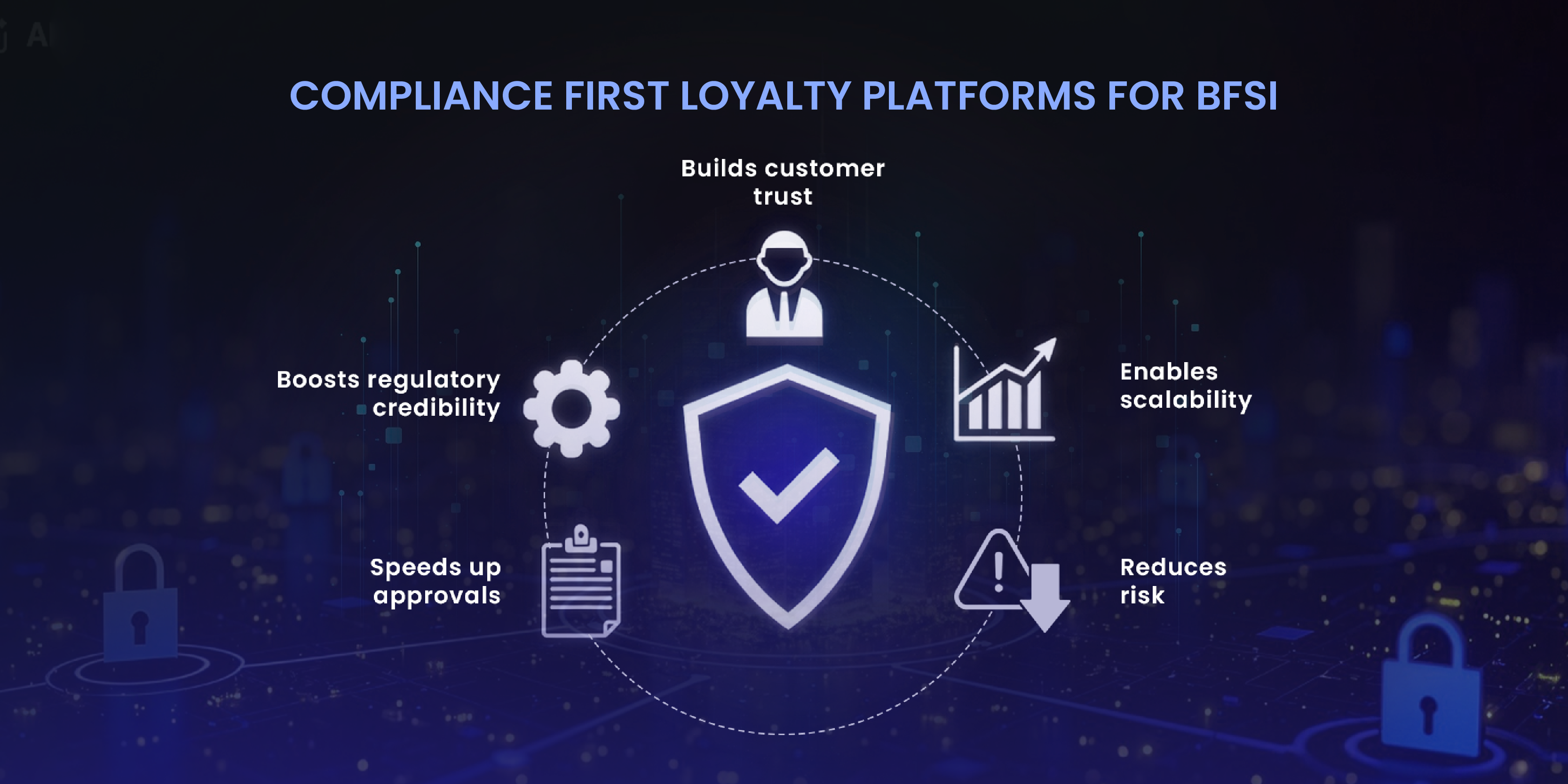
This broader perspective helps organisations reduce compliance risk while improving customer engagement across increasingly complex digital journeys.
What Regulatory Requirements Should a Loyalty Platform Support?
Compliance requirements differ across jurisdictions, but most regulated organisations expect loyalty platforms to demonstrate strong governance, security, and operational transparency.
Marketing Leaders should evaluate platforms against the following framework:
For organisations operating in India, compliance may include requirements relating to data privacy, financial sector guidance, and industry-specific regulatory expectations. Insurance providers must also consider guidance issued by the Insurance Regulatory and Development Authority of India (IRDAI) when designing customer engagement initiatives.
According to Forrester, customer trust increasingly depends on transparent digital experiences supported by secure technology platforms. Marketing Leaders should therefore prioritise governance features that strengthen trust without creating unnecessary friction for customers.
The strongest loyalty platforms combine compliance controls with flexible campaign management, enabling marketers to launch personalised programmes while maintaining organisational oversight.
How Can Marketing Leaders Balance Compliance and Customer Experience?
One of the biggest misconceptions about regulation is that stronger governance automatically reduces marketing agility. In practice, modern loyalty platforms can improve both compliance and customer experience when they automate governance rather than relying on manual approvals.
According to McKinsey, organisations that excel in personalisation combine high quality customer data with disciplined governance and advanced technology. Marketing Leaders should therefore build loyalty programmes that incorporate compliance throughout the customer journey instead of treating it as a final review stage.
A practical decision framework includes:
This approach enables organisations to personalise customer journeys without compromising governance.
Customers also expect transparency. Loyalty programmes should clearly explain eligibility criteria, reward validity, redemption conditions, and campaign rules. Consistent communication improves trust while reducing customer service enquiries and regulatory risk.
Marketing Leaders who integrate governance into programme design create loyalty initiatives that satisfy compliance teams and deliver engaging customer experiences at the same time.
What Features Should a Compliance Ready Loyalty Platform Include?
A loyalty platform for banking, financial services, insurance, and fintech must deliver more than campaign management. It should provide enterprise-grade governance that enables Marketing Leaders to launch engaging programmes without compromising compliance, security, or operational control.
A practical evaluation framework includes the following capabilities:
According to Forrester, trust increasingly depends on transparent digital experiences supported by secure technology. A compliance-ready loyalty platform therefore becomes a strategic asset that helps Marketing Leaders build customer confidence while maintaining operational agility.
The platform should also support configurable reward catalogues, campaign segmentation, lifecycle automation, and flexible redemption options. These capabilities allow organisations to personalise loyalty experiences while maintaining governance across every customer interaction.
How Does Rekyndl Support Loyalty Programmes for Financial Services?
Marketing Leaders require loyalty technology that combines customer engagement with enterprise governance. Rekyndl has been designed to help organisations build personalised loyalty journeys while maintaining operational oversight and compliance controls.
Rather than relying on disconnected marketing tools, Rekyndl brings together customer segmentation, behavioural triggers, campaign automation, loyalty management, and reward fulfilment within one platform.
A typical financial services loyalty journey can include:
- Customer onboarding.
- Consent-based communications.
- Behaviour-triggered campaigns.
- Points earning and redemption.
- Personalised offers.
- Automated lifecycle engagement.
- Reward fulfilment through an integrated marketplace.
- Analytics and campaign reporting.
The Reward Store's integrated ecosystem also provides access to gift cards from more than 5,000 brands, hotel bookings, flight bookings, dining vouchers, sports experiences, merchandise, concierge services, bus bookings, and curated experiences. Marketing Leaders can therefore offer meaningful rewards without managing multiple fulfilment partners.
By combining automation with governance, Rekyndl helps financial institutions improve customer engagement while supporting internal approval processes and operational transparency.
What Framework Should Marketing Leaders Use When Evaluating a Loyalty Platform?
Selecting a loyalty platform should involve more than comparing features. Marketing Leaders need a structured framework that considers compliance, scalability, customer experience, and long-term business value.
A practical decision guide includes five evaluation areas:
According to Bain & Company, loyalty programmes generate greater long-term value when they strengthen customer relationships instead of simply encouraging transactions. Marketing Leaders should therefore prioritise platforms that combine operational efficiency with meaningful customer engagement.
Evaluation should also include implementation support, reporting capabilities, integration flexibility, reward catalogue management, and future product development. A platform that evolves alongside regulatory expectations will continue to deliver value as customer needs and compliance requirements change.
Frequently Asked Questions
What regulatory requirements must a loyalty platform meet in India?
A loyalty platform should support data privacy, secure customer information management, consent-based communications, audit trails, role-based access, and configurable governance workflows. Organisations should also ensure the platform aligns with applicable industry regulations and internal compliance policies.
How does IRDAI affect insurance loyalty programmes?
Insurance organisations must ensure customer engagement activities align with applicable IRDAI regulations and guidelines. Marketing teams should work closely with compliance and legal teams to confirm that loyalty campaigns, rewards, and communications remain consistent with regulatory expectations.
Why is governance important in loyalty programme management?
Governance ensures loyalty campaigns operate transparently, fairly, and consistently. Approval workflows, reporting, audit logs, and configurable business rules help organisations reduce compliance risks while maintaining customer trust.
Can Rekyndl support regulated loyalty programmes?
Yes. Rekyndl supports customer segmentation, marketing automation, configurable campaign journeys, reward management, reporting, and governance capabilities that help financial institutions deliver compliant loyalty programmes at scale.
When should organisations review their loyalty platform?
Marketing Leaders should review platform performance regularly, particularly when regulations change, new products launch, or customer engagement strategies evolve. Periodic reviews help ensure the platform continues to support compliance, security, and business growth.
Conclusion
Loyalty programmes in regulated industries require far more than attractive rewards. Marketing Leaders need platforms that combine governance, security, automation, and customer engagement within a single ecosystem. By selecting a compliance-ready loyalty platform, organisations can strengthen trust, simplify operations, and deliver personalised customer experiences without compromising regulatory requirements. As financial services continue to digitise, loyalty technology will become an increasingly important driver of sustainable customer relationships and competitive differentiation.
See how Rekyndl helps banks, insurers, and fintech organisations build compliant, personalised loyalty programmes with marketing automation, governance, and an integrated rewards ecosystem.
https://www.therewardstore.com/rekyndl/solutions/financial-services-fintech
Sign up for our newsletter for trending top content!


