
How to Redesign Your Long Service Award Programme So Employees Actually Look Forward to Milestone Anniversaries

Sign up for our newsletter for trending top content!
Introduction
Long service awards remain one of the most common recognition investments in large organisations, yet many employees struggle to remember what they received for their last milestone anniversary. O.C. Tanner’s Global Culture Report found that employees who receive meaningful recognition are significantly more likely to feel connected to their organisation and less likely to be actively seeking another job. When milestone recognition feels generic, organisations lose a valuable retention opportunity.
For HR leaders, the challenge is not whether to recognise tenure. It is whether a 5, 10 or 15 year award creates a genuine emotional moment or becomes an administrative transaction. This article explains how to redesign a long service award programme design 5 10 15 year framework that employees anticipate rather than ignore. You will learn the psychology behind milestone recognition, how reward choice increases perceived value, how to balance public recognition with personal comfort, and how automation prevents missed anniversaries across large workforces.
Why Most Long-Service Award Programmes Feel Like an Afterthought and Why That Matters
Many long service programmes were designed years ago around payroll convenience rather than employee experience. A standard certificate, a fixed-value gift and a quarterly email announcement may satisfy a policy requirement, but they rarely create a memorable recognition moment.
SHRM’s research consistently shows that employees who feel recognised are more engaged and more likely to stay with their employer. Gallup also reports that recognition is a critical driver of engagement and retention. When milestone awards feel impersonal, organisations send an unintended signal that tenure is noticed but not truly valued.
Common design flaws
- The same reward for every employee at a milestone.
- Delayed recognition because HR runs anniversary checks manually.
- No manager involvement.
- No connection between the employee’s contribution and the award.
- Recognition delivered privately when employees expect acknowledgement.
The financial impact is larger than many HR teams estimate. Replacing experienced employees often costs several months of salary once recruitment, onboarding and productivity loss are included, according to SHRM and other workforce studies.
A useful redesign starts with one question: Would an employee tell their family or colleagues about this milestone experience? If the answer is no, the programme is functioning as a compliance exercise rather than a culture investment.
For organisations reviewing their broader recognition strategy, The Reward Store’s employee rewards and recognition platform outlines how milestone recognition can sit within a continuous recognition ecosystem rather than a once-a-decade event.
The Psychology of Milestone Recognition: What Makes a 5, 10 or 15 Year Award Feel Meaningful
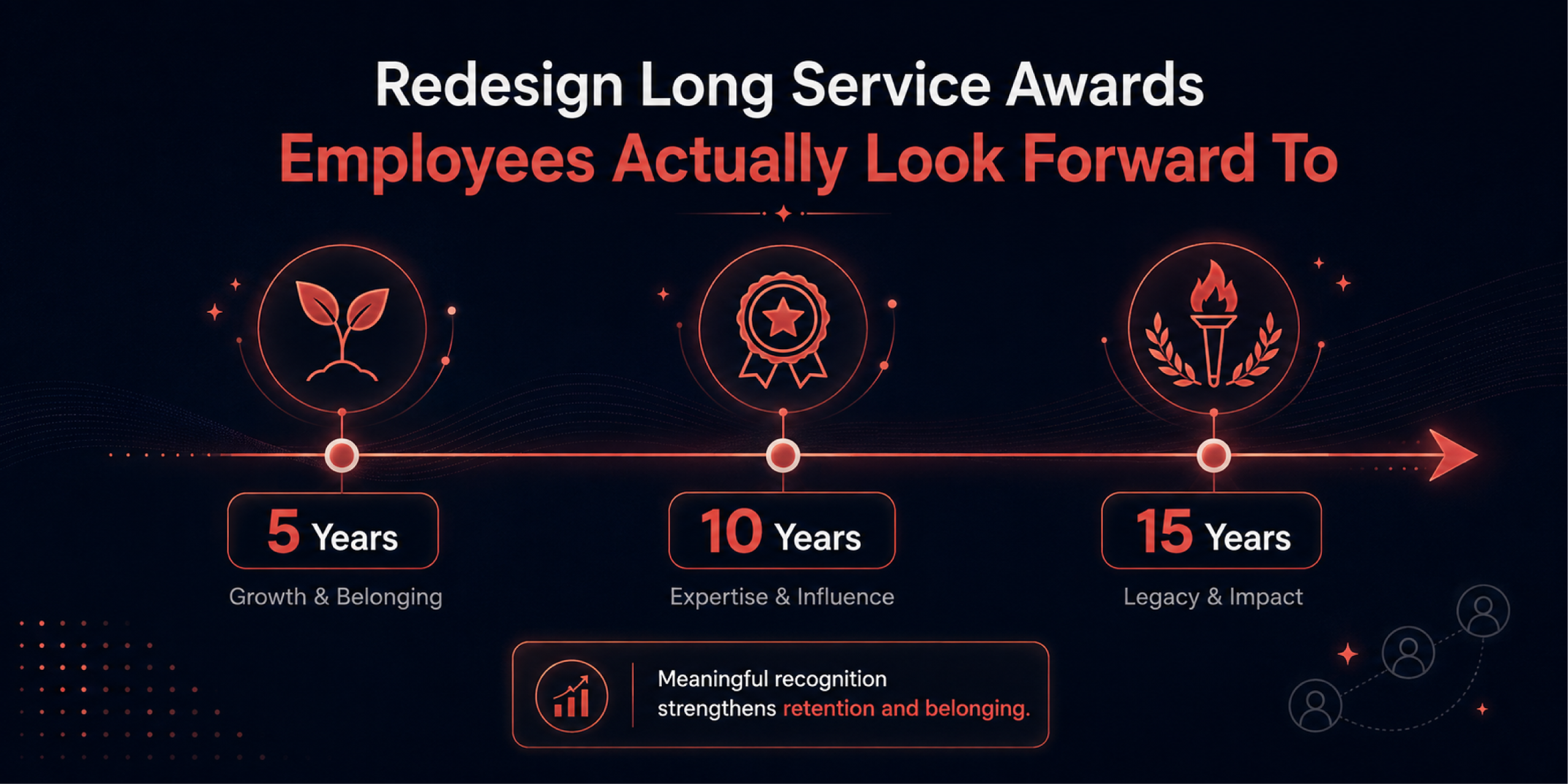
A 5 year anniversary represents early career commitment. A 10 year anniversary signals identity and expertise. A 15 year anniversary often reflects deep organisational knowledge and personal sacrifice. Treating all three milestones identically ignores how employees interpret tenure psychologically.
O.C. Tanner’s research shows that recognition becomes more meaningful when it is personal, timely and connected to contribution. Deloitte’s human capital research similarly highlights that employees value appreciation that acknowledges their unique impact, not just their presence.
A practical milestone framework
Three elements that increase emotional impact
1. Personal narrative
Ask the manager to include a short message describing a specific contribution, project or behaviour.
2. Visible effort
Employees notice when the organisation invests thought into the experience. A curated reward selection feels more meaningful than a standard item.
3. Timeliness
Recognition delivered on or near the actual anniversary carries far more emotional weight than recognition delivered weeks later.
McKinsey’s research on employee experience shows that moments that acknowledge identity and contribution disproportionately influence how employees remember their employer. The milestone award is one of the few predictable opportunities HR has to create such a moment.
Choice Architecture: Why Giving Employees Reward Selection Control Increases Perceived Value
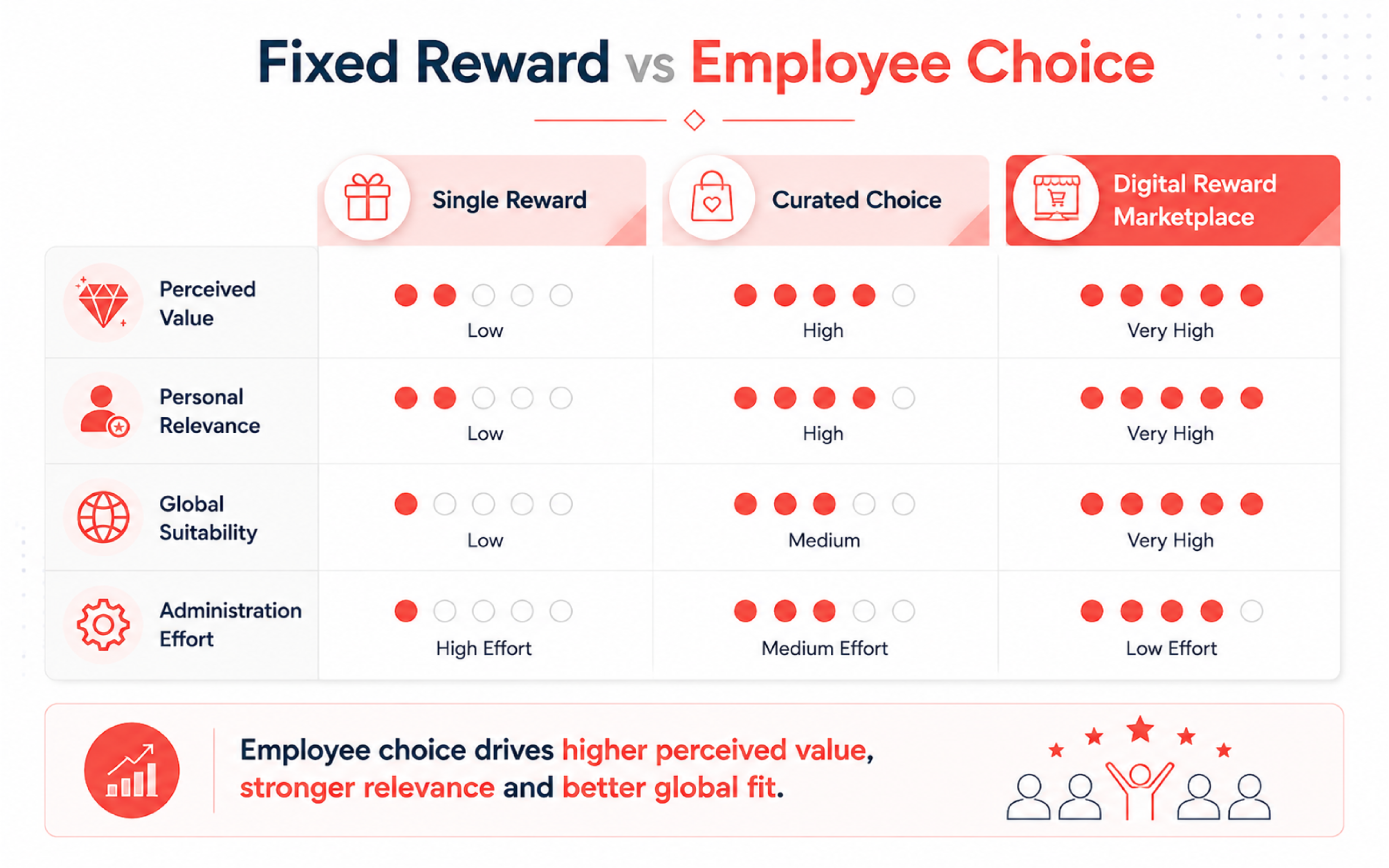
One employee may value a family hotel stay, another may prefer dining experiences, and another may choose merchandise or travel. Behavioural research repeatedly shows that people assign higher value to rewards they select themselves.
The Incentive Research Foundation (IRF) found that non-cash rewards often generate stronger emotional engagement when recipients can choose from a relevant catalogue. The increased perceived value frequently exceeds the actual monetary increase.
Fixed reward versus employee choice
For global workforces, choice becomes even more important. A reward that is attractive in one country may be impractical in another. Digital redemption across categories such as travel, dining, experiences and merchandise improves relevance while maintaining policy control.
Platforms such as ApplaudIQ allow HR teams to define milestone budgets while giving employees controlled choice from a global reward catalogue. This approach preserves governance without forcing uniformity.
If you are evaluating reward structures more broadly, The Reward Store’s article on employee rewards and recognition best practices provides additional guidance on balancing consistency, fairness and personalisation.
The key principle is simple: standardise the policy, personalise the reward.
How to Make Milestone Recognition Feel Public Without Making Introverts Uncomfortable
Public recognition can strengthen belonging, but forced visibility can create anxiety. Gallup’s workplace research shows that employees differ significantly in how they prefer to receive recognition. Effective programmes offer visibility without removing personal agency.
Use a consent-based recognition model
- Ask employees whether they are comfortable with company-wide announcements.
- Allow them to choose team-level recognition instead of enterprise-wide recognition.
- Offer written recognition if they prefer not to speak publicly.
A balanced recognition design
Public elements
- Team meeting acknowledgement.
- Internal social feed or recognition wall.
- Milestone badge on the employee profile.
Private elements
- Personal letter from a senior leader.
- Manager conversation.
- Reward redemption delivered directly to the employee.
Deloitte’s research on inclusive workplaces emphasises that employee experience improves when organisations provide flexibility rather than assuming one preferred interaction style.
A useful practice is the “public appreciation, private celebration” model. Colleagues see that the milestone was recognised, while the employee controls the depth of personal attention.
ApplaudIQ supports this approach through configurable recognition visibility settings, allowing HR teams to celebrate milestones across the organisation while respecting individual preferences.
Automating Long-Service Awards: How to Ensure No Anniversary Is Missed Across a Large Workforce
Manual anniversary tracking becomes unreliable once headcount grows across locations, business units and employment types. Missed milestones are not neutral events; employees often interpret them as evidence that the organisation does not notice their contribution.
Gartner’s HR technology research shows that automation improves process consistency and reduces administrative error in employee experience workflows. The highest-performing recognition programmes remove dependence on spreadsheets and calendar reminders.
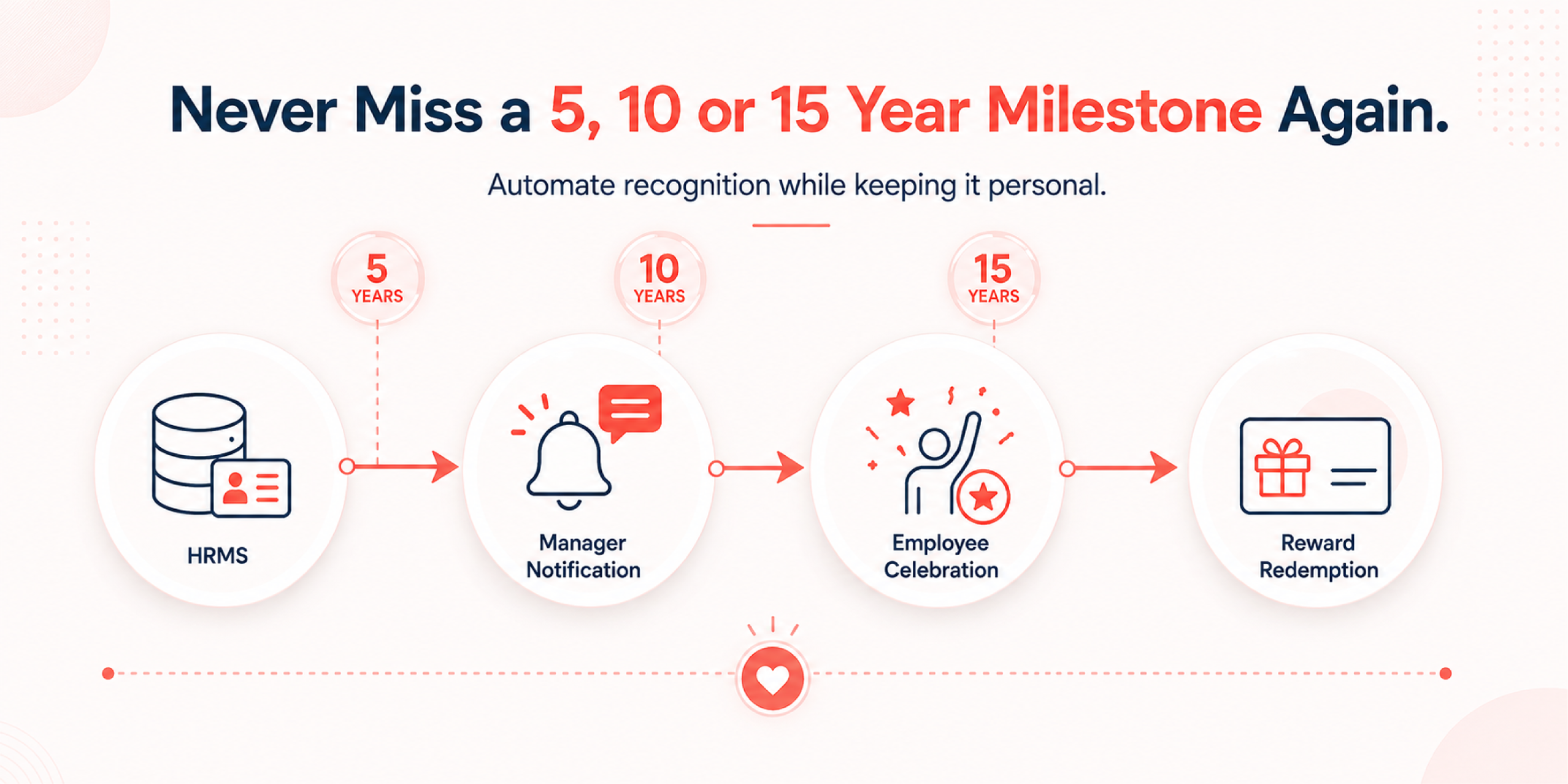
Essential automation workflow
- Sync employee data from the HRMS.
- Calculate upcoming 5, 10 and 15 year anniversaries automatically.
- Notify managers 30 days in advance.
- Trigger approval workflows.
- Release recognition on the anniversary date.
- Deliver reward redemption links instantly.
- Record completion and budget usage.
What to automate and what to keep human
ApplaudIQ integrates with major HRMS platforms and collaboration tools, enabling milestone workflows to run automatically while preserving manager participation in the recognition moment.
For HR operations teams managing distributed workforces, The Reward Store’s ApplaudIQ features page details how automated milestone recognition can be configured across geographies and business units.
The objective is not to automate appreciation. It is to automate the administration so leaders can focus on appreciation.
How to Calculate the Retention Impact of a Well-Designed Long-Service Programme
HR leaders increasingly need to justify recognition investments with measurable outcomes. The most defensible approach is to compare retention, engagement and productivity indicators before and after programme redesign.
Mercer’s workforce research and Gallup’s engagement studies both show that recognition is associated with lower turnover intent and higher engagement. While a long service programme will not eliminate attrition, it can influence the retention of experienced employees who are evaluating whether to stay.
A practical ROI framework
Use this formula:
Retention value = (Reduction in voluntary turnover among milestone employees × Average replacement cost per employee) − Annual programme cost
Example
- Employees reaching milestones annually: 400
- Baseline voluntary turnover within 12 months of milestone: 12%
- Post-redesign turnover: 9%
- Reduction: 3 percentage points = 12 employees retained
- Average replacement cost: £18,000
- Estimated retention value: £216,000
- Programme cost: £90,000
- Estimated net value: £126,000
Also track:
- Milestone participation rate.
- Reward redemption rate.
- Manager completion rate.
- Employee satisfaction with recognition.
- Engagement score changes among milestone recipients.
Aberdeen Group’s recognition research found that organisations with strong recognition practices report better retention outcomes than those with weak practices. Even modest improvements in retention among experienced employees can produce meaningful financial returns because replacement costs rise with seniority.
The most persuasive business case combines quantitative retention data with qualitative feedback from milestone recipients about whether the experience increased their sense of belonging and appreciation.
Frequently Asked Questions
What is the ideal structure for a 5, 10 and 15 year long service award programme?
Use a tiered structure that reflects the different meaning of each milestone. Five years should emphasise growth and belonging, ten years should recognise expertise and influence, and fifteen years should celebrate legacy and organisational impact. Keep the policy consistent while increasing personalisation and reward value at higher milestones.
How much should companies budget for long service awards?
Budget levels vary by industry and workforce demographics, but most organisations increase award value progressively with tenure rather than using a flat amount. Include both reward cost and administration cost in the budget. Measure retention and engagement outcomes annually to assess whether the investment is producing value.
How can we prevent missed anniversaries in a workforce spread across multiple countries?
Automate anniversary tracking through HRMS integration and workflow notifications. A platform such as ApplaudIQ can identify upcoming milestones, notify managers, trigger approvals and deliver rewards on the correct date across multiple geographies. Automation is particularly important when headcount is distributed across countries and business units.
Should long service recognition be public or private?
Offer employees a choice. Many employees appreciate public acknowledgement from colleagues, while others prefer a quieter celebration. A consent-based model that combines public acknowledgement with a private manager conversation works well for most organisations.
When should the recognition be delivered?
Deliver recognition on the anniversary date whenever possible. O.C. Tanner’s research shows that timely recognition has greater emotional impact than delayed recognition. Notify managers in advance so they can prepare a personalised message before the milestone occurs.
Conclusion
A successful long service award programme design 5 10 15 year strategy does more than mark time served. It reinforces belonging, recognises contribution and reminds experienced employees that their journey matters to the organisation. The strongest programmes combine personalisation, employee choice, appropriate visibility and reliable automation.
As workforces become more distributed and employee expectations become more experience-driven, milestone recognition will increasingly move from a ceremonial HR process to a measurable retention strategy. Organisations that redesign their programmes now will be better positioned to retain institutional knowledge and strengthen culture over the next decade.
See how ApplaudIQ automates milestone recognition for large workforces while giving employees meaningful reward choice. Explore the features: https://www.therewardstore.com/applaudiq/features
Sign up for our newsletter for trending top content!


