
How to Launch a Retail Gift Card Programme: A First Year Plan for Indian Retailers

Sign up for our newsletter for trending top content!
A retailer can launch a gift card programme in Indian retail by fixing three things before the first card is issued: the budget rules for each campaign, the reporting that finance will reconcile against, and the integration that connects every issuing channel. Campaign types, formats and channels are then added across four quarters, one change at a time, so that each addition can be measured against a known baseline. This order matters because a control cannot be applied afterwards to value that is already in circulation.
What a Retail Gift Card Programme Actually Involves
A retail gift card programme is an operating model that issues, funds, tracks and accepts stored value, and the card design is the smallest part of it. A gift card programme is a set of rules and systems that creates prepaid balances and follows each until it is spent or expires. Issuance is the act of creating a card or code with a loaded balance. Redemption is the point at which the retailer accepts the card and deducts the balance through authorisation at the till or checkout.
Why the operating model comes before the design
Teams that begin with card artwork discover the missing decisions late: printing begins, and finance then asks which budget funds the cards given to a creator campaign. If the card carries no campaign identifier at issuance, the answer cannot be rebuilt from card numbers, because a number records that value exists but not why it was created. Every campaign therefore needs an identifier, an owner and a funding source first.
Check the regulatory category before anything else
The Reserve Bank of India regulates prepaid instruments through its Master Direction on Prepaid Payment Instruments. A card usable only at the issuing retailer and its own outlets is generally a closed system instrument, which does not require authorisation. A card usable at unrelated merchants is generally a semi closed instrument and does require authorisation. Legal counsel should confirm the category in writing before launch.
This plan assumes a closed system card. If the retailer wants a card accepted across other merchants, this plan is the wrong starting point, and the retailer should first seek authorisation or work with an entity that already holds it.
Campaign Types to Plan for in Year One
Start with the campaign type where one internal team controls both the recipient list and the budget, and add types that depend on third parties only after reporting is proved. A campaign is a defined issuance of gift cards with its own recipients, rules, budget and period.
A quarter by quarter sequence
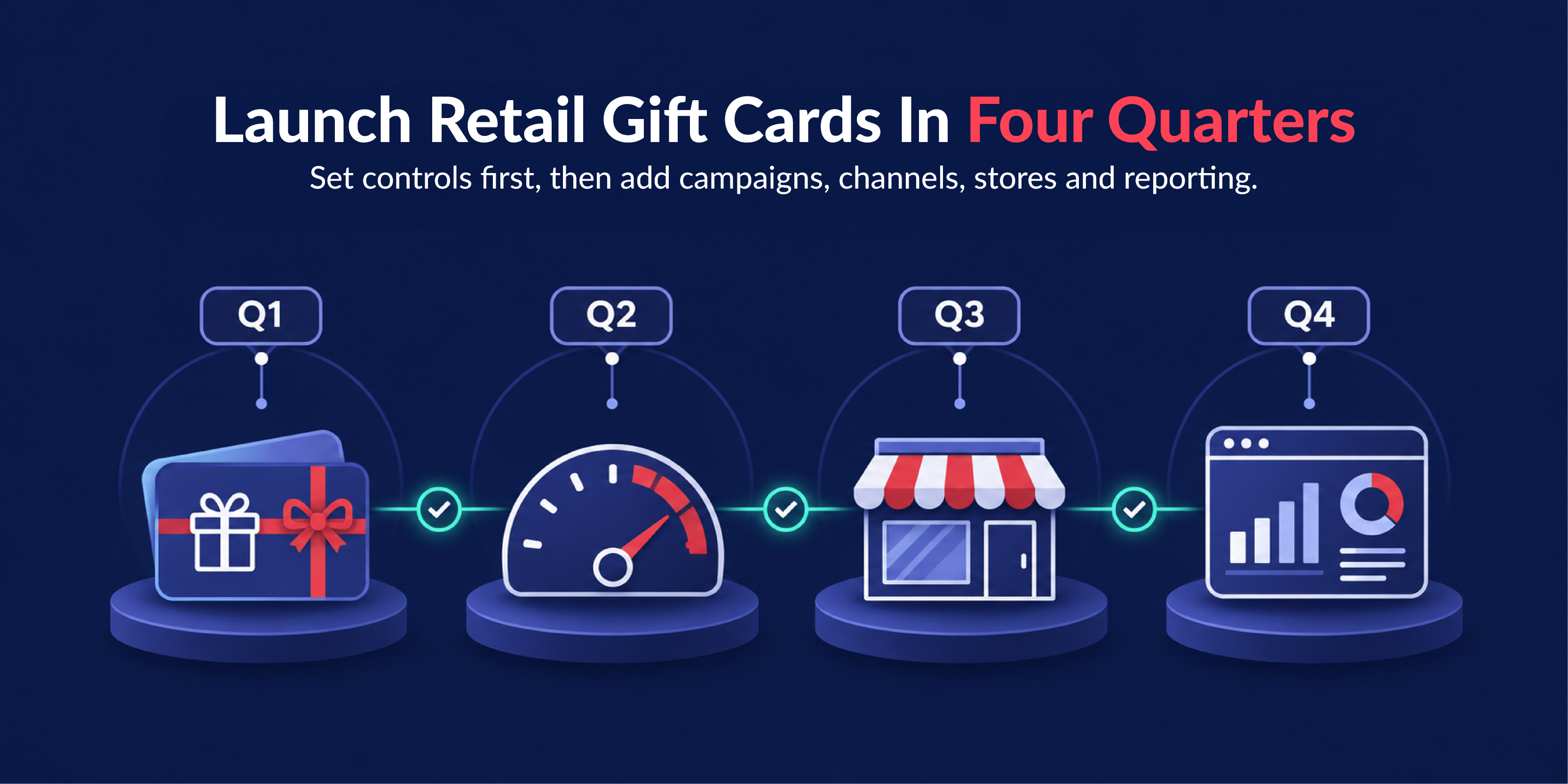
- Quarter one: run one loyalty or regional campaign in one channel, with a spend cap, to set a baseline.
- Quarter two: add a second channel and repeat the same campaign, so that any change in results is attributable to the channel.
- Quarter three: add an influencer or aggregator campaign, because both depend on outside parties and need proven reporting.
- Quarter four: add corporate distribution if demand exists, then review every campaign against its original budget and rules.
The reasoning is attribution. If a campaign type and a channel change together, the cause of a result cannot be separated.
This sequence is the wrong choice in two situations. A retailer whose sales concentrate around one festival should make the festival campaign its quarter one campaign, with the same cap and reporting. A retailer that intends only one seasonal campaign in one channel does not need a four quarter plan, because one budget approval, one campaign identifier and a manual reconciliation are enough.
Budget Governance From the First Campaign
Each campaign needs its own budget and an enforced cap, because a shared budget hides which campaign is consuming it. Budget governance is a set of limits and approvals that decides how much value each campaign may issue and who may change that limit.
What a workable control set contains
A spend cap is a limit on the total value a campaign may issue, beyond which issuance stops. A workable set has a separate budget for each campaign, a spend cap, an alert threshold below the cap and a named approver for top ups. The control must sit at issuance because stored value becomes a liability when the card is created.
A worked scenario
Consider a home furnishings retailer with stores in several cities and an online store. Marketing runs a regional campaign and an influencer campaign from one shared pool of funds. The influencer code is forwarded through messaging groups, and issuance accelerates over a weekend. Finance sees the effect only at the month end reconciliation, when the liability is well above the approved amount, and it cannot tell which campaign caused the excess. With a cap on each campaign, the influencer campaign would have stopped at its limit, the regional campaign would have continued, and the Head of Marketing would have received a top up request instead of a question from the finance controller.
Enforced caps and monitored caps
A gift card issuance platform enforces a cap inside the system, whereas a spreadsheet only records it. Reward Factory is a gift card issuance platform from The Reward Store, with campaign management and budget governance built in. Its spend cap pauses issuance automatically and top ups can be made at any time, which shows the difference between a cap that is watched and a cap that is enforced.
A reasonable objection is that an automatic pause can interrupt a campaign at its peak and lose sales. That risk is managed by setting the alert threshold early and agreeing in advance which role approves a top up.
Formats and Channels: Stores, Online and Partners
Launch with the formats the retailer can reconcile most easily, usually physical cards in store and a digital card on its own website, and add partner channels only once reconciliation works. A digital gift card is a code or link, delivered by message or email, that carries a balance. A physical gift card is a printed card activated at the point of sale.
One balance across every format
Every card should have a single balance that all formats read. If a customer buys a digital card online and redeems it in store, the till and the website must reduce the same balance. Two ledgers produce a card that is valid in one place and empty in the other. Store staff must also be able to validate a digital code before online sales begin.
Integration and Reporting Before Launch
Define the reports that finance needs first, then build the integration to produce them, because information not captured at issuance cannot be reconstructed later. An application programming interface, or API, is a defined way for one system to request an action or data from another. Reconciliation is the matching of issued value, redeemed value and settled money across the systems that hold each figure.
Integration
Four systems are usually involved: the point of sale system, the ecommerce platform, the enterprise resource planning system used by finance, and the customer relationship management system holding the loyalty membership base.
Connecting every issuing channel through one interface is safer than building a separate connection for each, because each connection is another place where a balance can go wrong. Redemption, meaning authorisation and balance deduction at the point of acceptance, happens in the till and checkout systems of the retailer. A gift card issuance platform can report the redemption status of cards it has issued, but acceptance remains a retailer process.
Reporting
Four reports cover most needs: issuance by campaign against budget, redemption status by campaign, outstanding liability by campaign, and settlement due to or from each partner. The diagnostic question is whether finance can state the outstanding liability for each campaign on any day without asking marketing.
Before launch, issue one card in each format, redeem part of the balance in each channel, and confirm that every system shows the same remainder. Digital delivery needs recipient contact details, so the Digital Personal Data Protection Act 2023 applies.
A First Year Launch Checklist
A launch is ready when marketing, finance and technology can each sign every item below.
- Marketing and legal counsel confirm in writing that the card is a closed system instrument under the Master Direction on Prepaid Payment Instruments, or that authorisation is in place.
- Marketing assigns every campaign an identifier, an owner and a funding source.
- Finance sets a budget, an alert threshold and a spend cap for each campaign, and names the approver for top ups.
- Finance confirms with its auditors how unredeemed balances will be treated under Ind AS 115.
- Technology confirms that every channel connects through one interface and reads one balance.
- Technology and finance agree the four reports and the day on which each is produced.
- Technology runs the pilot card test across every format and channel and records the result.
- Marketing trains store teams to activate physical cards and validate digital codes.
- Marketing confirms the consent notice under the Digital Personal Data Protection Act 2023.
- All three teams agree the quarter one campaign, its stop conditions and the date of its first review.
Where Reward Factory Fits
A gift card issuance platform creates the cards, applies the rules of each campaign, enforces budgets and records what has been issued. Reward Factory issues and manages gift card programmes for retailers and brands across a store network of any size. It supports regional, influencer, aggregator and loyalty campaigns, each with independent rules and a variable budget.
A spend cap pauses issuance automatically, and top ups can be made at any time. Issuance runs in store, online and through partner channels through a single API, with branded physical and digital cards managed from one dashboard. It distributes to a loyalty membership base and to corporate clients rewarding their own employees, tracks issuance in real time, and reports redemption status. It does not operate redemption, issue loyalty points or run loyalty tiers.
Frequently Asked Questions
What should a retailer decide first when planning to launch a gift card programme in India?
Decide the regulatory category, the funding source for each campaign and the reports that finance will need, before choosing the card design. The category determines whether Reserve Bank of India authorisation is required, the funding source sets the budget and cap, and the reports determine what each channel must record at issuance.
Do I need Reserve Bank of India approval to issue gift cards from my own stores?
Generally not, if the card is a closed system instrument that can be used only at the issuing retailer and its own outlets. A card that can be used at unrelated merchants is generally a semi closed instrument and requires authorisation. Legal counsel should confirm the category in writing before launch.
How do I stop an influencer gift card campaign from overspending its budget?
Give the campaign its own budget, set a spend cap that stops issuance when it is reached, and place an alert threshold below the cap. The control must sit at issuance because the liability is created when a card is issued. Add a cap for each creator, so that one widely shared code cannot consume the whole campaign.
Should we start with physical gift cards or digital ones?
Start with whichever format the retailer can reconcile most easily, and make sure both formats draw on one balance. Physical cards suit counter purchases but need stock and activation control. Digital cards suit gifting at a distance but depend on correct delivery and code validation in store.
What reports should finance receive from a gift card programme?
Finance needs four reports: issuance by campaign against its budget, redemption status by campaign, outstanding liability by campaign, and settlement due to or from each partner. The test is whether finance can state the outstanding liability for any campaign on any day without asking marketing.
How is unredeemed gift card value recorded in the accounts?
Finance teams generally record the value of an issued card as a liability until it is redeemed or recognised as revenue, and Ind AS 115 and the validity period govern unredeemed balances. The auditors of the retailer should confirm the policy before the first card is issued, because it affects how the reports are built.
What is a gift card issuance platform and what does Reward Factory do?
A gift card issuance platform is a system that creates, distributes and manages gift cards and the rules of each campaign. Reward Factory is a gift card issuance platform from The Reward Store, with campaign management and budget governance built in. It supports regional, influencer, aggregator and loyalty campaigns, spend caps and top ups, multi channel issuance through a single API, branded physical and digital cards, real time tracking and redemption status reports.
Sign up for our newsletter for trending top content!


