
How FMCG and Consumer Goods Companies Can Incentivise Key Account Managers for Modern Trade Performance

Sign up for our newsletter for trending top content!
Modern trade now contributes a substantial share of organised FMCG sales in urban India, yet many companies still reward Key Account Managers primarily on invoice value. NielsenIQ has repeatedly shown that assortment availability, shelf visibility, promotional execution, and in-store compliance materially influence category growth in organised retail, while McKinsey estimates that better retail execution can lift sales by several percentage points across consumer goods categories.
For a Sales Leader, this creates a costly mismatch. A KAM may hit billing targets while losing shelf share, promotional visibility, or category growth at a strategic retail account. This article explains how to build a key account manager incentive programme for modern trade in India that rewards the behaviours that actually drive revenue, margin, and long-term retailer partnerships. It also outlines practical ways to measure performance, prevent gaming, and manage incentive budgets across quarterly trade cycles.
Why Key Account Management Incentives in FMCG Are Often Disconnected From What Actually Drives Modern Trade Revenue
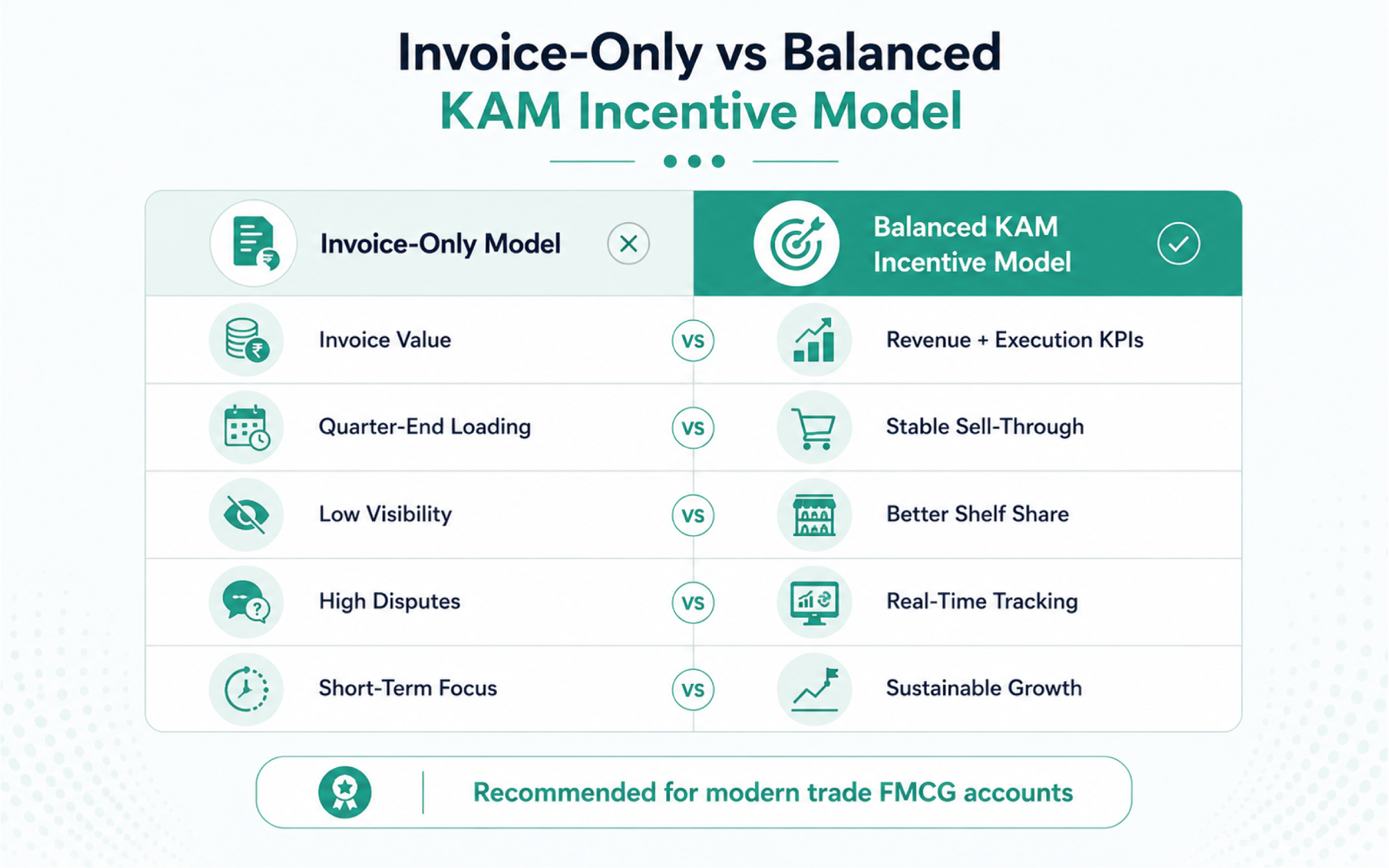
Most FMCG KAM incentive plans still reflect a distributor-era sales model. They reward primary sales booked into a retail account, even though modern trade profitability depends heavily on sell-through, category growth, promotional compliance, and in-store execution. McKinsey has found that commercial organisations often over-index on easily measurable financial outputs while underweighting operational drivers that determine sustainable growth.
This disconnect creates three common problems:
- Short-term loading: KAMs push inventory near quarter-end to secure payout.
- Retailer dissatisfaction: Store teams receive insufficient support on assortment, visibility, or activation.
- Margin erosion: Heavy discounting improves billing but weakens profitability.
Gallup’s workplace research shows that employees perform better when they clearly understand how their actions influence outcomes. If the incentive scorecard rewards billing alone, KAMs naturally optimise billing alone.
A more effective model links incentives to a balanced set of outcomes: account growth, execution quality, and strategic objectives. For example, a KAM managing a national supermarket chain should not receive the same payout for 10% sales growth with declining shelf share as for 8% growth with improved visibility and category penetration.
Sales leaders can use platforms such as Paytives to combine sales data, execution metrics, and retailer-specific targets into a single incentive scorecard, reducing disputes and improving accountability across large modern trade portfolios.
For a practical framework on partner and sales incentives, see https://www.therewardstore.com/paytives.
The Modern Trade KPI Stack: What to Incentivise Beyond Invoice Value
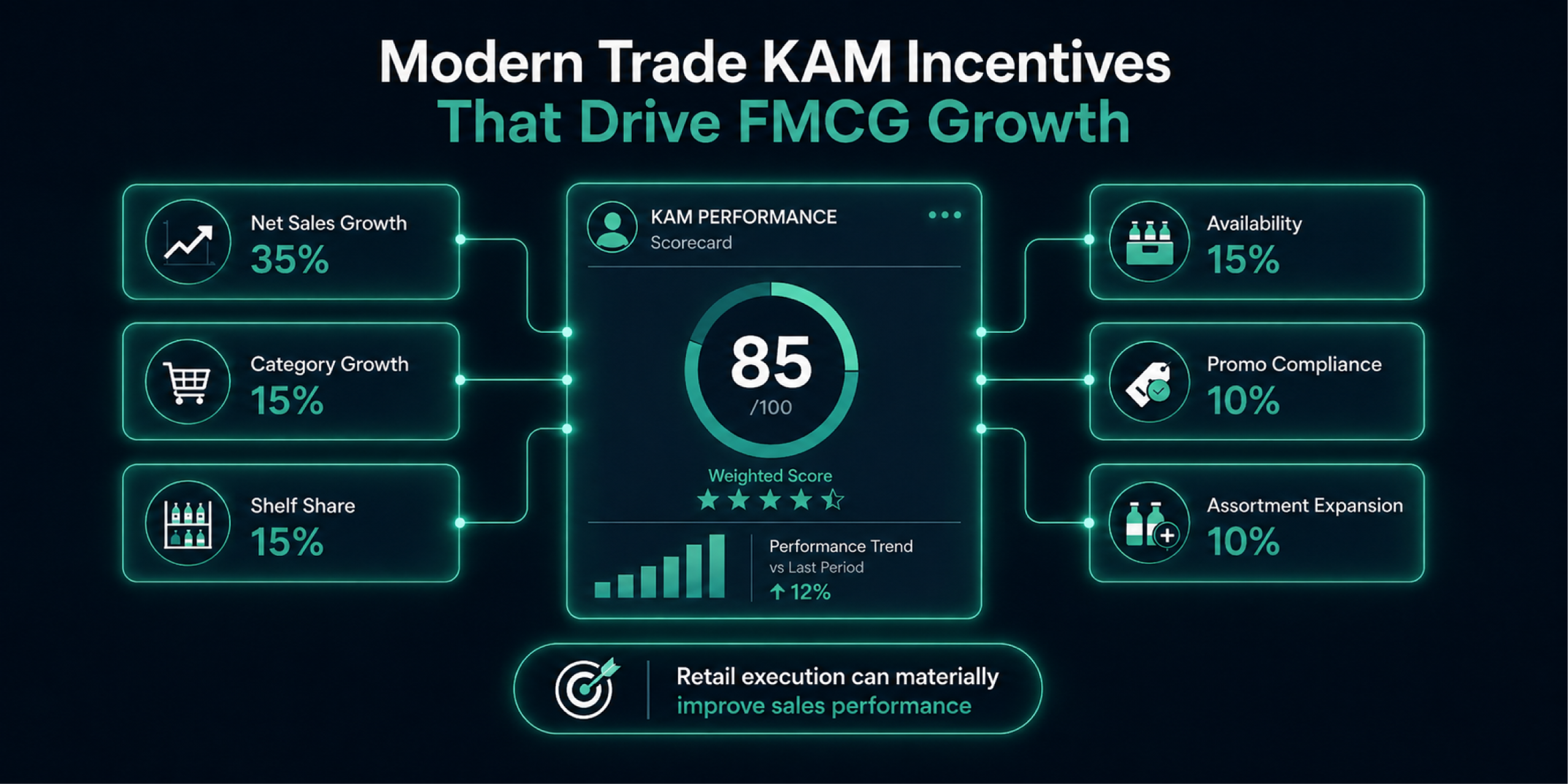
A modern trade KAM influences far more than monthly billing. Bain & Company has shown that category leadership in organised retail depends on consistent availability, visibility, assortment quality, and promotional execution. Incentive plans should therefore include both financial and execution KPIs.
Recommended quarterly KPI stack
NielsenIQ retail execution studies consistently identify on-shelf availability and display compliance as major drivers of sales uplift in organised retail environments.
Why category-relative metrics matter
A retailer category growing at 20% changes the interpretation of a brand growing at 8%. Relative growth prevents rewarding underperformance hidden by category expansion.
Add one strategic KPI each quarter
Examples include premium portfolio penetration, private-label defence, or new store activation. Deloitte recommends limiting performance scorecards to a manageable number of critical metrics to maintain focus and improve execution quality.
The key principle is balance. Financial metrics should remain dominant, but execution metrics must carry enough weight to change behaviour.
How to Design Quarterly KAM Incentives That Don’t Create Gaming or Channel Conflict
Poorly designed incentives encourage gaming. The Incentive Research Foundation (IRF) has documented that incentive plans tied to a single volume target often produce threshold behaviour, quarter-end spikes, and distorted sales patterns.
Use a threshold-target-stretch structure
- Threshold: 80% of target, minimum payout.
- Target: 100% achievement, standard payout.
- Stretch: 110-120% achievement, capped accelerator.
This structure rewards overperformance without encouraging excessive channel loading.
Include a quality gate
Require minimum execution standards before variable payout unlocks.
Example:
- On-shelf availability ≥ 95%
- Promotion compliance ≥ 90%
- No unresolved retailer claims beyond 30 days
Gartner’s sales performance research shows that multi-metric plans reduce the risk of employees maximising one metric at the expense of others.
Separate account potential from account performance
Do not compare a metro hypermarket portfolio directly with a regional supermarket portfolio. Use retailer-specific targets based on historical sales, category growth, and store footprint.
Avoid channel conflict
KAM incentives should complement distributor and field sales incentives. A simple governance rule works well: KAMs own retailer growth and execution; distributors own replenishment efficiency and outlet servicing.
Paytives supports multi-tier incentive structures, allowing sales leaders to manage retailer, distributor, and KAM incentives within one governance framework while maintaining separate payout logic for each stakeholder group.
For additional guidance on incentive governance, explore https://www.therewardstore.com/blogs.
Shelf Share, In-Store Activation, and Planogram Compliance: How to Reward KAMs for Retail Execution
Retail execution remains one of the largest untapped growth opportunities in FMCG. McKinsey has estimated that improving in-store execution can generate meaningful sales gains across consumer goods categories, while NielsenIQ research consistently links visibility and availability improvements with higher category performance.
Measure what the retailer sees
Reward KAMs for:
- Shelf share growth by category.
- Secondary display activation.
- End-cap or feature display execution.
- Planogram compliance.
- Promotional POSM deployment.
- Store audit completion rates.
Example execution scorecard
Use evidence-based verification
Require geo-tagged photos, retailer audit data, or third-party merchandising reports. Aberdeen Group has found that organisations using verified field execution data achieve better sales performance and lower reporting disputes than those relying on self-reported activity.
Reward improvement, not just absolute position
A challenger brand moving shelf share from 8% to 10% may deserve stronger recognition than a category leader holding 35%.
Execution incentives work best when they are frequent, visible, and directly linked to store-level evidence rather than subjective manager assessments.
Reporting and Transparency: How KAMs Perform Better When They See Their Own Incentive Progress in Real Time
One of the fastest ways to improve incentive effectiveness is to eliminate payout uncertainty. Gartner research on sales performance management shows that timely performance feedback improves focus and increases target attainment.
What KAM dashboards should show daily
- Sales vs target.
- Category growth vs benchmark.
- Shelf share trend.
- Compliance scores.
- Estimated payout.
- Pending actions affecting payout.
Why transparency changes behaviour
Gallup has consistently found that employees are more engaged when expectations and performance measures are clear. A KAM who sees that planogram compliance has fallen to 88% can correct the issue before quarter close rather than discovering it after payout calculation.
H3: Reduce disputes and manual administration
Manual incentive spreadsheets often create:
- conflicting target versions,
- delayed approvals,
- payout disputes,
- limited audit trails.
Paytives provides real-time incentive visibility, automated calculations, and role-based dashboards for KAMs, regional managers, and finance teams. This shortens payout cycles and allows sales leaders to identify underperforming accounts earlier in the quarter.
Real-time reporting also improves forecast accuracy because incentive liabilities update continuously instead of being reconciled at quarter end.
How to Align KAM Incentives With Trade Marketing Calendar Events Without Creating Budget Chaos
FMCG sales peaks rarely occur evenly across the year. Festival periods, summer demand spikes, regional events, and retailer anniversary campaigns can account for a disproportionate share of annual sales. Deloitte’s consumer industry research highlights the importance of synchronising commercial and marketing calendars to improve promotional ROI.
Build event-based incentive pools
Create separate quarterly pools for major trade events rather than permanently increasing target incentives.
Fund incentives from incremental contribution
Tie event incentives to incremental gross margin or incremental sales above baseline. This protects profitability and prevents incentive inflation.
Use pre-approved budget envelopes
Finance and sales should approve event budgets before the quarter begins. Mercer’s variable pay research shows that predefined funding rules improve budget predictability and reduce post-event disputes.
Rotate strategic priorities
Do not run every campaign simultaneously. Focus each quarter on one or two strategic objectives, such as premium portfolio penetration or new category expansion.
A structured calendar-based approach helps sales leaders support trade marketing priorities without losing control of incentive spend.
Frequently Asked Questions
What is a key account manager incentive programme for modern trade in India?
It is a structured variable pay plan designed for KAMs who manage organised retail accounts such as supermarkets, hypermarkets, and large retail chains. The programme rewards both financial outcomes and retail execution metrics. Typical measures include sales growth, shelf share, availability, and promotion compliance. The goal is to improve retailer performance rather than simply increase billing.
How should FMCG companies weight sales versus execution metrics?
Most FMCG organisations place 60-70% weight on financial outcomes and 30-40% on execution metrics. Financial metrics usually include net sales growth and category growth, while execution metrics include shelf share, availability, and compliance. The exact mix should reflect category maturity and strategic priorities. Newer brands often need a higher execution weighting.
Why do invoice-only incentives create channel conflict?
Invoice-only plans encourage KAMs to push inventory into the retailer regardless of sell-through. This can increase returns, stock ageing, and retailer dissatisfaction. Distributors may also receive conflicting signals on replenishment priorities. A balanced scorecard reduces these distortions by rewarding sustainable account growth.
How can Paytives help manage KAM incentives across multiple retail chains?
Paytives centralises target setting, performance tracking, payout calculation, and approval workflows for KAM teams. It supports retailer-specific scorecards, multi-tier incentive structures, and real-time dashboards. Sales leaders can monitor performance across chains, regions, and categories without maintaining separate spreadsheet models. This improves transparency and reduces administrative effort.
When should FMCG companies review their KAM incentive structure?
Review the structure at least twice a year and after any major change in retailer strategy, category mix, or trade terms. Annual reviews are often too slow for modern trade environments. Quarterly KPI reviews help ensure that incentives continue to support current commercial priorities. Frequent reviews also prevent obsolete metrics from driving behaviour.
Conclusion
The most effective key account manager incentive programme for modern trade in India rewards the behaviours that create sustainable retailer growth: availability, visibility, category performance, and execution quality, not just invoice value. Sales leaders who use balanced KPI scorecards, verified execution data, and real-time reporting typically gain better retailer relationships, more predictable growth, and fewer payout disputes.
As organised retail expands and data visibility improves, KAM incentives will become increasingly dynamic, account-specific, and event-linked. Companies that modernise their incentive design now will build a stronger competitive position in modern trade.
See how Paytives manages KAM incentive programmes for FMCG companies: https://www.therewardstore.com/paytives/solutions/consumer-goods-retail
Sign up for our newsletter for trending top content!


