
How Indian Hospitals Can Use Employee Recognition to Reduce Nurse Attrition and Prevent Clinical Burnout

Sign up for our newsletter for trending top content!
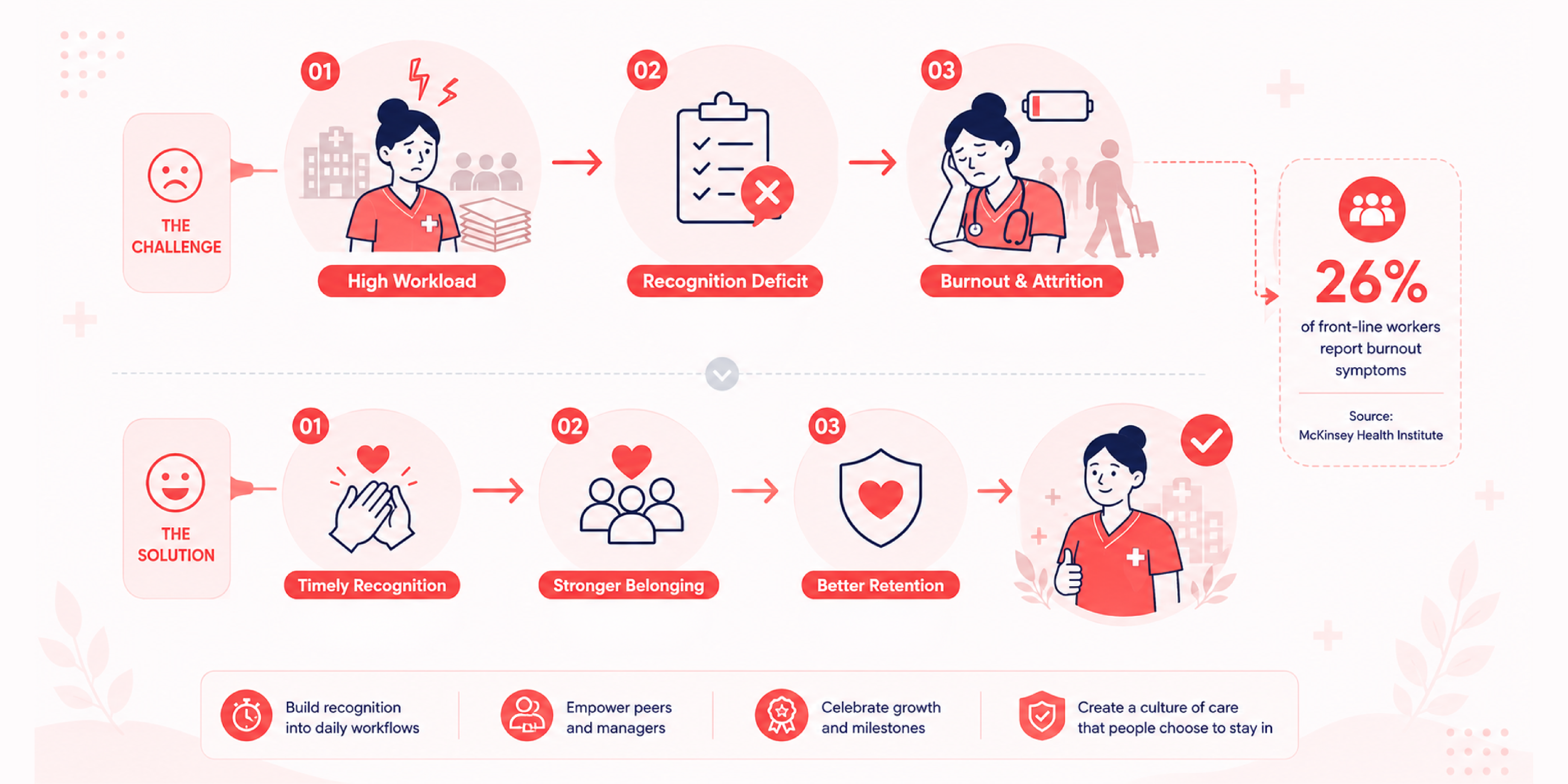
Front-line workers report burnout symptoms at a rate of 26%, according to McKinsey Health Institute research, with exhaustion a significant driver. For Indian hospitals, that pressure creates a workforce risk that extends beyond engagement. When experienced nurses and other clinical professionals leave, hospitals must recruit, train and integrate replacements while remaining responsible for uninterrupted patient care.
Recognition cannot solve understaffing, unsafe workloads or inadequate compensation. It can, however, address a critical and controllable part of the employee experience: whether healthcare workers feel that their contribution, professional growth and daily effort are noticed.
For HR leaders, the objective should therefore be clear. Build recognition into clinical workflows without creating another administrative burden. This article explains how hospitals can use shift-based appreciation, peer recognition, professional milestone awards and compliance-conscious programme design to strengthen retention and reduce the recognition deficit that can compound clinical burnout.
Why Indian Hospitals Are Losing Nurses Faster Than They Can Train New Ones
Nurse attrition rarely has a single cause. Compensation, staffing ratios, migration opportunities, career progression, shift patterns, management quality and workplace culture can all influence an employee's decision to stay. Recognition matters because it sits at the intersection of several factors that HR teams can directly improve.
McKinsey's research on workplace health found that front-line employees experience higher burnout than the global workforce average. The research also identifies belonging among the factors most strongly associated with positive holistic health for non-managerial workers. For hospitals, this matters because nurses, technicians and other patient-facing employees work in environments where sustained physical presence and intensive interpersonal interaction are unavoidable.
Recognition should not become a substitute for fair pay, adequate staffing or safe working conditions. Instead, hospitals should treat it as part of a broader retention architecture.
The practical question for an HR leader is not, "Do we give annual awards?" It is, "Does every employee have a credible opportunity to be recognised for meaningful work throughout the year?"
A structured programme can recognise clinical excellence, teamwork, patient-centred behaviour, professional development, service milestones and contributions during demanding shifts. The aim is to make appreciation frequent and equitable enough to reach employees beyond highly visible departments and senior roles.
The ApplaudIQ platform for HR leaders provides a structured approach to employee recognition, helping HR teams move beyond ad hoc appreciation towards measurable recognition programmes linked to retention and engagement objectives.
Clinical Burnout and the Recognition Deficit: What the Evidence Says About Appreciation and Exhaustion
Burnout requires a systemic response. Recognition alone cannot remove excessive workloads or repair poorly designed staffing models, but a lack of appreciation can make demanding work feel even less sustainable.
McKinsey Health Institute reports that 26% of front-line workers surveyed experienced burnout symptoms, compared with a 22% global average. Its research also highlights belonging as an important factor associated with positive workplace health. This distinction matters for hospitals because employees can find their profession meaningful while still feeling invisible within the organisation where they practise it.
Deloitte's 2025 workforce research similarly identifies well-being, meaningful work and development as interconnected priorities. It recommends that managers pay attention to employee stressors while supporting recognition, growth and learning opportunities.
For hospital HR leaders, the implication is straightforward: recognition should reinforce the conditions that help people feel connected to their work and colleagues.
That means recognising specific contributions rather than offering generic praise. "Thank you for your hard work" has less organisational value than acknowledging a nurse who supported a difficult handover, a clinical team that maintained care standards during a demanding shift, or an employee who completed an important professional certification.
Recognition becomes more credible when it answers three questions: what did the employee do, why did it matter, and which organisational or clinical value did the behaviour demonstrate?
This approach turns appreciation from an occasional HR activity into a visible signal about the behaviours the hospital values.
Shift-Based Recognition: How to Appreciate Healthcare Workers Without Adding to Their Administrative Load

A recognition programme will fail in a hospital if employees need to complete lengthy forms, wait for office hours or use systems disconnected from their daily workflow.
Clinical teams operate across nights, weekends, rotating rosters and multiple locations. McKinsey's analysis of the future of work identifies medical care as a high physical-proximity work arena in which doctors and nurses must perform their roles on site. Recognition systems designed around conventional desk-based employees therefore risk excluding the people they intend to engage.
HR leaders should design recognition around three principles: accessibility, speed and minimal administrative effort.
The strongest model combines these methods rather than relying on one annual event. Automated milestones provide consistency, while peer and manager recognition capture contributions that HR systems cannot identify automatically.
ApplaudIQ can support this model by automating milestone rewards, enabling peer-to-peer Cheers and connecting recognition with existing workplace systems. Its multi-channel approach can also help organisations reach front-line employees who may not spend their working day at a desk. Hospitals can explore the broader ApplaudIQ employee recognition platform when assessing how recognition can fit into existing HR workflows.
Peer Recognition in Clinical Teams: Why Colleague Appreciation Outperforms Manager Praise in High-Stress Environments
In high-pressure clinical settings, colleagues often see contributions that managers cannot.
A ward supervisor may know that a shift met its operational targets, but another nurse sees who stayed calm during a difficult handover, supported a new colleague, noticed a potential problem or stepped in when the team came under pressure. Peer recognition captures these otherwise invisible contributions.
McKinsey's workplace health research identifies belonging as an important factor associated with positive holistic health among non-managerial workers. Peer appreciation can reinforce that sense of belonging because recognition comes from people who directly understand the work and its demands.
However, hospitals should not treat peer recognition as a replacement for manager recognition. The two serve different purposes. Peer appreciation validates everyday teamwork and collegial support. Manager recognition signals that leadership notices performance, professional contribution and behaviour aligned with organisational priorities.
HR leaders should therefore create a dual recognition system. Employees should have a quick way to appreciate colleagues, while managers should receive prompts and data that help them recognise consistently across shifts, departments and locations.
The design also needs safeguards. Recognition criteria should remain transparent, participation data should be monitored for departmental or demographic imbalances, and rewards should never depend on popularity alone.
In healthcare, the strongest peer recognition programmes celebrate behaviours that support the team and patient experience without turning clinical outcomes into simplistic competitions. Collaboration, mentorship, learning, reliability and values-based contributions provide safer and more meaningful recognition categories.
Milestone and Certification Awards: Recognising Professional Growth, Not Just Seniority
A five-year service anniversary matters, but tenure should not become the only career milestone that receives formal recognition.
Healthcare employees invest continuously in professional development. Nurses complete specialist training, clinicians gain certifications, employees develop new technical capabilities, and experienced team members take responsibility for mentoring others. When hospitals recognise only length of service, they miss opportunities to reinforce the growth behaviours that strengthen workforce capability.
Deloitte's 2025 workforce research found that learning and development ranked among the top reasons younger employees chose their current employer. Seventy per cent of Gen Z respondents said they developed career skills at least weekly, demonstrating how closely employees increasingly connect work with continued professional growth.
Hospital recognition frameworks should therefore distinguish between different forms of achievement:
- Service milestones: Meaningful tenure anniversaries.
- Professional development: Completion of approved certifications or specialist training.
- Capability milestones: Acquisition of defined clinical or operational competencies.
- Contribution milestones: Mentorship, quality improvement or cross-functional support.
- Values-based achievements: Consistent demonstration of organisational values.
Recognition can range from public appreciation and digital badges to points and access to relevant reward categories, including gift cards from 5,000+ brands, dining vouchers, hotel bookings, flight bookings and experiential rewards.
The principle is more important than the reward value. HR should show employees that professional progress is visible. When development earns organisational recognition, the hospital communicates that careers can grow within the institution rather than only by leaving it.
How HR Leaders Can Build a Recognition Programme That Survives Nursing Union and Compliance Requirements
Healthcare recognition requires stronger governance than a typical employee engagement campaign. Hospitals must consider employment policies, union agreements where applicable, taxation, data privacy, clinical governance and fairness across employee categories.
The first rule is to separate recognition from clinical safety decisions. A hospital should never design rewards that encourage employees to conceal incidents, avoid reporting errors or compete on patient outcomes without appropriate risk adjustment. Recognition should reinforce safe behaviours, teamwork, learning and organisational values rather than create incentives that could distort clinical judgement.
HR leaders can use a five-part governance framework.
Define eligibility clearly. Specify which employees, contract categories, departments and locations can participate.
Publish objective criteria. Employees should understand what behaviours and achievements qualify for formal awards.
Protect fairness. Review recognition patterns by department, shift and employee group to identify systematic under-recognition.
Maintain approval controls. Higher-value awards should follow documented authorisation rules, while everyday appreciation should remain easy to give.
Consult relevant stakeholders. HR, clinical leadership, compliance, finance and recognised employee representatives should review the programme before launch.
SHRM consistently positions recognition as part of the wider employee experience rather than an isolated rewards exercise, while Deloitte emphasises the connection between recognition, employee well-being and development. The governance model should reflect that broader purpose.
For healthcare-specific recognition workflows, HR teams can review ApplaudIQ for Healthcare and Pharma and assess how structured recognition can support front-line workforce engagement.
Frequently Asked Questions
What is the best employee recognition programme for nurses in Indian hospitals?
The best approach combines frequent peer appreciation, manager recognition, automated milestones and professional development awards. It should work across shifts and locations without requiring nurses to complete lengthy administrative processes. Hospitals should also measure participation and recognition distribution to ensure night-shift and less visible teams receive equitable opportunities.
How can employee recognition help reduce nurse attrition?
Recognition can strengthen belonging, reinforce professional value and make employees' contributions more visible. McKinsey identifies belonging as an important factor associated with positive workplace health, while broader employee research connects recognition with stronger retention intentions. Recognition works best when hospitals combine it with appropriate staffing, fair compensation, career development and supportive management.
Can recognition programmes prevent clinical burnout?
Recognition cannot prevent burnout by itself. Burnout can result from workload, staffing pressures, working conditions and other systemic factors that require direct organisational action. However, meaningful appreciation can address the recognition deficit and strengthen belonging, making it a useful component of a broader workforce well-being and retention strategy.
How should hospitals recognise night-shift and front-line healthcare workers?
Hospitals should make recognition accessible regardless of shift timing, physical location or access to a corporate desktop. Automated milestone awards, mobile-accessible peer recognition and multi-channel notifications can reduce dependence on office-based processes. HR teams should also audit recognition data by shift to identify employees who receive less visibility.
When should hospitals reward professional certifications and clinical milestones?
Recognition should follow verified completion rather than wait for an annual awards cycle. Timely acknowledgement strengthens the connection between professional development and organisational appreciation. Hospitals can use ApplaudIQ to automate defined milestones while retaining approval controls for higher-value awards.
Conclusion
Indian hospitals cannot address nurse attrition and clinical burnout through recognition alone, but they should not underestimate the cost of allowing demanding work to go consistently unnoticed. The strongest programmes combine immediate peer appreciation, manager recognition, automated milestones and professional growth awards within a fair governance framework.
As healthcare workforce pressures increase, recognition will move from an occasional engagement activity towards a measurable component of retention strategy. HR leaders who build the infrastructure now can create a more visible culture of appreciation without adding another burden to clinical teams.

See how ApplaudIQ helps hospitals recognise healthcare workers and strengthen nurse retention. Build a recognition programme designed around the realities of clinical work.
Sign up for our newsletter for trending top content!


