
Gift Cards or Gift Boxes for Year End: How to Choose by Audience

Sign up for our newsletter for trending top content!
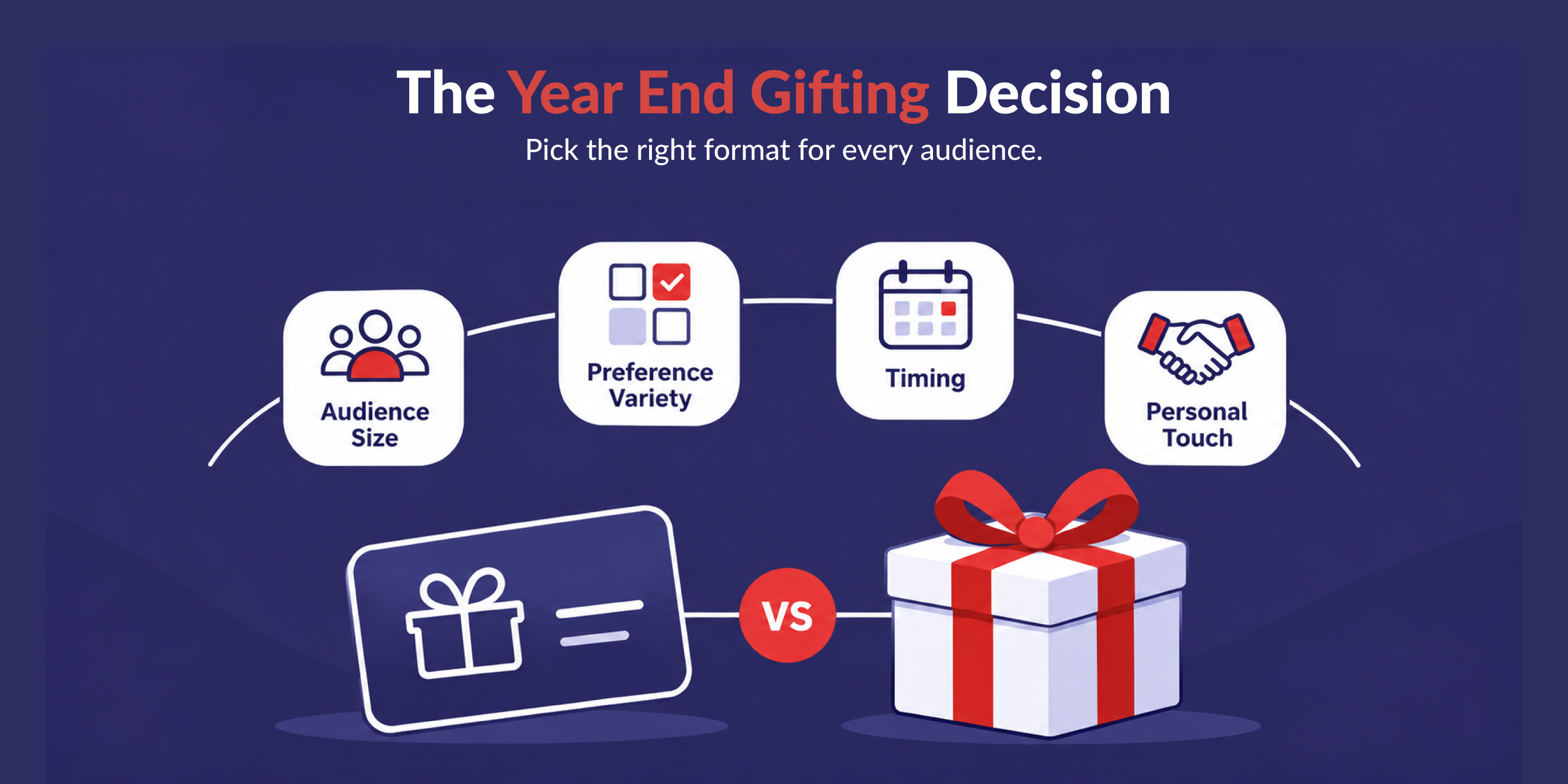
The gift cards vs gift boxes decision comes down to four factors: audience size, preference variety, timing and personal touch. Choose gift cards for large, varied or dispersed groups and tight timelines. Choose gift boxes for smaller, closer groups where a considered, tangible gesture matters more than individual choice.
Year end gifting reaches procurement and HR teams at the same time as budget closure, leave planning and festive calendars. A clear method prevents last minute compromises and keeps the decision defensible.
This guide compares the two options on four practical dimensions, then gives a five question framework that you can apply to each audience segment straight away.
Gift cards vs gift boxes: what each option does best
A gift box is a physical parcel that is sourced, assembled, packed and delivered to a named person. A gift card or voucher is a value that the recipient chooses how to spend.
Boxes communicate effort and thought. Cards communicate trust and flexibility. Neither is better in every situation, which is why the audience should drive the choice rather than habit or precedent.
Procurement teams also feel a difference in operations. Boxes involve sourcing, packing, storage and courier coordination. Cards involve less physical handling but need clear budget control and a record of who received what.
Each option also has a typical weak point. Boxes risk being unwanted, delayed or damaged in transit. Cards risk feeling transactional if they arrive without context or a personal message.
HR teams feel a difference in perception. A box can feel like a celebration of the team, while a card can feel like a practical benefit. Both succeed when they match what the recipient values.
Audience size and preference variety shape the decision
Start with size. A small group, such as a leadership team or a set of key clients, can receive boxes that are chosen and packed with care. Individual attention is realistic at that scale.
As the group grows, every extra box adds sourcing, packing, storage and delivery work, and errors become harder to catch. Cards need less physical handling, because the effort shifts to recipient data and approvals.
Spread matters as much as headcount. A group of moderate size across many cities is harder to serve with boxes than the same group in one office, because each city adds a delivery leg.
Consider also the mix of roles. Frontline, office and remote colleagues often receive gifts in different places, so a single delivery plan rarely fits everyone.
Next, consider preference variety. Teams that span ages, regions, dietary habits and household situations rarely agree on a single hamper. One box will delight some recipients and miss others.
Gift cards let each person choose, which removes the risk of an unwanted item. Boxes work better when the group shares a taste, a festival tradition or a dietary pattern that you already know.
Dietary and cultural considerations deserve particular care. A box with food in it can exclude recipients who cannot or do not eat the contents, whereas a card carries no such restriction.
Ask HR for a simple profile of each group before deciding. Location, age range, dietary needs and tenure are usually enough to show whether one box could suit everyone.
Clients and vendors add another layer. You usually know less about their tastes than about your own employees, which is a reason to lean towards choice for external audiences unless you hold clear information.
Timing and personal touch pull in opposite directions
Boxes need lead time for sourcing, personalisation, packing and delivery, and year end is a busy period for couriers and suppliers. Late boxes arrive after the occasion and weaken the gesture.
Cards suit compressed timelines because they involve far less physical handling than a parcel. Approvals and recipient lists still need to be settled early, since data errors cause delays in any format.
Work backwards from the date on which recipients should have their gifts. Then subtract the time needed for approvals, sourcing, packing and delivery.
Remember that year end overlaps with festivals, leave and office closures in many organisations. Recipients who are away may miss a delivery, whereas a card can wait until they return, provided its validity period allows it.
A sensible order of work is as follows.
- Confirm the audience segments and the approved budget for each segment.
- Choose the format for each segment, using the framework in the next section.
- Collect and verify recipient details, such as addresses, locations and dietary needs.
- Place orders or prepare issuance once the approvals are in place.
- Confirm receipt or use, and keep the record for reporting.
If that calculation leaves little room, choose the option with fewer physical steps or reduce the number of boxes that you plan to send.
Personal touch is where boxes excel. Handwritten notes, curated contents and thoughtful packaging show an effort that a card alone cannot easily match.
A card can still feel personal when it arrives with a sincere message from a manager who knows the recipient well. The message, rather than the format, carries the warmth.
Consider also where the gift will be enjoyed. A box is often shared with family, whereas a card supports an individual choice.
A five question framework for choosing by audience
Answer these questions separately for each audience segment, because one organisation often needs both options. Employees, senior leaders, clients and vendors rarely share the same answers.
- How large is the group? Larger groups favour gift cards, while small groups can justify the effort of boxes.
- How varied are the preferences? Wide variety favours gift cards, while shared tastes or traditions favour boxes.
- How much time remains before the occasion? A short runway favours gift cards, and a comfortable runway makes boxes realistic.
- How important is a tangible personal touch? If the physical gesture is the message, choose a box or add a handwritten note to a card.
- How dispersed are the recipients? Many cities, remote staff and distant clients favour gift cards, while a single office favours boxes.
Tally the answers for each segment. A clear lean towards one option settles the choice, while an even split points to a hybrid.
Use the answers as a guide rather than a formula. A single strong constraint, such as a very tight deadline, can outweigh the other four answers.
A common hybrid sends boxes to a small group of senior leaders and key clients, and cards to the wider workforce. Treat each segment as its own decision.
Record the reasoning for each segment in a short note. Approvers, finance teams and auditors can then see exactly why each format was chosen.
Budget control and record keeping apply to both options
Whatever the format, year end gifting needs a budget that is approved in advance, a recipient list that is checked and a clear record of what was sent.
For boxes, track quantities, delivery addresses and dispatch status. For cards, track recipients, values and the budget that each programme may draw on.
For cards, also confirm the validity period, so that recipients have enough time to use them. Share the dates clearly in the message that accompanies each gift.
Agree who owns each step, from approval to dispatch to reconciliation, so that no task falls between HR, finance and procurement.
Gifting that is spread across several teams, regions or campaigns benefits from one view of spend. Without it, duplicate gifts and budget overruns are easy to miss.
If gift cards are part of your answer, governance matters as much as selection. Reward Factory is the gift card and voucher issuance product from The Reward Store, covering issuance, campaign management and budget governance.
Frequently asked questions
Which is better for employees, gift cards or gift boxes?
Neither is better in every case. Gift cards suit large or varied workforces because each person chooses. Gift boxes suit smaller, closer teams where a considered, tangible gesture matters. Many organisations use both, depending on the segment.
How early should we plan year end corporate gifts in India?
Plan early enough to work backwards from the date on which recipients should have their gifts. Boxes need more lead time for sourcing, packing and delivery, so settle the format, budget and recipient list first. Cards allow a shorter runway.
When do gift boxes make more sense than gift cards?
Gift boxes make more sense for small groups, shared tastes and occasions where the physical gesture is the message, such as senior leaders or key clients. They also suit teams based in one place, where delivery is simple.
Are gift cards too impersonal for employees?
Not by nature. A gift card feels considered when it arrives with a sincere message from a manager and suits the recipient. The message and the relevance of the choice matter more than the format itself.
Can we mix gift cards and gift boxes in one programme?
Yes. Many programmes send boxes to a small group of senior leaders or key clients and gift cards to the wider workforce. Decide by segment, approve the budget in advance and record the reasoning for each choice.
Conclusion
Gift boxes reward closeness, shared taste and ample time, while gift cards reward scale, variety and tight timelines. Apply the five questions to each audience segment and the right format usually becomes clear.
Where cards are part of the plan, Reward Factory addresses issuance, campaign management and budget governance.
To discuss your year end gifting programme, Book a Demo.
Sign up for our newsletter for trending top content!


