
How to Build Zero Downtime Failover Across Multiple Gift Card Vendors

Sign up for our newsletter for trending top content!
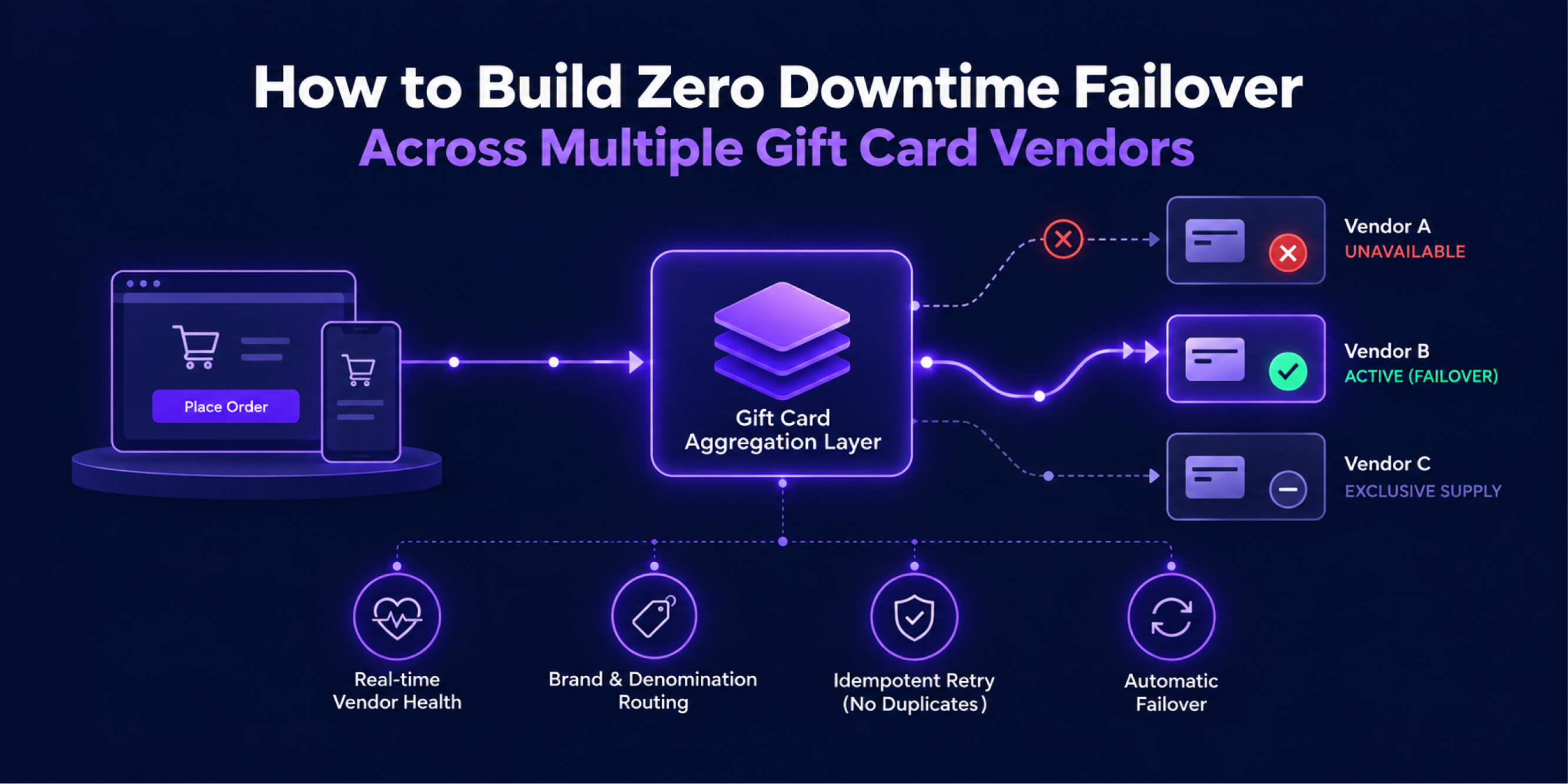
Zero downtime failover across gift card vendors is achieved by placing an abstraction layer, often built as a gift card aggregation platform, between the ordering system and every vendor it connects to, so that when one vendor becomes slow or unavailable, the request is rerouted to a healthy vendor before the customer sees any disruption.
This depends on three things working together: continuous health detection at the vendor level, a fallback hierarchy defined by brand and by denomination rather than by vendor alone, and a rerouting mechanism that can retry an order without creating a duplicate card or a duplicate charge. Without this layer in place, a vendor outage is passed straight through to the end customer as a failed purchase.
Why Vendor Downtime Reaches Customers Without an Abstraction Layer
An abstraction layer is a software layer that sits between an ordering system and multiple vendor application programming interfaces, translating one internal request into whichever call format each vendor requires. Most platforms integrate a single vendor per brand at launch, since it is the fastest route to a catalogue, and that integration becomes load bearing infrastructure long before anyone designs a fallback for it.
The result is a catalogue that looks diversified at the product level but is fragile at the vendor level, because each brand typically resolves to exactly one vendor behind the scenes. A vendor outage does not take down the whole catalogue. It takes down only the brands that vendor is the sole source for, which the system cannot distinguish from a genuine stock shortage unless it was built to know the difference.
The specific failure mode worth naming is that the ordering system treats a vendor timeout and a vendor stock shortage as the same event, a failed order, because nothing in the architecture separates infrastructure failure from catalogue failure. A reader auditing their own platform should ask, brand by brand, how many vendors sit behind each one, rather than assuming a diversified vendor list at company level means diversified coverage at brand level.
Detecting Vendor Degradation Before It Becomes an Outage
Degradation should be detected before it reaches the threshold of an outage, because by the time a vendor is fully down, orders have already been failing for some period beforehand. A health check is a scheduled or continuous test that measures whether a vendor's application programming interface is responding correctly and within an acceptable latency range. Most platforms implement this as a simple ping, which confirms the vendor is reachable but not that it is actually issuing valid cards.
The non obvious failure this misses is the vendor that returns a success response without a usable card, sometimes called a silent failure. A synthetic transaction is a test purchase run against a vendor on a schedule, structured to look like a real order, used specifically to catch this problem, since a reachability check alone will report the vendor as healthy throughout.
A platform relying on only one of these three has a detection blind spot. The sequencing decision that matters is which one runs first in the escalation path: latency alerts should trigger closer monitoring, not automatic failover, because a single slow response is not yet evidence of vendor failure. Synthetic transaction failures are stronger evidence and can justify a more assertive response, including automatic failover for that brand and denomination.
Fallback Hierarchies by Brand and by Denomination
A fallback hierarchy is an ordered list, defined per brand and per denomination, that specifies which vendor an ordering system should try next if the current vendor is unavailable or degraded. It is not a single backup vendor assigned to the whole catalogue, because vendor catalogues rarely mirror each other exactly.
A single fallback vendor does not work because vendor coverage varies along two dimensions at once. A vendor might carry a brand but only at certain denominations, or carry it in some regions and not others due to licensing. Treating vendor B as a blanket replacement for vendor A, without checking whether it actually carries the specific brand and denomination being ordered, produces a fallback that works in testing and fails intermittently in production.
Some platforms address the mapping problem by expressing every vendor's catalogue in one shared internal format, so that brand and denomination availability can be compared across vendors without hand built mapping tables.
Orchestro is a gift card aggregation platform from The Reward Store, a software as a service integration layer for gift card distribution, and its Gift Card Universal Protocol, referred to as GCUP, is a standardised interface of this kind, abstracting each vendor's brand and denomination catalogue into one consistent structure rather than leaving the platform team to maintain the mapping by hand.
Rerouting Requests Without Duplicating an Order
Rerouting a failed order to a second vendor introduces a state consistency problem that a straightforward retry does not solve: if the first vendor's request actually succeeded but the response was lost or delayed, and the system reroutes anyway, the customer receives two cards and is charged twice. Idempotency is a property of a request that guarantees calling it more than once produces the same result as calling it once, and it is the mechanism that prevents this.
A workable sequence for safe rerouting:
- Assign an idempotency key to the order at creation, before any vendor is called.
- Set the vendor call timeout shorter than the customer facing request timeout, so a routing decision can be made before the customer sees an error.
- On timeout, query the vendor's order status endpoint where one exists, rather than assuming the order failed.
- Reroute to the next vendor in the hierarchy, using the same idempotency key, only once status is confirmed as genuinely unresolved.
- Record both attempts in an order state machine, so a delayed success response from the first vendor is reconciled against the existing order rather than treated as a new one.
- Reconcile against vendor settlement files on a fixed schedule, to catch the cases where both vendors ultimately fulfilled the same order despite the safeguards above.
This reconciliation record is also worth keeping beyond failover itself, since transaction logging of this kind typically falls within the same audit scope as other payment adjacent standards, including PCI DSS.
A worked scenario makes the risk concrete. A regional employee benefits platform issues a GBP50 gift card as part of a wellbeing allowance. The order is sent to vendor A, which does not respond within the timeout window, so the platform reroutes to vendor B without querying vendor A's status first. Vendor B issues the card immediately.
Three minutes later, vendor A's original request completes successfully and issues a second card for the same order. The employee receives two codes, and the finance team later finds a duplicate charge during monthly reconciliation. The root cause was not the vendor timeout, which is a normal and expected event, but the absence of an idempotency key and a status check before the reroute occurred.
Where Redundancy Cannot Help: Exclusive Brand Supply
Redundancy cannot help where a brand has granted one vendor exclusive distribution rights in a given region, because there is no second vendor carrying that brand to route to. Exclusive brand supply is an arrangement in which only one vendor holds distribution rights for a given gift card brand in a given region, and it is common enough that most catalogues contain at least some brands in this position.
It is reasonable to argue that every brand should be sourced from at least two live vendors as a matter of policy, so that no single vendor relationship is ever a point of failure. This is sound risk management where it is achievable, and procurement teams are right to negotiate for a second source wherever a brand permits it. It simply does not apply where exclusivity exists, and treating it as a universal rule leads teams to build failover logic for brands that structurally cannot use it.
Where a brand is exclusive to one vendor, the correct response is not automated failover, because there is nothing to fail over to. The correct response is graceful degradation: mark the brand as temporarily unavailable in the catalogue during the outage rather than retrying it against a vendor that does not carry it, offer a substitute brand of equal denomination where the use case permits a substitution, and give the customer a clear indication of when the brand is expected to return rather than a generic error.
Monitoring and Alerting That Catches Degradation Early
Monitoring for this system should be built around leading indicators, not just the lagging ones most support teams already track. An SLO, or service level objective, is a target for how reliably a system should perform a specific function over a given period, and it is what turns a vendor's degraded state into a defined trigger for automatic failover rather than a judgement call made during an incident.
Support ticket volume is a lagging indicator: by the time it rises, customers have already been affected. Queue depth on outbound vendor calls, timeout rate per vendor over a rolling window, and the gap between a synthetic transaction's expected and actual response time are leading indicators, because they move before a customer notices anything. Alerting thresholds should be set per vendor rather than globally, since a threshold tuned to the fastest vendor will generate constant false alerts against a naturally slower one.
The alert itself should carry enough context to act on immediately: which vendor, which brands and denominations are affected behind it, and whether the fallback hierarchy has already engaged automatically or requires a manual decision. An alert that only says a vendor is degraded, without saying what is covered by fallback and what is not, still leaves the on call engineer to do the brand level analysis from scratch during the incident, which is exactly the work monitoring exists to avoid.
Where Orchestro Fits in This Architecture
The detection, hierarchy design, and safe rerouting described above are the function a gift card aggregation platform is built to provide as standing infrastructure, rather than a project each platform team assembles individually. Orchestro is one implementation of this category, provided by The Reward Store.
It gives a business access to its preferred gift card vendors through GCUP, with plug and play vendor onboarding, so that adding or replacing a vendor is a configuration change rather than a rebuild, and with no lock in to a specific vendor. Vendor instability is intended to be absorbed at this layer rather than passed through to the end customer. Each engagement includes a dedicated technical point of contact and a managed services team behind the application programming interface, and the full vendor estate is visible from one dashboard.
Frequently Asked Questions
What causes a gift card vendor outage to reach the end customer in the first place?
It reaches the customer when the ordering system has no abstraction layer between itself and the vendor, so a vendor timeout or error is returned to the customer directly as a failed purchase. Most platforms integrate one vendor per brand for simplicity at launch, which means a single vendor outage takes down every brand that vendor is the sole source for, with no fallback in between.
How is failover between gift card vendors different from failover in typical web infrastructure?
Standard infrastructure failover assumes any healthy server can take over from any other, because they are interchangeable. Gift card vendor failover cannot assume this, because vendors are not interchangeable: each carries a different brand catalogue, different denominations per brand, and different regional licensing. A fallback vendor has to be selected per brand and per denomination, not simply promoted as a generic backup.
Can a business build a fallback hierarchy without changing its existing vendor contracts?
Yes, in most cases, since a fallback hierarchy is a routing decision made in the ordering system rather than a contractual change with any vendor. What it does require is knowing, brand by brand and denomination by denomination, which existing vendor relationships can already serve as a fallback for which others, which is usually a catalogue mapping exercise rather than a procurement one.
How often should synthetic transactions run against a gift card vendor?
Frequently enough to detect degradation within a window the business considers acceptable, which depends on order volume for that vendor rather than a fixed interval that suits every vendor equally. A vendor handling a high volume of orders per hour warrants more frequent synthetic checks than one handling a handful per day, since the cost of an undetected outage scales with volume.
What is the biggest risk when retrying a failed gift card order against a second vendor?
The biggest risk is duplicate issuance: the first vendor's request actually succeeded, but the response was delayed or lost, and the system reroutes anyway, resulting in two cards issued and the customer charged twice. This is prevented with an idempotency key assigned before the first vendor call and a status check before any reroute, not by the reroute logic alone.
Is it possible to have zero downtime for a gift card brand that only one vendor supplies?
No, not in the sense of true vendor redundancy, because there is no second vendor to route to when a brand is exclusive to one supplier. What is achievable is graceful degradation: marking the brand temporarily unavailable rather than retrying it against a vendor that does not carry it, and offering a substitute brand where the use case allows one.
How does Orchestro handle failover when a gift card vendor becomes unavailable?
Orchestro is a gift card aggregation platform from The Reward Store. It connects a business to its preferred gift card vendors through the Gift Card Universal Protocol, referred to as GCUP, which standardises vendor specific application programming interfaces into one interface. Adding or replacing a vendor is handled through configuration rather than a rebuild. This structure is intended to absorb vendor instability rather than pass it through to the end customer.
Sign up for our newsletter for trending top content!


