
How to Centralise Security and Compliance Review Across a Gift Card Vendor Estate

Sign up for our newsletter for trending top content!
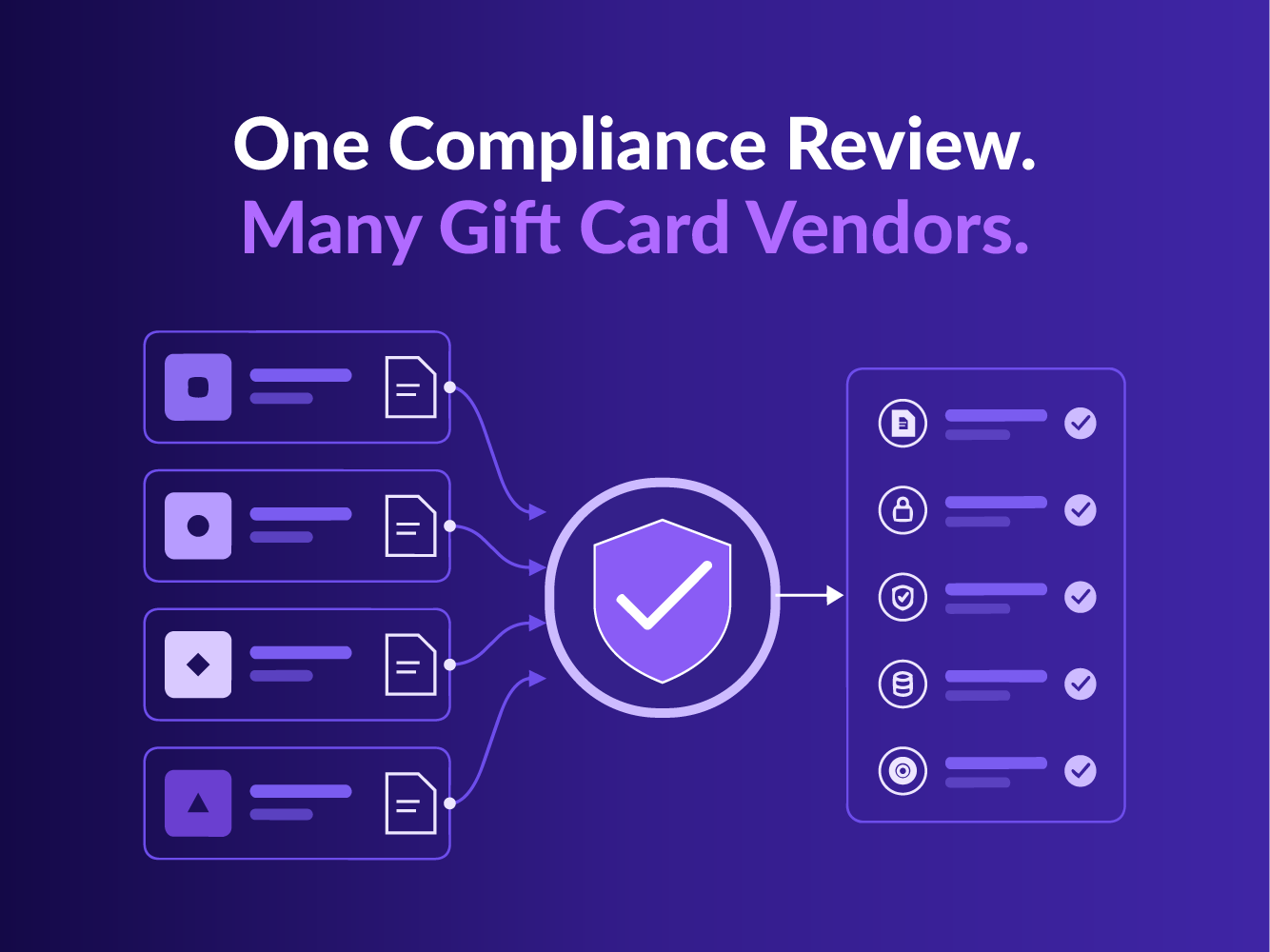
You centralise security and compliance review across a gift card vendor estate by placing a gift card aggregation platform between your platform and the individual vendors, so that one security assessment, one data processing agreement and one evidence relationship stand in for many. The aggregation provider assesses vendor level controls and evidences them upward to you, but accountability to regulators, customers and auditors does not move. Audit effort stays flat as vendors are added only if the evidence chain from each vendor, through the provider, to your platform is defined and tested.
Why Compliance Effort Multiplies With Every Vendor Added
Effort multiplies because the output of one vendor review cannot be reused for the next, and every vendor adds a recurring monitoring duty to the one-off assessment. A vendor estate is the set of gift card suppliers a platform connects to, together with the contracts, credentials and data flows attached to each.
Where the effort accumulates
Each vendor brings its own questionnaire answers, SOC 2 report scope, sub-processor list, data processing agreement under GDPR Article 28, incident notification terms and authentication model. None share a structure, so an analyst reconciles each against the platform's control framework by hand, and the reconciliation consumes the time. The integration adds a second stream, because each vendor API has its own error handling, logging format and secret management. The security team therefore reviews another body of code, not merely another document.
The recurring cost that initial reviews hide
Third-party risk management (TPRM) is the discipline that identifies, assesses and monitors the risks created by external suppliers. The supplier controls in ISO/IEC 27001 expect ongoing monitoring and change review, not a single admission check. Because each vendor is reassessed on its own calendar, evidence requests arrive continuously. A useful diagnostic is to ask which vendor evidence in your last audit cycle was older than the control it was meant to support.
How an Aggregation Layer Consolidates the Review Surface
An aggregation layer reduces repeated review by moving vendor-facing assessments to one provider, so the consuming platform performs one primary review of that provider and one assurance review of how the provider assesses the vendors behind it. An aggregation layer is an integration component that presents many vendor connections through one interface, so that the consuming platform integrates once.
What collapses and what does not
The consolidation is real only when the interface is genuinely standardised. A thin wrapper that passes vendor credentials and responses through unchanged leaves the platform exposed to each vendor's behaviour, and the reviewer ends up assessing every vendor anyway. The test is whether a change in one vendor's API is absorbed by the provider without any change to your integration.
A concrete illustration
Orchestro is a gift card aggregation platform from The Reward Store, a software as a service integration layer for gift card distribution. A business integrates once and gains access to its preferred gift card vendors, with no additional engineering effort for each new vendor connection, through the Gift Card Universal Protocol (GCUP), a standardised interface that abstracts vendor specific APIs into one consistent protocol. Security operations are managed by the platform, so review is not repeated for every vendor integration, and the whole vendor estate is visible from one dashboard.
What Abstraction Does Not Transfer: Accountability Stays With You
Using a gift card aggregation platform transfers operational work, not accountability, because regulators, customers and auditors hold the entity that offers the service responsible for it, whatever the supply chain looks like. Under GDPR Article 28 a controller may use a processor, and a processor may use sub-processors only with authorisation, yet the controller remains answerable. Where the Digital Operational Resilience Act (DORA) applies, the financial entity maintains its register of information on ICT third-party arrangements and retains responsibility for the risk.
A worked scenario
Consider a hypothetical employee benefits platform operator that adds a regional gift card vendor through its aggregation provider. Onboarding is a configuration change, and the provider's assessment of the vendor is current. Some weeks later, internal audit finds that the vendor stores order records in a jurisdiction absent from the platform's records of processing, with no transfer assessment on file. The provider's evidence was accurate. The gap sat in the platform's own register, which nobody updated because a configuration change did not trigger the platform's change process.
Where this approach is the wrong choice
A compliance lead may reasonably object that aggregation replaces many small dependencies with one large one and inserts a fourth party between you and each vendor. The objection is sound, and it is answered by tested exit and failover, not by assertion. Aggregation is also the wrong choice when the estate is one or two vendors, since the extra party adds review without removing any, and when a regulator or client contract requires direct audit rights over every party handling the data. In those cases keep direct relationships and reduce effort with a reusable assessment template, one evidence calendar and a control library mapped once. A hybrid is possible: a direct relationship for a critical vendor, aggregation for the rest.
Evidencing Vendor Level Controls Upward to the Consuming Platform
Vendor level controls reach you through a chain of three links, vendor to provider to platform, and the chain is only as current as its oldest link. An evidence chain is the sequence of attestations that carries proof of a control from the party that operates it to the party that relies on it. Require dated, scoped evidence, not a summary opinion.
Read the scope of the provider's report
A SOC 2 report covers the controls of a service organisation. Where the provider relies on subservice organisations, the report either carves them out or includes them, which is the inclusive method. Under carve-out, the vendors' controls sit outside the auditor's opinion. Complementary user entity controls (CUECs) are controls the service organisation expects its customer to operate, and each one needs a named owner on your side.
What to request upward
- A dated assessment record for each vendor, with the method used.
- Open exceptions and their remediation status.
- Changes to sub-processors and hosting locations, with notice.
- Incident notifications, with timings.
- Failover or exit test records.
- A bridge letter, which is a statement from a service organisation confirming no material change in controls since the date of its last report.
The failure mode to look for is a current provider report sitting above a stale vendor assessment. Dates per vendor expose it; a summary does not.
Diligence Questions to Ask an Aggregation Provider
Ask these of any gift card aggregation platform before relying on it. A sufficient answer is specific, dated and contractual.
A Governance Model That Keeps Audit Effort Flat as Vendors Grow
Audit effort stays flat when auditors test controls across a population instead of testing vendors one by one, so a new vendor adds a row to the population, not a new audit line. A control library is a single set of normalised controls, each mapped once to the frameworks you answer to. Apply the sequence below.
- Publish a vendor admission standard owned by Compliance, covering minimum controls, data location rules and incident terms.
- Build one control library, mapping each control once to ISO/IEC 27001, SOC 2 criteria, GDPR and any sector regulation such as DORA.
- Route every vendor addition through a change ticket that updates the records of processing, risk register and sub-processor list, even when engineering effort is nil.
- Name an evidence owner for each link: vendor to provider, provider to platform, platform to auditor.
- Review by tier and by event, not only by date, so that a provider notice of vendor change triggers reassessment of that vendor.
- Sample controls across vendors instead of auditing vendors individually.
- Test exit and failover on a schedule agreed with the risk committee, and report exceptions to it.
The trade-off sits in step 3. Where onboarding is a configuration, the count can rise faster than review capacity unless the gate is deliberate. Effort also stays flat only while vendors fit the admission standard, because a vendor requiring exceptions is a bespoke review again.
Where Orchestro Fits in a Gift Card Vendor Estate
A gift card aggregation platform sits at the integration boundary between a distributing platform and the vendors it buys from. Orchestro, from The Reward Store, is a gift card aggregation platform that standardises access to the vendors that issue gift cards. A business integrates once and reaches its preferred vendors, and adding or replacing a vendor is a configuration rather than a rebuild. Security operations are managed by the platform, so security and compliance review is not repeated for every vendor integration. The vendor estate is visible from one dashboard. Software agents can discover, purchase, redeem and manage gift cards through the same interface. Every engagement includes a dedicated technical single point of contact and a managed services team behind the API. The platform does not issue gift cards and does not run loyalty, recognition or incentive programmes.
Frequently Asked Questions
How does Orchestro reduce repeated security and compliance review across vendors?
A business integrates once with Orchestro and reaches its preferred gift card vendors through the Gift Card Universal Protocol, known as GCUP, a standardised interface that abstracts vendor specific APIs into one consistent protocol. Security operations are managed by the platform, so security and compliance review is not repeated for every vendor integration. The whole vendor estate is visible from one dashboard.
Do I still need to assess each gift card vendor if I use an aggregation provider?
Yes, but the assessment changes character. You review the provider's method for assessing vendors, its evidence and its scope, rather than repeating every vendor questionnaire yourself. You still sample vendor assessments to confirm the method works, and you remain responsible for deciding whether the provider's assurance meets your risk standard.
Who is accountable under GDPR when a gift card vendor is a sub-processor of my aggregation provider?
The controller remains accountable to data subjects and supervisory authorities. Under GDPR Article 28, a processor may engage a sub-processor only with the controller's authorisation, and must bind it to equivalent data protection obligations. The initial processor remains fully liable to the controller for the sub-processor's performance. Roles depend on the facts of the processing, so confirm them in the data processing agreement.
What evidence should a gift card aggregation platform give my audit team about the vendors behind it?
Request a dated assessment record for each vendor, the assessment method, open exceptions with remediation status, the current sub-processor and hosting location list, incident notifications with timings, and failover or exit test records. Ask for a bridge letter between report dates. Evidence without dates and scope cannot be relied on.
What is the difference between the carve-out and inclusive methods in a SOC 2 report?
In a SOC 2 report, the carve-out method excludes the controls of subservice organisations from the auditor's opinion, so the report says nothing about their operation. The inclusive method includes them in the description and testing. For a provider that relies on gift card vendors, the method determines whether the report evidences vendor level controls or only the provider's own.
How do I stop the vendor count growing without review when adding a vendor is only a configuration change?
Make the admission decision a governance gate rather than an engineering step. Require a change ticket that checks the vendor against the admission standard, updates the records of processing and sub-processor register, and is approved by Compliance before the configuration is enabled. Report additions to the risk committee so that ease of onboarding does not bypass review.
When is it better to keep direct relationships with gift card vendors instead of using an aggregation layer?
Keep direct relationships when the estate is one or two vendors, because an additional party adds review without removing any. Also keep them when a regulator or client contract requires direct audit rights over every party handling the data. In both cases, reduce effort with a reusable assessment template, one evidence calendar and a control library mapped once.
Sign up for our newsletter for trending top content!


