
How to Govern Gift Card Issuance Budgets With Caps, Auto Pause, Top Ups and Variable Limits


Sign up for our newsletter for trending top content!
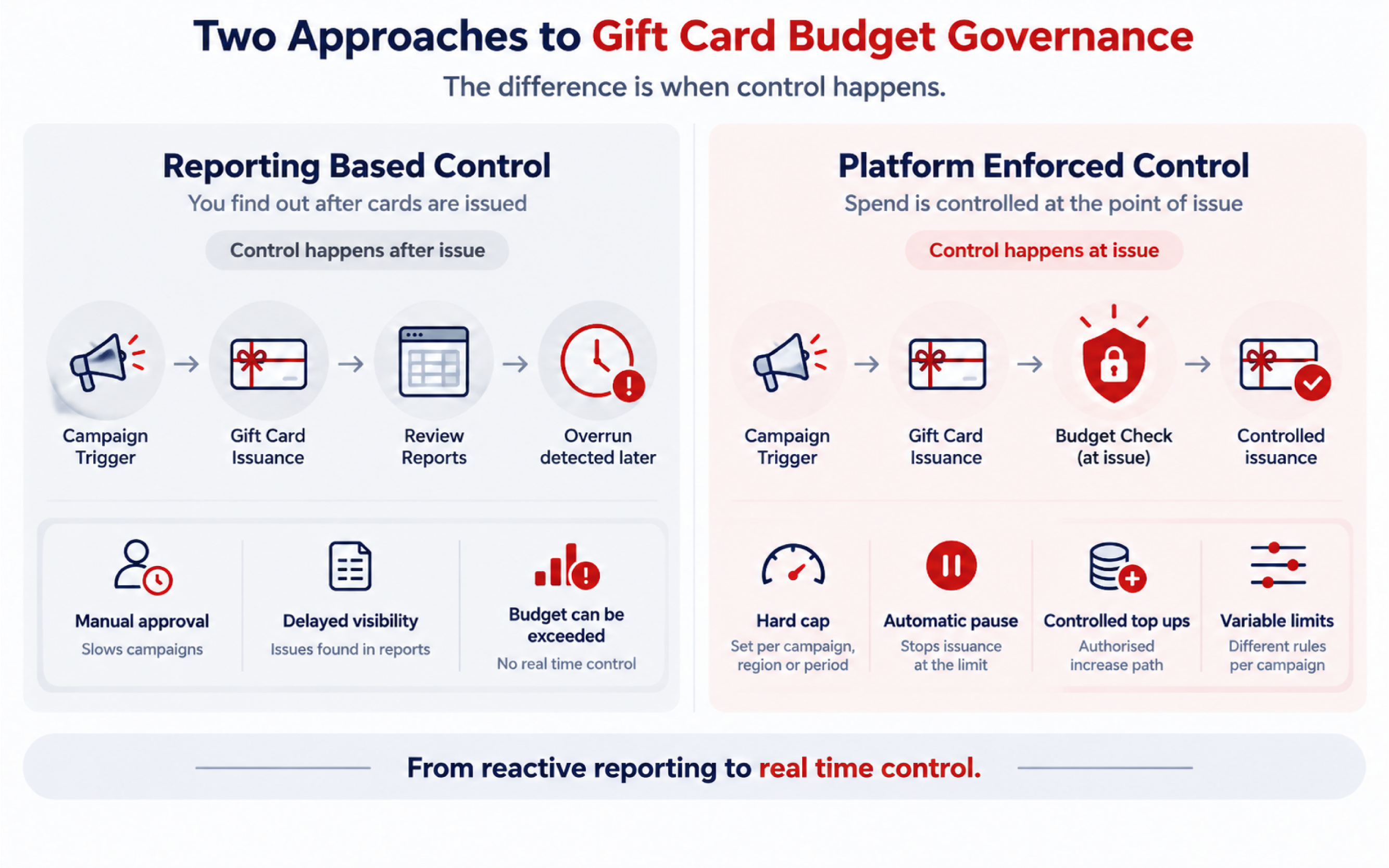
A gift card issuance budget is governed at the point of issue, not at the point of reporting. If a limit is enforced by the platform issuing the cards, spend cannot exceed it.
If it is enforced by an approval process, spend can exceed it, because approval and issuance run on different clocks. This distinction is the subject of this article.
Why Issuance Overruns Are a Control Failure, Not a Decision
An issuance budget overrun is rarely a decision to spend beyond the approved limit. It is the result of no mechanism at the moment of issue that could have stopped it. Cards are issued in response to triggers such as sign ups, purchases or referrals, and nobody notices the cumulative total until a report is generated, by which point the cards are already live.
This changes where the fix belongs. A decision problem is fixed with training or stricter sign off thresholds. A control problem is fixed inside the system that issues the cards, at the moment issuance happens, not in a process that reviews it afterwards.
A useful diagnostic question: when a campaign issues its one thousandth card against a nine hundred card budget, does anything stop that card, or does the organisation only learn about it when finance reconciles the month. If the honest answer is the second, the organisation has reporting, not governance.
Three conditions typically produce overruns: automatically triggered issuance whose volume is not fully predictable; multiple campaigns drawing from a shared pool with no real time view of remaining budget; and an enforcement point that is a person checking a spreadsheet, not the issuance path itself.
Hard Caps and Automatic Pause at Cap
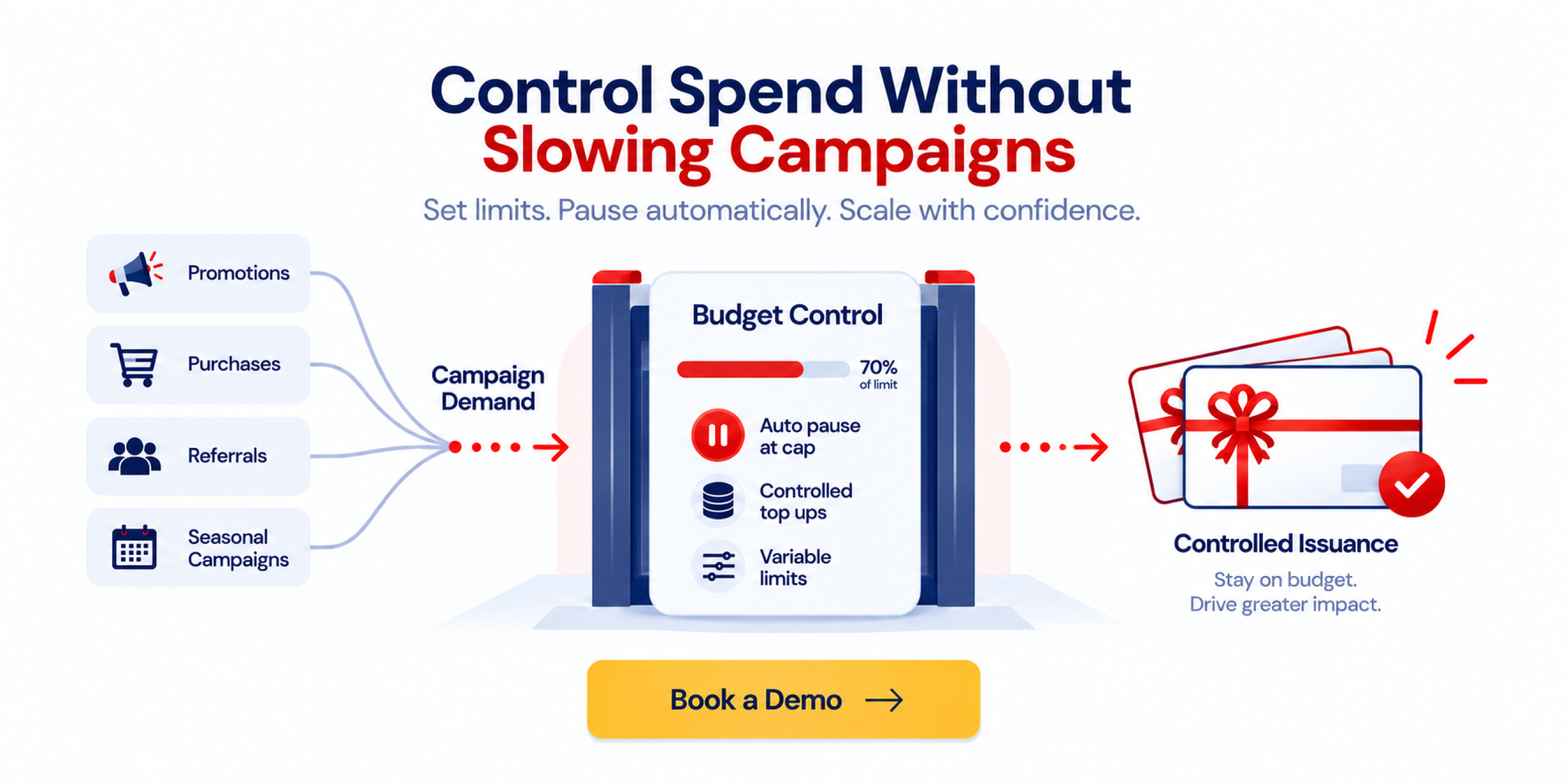
A hard cap is a maximum spend value set against a campaign, region or period, enforced by the issuance system itself rather than by a person reviewing spend after the fact. Automatic pause at cap is the mechanism that makes a hard cap real: once cumulative issuance reaches the cap, the system stops issuing further cards without anyone intervening.
The distinction is not semantic. A cap only visible in a dashboard is a reporting threshold. A cap that halts issuance when reached is a control. Many organisations believe they have the second when they only have the first, because the dashboard shows a number turning red without anything stopping.
Automatic pause needs a defined behaviour for the moment it triggers: issuance should stop cleanly rather than fail mid transaction, the responsible person should be notified immediately rather than discovering the pause from a complaint, and there should be a defined path back, such as a top up, rather than a dead end. A hard cap without that last point replaces one operational problem with another: campaigns that stop dead mid promotion, with no route to resume.
Controlled Top Up Workflows and Who Should Approve Them
A top up is an increase to a campaign's issuance budget after the original allocation, applied without redesigning the campaign or its rules. A controlled top up workflow exists so raising a budget is a deliberate act by someone with financial authority, not a side effect of someone finding the pause inconvenient.
The design question is not whether top ups should be possible. They should, since campaigns legitimately outperform forecast and a rigid budget punishes success as readily as it prevents overspend. The question is who can authorise one, and whether that authority moves at campaign speed.
Three approval patterns are common, with different trade offs.
The organisation that gets this wrong most often treats every top up the same way, applying two person approval to a routine regional campaign and a single pre authorised limit to a large first time influencer campaign. The pattern should match the campaign type's risk profile, not be fixed programme wide.
A finance business partner reviewing a top up request should ask a narrower question than "should this campaign get more budget": does the outperformance suggest the forecast was wrong, or that the campaign is being used in a way it was not designed for. The first is a forecasting correction. The second is a scope conversation that belongs before money moves.
Variable Budgets That Flex by Campaign, Region or Period
A variable budget is a budget structure in which the limit is a function of campaign type, region or period, rather than a single fixed number, so different parts of a programme can carry different exposure without a separate manual budget for each. Variable budgets exist because a single organisation wide cap is either too loose for the smallest campaigns or too tight for the largest.
Consider a national retailer running four concurrent campaign types: a regional promotion tied to store openings, an influencer campaign with unpredictable single day spikes, an aggregator partnership issuing at a steady rate, and a loyalty linked issuance tied to purchase thresholds. Each carries a different risk profile.
The regional campaign is bounded and forecastable from footfall data. The influencer campaign can spike hard within one hour of a post going live, so the ceiling that matters is the hourly rate, not the monthly total. One flat structure across all four either caps the influencer campaign too low to work, or caps the loyalty issuance so loosely it can absorb the whole programme budget during a quiet month for the others.
This is where a gift card issuance platform earns its place over a manually administered spreadsheet: the budget logic must be evaluated per campaign, per region and sometimes per hour, continuously, which a person checking a daily report cannot do.
Reward Factory is a gift card issuance platform from The Reward Store, with campaign management and budget governance built in, and campaign types including regional, influencer, aggregator and loyalty each hold independent rules, so a spend cap, an automatic pause and a variable budget can be set per campaign rather than one flat structure across differing risk profiles.
Variable budgets are not automatically the right structure. A small organisation running one seasonal campaign gains nothing from campaign level variability, only a configuration burden. With one campaign type, running once or twice a year, a single hard cap with automatic pause is the correct and complete control.
Why Approval Based Control Fails at Campaign Speed
Approval based control fails at campaign speed because approval and issuance run on different clocks, and the gap between them is where an overrun lives. A campaign that issues cards automatically in response to a customer action can issue hundreds of cards in the time it takes one approver to read an email. An approval step outside the issuance path cannot intervene in that window, since by the time approval is granted or withheld, the cards it was meant to review have already gone out.
This is not an argument against approval as a concept. It is the correct mechanism for decisions that are genuinely infrequent and require human judgement, such as authorising a new campaign type. It is the wrong mechanism for decisions that recur at issuance speed, since no approval process can run at the speed of an automated trigger.
Organisations that struggle most here respond to a past overrun by adding another layer of approval, assuming more scrutiny prevents recurrence. It does not, if the scrutiny still sits outside the issuance path. The fix is moving the control point to the same clock as issuance.
A genuine counter argument deserves acknowledgement. Automated, platform enforced controls remove a human's ability to make a contextual judgement call in the moment, such as letting a campaign run slightly over cap because a competitor is running a conflicting promotion that week and the marginal spend is justified.
A rigid automatic pause does not know that. The correct response is not to abandon automatic pause but to pair it with a fast, pre authorised top up path, so judgement is still exercised through a top up request, rather than through the absence of any cap.
A Governance Model That Gives Marketing Autonomy and Finance Certainty
A governance model that gives marketing autonomy and finance certainty at once separates two things usually bundled together: who sets the ceiling, and who operates beneath it.
Finance sets the ceiling once, as policy. Marketing operates freely beneath it, without needing finance's involvement in every issuance event.
This works because the ceiling is enforced by the system rather than by a person, which makes real marketing autonomy possible without it becoming risk. If the ceiling depended on a person reviewing every campaign's daily spend, finance could not safely step back.
Once a gift card issuance platform enforces the ceiling at the point of issue, finance does not need to watch every campaign, since the system cannot exceed policy regardless of who is running it.
A five step framework for building this model in an existing organisation:
- Classify every campaign type by issuance trigger, manually batched or automatically triggered by customer behaviour, since this determines whether approval based control can work at all.
- Set a hard cap with automatic pause for every campaign type, sized from the previous period's actual issuance, not an aspirational target.
- Define a top up approval pattern per campaign type, matched to its risk profile, rather than one pattern programme wide.
- Decide, in advance and in writing, which campaign types are eligible for variable budgets and which are served adequately by a single flat cap.
- Review cap sizing on a fixed cadence, not only after an overrun, so caps stay aligned to actual performance rather than drifting stale.
A worked scenario illustrates this. A regional grocery chain runs a loyalty linked issuance tied to purchase thresholds, alongside an occasional influencer campaign for new store openings. Under an approval based model, finance reviews issuance weekly and has, twice in the past year, found a threshold campaign running thirty percent over its informal budget by the time the report was generated.
Under a platform enforced model, the loyalty campaign carries a hard cap sized to the prior quarter's actual issuance, with automatic pause and a pre authorised top up band the loyalty team can draw on without a finance meeting. The influencer campaign keeps a two person approval step, since its risk profile justifies slower authorisation. Finance stops reviewing weekly reports for overrun risk and instead reviews cap sizing quarterly.
Frequently Asked Questions
What is the difference between a soft budget and a hard cap in gift card issuance?
A soft budget is a target that issuance can exceed without being stopped, typically surfaced as a warning or report. A hard cap is enforced at the point of issue, so issuance cannot continue once reached. Only a hard cap, paired with automatic pause, functions as an actual control rather than a monitoring aid.
How often should a gift card issuance budget be reviewed?
Cap sizing should be reviewed on a fixed cadence, commonly quarterly, using actual issuance data from the prior period rather than the original forecast. Reviewing only after an overrun means the cap was already wrong for some period before anyone noticed.
Who should own the decision to approve a budget top up?
Ownership should match the campaign's risk profile, not be fixed programme wide. Predictable, recurring types can use a single pre authorised approver within a defined limit. High value or first time campaign types warrant slower, two person approval, since the cost of a wrong decision is higher.
What is a variable budget in the context of gift card campaigns?
A variable budget is a budget structure in which the spend limit differs by campaign type, region or period, rather than one fixed limit across an entire programme. It suits organisations running several campaign types with materially different risk profiles, such as a regional promotion alongside an unpredictable influencer campaign.
Why do gift card issuance overruns happen even when a budget has been agreed?
An agreed budget is a number, not a control. Overruns happen when nothing in the issuance path stops spend once that number is reached, so the figure functions as a reporting threshold rather than an enforced limit. The gap between agreement and enforcement is where the overrun occurs.
How does budget governance work in Reward Factory?
Reward Factory's budget governance includes a spend cap that pauses issuance automatically once reached, a top up that can be applied at any time, and variable budgets set per campaign. Campaign types, including regional, influencer, aggregator and loyalty, each hold independent rules, so caps and variable budgets can be configured separately for each one.
Where a Gift Card Issuance Platform Fits: Reward Factory
Everything above describes governance as a mechanism, independent of any particular system. Where a gift card issuance platform fits is at the enforcement point itself, the moment a card is about to be issued. Reward Factory is a gift card issuance platform from
The Reward Store. Its budget governance covers a spend cap that pauses issuance automatically once reached, a top up applicable at any time, and variable budgets set per campaign, with campaign management covering regional, influencer, aggregator and loyalty campaign types, each holding its own independent rules. It reports the redemption status of cards it has issued, without operating redemption.
Sign up for our newsletter for trending top content!


