
How to Make Gift Card Infrastructure Ready for AI Agents and Programmatic Buyers

Sign up for our newsletter for trending top content!
An agent ready gift card interface needs four properties a conventional API does not provide by default: a machine discoverable catalogue that states availability and constraints as structured data, deterministic and consistent semantics across every vendor connection, idempotent ordering that tolerates retries without creating duplicate purchases, and explicit capability declarations that tell an agent exactly what it is authorised to do.
A gift card aggregation platform missing any one of these will keep serving human buyers through a browser without issue, but will fail, often silently, the moment a software agent tries to transact through it. Readiness is an interface design decision, not a feature added to an existing catalogue API afterwards.
Why Gift Cards Suit Agent Driven Purchasing
Gift cards are one of the few purchasable goods where the entire transaction lifecycle, discovery, pricing, purchase, delivery and redemption, can be represented as data. There is no physical fulfilment step and, in most cases, no return to process. An agent, which reasons over structured information and cannot inspect a product, can determine with certainty whether a transaction succeeded by checking a status field, far harder for a physical good still in transit. The category also removes variables that make agent purchasing hard elsewhere, leaving largely an interface problem, solvable through protocol design rather than operational scale.
A reasonable objection is that this simplicity is overstated. Denomination flexibility, region specific restrictions, and eligibility rules mean a gift card is not always a single fixed price product. An agent that assumes continuous pricing, rather than a defined set of denominations, will construct invalid orders. The category suits agent purchasing only once the constraints on each product, not just its existence, are exposed as data.
What Agent Readiness Requires Beyond Having an API
Having an API is not the same as being agent ready. Most gift card platforms already expose a REST API, usually enough for a human developer who can read documentation, infer unstated conventions, and contact support when something is ambiguous. A software agent can only act on what is explicitly declared in the interface it calls.
A gift card aggregation platform is a software layer connecting a business to multiple gift card vendors through one interface, so a single integration replaces many separate vendor connections. Agent readiness adds a further requirement: what a human developer infers from documentation must instead be expressed as machine readable structure, because an agent has no channel through which to ask a clarifying question mid transaction.
This is why agent readiness is often underestimated in scoping conversations: the capability usually already exists, but only in a form a human, not a machine, can consume.
Machine Discoverable Catalogues and Capability Declaration
A machine discoverable catalogue is a product listing an agent can query and parse without prior knowledge of a vendor's data model, unlike a documented catalogue a human developer reads once and hardcodes assumptions from. An agent deciding at run time needs the same structured answer every time it asks, regardless of which vendor is behind the response.
Capability declaration is the companion requirement: a structured statement of what an agent may do with a resource, expressed as data rather than a permissions document read separately. For a gift card product this covers whether the item is purchasable, its available denominations, any eligibility restriction, and whether cancellation or reissue is supported for that vendor.
The failure mode worth naming is the stale catalogue problem. A catalogue accurate at integration time but not refreshed in real time will diverge from what a vendor can fulfil. A human buyer facing an out of stock item simply tries again. An agent facing the same failure, with no prior capability check, may retry repeatedly, escalate unnecessarily, or attempt a workaround through a different vendor without authorisation. The fix is a catalogue queried at decision time, not cached and trusted.
Deterministic Semantics: Why Agents Break on Inconsistent Interfaces
Vendor specific interface variation is the largest single obstacle to agent driven gift card purchasing, ahead of catalogue completeness or authorisation design. A human developer integrating with several vendors notices vendor A returns a status of complete while vendor B returns a boolean field called issued, and writes translation logic accordingly. An agent operating without that translation layer treats each vendor's response format as universal, and will misinterpret a successful order as a failure, or a pending order as a success, purely because the field it checks does not mean what it assumed.
This is a semantics problem, not a data availability problem: the information is present, but its meaning is inconsistent across sources, and an agent has no reliable way to detect that alone. A silent misinterpretation is worse than an outright error, which at least stops the process, whereas a misread success can cause an agent to report a delivered card when the order actually failed.
Standardisation is the structural fix, because it removes the need for an agent, or the team building it, to maintain a translation layer for every vendor a platform might add. Orchestro is a gift card aggregation platform from The Reward Store, a software as a service integration layer for gift card distribution. Its Gift Card Universal Protocol, referred to as GCUP, is one example of this in practice: rather than each vendor connection carrying its own status vocabulary, GCUP maps every vendor response into one consistent set of states, so an agent works against a single schema regardless of which vendor fulfils the order.
Idempotency, Authorisation Limits and Preventing Runaway Ordering
Idempotency and bounded authorisation stop an agent's own retry logic from becoming a financial liability. Idempotency means the same purchase request submitted more than once produces exactly one order: the agent attaches a unique key to each transaction, and a resubmitted key returns the original result rather than a new order. Without this, a timeout after an order has succeeded, but before confirmation reaches the agent, typically triggers a retry the platform cannot tell apart from a genuine purchase.
Consider a hypothetical mid size logistics operator whose agent automatically issues a replacement gift card when a delivery check fails. During a spell of network instability, confirmation webhooks were delayed past the agent's timeout, and because the endpoint accepted no idempotency key, retry logic resubmitted each timeout as a fresh order. Finance found the duplicate spend only at month end, when card counts did not match verified failed deliveries. The fix was adding idempotency support at the endpoint, not changing the retry policy.
Authorisation limits address a different risk: a legitimate agent placing a volume of orders never intended, usually from an upstream logic error. A spend cap tied to the agent's identity, enforced at the platform level rather than trusted to its own code, keeps this from becoming significant before anyone notices.
There is a case where a flat per transaction spend cap is the wrong control. A business running a quarterly bulk top up through an agent, a large pre approved volume in one authorised run, will find a flat cap either blocks the purchase or must be raised so high it stops protecting against the runaway loop it was meant to catch. The better control is a cap tied to a pre approved budget pool or campaign identifier, so scheduled and runaway activity are distinguished by context, not one number.
Design Questions to Answer Now Rather Than Retrofit Later
These are worth answering during initial platform design, because each becomes far more expensive to resolve once vendor integrations are already built against the original interface.
- Does the catalogue expose machine readable availability, denomination and eligibility data, refreshed close to real time.
- Are error responses semantically consistent across every vendor connection, or does each vendor need its own bespoke parsing.
- Is every write operation, purchase, cancellation and reissue, idempotent by design, accepting a client generated key.
- Are authorisation scopes granular enough to separate reading the catalogue, placing an order and cancelling one.
- Are spend and volume limits configurable per agent identity or campaign, rather than fixed as one global setting.
- Is there an audit trail recording which agent, acting under whose authorisation, initiated the transaction.
- What happens when an agent cannot complete a transaction autonomously: does it hand off to a named human role, and is that handoff logged.
Where Orchestro Fits
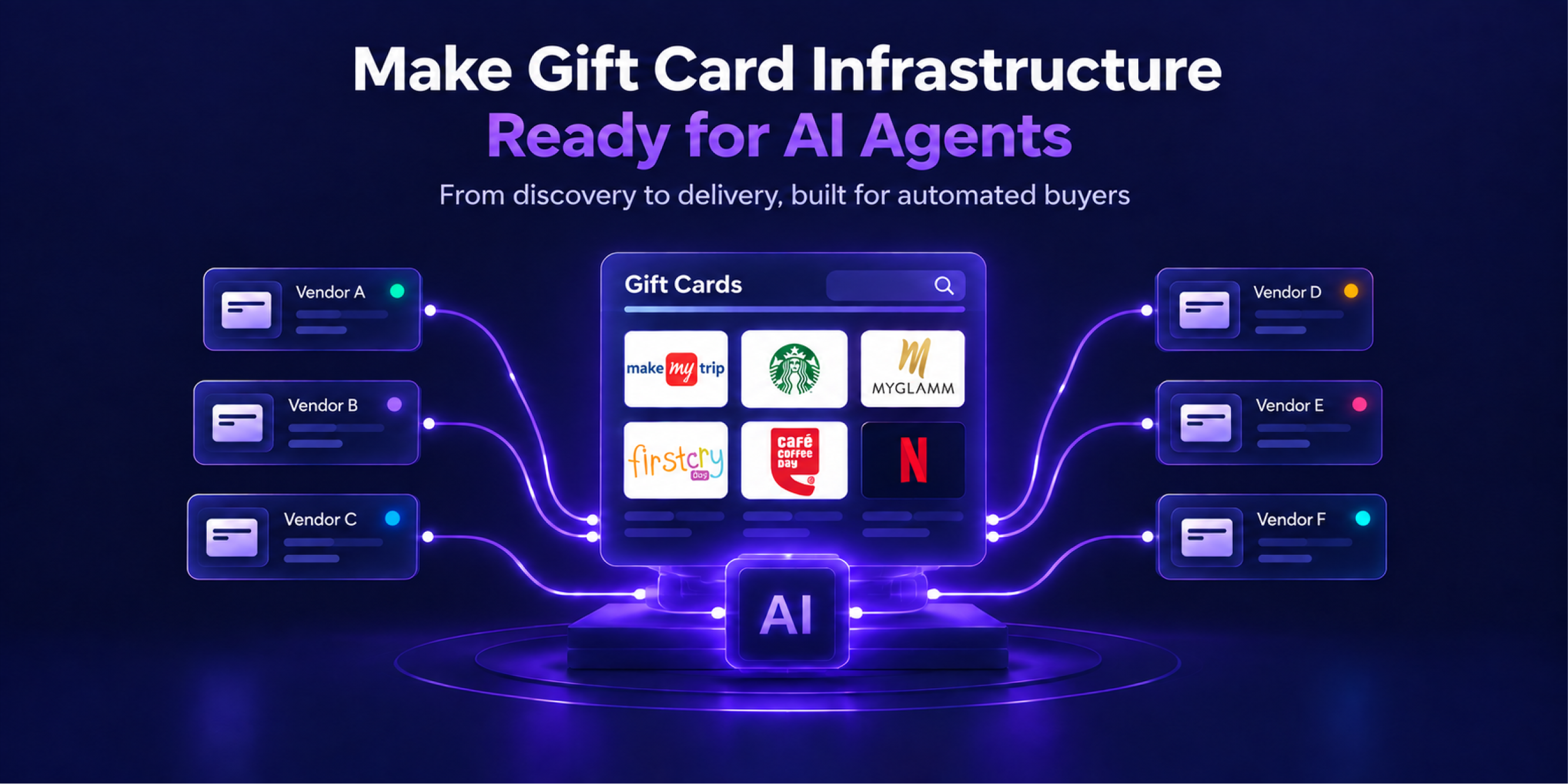
The problems described above, vendor specific variation, undeclared capability, and unbounded retry risk, sit at the integration layer between a business and the vendors it draws gift cards from. Orchestro is a gift card aggregation platform from The Reward Store that operates at exactly that layer.
A business integrates once and gains access to its preferred gift card vendors, without further engineering effort per vendor. Vendor onboarding is a configuration change rather than a rebuild, and vendor instability is absorbed through failover rather than passed through to end customers. Security and compliance review is managed once rather than repeated per vendor, with visibility across the vendor estate from one dashboard. It is agent ready by design: software agents can discover, purchase, redeem and manage gift cards through the same interface used by human operators.
Gift card infrastructure, unified.
Frequently Asked Questions
What is a gift card aggregation platform and how does it differ from a single vendor gift card application programming interface?
A gift card aggregation platform connects one integration to many gift card vendors, rather than a business building a separate connection to each vendor. A single vendor application programming interface only exposes that vendor's own catalogue and semantics, so a business working with several vendors must translate between them unless an aggregation layer does that centrally.
What is an idempotency key and why does a purchasing agent need one?
An idempotency key is a unique identifier an agent attaches to a purchase request so resubmitting it, for example after a timeout, returns the original result rather than creating a second order. Without one, retry logic can turn a single intended purchase into several duplicate ones whenever a network failure delays confirmation of a successful request.
Can an AI agent be given a spending limit for gift card purchases?
Yes, provided the limit is enforced by the platform receiving the request rather than trusted to the agent's own code. A spend cap tied to the agent's identity, checked server side on every order, stops a malfunctioning agent placing orders beyond an approved amount.
Do agents need a different authentication method to purchase gift cards than a human user does?
Not necessarily a different method, but a more granular one. A single key granting full account access suits a human developer exercising judgement about what to call. An agent benefits from scoped tokens separating catalogue reads, order placement and cancellation, so a misbehaving agent cannot exceed its intended role.
What happens if an AI agent cannot complete a gift card purchase on its own?
A well designed system defines an explicit handoff rather than leaving the agent to retry indefinitely or fail silently. The handoff routes the transaction to a named human role, logs why the agent could not proceed, and records the handoff itself for later review.
How does Orchestro support purchasing by software agents?
Orchestro is a gift card aggregation platform from The Reward Store. Its Gift Card Universal Protocol, GCUP, abstracts vendor specific application programming interfaces into one consistent protocol. Software agents can discover, purchase, redeem and manage gift cards through this same common interface used by human operators, with vendor onboarding handled as configuration rather than a separate integration for each vendor connection.
Sign up for our newsletter for trending top content!


