
How FMCG Companies Can Automate Trade Scheme Calculations and End Distributor Disputes for Good

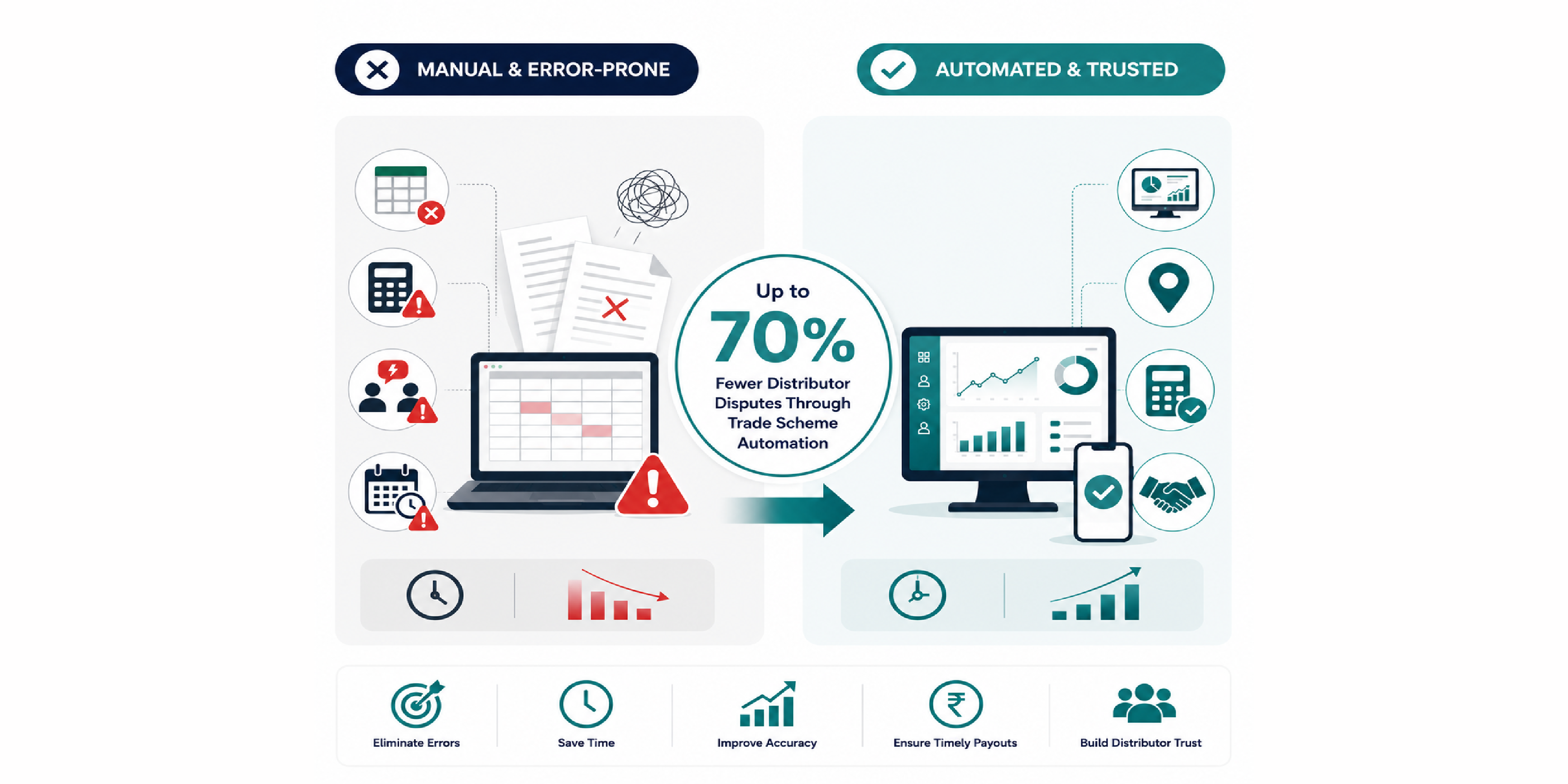
Sign up for our newsletter for trending top content!
Introduction
Research from Deloitte shows that organisations can lose between 20% and 30% of revenue through operational inefficiencies, including incentive administration errors and fragmented processes. In FMCG distribution networks, trade scheme calculations remain one of the most common sources of friction between manufacturers and distributors.
Volume rebates, slab-based incentives, seasonal bonuses and multi-product schemes often rely on spreadsheets, manual validations and delayed reconciliations. The result is predictable: disputes, delayed payouts, strained relationships and lost sales momentum.
For Sales Leaders responsible for distributor performance, the challenge extends beyond calculating incentives correctly. They must create trust, maintain channel engagement and ensure every scheme drives measurable growth.
This article explains why distributor disputes occur, how automated trade scheme management solves the root causes, and what FMCG companies can do to build transparent, scalable incentive programmes.
Why FMCG Trade Schemes Create More Distributor Conflict Than They Resolve
Trade schemes exist to encourage distributors to increase sales volumes, improve product mix and prioritise strategic brands. Yet many schemes create confusion rather than motivation.
According to Gartner, channel partners disengage when incentive structures become difficult to understand or predict. Complexity often reduces participation rates because partners cannot clearly connect actions with rewards.
FMCG organisations frequently operate multiple incentive layers simultaneously:
- Volume rebates
- SKU mix incentives
- Quarterly growth bonuses
- Seasonal campaigns
- Market expansion rewards
Each layer introduces additional calculation variables. When distributors receive incentive statements weeks after programme completion, they often question the numbers.
McKinsey research consistently highlights transparency as a critical factor in channel partner performance and long-term commercial relationships. When distributors lack visibility into how incentives accumulate, trust deteriorates.
The Visibility Gap
Most disputes originate from information asymmetry. Manufacturers calculate rebates internally while distributors rely on their own estimates.
This creates disagreements around:
- Eligible sales volumes
- Product qualification criteria
- Achievement thresholds
- Bonus eligibility periods
- Exception handling
Without a shared source of truth, even well-designed trade schemes generate conflict. Sales teams then spend valuable time resolving claims instead of driving market growth.
The issue is not incentive strategy. The issue is execution.
The Calculation Problem: What Goes Wrong When Volume Rebates Are Computed Manually
Manual rebate administration introduces risk at every stage of the process.
According to Aberdeen Group, organisations that automate incentive management achieve significantly higher accuracy rates than businesses relying on spreadsheets and manual workflows. Human error increases as programme complexity grows.
A typical FMCG rebate calculation may include:
- Monthly sales volume thresholds
- Product category weighting
- Regional adjustments
- Distributor tier multipliers
- Promotional exclusions
Even a minor formula error can trigger substantial payout discrepancies across hundreds of distributors.
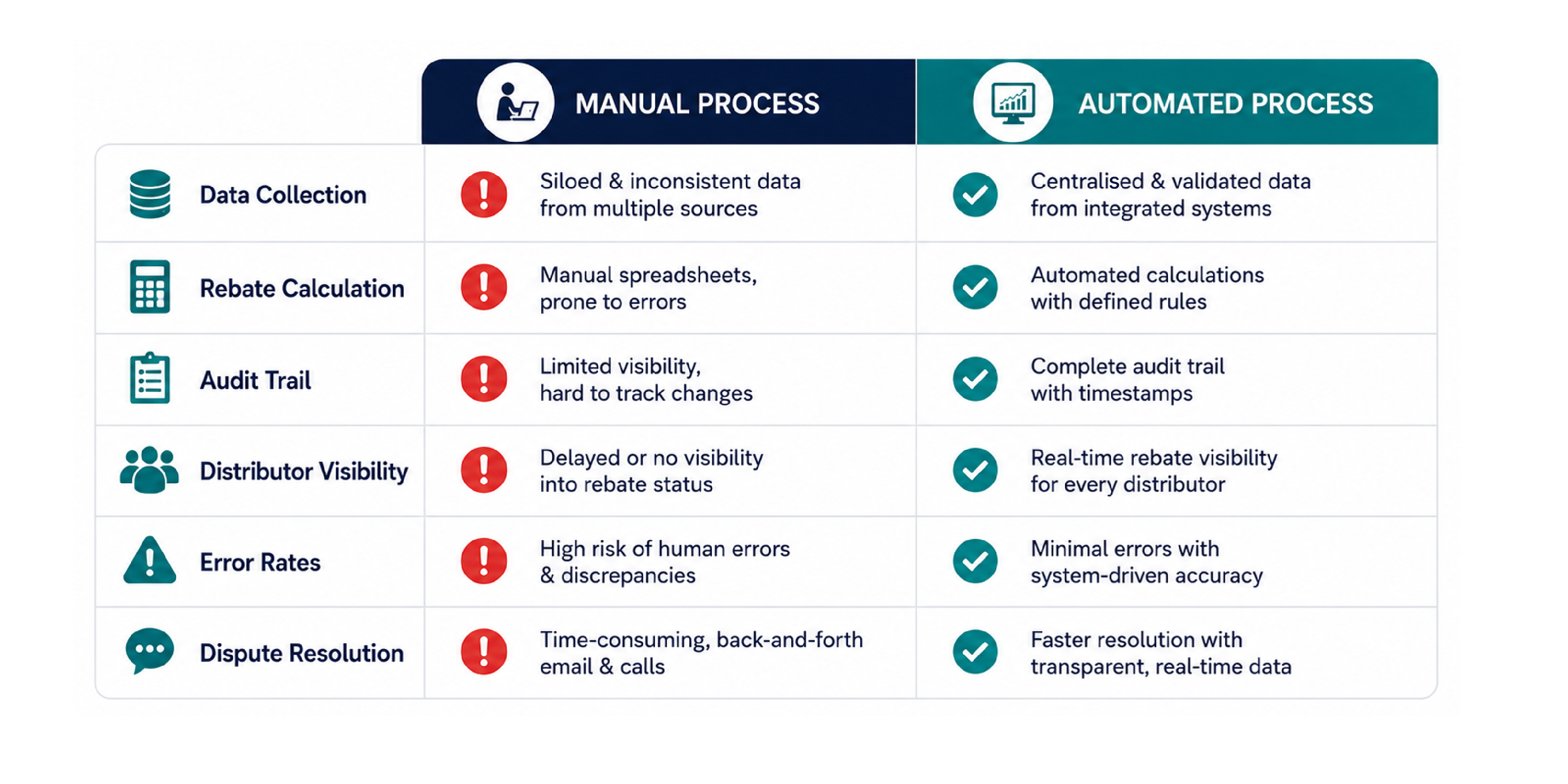
Manual vs Automated Trade Scheme Management
Forrester research shows that organisations with automated operational workflows reduce process-related errors while improving decision-making speed.
Sales Leaders face an additional challenge. Every dispute consumes internal resources.
Finance teams verify calculations. Sales managers investigate claims. Operations teams reconcile transactions. The hidden administrative cost often exceeds the disputed rebate value itself.
Platforms such as Paytives address this challenge by automating incentive calculations against predefined business rules, eliminating dependence on spreadsheet-driven processes and reducing calculation inconsistencies before they become disputes.
How Real-Time Rebate Visibility Changes Distributor Behaviour and Reduces Tension
Behavioural science consistently demonstrates that immediate feedback influences performance more effectively than delayed feedback.
Research from Gallup shows that employees and business stakeholders perform better when they receive frequent visibility into progress and outcomes. The same principle applies to distributors.
When distributors can see rebate earnings accumulating in real time, several positive behaviours emerge:
- Increased focus on target achievement
- Faster corrective action
- Greater participation in incentive programmes
- Higher confidence in payout accuracy
- Reduced dispute frequency
From Retrospective to Predictive Performance Management
Traditional trade schemes operate retrospectively. Distributors discover outcomes after the qualifying period ends.
Real-time visibility changes the dynamic entirely.
Distributors can monitor:
- Current achievement levels
- Remaining volume required
- Bonus qualification status
- Product mix performance
- Upcoming incentive opportunities
According to Bain & Company, transparency strengthens commercial relationships because partners perceive reward systems as fair and predictable.
Instead of questioning final rebate calculations, distributors focus on increasing performance.
Paytives supports this shift through real-time partner performance tracking and incentive visibility, allowing distributors to monitor progress continuously rather than waiting for end-of-period reconciliations.
The result is a healthier commercial relationship built on shared data rather than conflicting spreadsheets.
Designing Multi-SKU Incentive Logic That Works Across a Complex Product Portfolio
FMCG manufacturers rarely operate simple product portfolios.
A distributor may purchase hundreds of SKUs across multiple categories, price points and strategic priorities. Incentive structures must encourage the right mix of products rather than rewarding volume alone.
McKinsey research suggests that sophisticated channel incentive programmes outperform simple volume-based schemes when they align rewards with strategic business objectives.
A Practical Decision Framework
Sales Leaders should evaluate trade schemes against four criteria:
1. Revenue Impact
Does the scheme encourage growth in priority categories?
2. Portfolio Balance
Does it prevent overconcentration in a small number of products?
3. Simplicity
Can distributors understand qualification rules quickly?
4. Scalability
Can the organisation administer the scheme without increasing operational burden?
Modern incentive platforms automate complex logic including:
- Multi-SKU purchase combinations
- Category-specific thresholds
- Weighted product scoring
- Tier-based reward structures
- Regional programme variations
This capability becomes particularly important during product launches or portfolio expansion initiatives.
Forrester notes that organisations adopting automated decision engines improve operational consistency while reducing administrative complexity.
When incentive logic operates automatically, Sales Leaders gain flexibility to design programmes that support strategic growth without creating calculation challenges.
For additional insights into channel incentive management, see The Reward Store's channel incentive solutions:
https://www.therewardstore.com/paytives/
Seasonal and Promotional Bonus Campaigns: Running Them Alongside Standard Rebates Without Chaos
Seasonal demand spikes create both opportunity and complexity for FMCG companies.
Whether linked to festive periods, regional events or promotional campaigns, temporary incentive programmes often overlap with standard rebate structures.
According to Gartner, incentive fatigue occurs when participants struggle to understand multiple concurrent reward mechanisms.
Many FMCG businesses attempt to manage seasonal schemes separately from ongoing trade programmes.
This fragmented approach creates:
- Duplicate calculations
- Conflicting eligibility rules
- Reporting inconsistencies
- Distributor confusion
- Increased dispute risk
The Need for Unified Incentive Management
Sales Leaders require a single framework that accommodates:
- Base volume rebates
- Seasonal bonuses
- Product launch incentives
- Market penetration campaigns
- Strategic growth accelerators
NASSCOM research highlights automation as a key enabler of operational scalability in rapidly growing enterprises.
Rather than creating separate administrative processes for each campaign, automated platforms apply predefined rules across all incentive layers simultaneously.
This enables organisations to launch targeted campaigns quickly without introducing manual complexity.
Businesses using integrated incentive management gain better reporting accuracy, faster campaign deployment and greater distributor confidence because every reward calculation follows a consistent framework.
For broader loyalty and engagement strategy insights, visit:
https://www.therewardstore.com/rekyndl/
From Dispute to Trust: What Changes When Distributors See the Same Data You Do
Trust remains one of the most valuable assets in channel management.
Bain & Company has repeatedly identified trust and transparency as critical drivers of long-term commercial relationships and sustainable growth.
Distributor disputes rarely arise because partners reject incentive programmes. Most disputes occur because partners cannot verify calculations independently.
Creating a Shared Source of Truth
When manufacturers and distributors access the same performance data:
- Disputes decline
- Communication improves
- Programme participation increases
- Incentive adoption accelerates
- Relationship quality strengthens
O.C. Tanner research demonstrates that visibility and recognition significantly improve engagement and trust within performance-driven ecosystems.
The same principle applies to distributor networks.
Instead of debating numbers, conversations focus on business growth. Sales teams spend less time resolving historical issues and more time identifying opportunities.
Paytives supports this transition through real-time dashboards, automated incentive calculations, multi-tier partner structures and transparent performance tracking across global distribution networks.
As distributor ecosystems become more data driven, transparency will move from a competitive advantage to a commercial necessity.
Frequently Asked Questions
What is FMCG trade scheme automation?
FMCG trade scheme automation uses software to calculate rebates, incentives and distributor rewards automatically based on predefined business rules. The system tracks sales performance, applies eligibility criteria and generates accurate payouts without manual spreadsheet calculations. This reduces administrative effort and improves calculation accuracy.
How do automated volume rebate programmes reduce distributor disputes?
Automated programmes create a consistent calculation framework and provide clear visibility into performance data. Distributors can track progress in real time and understand how rewards accumulate. This eliminates many disagreements caused by delayed reporting and manual calculations.
Why do distributors challenge rebate calculations?
Distributors often challenge calculations when they cannot verify achievement data or understand programme rules. Manual processes frequently create inconsistencies between manufacturer records and distributor expectations. Greater transparency significantly reduces these conflicts.
When should FMCG companies move away from spreadsheets?
Companies should consider automation when they manage multiple distributor tiers, complex SKU incentives, seasonal campaigns or large partner networks. As programme complexity increases, spreadsheet-based administration becomes difficult to scale accurately.
Can Paytives manage multiple trade schemes simultaneously?
Yes. Paytives supports volume rebates, promotional bonuses, seasonal campaigns and multi-tier partner incentives within a single platform. This allows FMCG companies to administer complex incentive structures without creating separate calculation processes.
Conclusion
Distributor disputes rarely stem from poor incentive strategy. They stem from poor visibility, inconsistent calculations and fragmented processes. FMCG organisations that automate trade scheme management create greater transparency, improve distributor trust and reduce administrative overhead.
As channel ecosystems become more complex, real-time incentive visibility and automated calculations will become standard practice. Organisations that adopt these capabilities early will build stronger distributor relationships and accelerate growth.
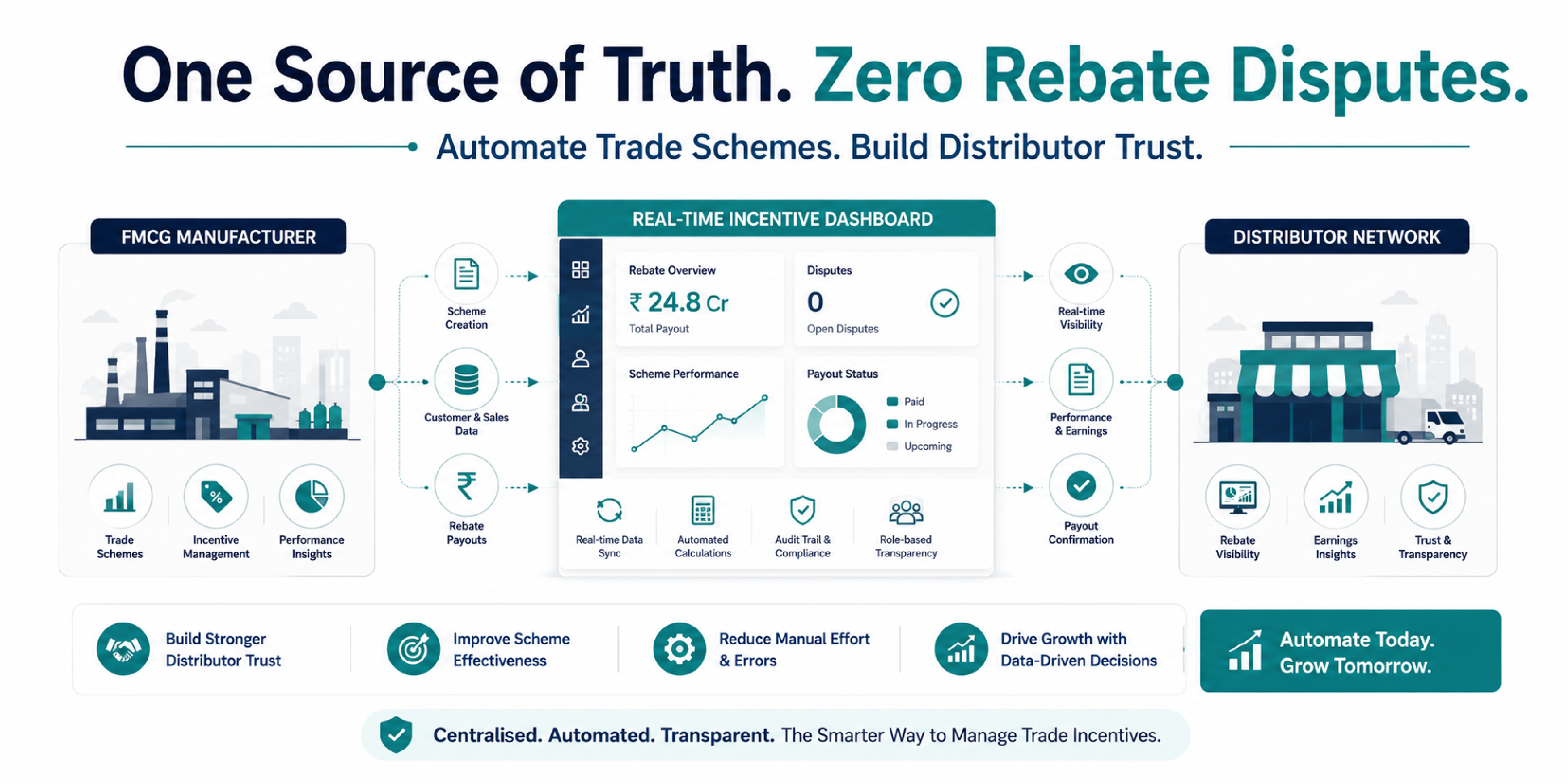
See how Paytives eliminates trade scheme disputes for FMCG distributors and automates volume rebate management across complex channel networks.
https://www.therewardstore.com/paytives/solutions/consumer-goods-retail
Sign up for our newsletter for trending top content!


