
How to Run a Festive Season Loyalty Campaign That Drives Revenue Without Training Customers to Wait for It

Sign up for our newsletter for trending top content!
Introduction
Deloitte's annual festive spending research has repeatedly shown that Diwali accounts for a disproportionate share of India's yearly consumer spend, concentrated into a matter of weeks. For a marketing leader, that concentration is the problem, not the opportunity. Every year the same discount-led playbook runs again, and every year it teaches the same customers to do the same thing: wait for the sale.
The cost is not visible on a single campaign's dashboard. It shows up months later, in flattening repeat purchase rates and rising acquisition costs during the rest of the calendar.
This article sets out how to structure a festive season campaign around points and recognition rather than blanket discounting, so that the revenue spike during Diwali becomes a foundation for retention rather than a one-off transaction.
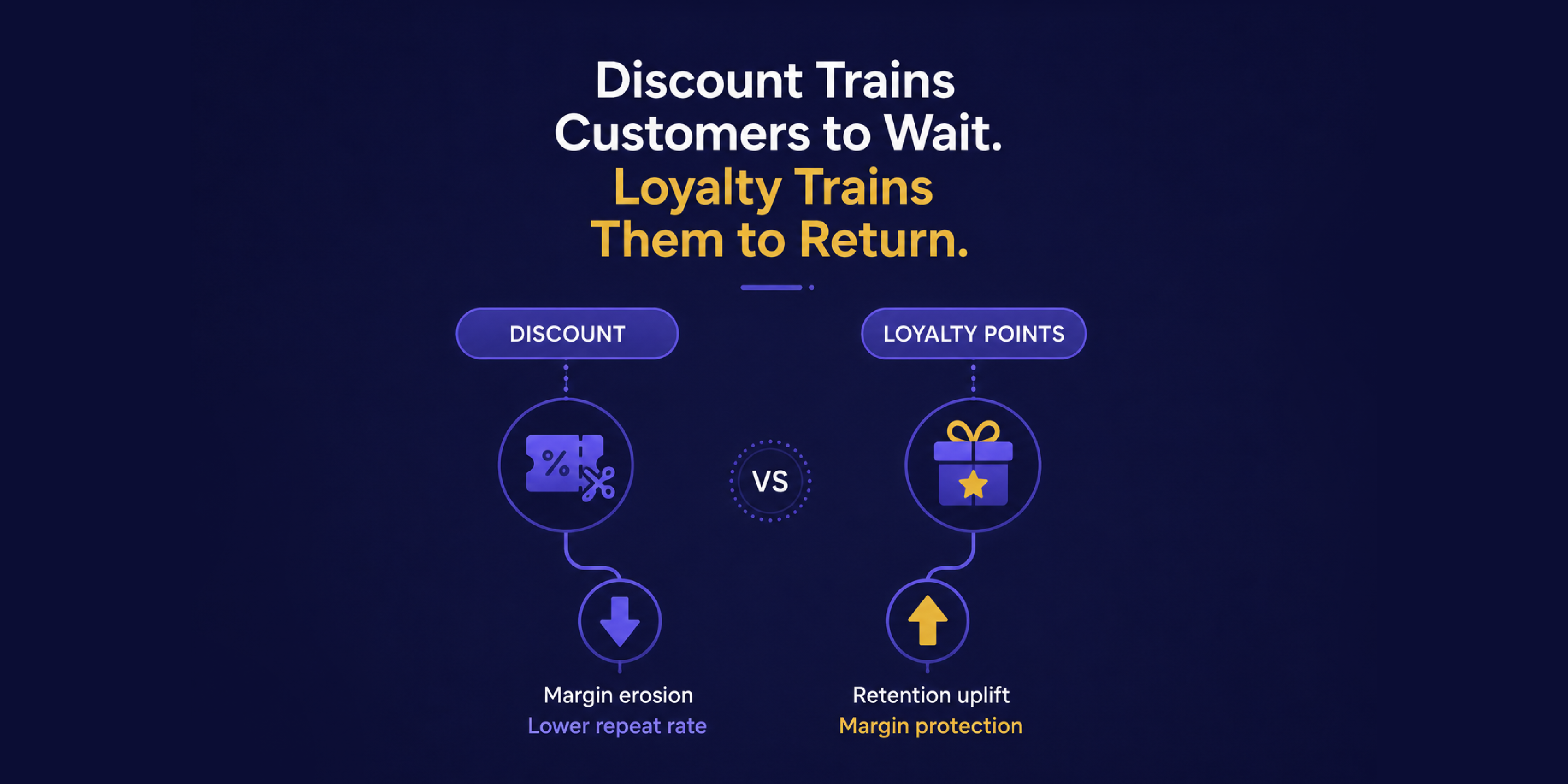
The Festive Discount Trap: Why Most Brands Create Deal-Seekers During Diwali Instead of Loyal Customers
A blanket discount solves for one thing only: short-term volume. It does not distinguish between a first-time bargain hunter and a customer who has been buying from the brand for two years. Both get the same offer, which means the brand pays the same margin to acquire a transaction as it does to reward loyalty, and gets none of the differentiation it needs.
Research from Bain on customer economics has long argued that repeat customers are cheaper to serve and more profitable over time than newly acquired ones, precisely because acquisition and onboarding costs are already sunk. A flat discount ignores that distinction entirely. It optimises for the transaction in front of the brand, not the relationship behind it.
The behavioural effect compounds year on year. McKinsey's work on promotional behaviour has noted that consumers recalibrate their willingness to pay full price once discounting becomes predictable, and a fixed seasonal event like Diwali is about as predictable as promotional cadence gets. Customers do not need to be told the sale is coming.
They plan around it, which means brands are effectively negotiating against their own calendar.
The fix is not to abandon the festive spike. It is to change what the brand pays for. A loyalty-led structure lets a brand reward a known customer more generously than an unknown one, without discounting the product itself.
Loyalty-Powered Festive Campaigns: How Points and Rewards Change the Economics of Seasonal Promotions
Points-based mechanics change the unit economics of a seasonal campaign in a specific way: the brand controls the redemption timeline, not just the acquisition timeline. A discount is spent the moment it is given. A points accrual sits on the brand's books and is typically redeemed against a future purchase, at a future margin, on the brand's terms.
Forrester's research on loyalty programme design has consistently found that points-based incentives produce a measurably different repeat purchase pattern compared with straight percentage-off promotions, because the reward is tied to continued engagement with the brand rather than to a single transaction. A customer who earns points during Diwali has a reason to return before those points expire. A customer who receives 20 percent off has no equivalent reason.
This is also where the festive period becomes a genuine acquisition lever rather than a margin drain. A points multiplier, for example, "earn double points this week," costs the brand nothing until the customer actually redeems, and gives marketing a lever to pull without touching the headline price.
This is the mechanism Rekyndl is built around: a loyalty programme layer that sits on top of existing purchase flows, so that a festive bonus points event can be configured and switched on without rebuilding pricing or checkout logic.
The distinction matters for board-level reporting too. A discount is a cost booked against the campaign. A points liability is a forward-looking retention asset, and it should be reported as one.
Early Access as a Loyalty Benefit: How to Reward Your Best Customers Without the Full Discount
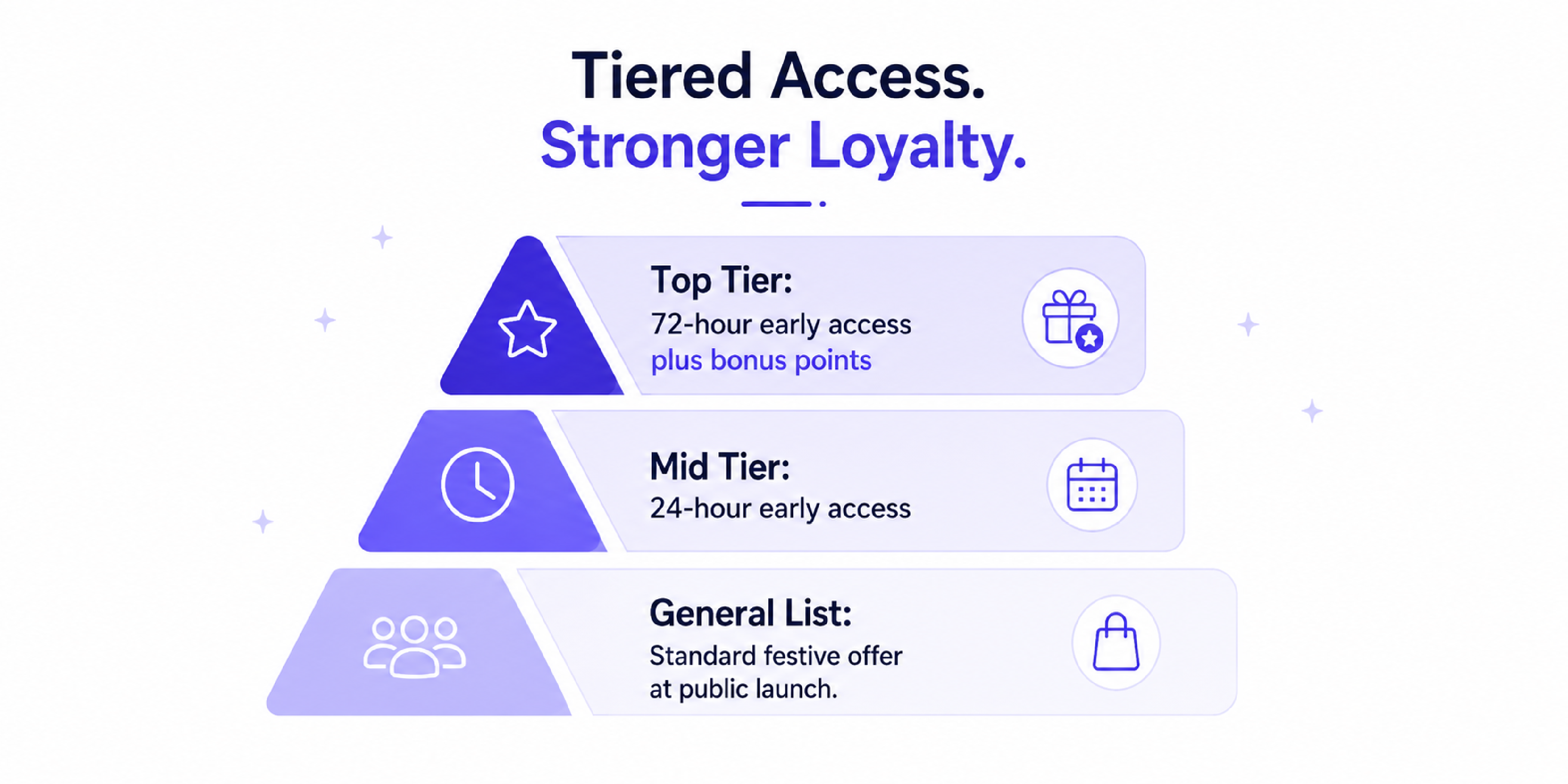
Early access is the most underused lever in a festive campaign, largely because it costs nothing to grant and does not touch margin at all. Giving loyalty members a 48-hour or 72-hour head start on festive stock or offers rewards status rather than price sensitivity, which is precisely the distinction a flat discount cannot make.
IRF (the Incentive Research Foundation) has published extensively on the psychology of status-based rewards, and its findings are consistent with what most loyalty operators observe directly: recognition and access are valued independently of monetary worth, and in some segments more highly than an equivalent cash discount. Early access works because it signals the customer's tier to them before it signals it to anyone else.
A simple way to structure this:
This structure gives a marketing leader a genuine decision framework rather than a single on/off discount switch. Each tier receives something real, but only the top tier receives anything that touches margin directly, and even then it is points rather than price.
How to Structure a Festive Bonus Points Event That Drives Volume Without Margin Erosion
A bonus points event needs three variables set deliberately, rather than copied from the previous year's campaign: the multiplier, the window, and the cap.
The multiplier should scale with how much margin the brand is willing to defer, not how aggressive competitors appear to be. A modest multiplier sustained across a longer window will typically outperform a large multiplier compressed into 48 hours, because it avoids concentrating redemption pressure into a single post-campaign period.
The window should be tied to a specific festive moment rather than the whole season. NASSCOM's commentary on Indian consumer behaviour during the festive period has pointed to distinct spending peaks around specific days rather than a flat curve across the full month, which means a bonus points event timed to a peak will draw more attention than one that runs indiscriminately for four weeks.
The cap protects the brand from open-ended liability. A capped points pool, with automatic reduction of the multiplier once the cap is approached, keeps the campaign's cost predictable in a way that an uncapped discount code never is.
This is a structural advantage of a points mechanic over a percentage-off code: the brand sets the ceiling in advance, and the mechanic itself enforces it. Configuring capped, time-bound points events of this kind is a standard part of how Rekyndl's campaign builder is used during peak season.
Post-Festive Retention: How to Keep Customers Engaged After the Campaign Ends
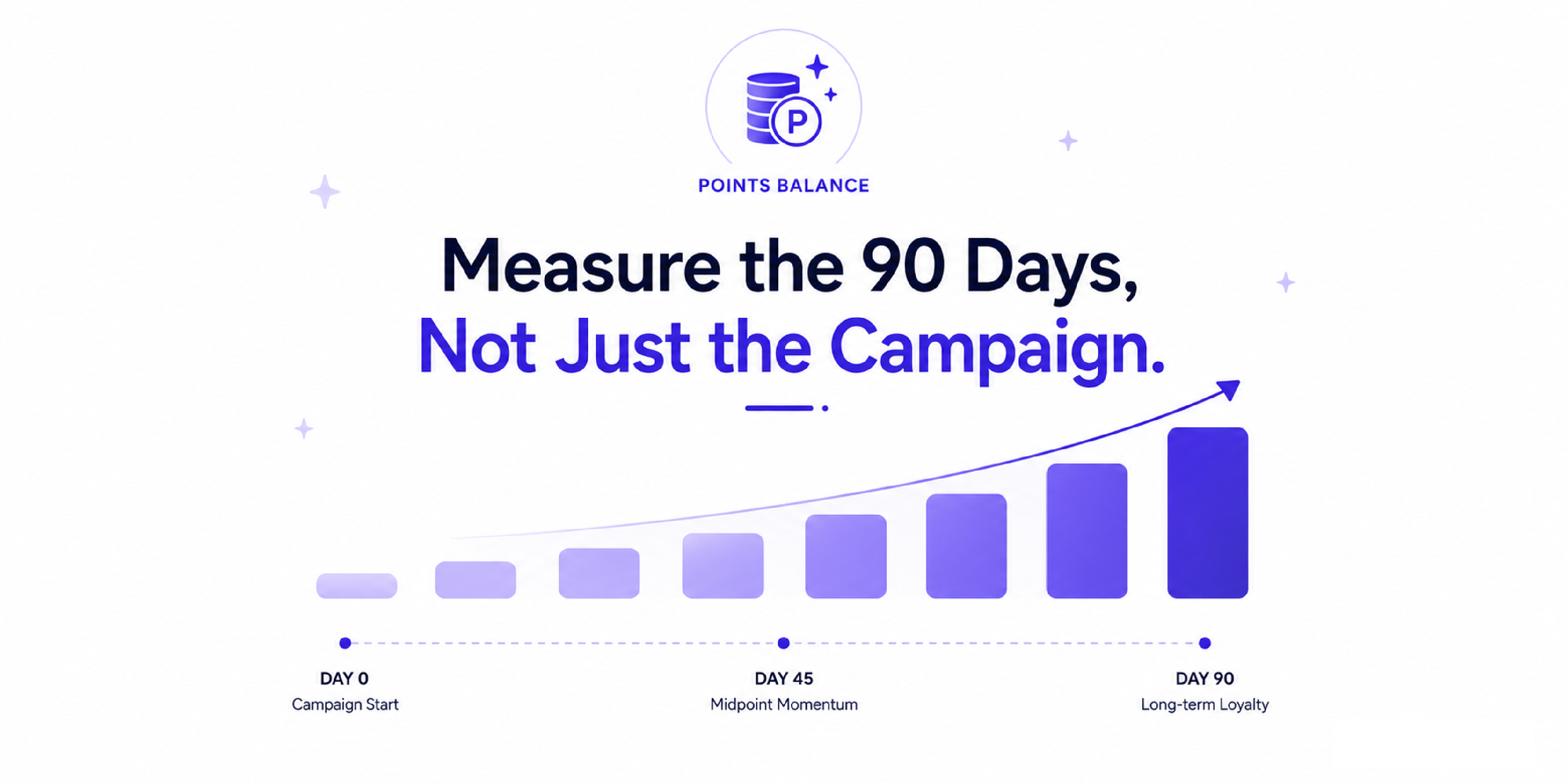
The real test of a festive loyalty campaign is not the fortnight around Diwali. It is the 90 days after it, when the natural pull of the next big moment has faded and the brand has to hold attention on its own.
Gallup's research on customer engagement has found that engaged customers, meaning those who feel a continued relationship with a brand rather than a one-off transactional link, deliver meaningfully higher lifetime value than satisfied-but-disengaged customers. A festive points balance is one of the few natural mechanisms that keeps a customer engaged past the campaign, provided the brand actively reminds them of it.
Three tactics do most of the work here. First, a points expiry reminder sent well before the deadline, which converts a dormant balance into a return visit. Second, a follow-up journey that nudges the customer toward redemption rather than leaving them to remember on their own. Third, a small "welcome back" bonus for customers who redeem within a defined post-festive window, which extends the relationship without repeating the original discount.
None of this requires a second campaign built from scratch. It requires the loyalty mechanics already switched on during the festive event to keep running quietly afterwards, which is the retention layer a points-based structure provides and a discount code cannot.
Measuring Festive Loyalty Campaign ROI: Revenue Lift, New Member Acquisition, and 90-Day Retention Rate
A festive loyalty campaign should be measured against three figures, reported together rather than in isolation, because any one of them read alone can be misleading.
Revenue lift during the campaign window is the obvious headline number, but Aberdeen Group's benchmarking work on promotional reporting has noted that revenue lift figures are frequently reported without a margin adjustment, which overstates the campaign's real contribution once points liability and early-access costs are accounted for.
New loyalty member acquisition during the campaign matters because it shows whether the festive event is building the programme's base or simply activating existing members. A campaign that produces strong revenue lift but adds few new members is not compounding in value the way one that grows the base will.
90-day post-campaign retention rate is the figure that actually validates the strategy. It answers the question a flat discount can never answer: did the customer come back on the brand's terms, or only because the price was low. Mercer's work on customer lifecycle measurement backs this framing, noting that short-window revenue metrics routinely overstate a campaign's durable impact compared with a measurement window that extends well past the promotional period itself.
Reporting all three together, rather than leading with revenue lift alone, is what turns a festive campaign report from a one-off event summary into a genuine input for next year's loyalty strategy.
Frequently Asked Questions
What is the difference between a festive discount and a festive loyalty campaign?
A discount reduces the price for every buyer equally and is spent the moment it is redeemed. A loyalty campaign rewards a customer with points or access tied to their existing relationship with the brand, which defers the cost and gives the brand a reason for the customer to return.
How do I structure early access without alienating customers who are not in the top tier?
Give every tier something real, even if the top tier receives more. A short access window for mid-tier members alongside a longer one for top-tier members keeps the mechanic feeling like recognition rather than exclusion.
Why does a points-based festive campaign protect margin better than a sitewide discount?
Because the brand controls the redemption timeline and can cap the total points pool in advance. A discount code has no equivalent ceiling once it is live.
Can a loyalty programme like Rekyndl be configured for a single seasonal event, or does it require a full-year commitment?
Rekyndl's campaign builder is designed to configure time-bound events, such as a capped festive bonus points period, without requiring the loyalty programme to be run as a continuous full-year mechanic from day one.
When should post-festive retention messaging start?
Before the points expiry deadline, not after. A reminder sent with enough lead time converts a dormant balance into a return visit, whereas a message sent close to or after expiry has already lost most of its effect.
Conclusion
A discount-led Diwali campaign buys a short-term spike and trains customers to wait for the next one. A points-led campaign buys the same spike while building a base of customers who have a reason to return on the brand's own terms, not the calendar's.
The shift is structural, not cosmetic: cap the points pool, tier the access, and measure retention alongside revenue rather than instead of it. As festive spending patterns become more predictable year on year, the brands that stop competing purely on price during that window will be the ones still growing after it closes.
See how Rekyndl helps marketing teams structure festive loyalty campaigns that protect margin and extend engagement well past the campaign window. Book a Demo
Sign up for our newsletter for trending top content!


