
Why Event-Based Loyalty Triggers Are Replacing Static Reward Structures

Sign up for our newsletter for trending top content!
Introduction
Bond Brand Loyalty's Loyalty Report found that 71% of consumers say loyalty programme communications are not relevant to them — yet most brands continue to run fixed, points-for-spend models that treat every customer identically. The result is predictable: low redemption, passive participation, and churn that a quarterly newsletter cannot reverse.
Event-based loyalty triggers represent the structural alternative. Rather than rewarding cumulative spend alone, they activate automatically when a customer takes a specific action — a referral, a milestone, a re-engagement — delivering a reward at the precise moment it carries emotional weight. This post defines event-based triggers clearly, explains why static models underperform on measurable grounds, and gives marketing leaders a practical framework for evaluating the shift.
Why Are Static Loyalty Programmes Losing Their Effectiveness?
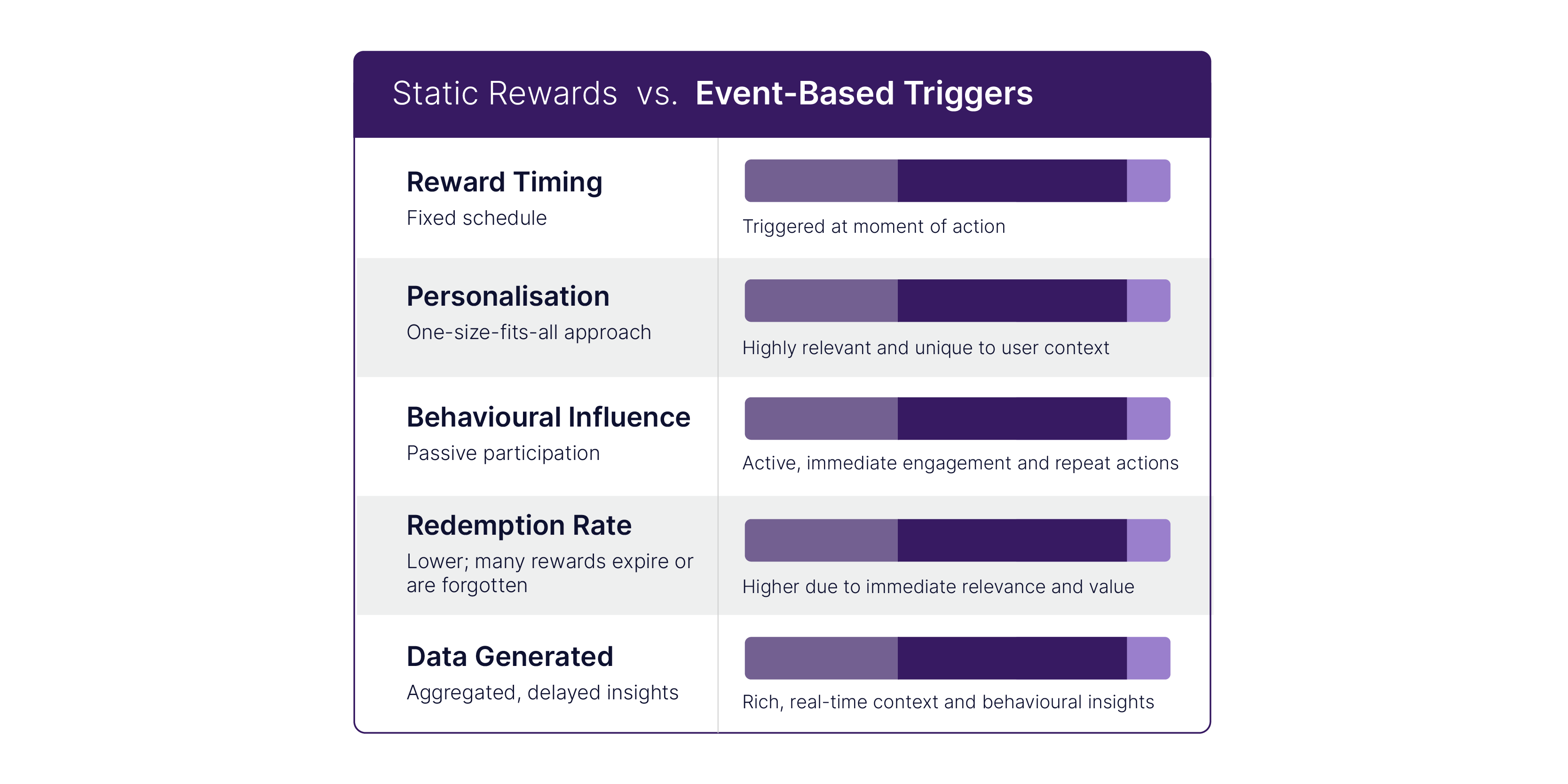
Static reward structures were designed for a simpler commercial environment. A customer earns one point per unit of spend; points accumulate until a threshold is crossed; a reward is issued. The model is administratively clean, but it carries three structural weaknesses that compound over time.
First, it rewards outcomes, not behaviour. A customer who makes one large annual purchase receives the same treatment as one who visits twelve times a year. Forrester's research on loyalty programme design shows that programmes failing to differentiate by engagement pattern see member attrition rates 30% higher than those that do.
Second, delayed gratification erodes motivation. Behavioural economics research by Thaler and Sunstein, widely cited in customer engagement literature, demonstrates that the motivational value of a reward declines sharply when it is separated from the triggering action by time. A reward issued six weeks after a behaviour reinforces almost nothing.
Third, generic rewards produce generic attachment. McKinsey's 2023 personalisation research found that 71% of consumers expect companies to deliver personalised interactions, and 76% report frustration when they do not receive them. A fixed catalogue issued uniformly across an entire member base cannot meet this expectation.
The combined effect is a programme that costs marketing budget without building the behavioural loyalty it was designed to create.
What Is an Event-Based Loyalty Trigger, and How Does It Work?
An event-based loyalty trigger is an automated reward action that fires in response to a specific customer behaviour or milestone. The loyalty engine monitors activity continuously; when a predefined condition is met, it delivers a reward, message, or offer without manual intervention.
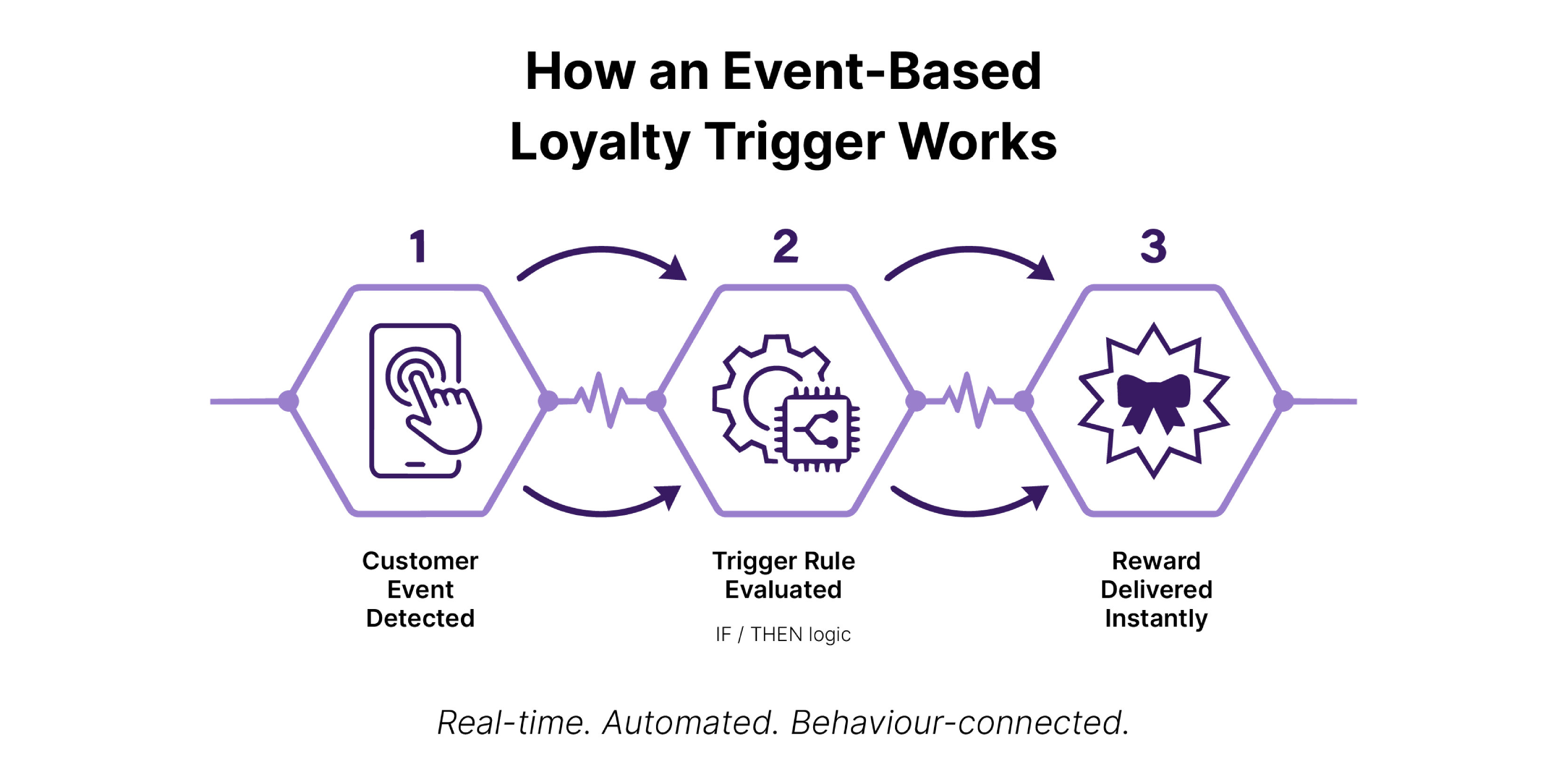
The operational logic follows three stages:
Stage 1 — Event detection. The platform identifies that a customer has performed a qualifying action. This may be a transaction, a non-transactional engagement (a review, a referral, an app login), or a time-based milestone (an anniversary, a period of inactivity).
Stage 2 — Rule evaluation. The engine checks the event against predefined conditions: "Has this customer completed three purchases in 30 days?" or "Has this member been inactive for 45 days?" Rules can be simple Boolean conditions or complex multi-variable logic.
Stage 3 — Reward delivery. The system issues the appropriate response — bonus points, a digital reward from a catalogue of 5,000+ brands, a tier upgrade, or a personalised communication — immediately, without waiting for a batch-processing cycle.
This architecture transforms a loyalty programme from a passive accounting ledger into an active behavioural engine. The Incentive Research Foundation (IRF) reports that real-time recognition is 4x more effective at reinforcing target behaviours than delayed rewards of equivalent monetary value.
Which Customer Events Should Trigger Loyalty Rewards?
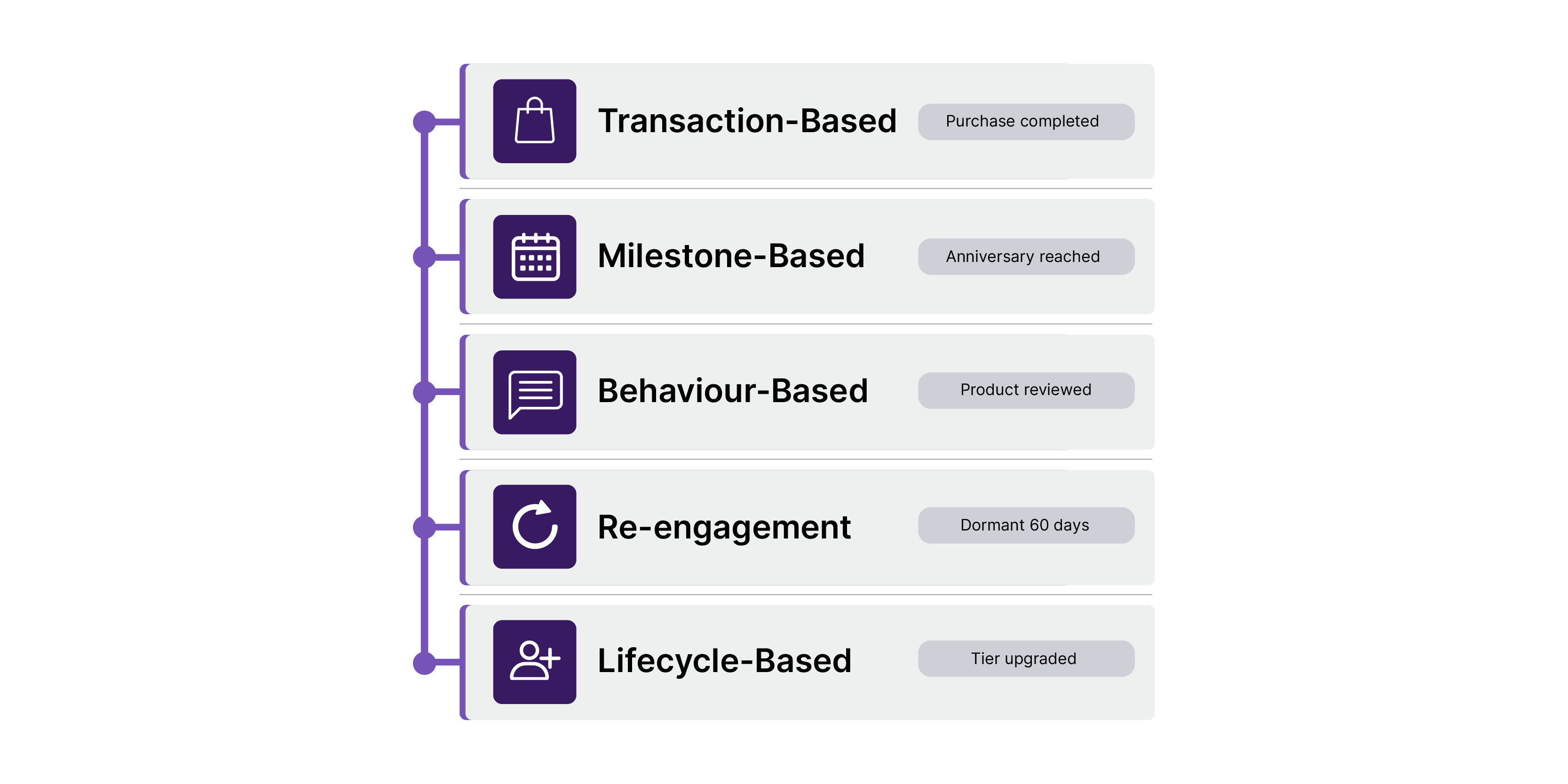
Not every customer action warrants a trigger. Marketing leaders must identify the events that correlate with long-term value, then design triggers that reinforce those specific behaviours. The following framework organises trigger types by strategic objective.
Starbucks Rewards and Marriott Bonvoy are well-documented examples of programmes that combine transactional and milestone triggers effectively. Starbucks uses "Double Star Days" as a promotional transaction trigger; Marriott Bonvoy uses anniversary night rewards as a milestone trigger. Both serve distinct behavioural objectives within a single programme architecture.
Aberdeen Group research shows that organisations using behaviour-driven loyalty triggers achieve 55% higher customer retention rates than those relying on transaction-only models.
How Do Event-Based Triggers Improve Measurable Marketing Outcomes?
The business case for trigger-based loyalty rests on four measurable outcomes, each supported by independent research.
Redemption rate. Programmes with event-triggered rewards see significantly higher redemption velocity. Bond Brand Loyalty reports that members who redeem at least once every quarter are 3.5x more likely to increase their spend with the brand in the following six months. Triggers accelerate redemption by making rewards feel immediately earned rather than distantly accumulated.
Customer lifetime value. Bain & Company's loyalty economics research shows that a 5% increase in customer retention correlates with a 25–95% increase in profits, depending on the sector. Trigger-based programmes extend tenure by maintaining engagement between purchase cycles — a structural advantage that a points-for-spend model cannot replicate.
Behavioural influence. Dynamic triggers allow marketing leaders to guide customers toward commercially valuable actions. A re-engagement trigger deployed at day 30 of inactivity reaches a customer before they have mentally exited the relationship; the same trigger deployed at day 90 is recovering a lapsed member. O.C. Tanner's research confirms that timely, behaviour-connected recognition produces 2.7x higher engagement scores than generic periodic rewards.
Data quality. Event-based systems generate granular behavioural data as a by-product of normal operation. Marketing leaders gain visibility into which actions precede high-value customer journeys, enabling continuous programme optimisation. Forrester notes that brands with behavioural loyalty data outperform peers on customer acquisition cost by an average of 20%.
Rekyndl's automated journey builder was built specifically to operationalise this logic — connecting trigger events to personalised reward delivery across the full customer lifecycle, without requiring manual campaign management for each event type.
Frequently Asked Questions
What is an event-based loyalty trigger?
An event-based loyalty trigger is an automated rule within a loyalty platform that fires a reward, message, or offer when a customer performs a specific action or reaches a defined milestone. Unlike a static points model, which processes rewards in batch cycles, an event trigger responds in real time — meaning the customer receives recognition at the moment their behaviour occurs, not days or weeks later.
How does an event-based trigger differ from a standard points programme?
A standard points programme rewards cumulative spend uniformly, regardless of which specific actions a customer takes or when they take them. An event-based trigger system rewards defined behaviours individually and immediately, allowing brands to reinforce specific actions — a referral, a review, a re-engagement — rather than simply accumulating a spending balance. The IRF reports that this real-time specificity produces 4x stronger behavioural reinforcement than delayed, spend-based rewards.
What events should trigger loyalty rewards in a consumer programme?
The events worth triggering depend on the commercial behaviour a brand wants to reinforce. High-priority triggers typically include: first purchase (to activate early habit formation), third purchase within a defined window (to establish repeat behaviour), referral completion (to drive acquisition), and inactivity at 30 days (to recover at-risk members). Milestone events — anniversaries, birthdays, tier crossings — complement transactional triggers by building emotional connection between commercial moments.
How does Rekyndl support event-based loyalty programme design?
Rekyndl, The Reward Store's consumer loyalty product, includes a built-in automated journey builder that connects trigger events — transactional, behavioural, and milestone-based — to personalised reward delivery from a catalogue of 5,000+ brands spanning gift cards, hotel bookings, flight bookings, dining vouchers, and experiential rewards. Brands can configure multi-step trigger sequences without custom engineering, and the platform's built-in marketing automation ensures reward communications are personalised and timely.
Can event-based triggers work across a global, multi-market loyalty programme?
Yes. Cloud-based loyalty platforms with native multi-currency and multi-catalogue support can serve trigger-based programmes across geographies without requiring separate regional configurations. The critical requirement is that the reward catalogue offers locally relevant options in each market — a trigger programme offering only one country's reward options will underperform in others regardless of how well the trigger logic is designed.
Conclusion
Static loyalty programmes reward an outcome — a spending total — long after the behaviour that produced it. Event-based triggers reward the behaviour itself, at the moment it occurs, with a reward calibrated to its context. The evidence from the IRF, Bain, Forrester, Bond, and Aberdeen Group consistently points in the same direction: immediacy and relevance drive retention; generic delays do not. As loyalty programmes mature from accounting systems into behavioural growth engines, the brands that invest in event-based architecture now will hold a structural advantage that compounds over time.
See how Rekyndl's automated journey builder connects event triggers to personalised reward delivery across your entire customer lifecycle — without manual campaign management. Explore Rekyndl's features →
Sign up for our newsletter for trending top content!


