
How to Build Employee Recognition That Actually Reaches Remote and Hybrid Teams Equally

Sign up for our newsletter for trending top content!
Introduction
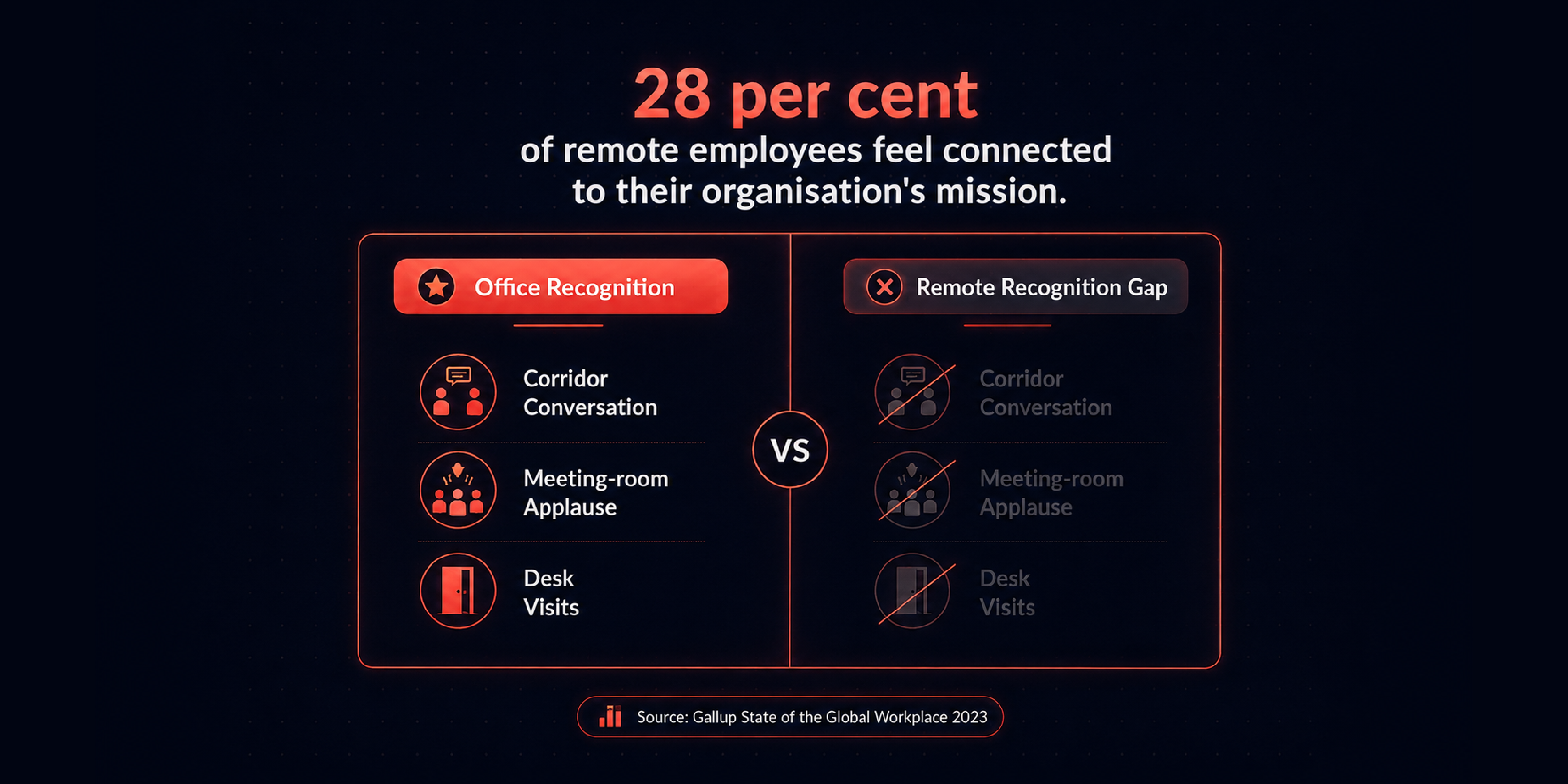
Gallup's most recent workplace research puts connection to organisational mission and purpose among fully remote employees at 28 per cent, a record low and down from 36 per cent in 2021. Hybrid and on-site colleagues report notably higher figures.
That gap does not close itself. It is the direct result of recognition systems built for people who share a corridor, a lunch break, and a manager's line of sight, and never redesigned for people who do not.
This blog sets out, for HR leaders managing distributed workforces, exactly where recognition breaks down across time zones and shift patterns, and what a genuinely equitable recognition system requires. Left unaddressed, the cost shows up as disengagement, quiet attrition, and a workforce that no longer feels seen.
The Remote Recognition Deficit: Why Distributed Employees Fall Behind Office Workers
Recognition has historically travelled through informal, physical channels: a comment overheard in a corridor, a manager stopping by a desk, applause in a meeting room. None of these channels exist for a distributed workforce, and the data reflects it. Gallup's State of the Global Workplace research shows fully remote employees now report the lowest connection to organisational mission and purpose of any working arrangement, a decline that has been sustained rather than temporary.
The same research links this disconnect to elevated flight risk: Gallup finds that a majority of fully remote employees globally are either actively searching for a new role or watching passively for one, a proportion that falls sharply only when both engagement and personal wellbeing are strong.
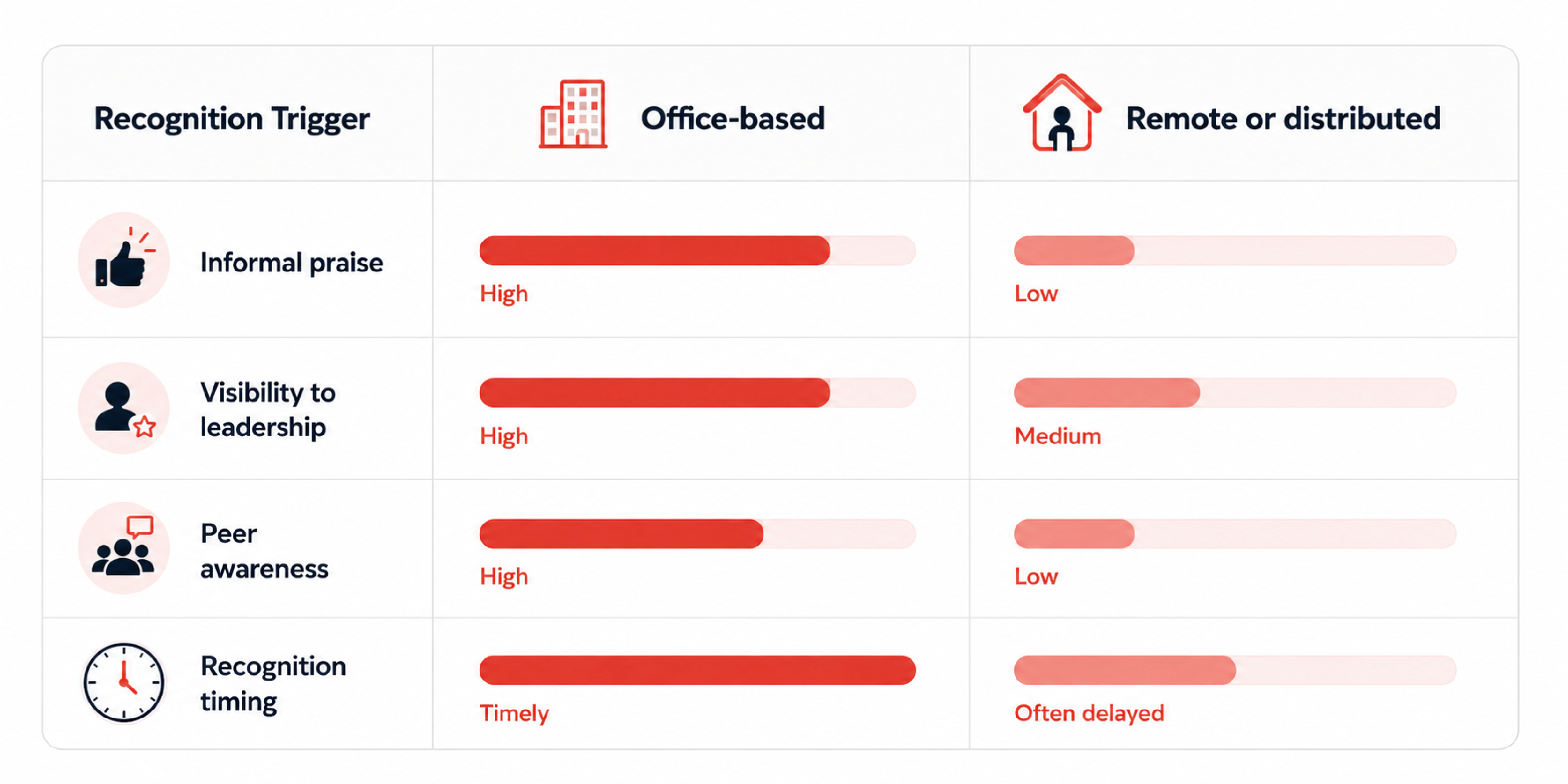
Society for Human Resource Management research on distributed teams points to a structural cause rather than a motivational one. Recognition that depends solely on a manager noticing behaviour in real time will always under-serve people the manager does not physically see. Organisations that rely on manager-only recognition create, in effect, a visibility tax on remote employees.
The comparison below sets out where the deficit typically originates.
Closing this gap requires recognition infrastructure that does not depend on physical proximity at all.
Time Zone and Shift Challenges: How to Design Recognition That Works Asynchronously
Recognition programmes designed around a single working day fail distributed teams by construction. A programme that depends on a live team meeting, a synchronous Slack channel moment, or a manager's end-of-day summary will systematically miss employees working six, eight, or twelve hours out of step with headquarters.
Gallup's engagement research indicates that employees need recognition at a sustained, near-weekly cadence to maintain high engagement, a frequency that monthly or quarterly recognition cycles, the most common format in use, structurally cannot deliver. For distributed teams, the practical implication is that recognition needs to be logged and delivered asynchronously, so that a contribution made during a night shift in one geography is recognised without requiring anyone to be awake to witness it.
Organisations for Human Resource Management research on distributed team dynamics also finds that peer recognition, rather than manager-led recognition alone, is the primary driver of belonging for remote employees. Peer recognition is naturally asynchronous. A colleague in a different time zone can log appreciation the moment they notice it, without waiting for a shared meeting slot.
Building a programme around this principle means three design choices matter most: recognition should be logged the moment it happens rather than saved for a review cycle, it should be visible to the whole team regardless of who is online, and it should not require real-time participation to count. Shift-based and frontline distributed teams need the same logic applied to hourly and rotational patterns, not only to time zones.
Digital Recognition Tools for Remote Teams: What Actually Changes Participation When You Remove Physical Proximity
Removing physical proximity does not remove the need for recognition to feel immediate and specific. It changes which tools can deliver that. Recognition platforms that sit natively inside the tools distributed employees already use, rather than requiring a separate login, consistently see higher participation, because the friction of switching systems is itself a barrier to spontaneous recognition.
This is where the channel matters as much as the message. ApplaudIQ is built with native Slack and Microsoft Teams integration specifically to address this, allowing peer-to-peer recognition, milestone rewards, and leaderboard visibility to happen inside the channels distributed teams already use for daily work, rather than in a separate portal that competes for attention.
Research from O.C. Tanner on recognition programme design consistently finds that peer-to-peer recognition generates substantially more recognition moments per employee than manager-only programmes, because peer recognition removes the single point of failure that a busy manager represents.
Three participation factors are worth testing directly: does the tool require a separate login, does it surface recognition to the wider team rather than keeping it private between two people, and does it work identically well for an employee logging in from a shared kiosk on a warehouse floor as for one on a laptop at home. A tool that only satisfies the third condition for desk-based staff has not solved the distributed recognition problem, it has relocated it.
How to Train Managers to Recognise Remote Reports With the Same Frequency and Quality as Office Staff
Manager behaviour, not tooling alone, determines whether recognition reaches distributed reports. Gallup research on manager accountability finds that employees who strongly agree their manager holds them accountable for performance are 2.5 times more likely to be engaged in their work, and accountability of this kind depends on the manager actively tracking contribution rather than passively observing it.
For managers of distributed teams, this means recognition needs to become a scheduled discipline rather than an ambient habit. Three practical changes make the difference.
First, managers should maintain a written log of contributions from remote reports between one-to-ones, since memory alone favours whoever was most recently visible.
Second, recognition frequency should be tracked as a manager metric, not left to individual judgement, so that remote reports are not quietly deprioritised under time pressure.
Third, managers should be trained to recognise outcomes and effort that are only visible in written or asynchronous form, such as thorough documentation or proactive problem flagging, rather than defaulting to recognising only what happened in a live meeting.
Organisations that build recognition frequency into manager scorecards, and pair that with a platform that surfaces overdue recognition automatically, close the gap between office and remote reports far faster than guidance alone achieves.
All-Hands and Town Hall Recognition Moments: How to Make Virtual Celebration Feel Real
Public recognition at scale, the kind that used to happen through applause in a shared room, needs deliberate redesign for a virtual audience. A name read aloud on a video call, with no accompanying detail or interaction, does not carry the same weight as recognition delivered in person, and distributed employees notice the difference.
Deloitte's research on employee connection finds that employees who are recognised regularly report meaningfully stronger connection to their organisation's mission than those who are not, underscoring that the format of recognition matters less than its consistency and visibility.
For all-hands recognition specifically, three elements make a virtual moment land: the recognition should include specific detail about what was done and why it mattered, rather than a name and a generic thank you; it should be visible afterwards, through a channel post, a wall of appreciation, or a written record, so that employees who missed the live session still see it; and it should include a moment for peer reaction, such as reactions or comments, so the moment is not passive broadcast but shared acknowledgement.
Town halls should also rotate who presents recognition, so it does not become solely a leadership-down exercise, which reinforces exactly the visibility gap distributed employees already experience in daily work.
Using Recognition Data to Detect Remote Disengagement Before It Becomes Attrition
Recognition data is also an early warning system, and this is where distributed organisations most often under-use the tools they already have. The Society for Human Resource Management estimates that replacing an employee typically costs between 50 and 200 per cent of that employee's annual salary depending on seniority, a cost that is almost always higher than the intervention that would have prevented the departure.
A sudden drop in recognition received, recognition given, or peer interaction for a specific employee or team is a leading indicator worth monitoring directly, ahead of formal engagement surveys. Gallup's research on fully remote employees finds a majority are actively or passively open to new roles, a proportion that falls substantially among employees who are both engaged and thriving, which makes recognition frequency a meaningful proxy signal for both.
Platforms such as ApplaudIQ that centralise recognition data across an organisation allow HR teams to flag individuals or teams whose recognition activity has fallen away, rather than waiting for a resignation to surface the pattern. Treating recognition data as a retention signal, reviewed on a monthly cadence alongside standard engagement metrics, gives HR leaders a materially earlier intervention point than annual survey cycles allow.
Frequently Asked Questions
What is the biggest cause of unequal recognition between remote and office employees?
The primary cause is that most recognition still depends on physical visibility, a manager or colleague noticing behaviour in person. Remote employees are structurally excluded from this channel regardless of how well they perform. Fixing it requires recognition systems that capture contribution asynchronously rather than relying on someone being in the room to witness it.
How often should managers recognise remote employees?
Research indicates that recognition needs to happen at close to a weekly cadence to sustain engagement, which is more frequent than most formal review cycles allow. This means recognition needs to be built into regular manager habits and supported by tools that surface overdue recognition, rather than left to be remembered during scheduled one-to-ones.
Can peer-to-peer recognition really replace manager recognition for distributed teams?
Peer recognition does not replace manager recognition, but it addresses a gap manager recognition alone cannot close, since one manager cannot observe every contribution across a distributed team. Research associates peer-to-peer recognition programmes with substantially higher recognition volume than manager-only programmes, because it removes the single point of failure a busy manager represents.
How does ApplaudIQ help HR leaders recognise remote and hybrid employees equally?
ApplaudIQ delivers peer-to-peer recognition, milestone rewards, and leaderboard visibility natively inside Slack and Microsoft Teams, the tools distributed employees already use, removing the friction of a separate portal. It also centralises recognition data so HR leaders can identify individuals or teams whose recognition activity has dropped, giving an earlier signal of disengagement than annual surveys provide.
When should HR teams start treating recognition data as a retention signal?
Recognition data should be reviewed on a recurring basis, ideally monthly, alongside standard engagement metrics rather than only during annual survey cycles. A sustained drop in recognition received or given for a specific employee or team is a leading indicator worth investigating directly, well ahead of a formal exit.
Conclusion
Recognition built for a physically shared office will always under-serve a distributed workforce, not because remote employees contribute less, but because the channels that carried recognition in the past do not reach them.
Closing that gap requires asynchronous design, manager accountability, and tools built into where distributed teams already work, not a scaled-down version of office recognition. As distributed and shift-based work becomes the default rather than the exception, recognition infrastructure will increasingly determine retention outcomes on its own.
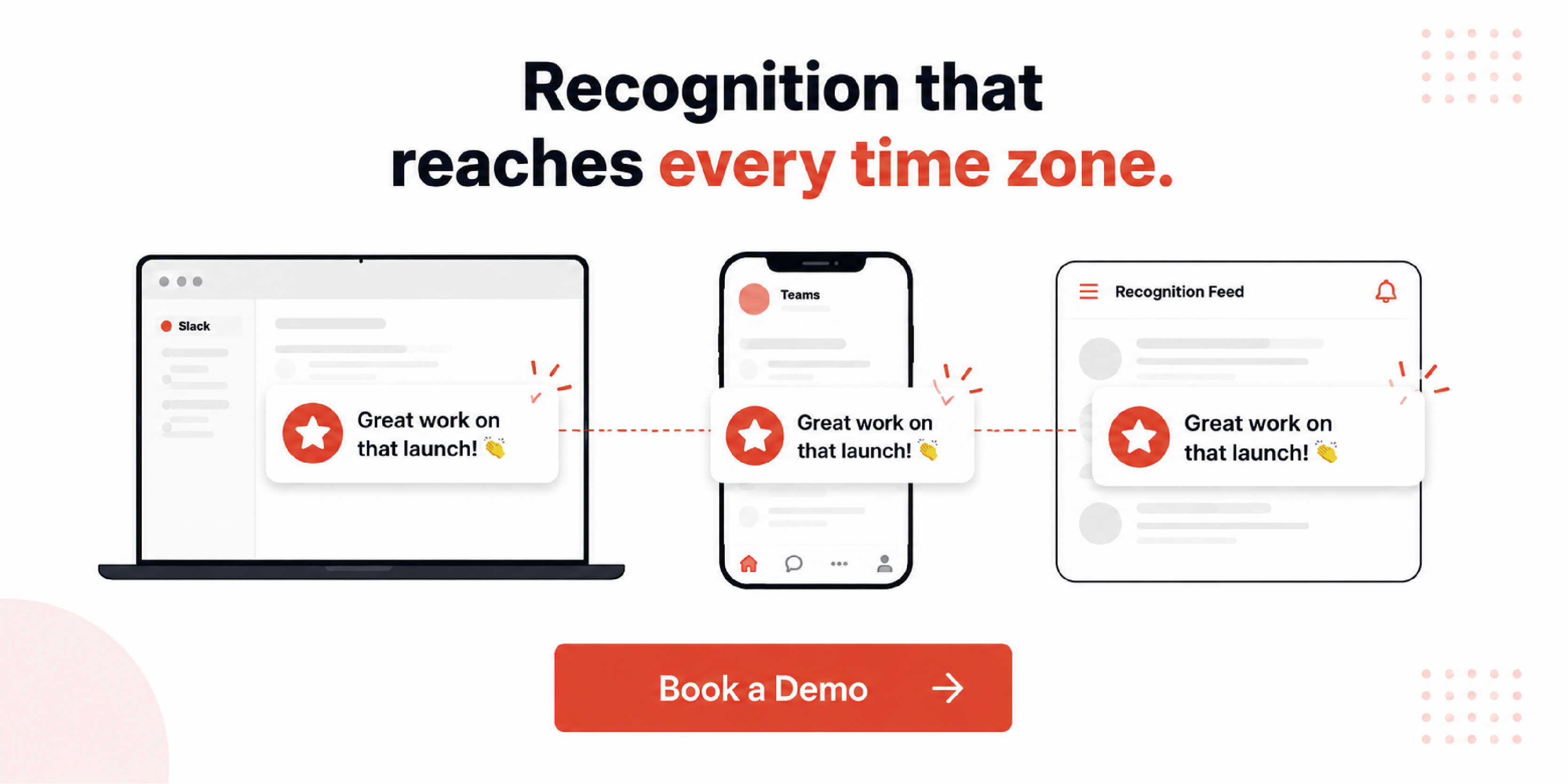
See how ApplaudIQ brings peer recognition, milestone rewards, and recognition analytics natively into Slack and Microsoft Teams for distributed workforces. Book a Demo.
Sign up for our newsletter for trending top content!


