
How to Launch an Employee Recognition Programme Without It Dying in the First Three Months

Sign up for our newsletter for trending top content!
Introduction
Recognition has become a measurable business driver rather than an employee engagement initiative alone. According to Gallup, employees who receive meaningful recognition are significantly more likely to be engaged, while organisations with highly engaged workforces report stronger productivity, profitability and retention outcomes. Yet many recognition initiatives fail to maintain participation after their initial launch because organisations focus on the announcement instead of long term behavioural adoption.
For HR leaders, the challenge is not selecting a recognition platform. It is designing a rollout that embeds recognition into everyday work. Without executive visibility, manager accountability and sustained communication, even well funded programmes quickly lose relevance.
This guide explains how to launch an employee recognition programme that continues delivering value well beyond the first few months. It covers the change management strategies, communication plans, manager preparation and success metrics that consistently predict long term adoption.
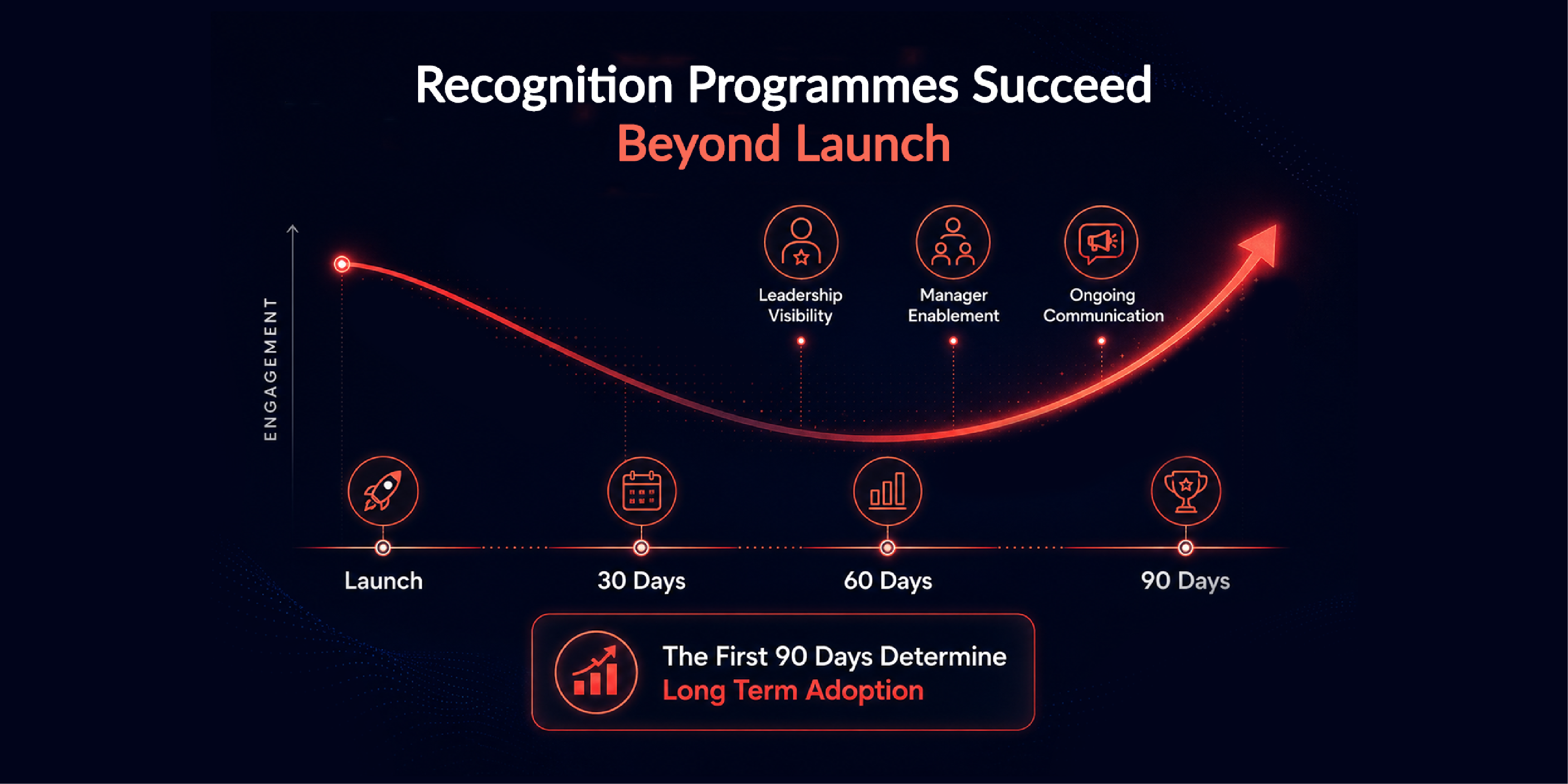
Why 70% of Recognition Programme Launches See Engagement Drop After Week Four
Many employee recognition programmes begin with enthusiasm. Employees attend launch events, redeem initial rewards and participate during the first few weeks. However, activity frequently declines once the novelty disappears. Research from O.C. Tanner's Global Culture Report shows that recognition only influences culture when it becomes a consistent organisational habit rather than a one off initiative. Likewise, Gallup reports that employees who receive regular, meaningful recognition remain substantially more engaged than those recognised infrequently.
The first month often exposes a simple reality. Employees cannot adopt a new behaviour if leaders and managers do not reinforce it consistently.
Recognition launches often fail because change management ends too early
Many organisations invest heavily in launch communications but allocate little attention to what happens afterwards. Employees quickly return to existing habits if recognition is not embedded into daily workflows.
Common causes of declining participation include:
- Limited executive visibility after launch.
- Managers forgetting to recognise achievements regularly.
- No scheduled communication beyond the launch week.
- Recognition criteria that employees find unclear.
- Lack of visible success stories across teams.
According to McKinsey & Company, successful organisational change depends on sustained reinforcement, visible leadership and clear behavioural expectations. Recognition programmes follow exactly the same pattern because they require people to adopt new workplace behaviours rather than simply use new technology.
Behaviour changes before culture changes
Recognition should become part of how work happens, not an additional HR activity.
Instead of measuring launch success by employee registrations alone, HR leaders should ask:
These behavioural indicators reveal whether employees are building lasting habits or simply responding to launch communications.
Platforms such as ApplaudIQ support this transition by integrating recognition into everyday collaboration through Microsoft Teams, Slack and HRMS integrations. Rather than relying on employees to remember another system, recognition becomes part of existing workflows, reducing friction during the critical adoption period.
Executive Sponsorship: Why Leadership Visibility in the First 30 Days Determines Long Term Adoption
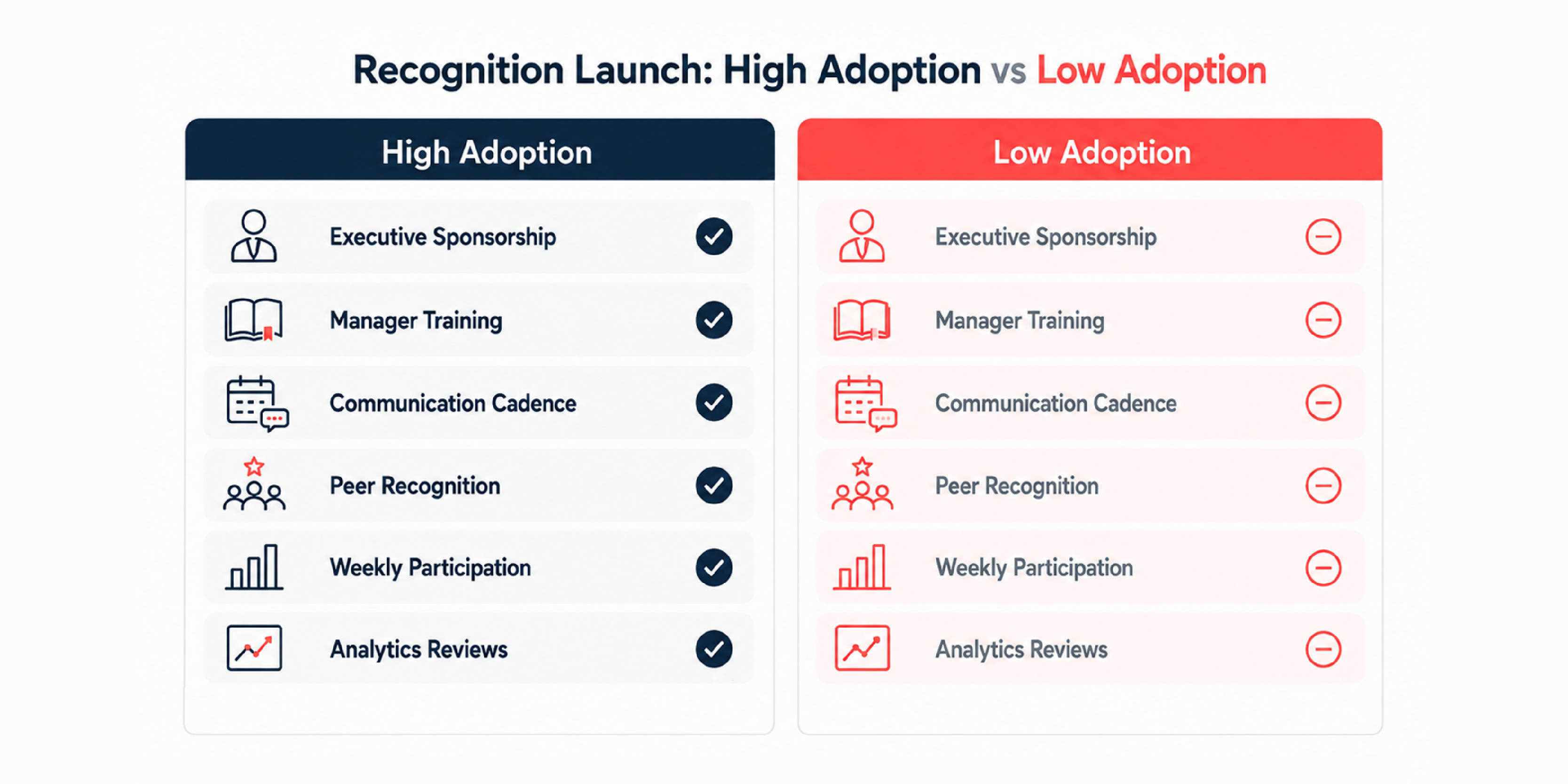
Employees pay close attention to what leaders repeatedly do rather than what organisations announce. If executives actively recognise contributions during the first month, employees understand that recognition reflects organisational priorities rather than another HR campaign.
Research from Deloitte's Global Human Capital Trends consistently identifies leadership behaviour as one of the strongest drivers of cultural transformation. Similarly, Gallup finds that employees who believe leadership genuinely values recognition demonstrate higher engagement and stronger commitment to organisational goals.
Executive sponsorship requires visible action
Launching a recognition programme with a CEO email is rarely enough.
Senior leaders should actively participate by:
- Recognising employees publicly every week.
- Celebrating achievements during town halls.
- Sharing examples of recognition aligned with organisational values.
- Highlighting cross functional collaboration.
- Encouraging managers through regular reminders and updates.
Visible participation establishes recognition as a leadership behaviour instead of an HR responsibility.
The first 30 days establish organisational norms
Employees observe how leaders behave during the earliest stages of change.
If recognition activity disappears after launch week, employees assume the initiative lacks strategic importance. Conversely, when executives continue recognising employees consistently, participation spreads naturally throughout management layers.
Research from SHRM shows that employees place greater trust in organisational initiatives when senior leadership demonstrates ongoing commitment through visible actions rather than communications alone.
ApplaudIQ helps HR leaders maintain executive visibility through configurable recognition feeds, leadership dashboards and organisation wide Walls of Appreciation. These features make recognition highly visible while allowing leaders to reinforce company values consistently across global teams.
The most successful recognition programmes treat executives as active participants, not ceremonial sponsors. Their behaviour during the first month shapes adoption far more effectively than any launch campaign alone.
Manager Enablement Before Launch: What Training and Toolkits HR Leaders Must Prepare
Managers determine whether recognition becomes a daily habit or remains an occasional event. According to Gallup, managers account for as much as 70 percent of the variance in employee engagement. When managers recognise meaningful contributions consistently, employees feel valued, remain motivated and are more likely to contribute discretionary effort. Without manager buy in, even the most sophisticated recognition platform struggles to sustain participation.
Preparing managers before launch therefore deserves as much attention as configuring the platform itself.
Equip managers with practical guidance rather than policies
Many organisations provide lengthy documentation explaining the recognition programme but fail to show managers how to use it effectively. Training should focus on practical application rather than theory.
An effective enablement toolkit should include:
- Clear examples of behaviours that deserve recognition.
- Recognition templates aligned with organisational values.
- Guidance on balancing public and private recognition.
- Recommended weekly recognition targets.
- Frequently asked questions for handling common employee queries.
- Short demonstration videos that show recognition in real workplace scenarios.
Research from McKinsey & Company highlights that capability building significantly improves the success rate of organisational change initiatives because managers become confident in reinforcing new behaviours.
Build accountability into everyday leadership
Recognition should appear alongside other management responsibilities such as coaching, performance conversations and team meetings.
HR leaders can reinforce this expectation by encouraging managers to:
- Begin weekly meetings with recognition highlights.
- Celebrate cross functional collaboration.
- Recognise progress as well as final outcomes.
- Encourage peer to peer recognition within teams.
-
- Review recognition activity during leadership check ins.
Organisations using platforms such as ApplaudIQ can further support managers through automated milestone reminders, native Microsoft Teams and Slack integrations, leaderboards and analytics dashboards. These features reduce administrative effort while giving managers timely prompts to reinforce positive behaviours.
Successful recognition programmes do not depend on exceptional managers. They provide every manager with the tools, confidence and accountability needed to make recognition an expected part of everyday leadership.
The First 90 Days: How to Sustain Momentum After the Launch Announcement Excitement Fades
The first three months determine whether an employee recognition programme becomes part of organisational culture or fades into the background. According to Prosci's Best Practices in Change Management, successful change initiatives maintain structured reinforcement well beyond the initial launch because employees require repeated encouragement before new behaviours become routine. Similarly, Gallup emphasises that frequent recognition strengthens engagement only when organisations apply it consistently over time.
Rather than viewing launch day as the finish line, HR leaders should treat it as the beginning of a structured adoption plan.
A practical 90 day reinforcement framework
Each phase reinforces the previous one. Organisations that continue communicating progress, celebrating success stories and sharing recognition examples are more likely to sustain participation than those relying on launch communications alone.
Reinforce behaviour through visibility
Recognition should remain highly visible across the organisation during the first 90 days. Weekly updates highlighting participation rates, stories that demonstrate company values and recognition milestones remind employees that the initiative remains a strategic priority.
Research from O.C. Tanner shows that recognition becomes significantly more effective when employees see it happening across the organisation rather than only within their immediate teams.
HR teams should also review adoption data every fortnight. If manager participation falls or peer recognition slows, targeted communication and coaching can restore momentum before disengagement spreads.
Communication Cadence: What to Say, How Often, and Through Which Channels to Drive Ongoing Participation
Launching a recognition programme with a single announcement rarely changes behaviour. Employees require repeated reminders, practical examples and visible leadership participation before recognition becomes an established habit. Gartner notes that effective organisational communication is consistent, relevant and delivered through the channels employees already use. Likewise, McKinsey & Company identifies ongoing communication as one of the strongest predictors of successful organisational change.
The objective is not to communicate more frequently. It is to communicate with purpose.
A communication cadence HR leaders can follow
Weekly
- Share recognition highlights.
- Celebrate employee achievements linked to company values.
- Encourage managers to recognise contributions before team meetings.
Fortnightly
- Publish participation statistics.
- Feature stories from different departments.
- Answer frequently asked employee questions.
Monthly
- Executive message reinforcing programme objectives.
- Showcase teams with strong participation.
- Share lessons learned and upcoming improvements.
Communication should reach employees through multiple channels, including email, collaboration platforms, intranet announcements and town hall meetings. Repetition across familiar channels reinforces the desired behaviour without overwhelming employees.
Organisations using ApplaudIQ can simplify this process through native integrations with Microsoft Teams and Slack, automated milestone recognition and organisation wide recognition feeds. These capabilities place recognition directly within existing workflows, reducing the effort required from both employees and managers.
The most effective communication plans evolve with employee behaviour. As participation grows, organisations should shift from explaining the programme to celebrating real examples of recognition in action.
How to Know If Your Programme Is Working: The Week by Week Metrics That Predict Long Term Success
Many HR teams measure success by counting registrations or rewards redeemed. While these indicators show initial interest, they do not predict whether recognition will become part of organisational culture. Aberdeen Group has consistently found that organisations using ongoing engagement metrics achieve stronger workforce outcomes than those relying solely on participation figures. Gallup also recommends measuring behavioural indicators alongside engagement outcomes.
The most valuable metrics reveal whether recognition is becoming habitual.
Weekly metrics that matter
Beyond weekly reporting, HR leaders should monitor quarterly trends in employee engagement, voluntary turnover, internal mobility and employee sentiment. According to SHRM, recognition programmes generate the strongest organisational outcomes when they align with broader talent strategies rather than operating independently.
Analytics should drive action rather than simply reporting results. Declining participation may indicate communication gaps, inconsistent manager behaviour or recognition criteria that employees do not fully understand. Addressing these issues early prevents long term disengagement.
The most successful organisations continuously refine their recognition strategy based on data, employee feedback and changing business priorities.
Frequently Asked Questions
What is the biggest reason employee recognition programmes fail?
Most recognition programmes lose momentum because organisations concentrate on the launch instead of long term adoption. Employees need consistent leadership support, manager participation and regular communication before recognition becomes part of everyday work. Research from Gallup and O.C. Tanner shows that frequent, meaningful recognition delivers the strongest engagement outcomes.
How long does it take for an employee recognition programme to become established?
Most organisations require around 90 days to establish consistent participation, although culture change continues well beyond this period. The first month builds awareness, the second develops manager habits and the third encourages broader employee participation. Sustained reinforcement during these stages significantly improves long term adoption.
What metrics should HR leaders monitor after launch?
HR leaders should track manager participation, peer to peer recognition, repeat recognition activity, employee reach and recognition aligned with organisational values. These behavioural indicators provide earlier insight than annual engagement surveys and allow HR teams to intervene before participation declines.
Can ApplaudIQ help improve adoption after launch?
Yes. ApplaudIQ supports long term adoption by integrating recognition into everyday work through Microsoft Teams, Slack and leading HRMS platforms. Automated milestone rewards, peer recognition, leaderboards, Walls of Appreciation and analytics dashboards help HR leaders sustain participation long after the initial launch announcement.
Conclusion
Launching an employee recognition programme is only the first step. Long term success depends on structured change management, visible executive sponsorship, confident managers, consistent communication and careful measurement during the first 90 days. Organisations that reinforce recognition as an everyday behaviour build stronger engagement, higher retention and a culture where appreciation becomes part of how work gets done.
As recognition strategies become increasingly data driven and integrated into daily workflows, HR leaders who prioritise adoption over announcement will achieve the greatest long term impact.
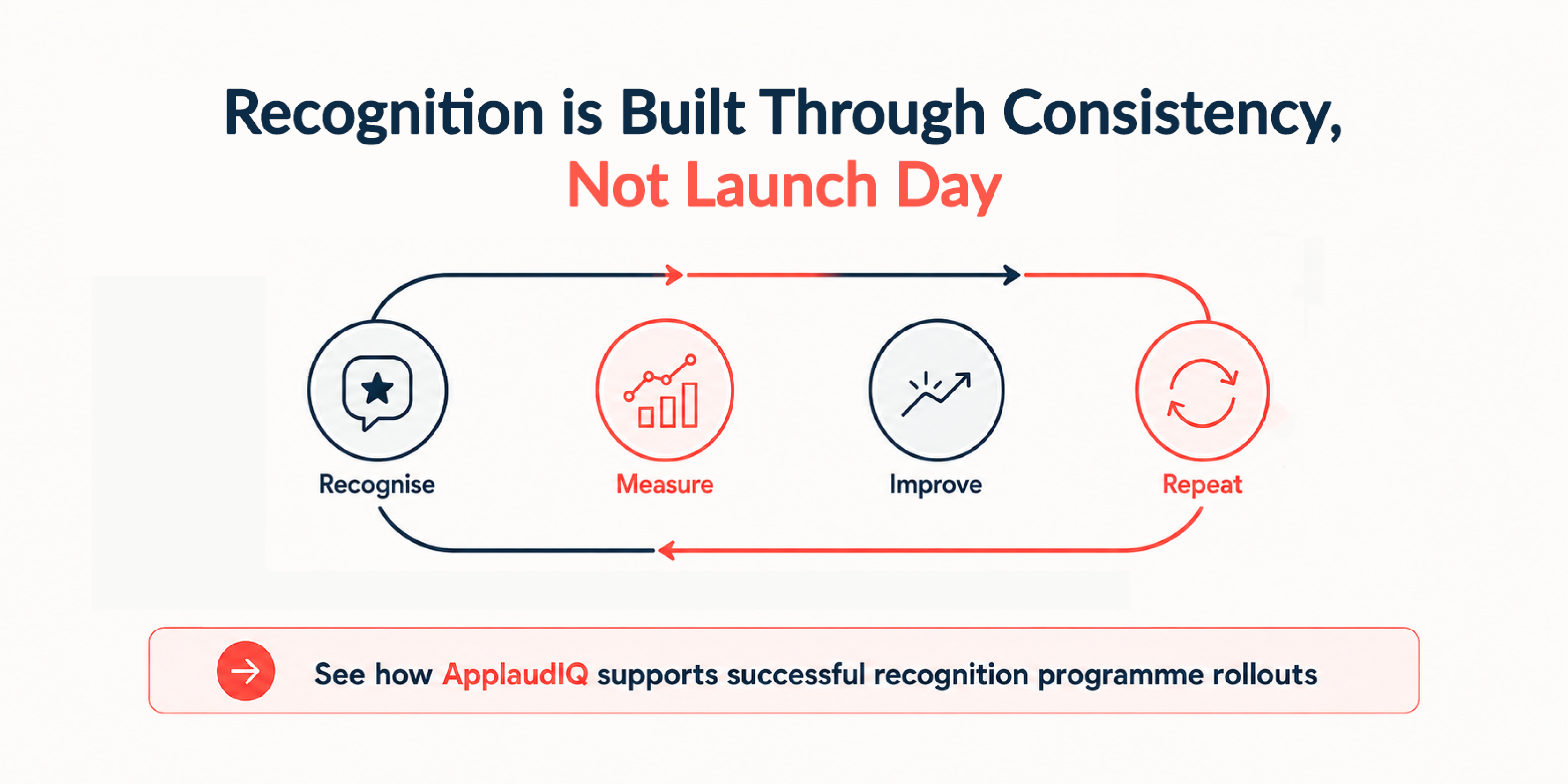
See how ApplaudIQ helps HR leaders launch recognition programmes that sustain engagement through onboarding workflows, manager enablement, automated milestones and actionable analytics. Explore ApplaudIQ today: https://www.therewardstore.com/applaudiq/overview
Sign up for our newsletter for trending top content!


