
How Logistics and Supply Chain Companies Can Use Recognition to Reduce Driver and Warehouse Attrition

Sign up for our newsletter for trending top content!
Introduction
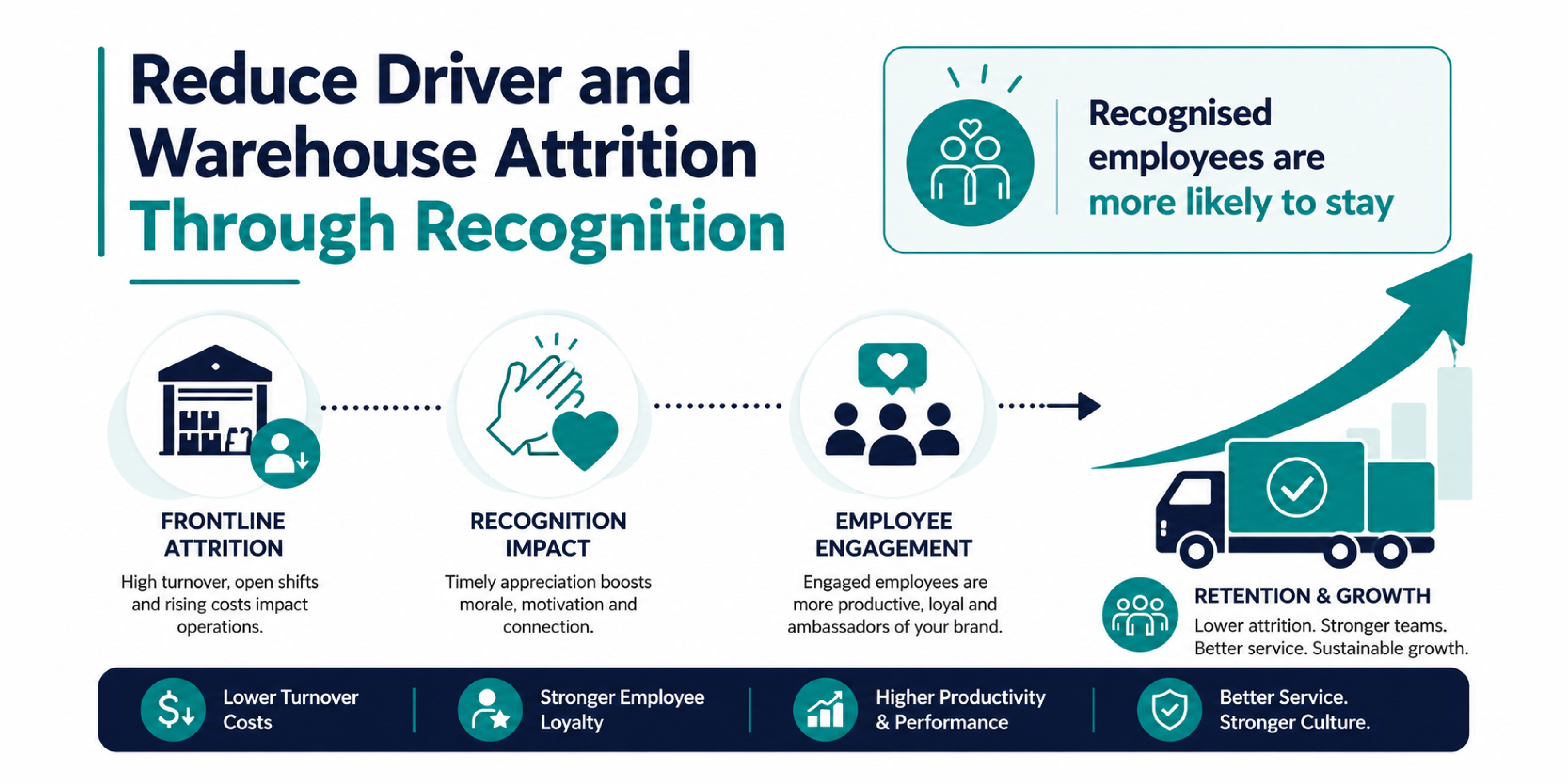
Logistics organisations face some of the highest employee turnover rates in the global workforce. Research from the American Trucking Associations estimates that long-haul driver turnover can exceed 90% in some segments, while warehousing operations continue to battle labour shortages and retention pressures. Gallup reports that employees who receive meaningful recognition are significantly more likely to remain with their employer, highlighting a critical opportunity for HR leaders responsible for frontline workforces.
For logistics and supply chain organisations, attrition creates more than recruitment challenges. It increases training costs, disrupts service levels, impacts safety performance and places pressure on already stretched operations teams.
This article explores why salary increases alone rarely solve frontline retention issues, how recognition strategies can reach distributed workers, and what HR leaders can do to measure the business impact of appreciation initiatives across drivers and warehouse teams.
Why Logistics Has the Highest Frontline Attrition Rate of Any Sector and Why Salary Alone Won't Fix It
Logistics businesses operate in conditions that naturally increase workforce instability. Shift work, physical demands, fluctuating schedules and limited career visibility contribute to persistent turnover.
Research from Gallup shows that employees who feel recognised and valued are more engaged, while disengaged workers are substantially more likely to leave their organisations. SHRM estimates that replacing frontline employees can cost between six and nine months of salary once recruitment, onboarding and productivity losses are considered.
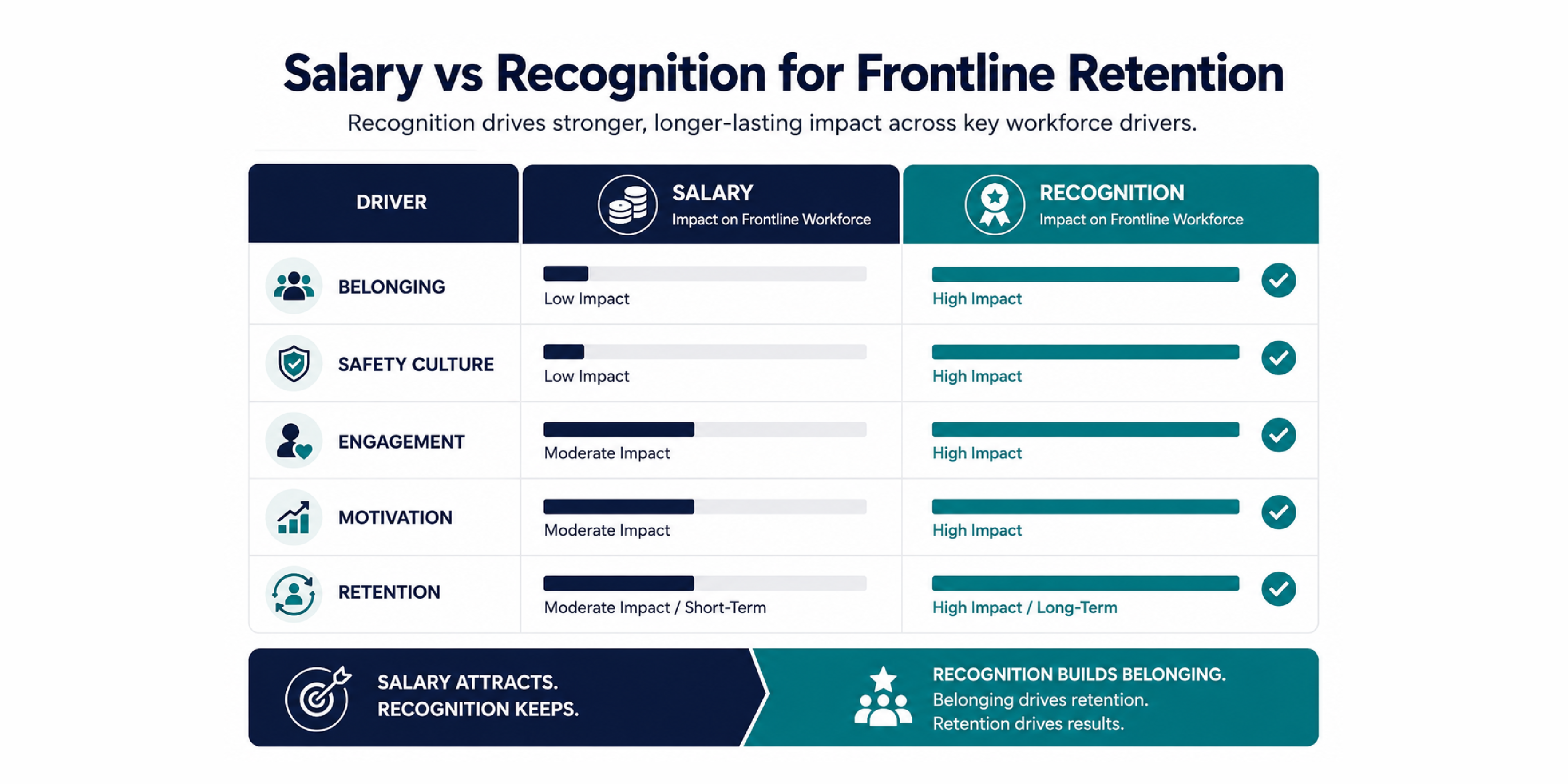
Compensation remains important, but evidence suggests it rarely acts as a long-term retention strategy on its own. McKinsey research indicates that employees increasingly prioritise purpose, appreciation, flexibility and belonging alongside financial rewards. For drivers and warehouse employees, these factors become even more significant because many operate away from central offices and leadership teams.
Why pay increases deliver diminishing returns
Employees adapt quickly to salary adjustments. Recognition, however, reinforces behaviour repeatedly and strengthens emotional connection with an organisation.
According to O.C. Tanner, workers who receive regular recognition demonstrate higher commitment levels, stronger trust in leadership and greater willingness to stay.
For logistics employers, recognition addresses challenges that compensation cannot solve:
HR leaders increasingly recognise that retention strategies must blend compensation, career progression and recognition practices to create a sustainable employee experience.
For organisations seeking to improve retention outcomes, solutions such as ApplaudIQ for Logistics and Supply Chain help operationalise recognition at scale without adding administrative burden.
The Shift-Based Recognition Problem: How to Appreciate Workers You Never See in an Office
Most recognition frameworks were designed around office environments. Logistics organisations rarely enjoy that advantage.
Drivers spend days or weeks on the road. Warehouse employees rotate shifts across twenty-four-hour schedules. Supervisors often oversee hundreds of workers across multiple facilities. This makes spontaneous appreciation difficult.
Gallup found that employees who receive recognition from managers at least weekly report substantially higher engagement levels. Yet many frontline logistics workers interact with managers only occasionally.
Common barriers to frontline recognition
Recognition programmes often fail because they depend on physical presence.
Challenges include:
- Managers cannot observe achievements in real time.
- Shift patterns limit peer interaction.
- Recognition announcements occur during meetings many workers cannot attend.
- Remote teams receive delayed feedback.
- Appreciation becomes reactive instead of systematic.
Technology helps close these gaps.
Digital recognition tools enable organisations to celebrate achievements instantly, regardless of geography or schedules. Drivers completing service milestones, warehouse staff achieving accuracy targets and teams maintaining attendance standards can receive timely recognition through channels employees already use.
ApplaudIQ addresses this challenge through integrated recognition workflows that support peer-to-peer appreciation, milestone celebrations and manager recognition across distributed workforces. Integrations with communication platforms ensure recognition reaches employees wherever they work, reducing dependence on physical interactions.
Deloitte research suggests organisations with strong recognition cultures outperform peers in employee experience metrics, while employees who feel appreciated exhibit higher discretionary effort.
For HR leaders, visibility remains one of the most overlooked factors influencing retention. Recognition transforms unseen work into acknowledged contribution.
Relevant insights can also be explored through ApplaudIQ Employee Rewards and Recognition Solutions.
Driver Recognition Programmes: What Mechanics Motivate Long-Haul and Last-Mile Teams
Driver retention remains one of the most persistent challenges across transportation networks.
Recognition programmes succeed when they align with behaviours employees can influence directly. Drivers respond particularly well to achievements connected to safety, service quality and reliability.
Recognition mechanics that work
According to IRF findings on transportation workforce development, recognition initiatives improve morale and reinforce operational discipline when organisations celebrate measurable accomplishments.
Effective driver recognition often includes:
Service excellence milestones
Recognise drivers achieving customer satisfaction benchmarks, on-time delivery performance or route consistency.
Tenure celebrations
Long-service milestones communicate commitment from employers and reinforce belonging. Mercer research indicates that employees who see career longevity acknowledged report stronger attachment to organisations.
Peer recognition
Drivers frequently learn from one another. Creating opportunities for colleagues to acknowledge teamwork, support and mentoring helps strengthen community despite geographical separation.
Personalised rewards
Recognition becomes more meaningful when employees choose experiences or rewards aligned with their preferences. Flexibility increases perceived value.
O.C. Tanner research highlights that meaningful recognition drives stronger retention outcomes than transactional incentives alone.
HR teams should focus less on occasional awards ceremonies and more on creating ongoing moments of appreciation. Monthly acknowledgements, milestone triggers and visible leaderboards often sustain motivation more effectively than annual recognition events.
Consistency matters more than scale. Employees remember frequent recognition because it validates effort at the moment it occurs.
Warehouse Team Recognition: How to Build Appreciation Into Operational Rhythms Without Disrupting Output
Warehouse operations depend heavily on precision, speed and teamwork. Recognition strategies should support these objectives rather than compete with them.
Many HR leaders worry that recognition activities reduce productivity. Evidence suggests the opposite.
Aberdeen Group research found organisations with formal recognition strategies achieve stronger engagement outcomes and often experience improvements in operational performance indicators.
Embedding recognition into existing workflows
Recognition should become part of operational routines.
Examples include:
- Daily shift huddles featuring standout contributions.
- Weekly acknowledgement of attendance excellence.
- Celebrating inventory accuracy milestones.
- Recognising quality improvements.
- Highlighting collaboration across departments.
Recognition moments that fit operational schedules
Rather than introducing separate initiatives, HR teams can attach appreciation to existing activities.
Examples include:
- Safety briefings.
- Shift transitions.
- Monthly performance reviews.
- Operations meetings.
- Internal communication channels.
ApplaudIQ supports this approach by automating milestone recognition, enabling peer appreciation through Cheers, and creating visible recognition through leaderboards and Walls of Appreciation. This reduces manual effort for supervisors while ensuring achievements remain visible across facilities.
Gartner research indicates that employees increasingly expect personalised workplace experiences. Recognition contributes significantly to meeting those expectations.
Warehouse employees often measure organisational commitment through everyday interactions. Small but regular acknowledgements reinforce trust and create stronger emotional connections with employers.
Recognition becomes especially powerful when operational leaders participate actively. Employees notice when managers celebrate effort consistently.
Using Safety Milestones as Recognition Triggers: Why Zero-Incident Streaks Deserve Rewards
Safety sits at the centre of logistics operations.
Recognition strategies offer HR leaders an opportunity to reinforce safety behaviours without relying solely on compliance mandates.
Deloitte research shows organisations that recognise desired behaviours more frequently create stronger performance cultures. In logistics environments, safety provides a highly visible and measurable recognition trigger.
Safety achievements worth recognising
Examples include:
- Thirty-day zero-incident periods.
- Accident-free driving milestones.
- Perfect safety audit results.
- Near-miss reporting participation.
- Compliance training completion.
Recognition should reward proactive behaviours rather than only celebrate outcomes.
Employees who actively report hazards, participate in safety initiatives and support colleagues contribute to long-term organisational resilience.
Recognition framework for safety milestones
According to Gallup, employees who feel their efforts matter are more likely to maintain positive workplace behaviours over time.
Recognition also helps organisations shift safety conversations away from penalties and towards shared accountability. This creates a culture where employees actively support safer operations instead of viewing compliance as an obligation imposed from above.
For HR leaders, safety recognition represents one of the clearest opportunities to align employee engagement initiatives with operational objectives.
How Logistics HR Leaders Can Report Recognition ROI to Operations Directors Who Only Care About Cost-Per-Delivery
HR leaders often understand the value of recognition intuitively. Operations executives require evidence.
Recognition initiatives gain traction when HR connects them directly to measurable business outcomes.
SHRM reports that turnover carries significant financial implications, particularly in frontline environments where recruitment cycles repeat frequently.
Metrics that resonate with operations leaders
Focus on indicators that influence delivery economics.
Track:
- Voluntary turnover rates.
- Time-to-fill frontline roles.
- Safety incidents.
- Absenteeism.
- Employee engagement scores.
- Productivity metrics.
- Training costs.
- Overtime expenditure.
A practical recognition ROI framework
Forrester research consistently shows that employee experience investments influence productivity and customer outcomes. Logistics organisations benefit because workforce continuity supports better delivery performance and service reliability.
Recognition data also enables stronger conversations with finance leaders.
Platforms such as ApplaudIQ provide reporting capabilities that help HR teams demonstrate participation rates, reward utilisation, recognition trends and behavioural outcomes. Instead of presenting recognition as an engagement initiative, HR can position it as a measurable operational investment.
That shift changes recognition from a discretionary expense into a retention strategy supported by evidence.
Frequently Asked Questions
What causes high attrition in logistics and supply chain organisations?
Frontline logistics employees often face demanding schedules, physically intensive work, limited interaction with leadership and high operational pressure. Gallup research suggests employees who feel undervalued are more likely to leave. Organisations that recognise contributions consistently tend to strengthen engagement and retention outcomes.
How can companies recognise drivers who rarely visit offices?
Digital recognition platforms enable organisations to celebrate achievements regardless of location. Recognition can be triggered through milestones, service performance, safety achievements and peer nominations. Mobile-friendly experiences help ensure drivers receive appreciation in real time.
Why is employee recognition important for warehouse teams?
Warehouse employees contribute directly to productivity, accuracy and customer satisfaction. Recognition reinforces desired behaviours, improves morale and strengthens team cohesion. Research from O.C. Tanner indicates that employees who feel recognised show stronger loyalty towards employers.
How often should logistics organisations recognise employees?
Gallup recommends frequent and meaningful recognition rather than infrequent annual awards. Monthly milestones, weekly acknowledgements and milestone-based rewards create stronger engagement patterns. Consistency matters more than the size of the reward.
Can ApplaudIQ support recognition across multiple warehouses and regions?
Yes. ApplaudIQ supports distributed workforces through automated milestone rewards, peer-to-peer recognition, leaderboards, integrated communication channels and access to a global rewards catalogue. This enables logistics organisations to maintain a consistent recognition culture across facilities, countries and operational teams.
Conclusion
Recognition represents one of the most practical retention strategies available to logistics employers facing persistent driver and warehouse attrition. Organisations that acknowledge contributions consistently improve engagement, reinforce safety behaviours and strengthen workforce stability.
As logistics operations become increasingly distributed, recognition will continue shifting towards automated, personalised and data-driven experiences. HR leaders who invest in scalable appreciation frameworks today will build more resilient frontline workforces tomorrow.
See how ApplaudIQ reduces driver and warehouse attrition in logistics operations. Explore the solution at https://www.therewardstore.com/applaudiq/solutions/logistics-supply-chain.
Sign up for our newsletter for trending top content!


