
How to Design Employee Recognition That Works for Gen Z and Millennial Workforces: Without Losing Gen X

Sign up for our newsletter for trending top content!
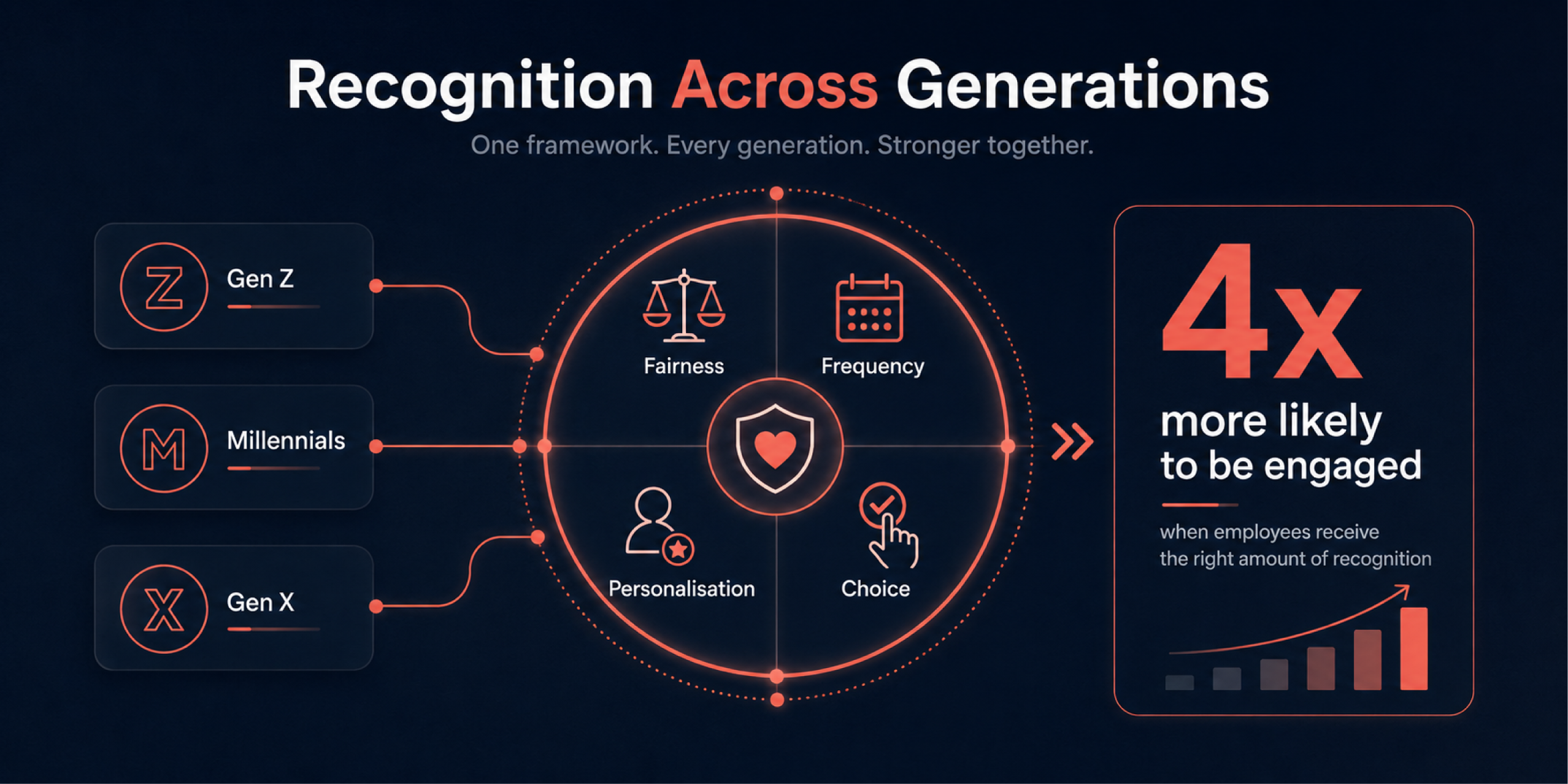
Gallup research found that employees are four times more likely to be engaged when they strongly agree they receive the right amount of recognition. Yet younger employees often want recognition more frequently than older colleagues, creating a design challenge for HR Leaders managing multigenerational teams.
The answer is not to build separate recognition programmes for Gen Z, millennials and Gen X. It is to create a recognition architecture that gives employees choice, frequency, relevance and fairness while preserving consistent organisational standards. Deloitte's 2025 research also shows that Gen Z and millennials place strong emphasis on learning, purpose, well-being and manager support, making recognition part of a broader employee experience rather than an isolated reward mechanism.
For HR Leaders, the cost of getting this wrong is practical: inconsistent recognition can weaken engagement, obscure valuable behaviours and create perceptions of favouritism. This guide explains how to design a digital-first recognition approach that works across age groups without stereotyping employees by generation.
Why Generational Differences in Recognition Are Real: And Why HR Leaders Often Overcorrect for Them
Generational differences in recognition preferences are real, but they should inform programme design rather than dictate it. Gallup found that younger workers are more likely to prefer frequent recognition. Nearly four in ten employees in the youngest generation surveyed preferred recognition from their manager at least a few times a week, while only about a quarter received it at that frequency.
The same research highlights an important qualification. Younger employees did not necessarily receive less recognition than older colleagues. The difference was often the gap between how much recognition they wanted and how much they experienced. That distinction matters because HR Leaders can easily mistake a preference for frequency as a requirement for a completely different recognition model.
The better approach is to separate design principles from delivery preferences:
Gallup research shows that employees who perceive recognition as fair and equitable are four times more likely to be engaged and four times more likely to feel valued as team members.
So the HR objective should not be to make recognition "Gen Z friendly". It should be to make recognition employee friendly, with enough flexibility to accommodate different expectations.
What Gen Z Employees Say They Want From Recognition vs What They Actually Respond To
Gen Z employees increasingly expect recognition to fit naturally into the way they work. Deloitte's 2025 research found that 70% of Gen Z respondents develop skills to advance their careers at least weekly, while learning and development ranks among their top reasons for choosing an employer. The same research identifies lack of recognition as a workplace contributor to stress.
That does not mean every Gen Z employee wants instant digital rewards. What employees respond to is recognition that connects contribution with meaning, progress and value.
Three characteristics matter.
Specificity. Gallup found that authentic recognition helps employees understand how their performance is viewed. Employees who strongly agree that recognition is authentic are six times more likely to say they understand how their manager views their performance.
Personalisation. SHRM, citing O.C. Tanner Institute research involving more than 40,000 workers, reported that 70% of employees found recognition most meaningful when it was personalised.
Choice. Personalisation does not mean HR needs to predict what every employee wants. A better system gives people options. Some employees may value public appreciation, while others prefer private acknowledgement, points, experiences, learning opportunities or flexible reward choices.
This is where digital recognition can help. A digital-first approach can make recognition immediate while allowing employees to choose how they receive value. The technology should support human judgement, not replace it.
For HR Leaders, the practical question is therefore not "How do we recognise Gen Z?" It is "How do we make meaningful recognition easy enough to happen regularly?"
How Millennial Managers Recognise Differently: And the Blind Spots That Create Consistency Problems
Millennials now occupy a significant share of management roles, which means their recognition habits can shape the experience of multiple generations. Deloitte's 2025 research found that millennials, like Gen Z, place strong emphasis on learning, purpose and well-being. Yet only 21% of millennials surveyed believed managers were actually fostering the positive and inclusive culture that 41% said managers had a responsibility to create.
This creates a management blind spot. A manager may believe that regular one-to-one feedback, coaching or informal praise constitutes strong recognition, while employees may experience the programme as inconsistent or invisible.
Gallup's research found that 67% of leaders and 61% of managers reported giving recognition at least a few times a week, yet 40% of employees said they received recognition only a few times a year or less.
The gap suggests that HR should not measure recognition through manager intention alone. It should measure employee experience.
A practical manager recognition test
Ask managers to apply four questions before recognising someone:
- Is it specific? What exactly did the employee do?
- Is it timely? Is recognition close to the contribution?
- Is it relevant? Does it reinforce a useful behaviour, value or outcome?
- Is it fair? Are less visible contributors receiving comparable opportunities to be recognised?
SHRM's recognition guidance also encourages managers to build recognition into regular practice rather than relying on occasional events.
The implication for HR is straightforward. Train managers, establish clear recognition behaviours and use programme data to identify gaps. Do not assume that a manager who says "I recognise my team regularly" creates a consistent recognition experience.
Digital-First Recognition Formats: What Works Across Age Groups When Done Correctly
Digital recognition works across generations when it removes friction rather than turning appreciation into an automated transaction. Mercer reports that modern rewards and recognition strategies increasingly support digital-first cultures, while three quarters of employees in its cited research said feeling recognised inspires them to work harder.
The strongest digital formats share four characteristics.
Recognition happens close to the moment. Gallup's research shows that recognition received only a few times a year is associated with weaker employee outcomes. In its study, employees receiving consistently low recognition from managers were five times as likely to be actively disengaged.
Employees can recognise peers as well as receive manager recognition. Peer recognition increases the number of people who can see contribution across teams, particularly in distributed organisations.
Recognition connects to behaviour. SHRM's recent recognition guidance emphasises frequent, specific recognition linked to behaviours rather than outcomes alone.
Employees have meaningful reward choice. A digital catalogue can support different preferences without requiring HR to maintain separate reward schemes by age.
For example, ApplaudIQ combines peer recognition, milestone workflows, points-based rewards and a broad rewards catalogue. That structure allows HR to maintain common rules while giving employees flexibility in how recognition translates into value. It also supports recognition through digital workflows rather than relying entirely on annual events.
This approach fits the wider direction of work. Deloitte found that 57% of Gen Z and 56% of millennial respondents already use generative AI in their day-to-day work, reinforcing how embedded digital workflows have become for younger employees.
The principle is simple: digitise the process, not the humanity behind it.
Frequency vs Significance: How to Balance Micro-Recognition and Milestone Awards Across a Mixed-Age Team
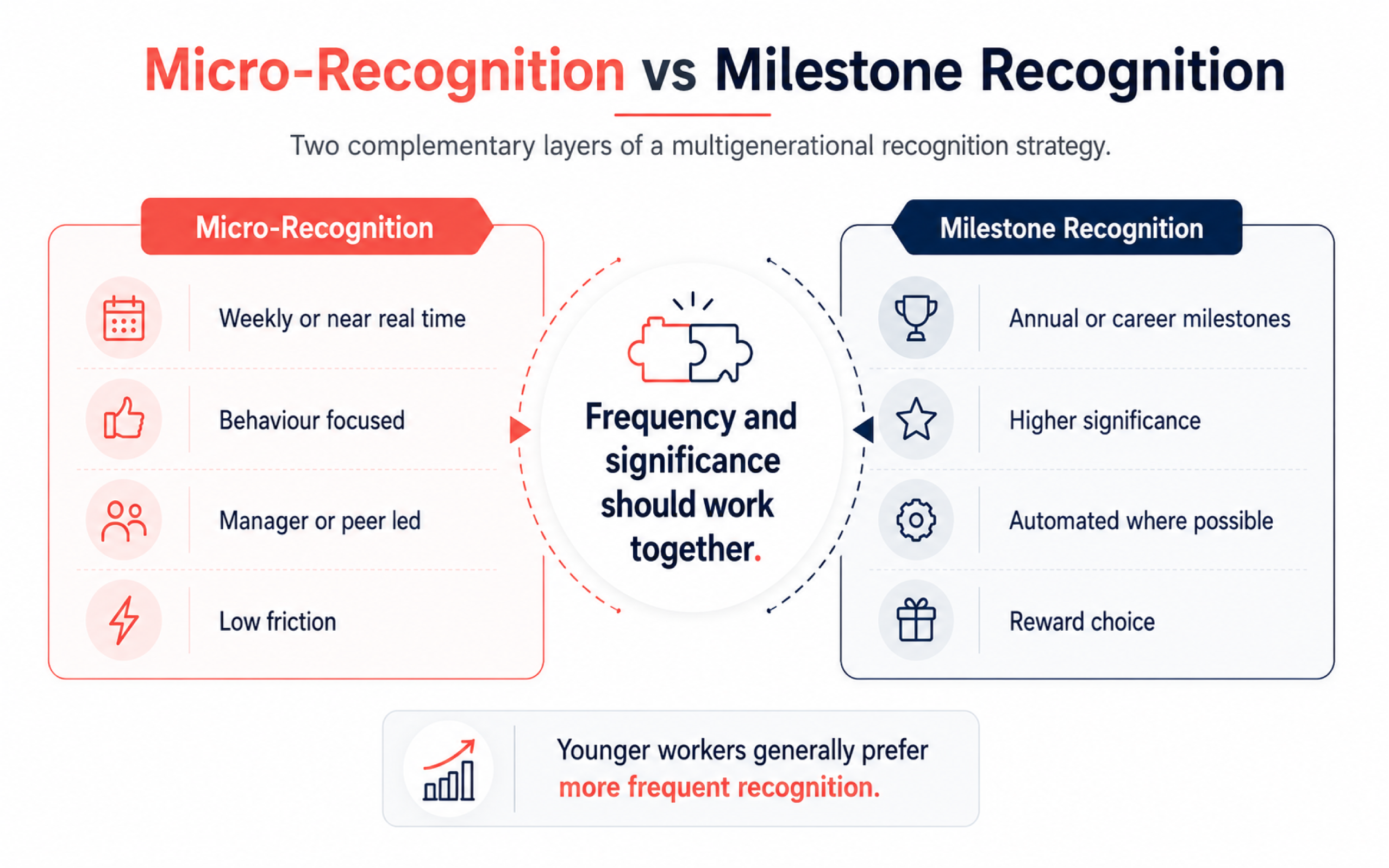
Frequency and significance should not compete. They serve different purposes.
Gallup research found that employees are four times more likely to be engaged when they receive the right amount of recognition. Its research also shows that younger workers generally prefer more frequent recognition than older generations.
At the same time, SHRM reported research showing that meaningfulness can matter more than frequency. Two thirds of employees in the cited research preferred more meaningful recognition over recognition delivered more often.
The answer is a layered recognition rhythm:
This model protects against two common errors. The first is making recognition so frequent that messages become generic. The second is making recognition so significant that employees receive it too rarely.
The Reward Store's guidance on recognition frequency similarly recommends combining everyday recognition with project, behavioural, milestone and major achievement moments.
For HR Leaders, the useful metric is not simply recognition volume. Track reach, recency, manager participation, peer participation, recognition quality and distribution across teams. If recognition volume rises but the same small group receives most of it, the programme has a fairness problem rather than a frequency problem.
How to Audit Your Current Programme for Generational Bias: And Adjust Without Starting Over
HR does not need to rebuild its recognition programme to make it more inclusive across generations. Start with an evidence-based audit.
Gallup found that employees who receive recognition that meets strategic recognition principles are substantially more likely to be engaged. Its research also shows that recognition needs to be meaningful, authentic, equitable and connected to contribution.
Use five checks.
1. Compare preferred and actual frequency. Segment survey responses by generation, function, location and manager group. Look for gaps rather than assuming generational preferences.
2. Audit who gets recognised. Identify whether recognition concentrates around highly visible roles, senior employees or particular teams. Gallup's research links equitable recognition with stronger engagement and feelings of belonging.
3. Review message quality. Sample recognition for specificity. "Great job" provides little behavioural information. "Thank you for resolving the client issue within the same day and keeping the project on schedule" reinforces a clear contribution.
4. Check reward choice. Ask employees whether available rewards reflect different needs. Choice can support personalisation without creating separate programmes.
5. Measure manager consistency. Compare recognition activity across managers. Large differences often indicate a capability or workflow problem rather than an employee preference problem.
The final step is targeted adjustment. Improve manager training, recognition prompts, reward choice, peer participation or milestone automation where the data identifies a gap. This is more effective than launching a new programme simply because workforce demographics have changed.
For a practical framework on building recognition into everyday work, see The Reward Store's guide to continuous employee recognition: https://www.therewardstore.com/blogs/continuous-employee-recognition
Frequently Asked Questions
What type of employee recognition works best for Gen Z?
Gen Z employees tend to respond well to recognition that is timely, specific, personalised and connected to development or meaningful contribution. Deloitte's 2025 research shows that learning, purpose and well-being are important priorities for Gen Z. Gallup also finds that younger workers generally prefer more frequent recognition.
How often should employees be recognised?
HR Leaders should aim for regular recognition, with meaningful contributions acknowledged close to the time they occur. Gallup's engagement research uses recognition or praise within the previous seven days as a useful indicator of employee experience.
Why should HR avoid creating separate recognition programmes by generation?
Separate programmes can reinforce stereotypes and increase administrative complexity. A better approach provides consistent principles around fairness, relevance and access while allowing employees flexibility in recognition format, frequency and reward choice.
Can digital recognition work for Gen X employees too?
Yes. Digital recognition is not inherently a Gen Z format. Gallup's research shows that recognition needs differ in frequency across generations, but meaningfulness, authenticity and fairness matter broadly across the workforce.
How can ApplaudIQ support multigenerational recognition?
ApplaudIQ gives organisations a common recognition framework while supporting different recognition moments and reward preferences. It includes peer recognition, milestone rewards, points-based rewards and a global rewards catalogue, helping HR teams combine frequent appreciation with significant milestone recognition.
Conclusion
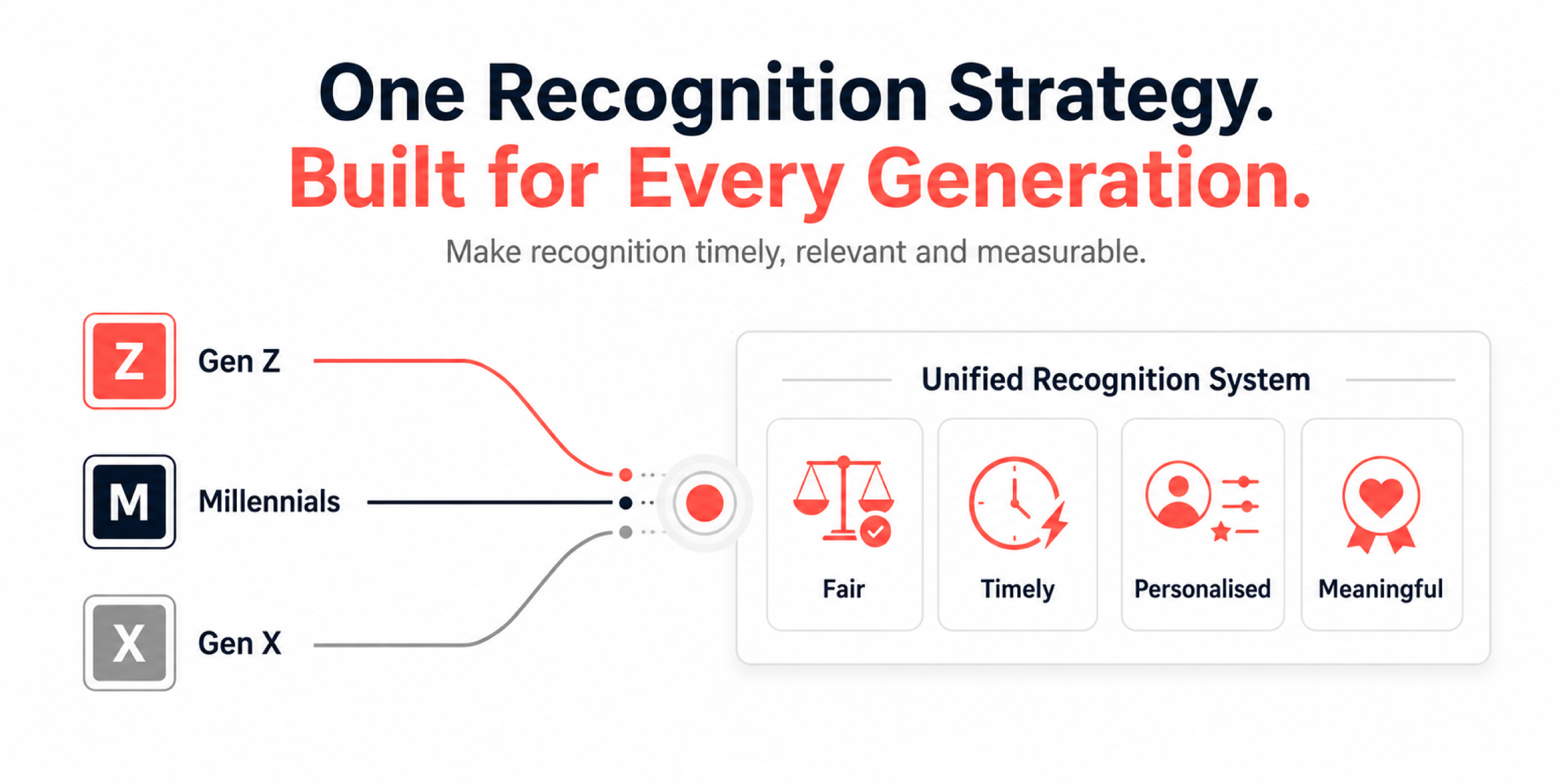
Effective multigenerational recognition does not require HR Leaders to design a separate experience for every generation. It requires a consistent foundation of fairness, specificity and relevance, supported by enough flexibility for employees to engage with recognition in ways that feel meaningful to them. Research increasingly points towards recognition becoming a continuous part of the employee experience rather than an annual HR event. As workforces become more digital and multigenerational, the organisations that measure and personalise recognition will be better positioned to retain valuable talent.
See how ApplaudIQ supports recognition across multigenerational workforces: https://www.therewardstore.com/applaudiq/overview
Sign up for our newsletter for trending top content!


