
Diwali Corporate Gifting 2026: A Week by Week Countdown to the Dispatch Cutoff

Sign up for our newsletter for trending top content!
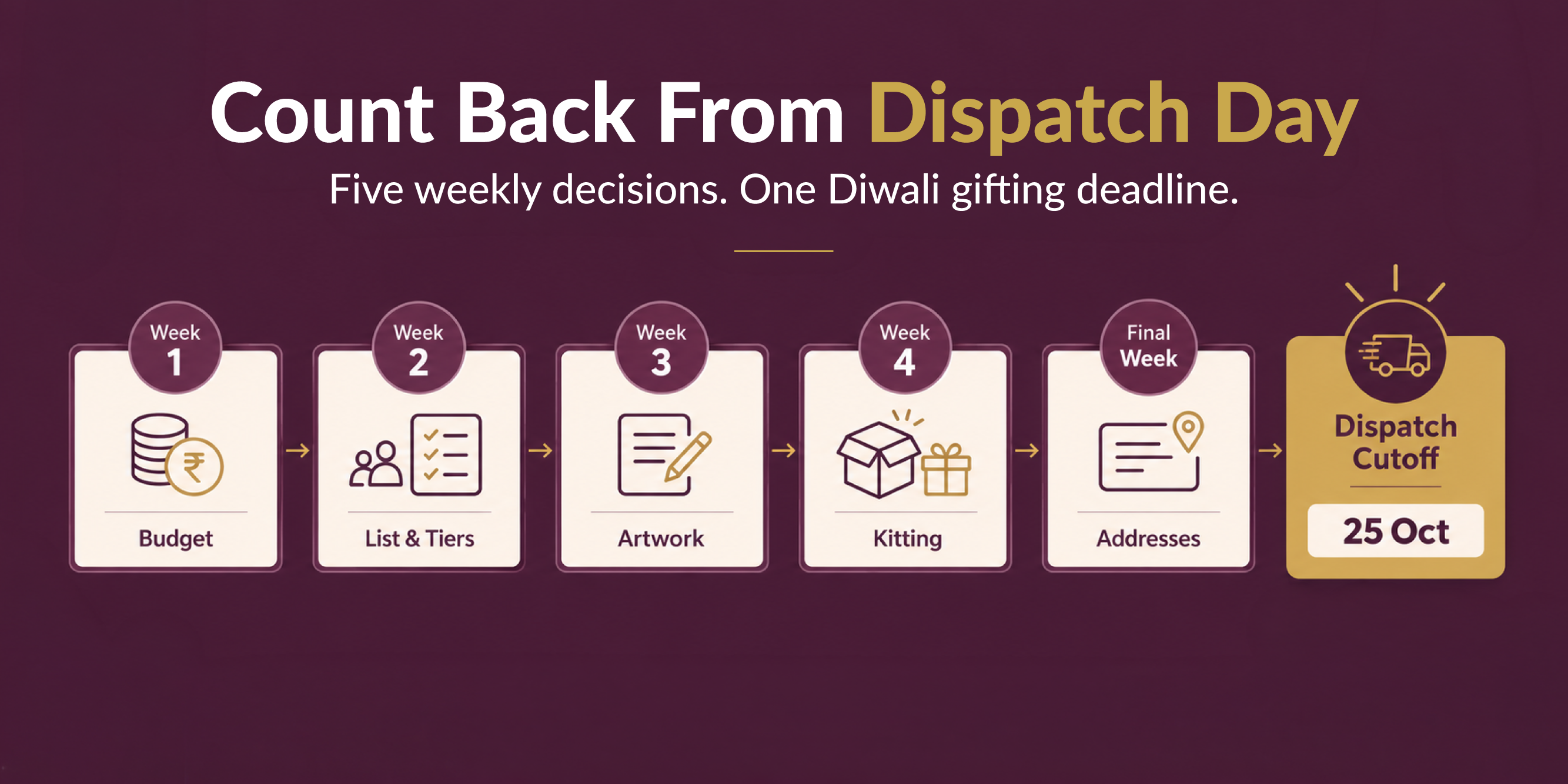
Diwali corporate gifting 2026 should be planned backwards from a physical dispatch cutoff of 25 October, with one decision closed in each of five weeks: budget, recipient list and tiers, artwork, kitting, and finally address data and dispatch. Each decision depends on the one before it, so a late approval or an incomplete address file stops every later step. These two causes produce more missed deliveries than stock shortages do.
Why Diwali Gifting Is Decided Weeks Before It Is Dispatched
Diwali gifting is decided weeks before dispatch because every physical step depends on an earlier approval, and a late approval removes time from every step that follows. Printing, assembly and courier booking cannot be shortened in proportion, so the delay appears as a missed delivery.
Why approvals and addresses fail more often than stock
A stock shortage is visible early. A supplier reports that an item is unavailable, and the team substitutes it while there is still time to approve a replacement. A late approval is invisible until it is too late, because nothing appears wrong on paper: the artwork is simply waiting in an inbox.
An incomplete address behaves in the same way. It passes every internal check, is packed, and fails only when a courier cannot find the door. The parcel is then returned to origin (RTO), which is the courier process that sends an undelivered parcel back to the sender. The return consumes the days that remained.
The control is a diagnostic question asked in week one: which single signature, if delayed by three days, would stop production? That name belongs on the countdown with a deadline and a named deputy.
A counter argument worth taking seriously
Stock does decide the outcome for perishable hampers and for any gift built around one item from one supplier. The test is simple. If substituting the main item would require a new artwork approval, then stock risk and approval risk are the same risk and should be closed together.
The Dispatch Cutoff and How to Work Backwards From It
Work backwards by subtracting each step’s duration and a buffer, in the order the dependencies run, so that the earliest decision receives the earliest date. The dispatch cutoff is the last date on which parcels leave the warehouse and still reach recipients before the festival. The table assumes week one begins on Monday 21 September.
Transit time and the buffer
Transit time depends on the courier and on pincode serviceability, which is a courier check that confirms whether a postal code lies on the carrier’s delivery network. Outlying locations are often classed as out of delivery area (ODA) and take longer. Treat 25 October as the handover date, not the arrival date, and replace it with the date your own courier confirms in writing.
When this countdown is the wrong approach
A five week sequence is the wrong choice for an organisation that begins inside the last three weeks. Custom artwork and kitting require sequential approvals, and compressing them produces errors that are discovered after packing. In that case, choose a standard sealed hamper with a printed card, or a digital gift card for recipients in remote locations, and close budget, list and addresses in the same week. A corporate gifting and merchandise partner can confirm which items are available in standard packaging, and so can any supplier asked the same question.
Weeks One and Two: Budget, Recipient List and Gift Tiers
By the end of week two, the budget per recipient, the recipient master list and the gift tiers must be frozen. A recipient master list is a single controlled file that records every eligible recipient with a tier and a verified delivery address, and it is the source for quantities, personalisation and dispatch.
Week one: budget and approval authority
Set the budget as a figure per tier, add a reserve for joiners and exits, and name who may release the reserve. Confirm with the finance head how the gift is treated for tax, because the ceiling per recipient may need to be set before or after tax. Input tax credit on goods given as gifts is restricted under Section 17 of the Central Goods and Services Tax Act, 2017, and employee gifts can also carry perquisite or supply implications depending on value and form. A budget set without this check is often revised after quotes arrive, and a revised budget restarts the approvals.
Week two: recipient list and gift tiers
Extract the list from the human resource information system (HRIS), reconcile it with payroll, and have each business head confirm their own names. The reconciliation catches leavers and contractors, who otherwise receive gifts that were never budgeted. Because the list holds personal data, handle it in line with the Digital Personal Data Protection Act, 2023, and restrict access to those who need it.
Weeks Three and Four: Artwork, Personalisation and Kitting
Artwork must be signed by the end of week three and kitting specified by the end of week four, because production cannot start without a signed proof and assembly cannot start without a complete component list.
Week three: artwork and personalisation
An artwork proof is a print ready mock up that a named approver signs to authorise production. Appoint one approver, set a deadline, and agree beforehand what happens if the deadline passes. Without a default, a proof circulating among five reviewers collects five rounds of changes. Personalisation by name depends on the recipient list being final, because a spelling corrected after printing means reprinting.
Week four: kitting and the bill of materials
Kitting is the assembly of several components into one gift box. A bill of materials is a list that states each component, its quantity and its supplier. The failure usually occurs in the smallest component, such as a card or a sleeve, rather than in the main item, so stock must be checked at component level.
Cherishd is the corporate physical gifting and branded merchandise business from The Reward Store. It works from a bill of materials with component level stock and artwork approval, which is the control described here. A corporate gifting and merchandise partner will normally ask for this list before quoting, and an internal team should be able to produce the same list in the same form.
The Final Week: Address Data, Dispatch and Tracking
In the final week, close address validation first, dispatch in waves by distance, and track every parcel to proof of delivery, because an address error cannot be corrected once the parcel has left.
Address data
Address validation is a check that confirms each address has complete fields, a valid six digit PIN code and a mobile number that a courier can call. The decision that matters most is home or office delivery. Office delivery fails when the recipient is absent during the festival period, and home delivery requires the employee to consent to sharing a personal address. Ask each employee to confirm or correct the address through a form with a deadline, and send the file to the courier only after that deadline.
A worked scenario
Consider an engineering services company with a head office, two branch offices and one plant. The HR team takes addresses from payroll, which holds permanent addresses rather than current ones. Parcels leave on 25 October as planned, and every internal report shows complete. In the last days of October, return notices begin to arrive, and employees who relocated for work have received nothing. The stock was complete and the artwork was on time, but the address file was never confirmed with the employees. A confirmation form issued in week four would have caught the problem while correction was still possible.
Dispatch and tracking
Dispatch in waves, beginning with the locations that take longest. One counter argument holds that a single dispatch day gives uniform arrival, but transit time differs by location, so uniform dispatch produces uneven arrival. Where goods cross state lines, check the e way bill, which is an electronic document under GST rules that must accompany the movement of goods above a value threshold. Record the air waybill (AWB) number, which is the courier’s tracking identifier for a parcel, and treat proof of delivery (POD), which is the courier’s record that the recipient received the parcel, as the closing evidence. Review tracking exceptions each morning.
A Diwali Gifting Countdown Checklist
This checklist can be printed and run against your own calendar. Replace the dates if your cutoff differs.
- By 27 September, fix the budget per tier, record the approver and name a deputy.
- By 27 September, confirm the tax treatment of the gift with the finance head.
- By 4 October, reconcile the HRIS list with payroll and have each business head confirm their names.
- By 4 October, freeze the gift tiers and set a reserve for joiners.
- By 11 October, issue the artwork brief with vector logo files and one named approver.
- By 11 October, obtain the signed proof and record the approval date.
- By 11 October, issue the personalised name file only after the list is final.
- By 18 October, sign off the bill of materials and check stock for every component.
- By 18 October, collect and validate every delivery address, with a mobile number for each.
- By 18 October, confirm courier pincode serviceability and list the out of delivery area locations.
- By 25 October, hand over all parcels, with e way bills where required, and record the AWB numbers.
- From 26 October, review tracking exceptions each morning and call recipients whose delivery has failed.
- After the festival, record the date on which each approval actually closed, for next year.
Where Cherishd Fits
A corporate gifting and merchandise partner fits where the work moves from decisions to physical execution: sourcing, assembly, approvals and delivery. Cherishd, from The Reward Store, curates, sources and supplies gifts and hampers for employee and client gifting occasions, drawing on 500+ Indian brands. It prepares gift boxes with a bill of materials, component level stock and artwork approval. It issues quotes with versions and counteroffers, and runs approval chains by budget, department or cost centre, with every approval logged.
It dispatches from multiple warehouses through multiple carriers, including multi location dispatch, and provides native GST invoicing in India. It does not run loyalty programmes, provide employee recognition software or operate redemption. An organisation with a small headcount in one city may not need any partner at all.
Frequently Asked Questions
What is the last date to dispatch Diwali gifts so they arrive on time?
The last safe dispatch date is the date on which your courier confirms in writing that parcels leave the warehouse and still arrive before the festival, with a buffer for delays. This guide uses 25 October 2026 as the planning cutoff. Outlying locations and out of delivery area pincodes need an earlier handover than major cities.
How many weeks before Diwali should corporate gift planning start?
Planning should start five weeks before the dispatch cutoff, which means 21 September for a cutoff of 25 October. This gives budget, recipient list, artwork, kitting and address data one week each, with the first two sharing a double window. Organisations that print custom artwork need the full period because each approval depends on the previous one.
Why do corporate Diwali gifts arrive late even when stock is available?
Gifts usually arrive late because approvals close after production should have started, or because delivery addresses are incomplete. A late proof delays printing and assembly, which cannot be shortened in proportion. An incorrect address fails only at the last mile, and the returned parcel uses the days that remained before the festival.
What address details should HR collect from employees for gift delivery?
Collect the full postal address with a landmark, the six digit PIN code, a mobile number the courier can call, and a preferred delivery location, either home or office. Record an alternate recipient where possible. Handle the data in line with the Digital Personal Data Protection Act, 2023, and restrict access to the dispatch team.
Do Diwali gifts for employees have GST or tax implications?
They can. Input tax credit on goods given as gifts is restricted under Section 17 of the Central Goods and Services Tax Act, 2017, and the treatment of employee gifts for GST and income tax depends on their value and form. Confirm the position with your finance head or tax adviser before fixing the budget per recipient.
Should we use a corporate gifting and merchandise partner or run Diwali gifting in house?
It depends on volume, locations and customisation. An internal team can manage one city, one standard item and no printed artwork. A corporate gifting and merchandise partner becomes useful when gifts are kitted, personalised, approved by cost centre or dispatched to several locations, because those steps require component stock, proofs and carriers to be coordinated.
How does Cherishd handle Diwali corporate gifting orders?
Cherishd supplies gifts and hampers for employee and client gifting occasions, drawing on 500+ Indian brands. It prepares gift boxes with a bill of materials, component level stock and artwork approval. Quotes carry versions and counteroffers, and approval chains run by budget, department or cost centre, with every approval logged. Orders ship from multiple warehouses through multiple carriers, with native GST invoicing in India.
Sign up for our newsletter for trending top content!


