
What Is the Difference Between Open and Closed Reward Catalogues?

Sign up for our newsletter for trending top content!
The Incentive Research Foundation identifies reward choice as an important feature of an effective reward and recognition programme. It also reports wide variation in how people prefer to receive rewards, which makes catalogue design a commercial decision rather than a procurement detail.
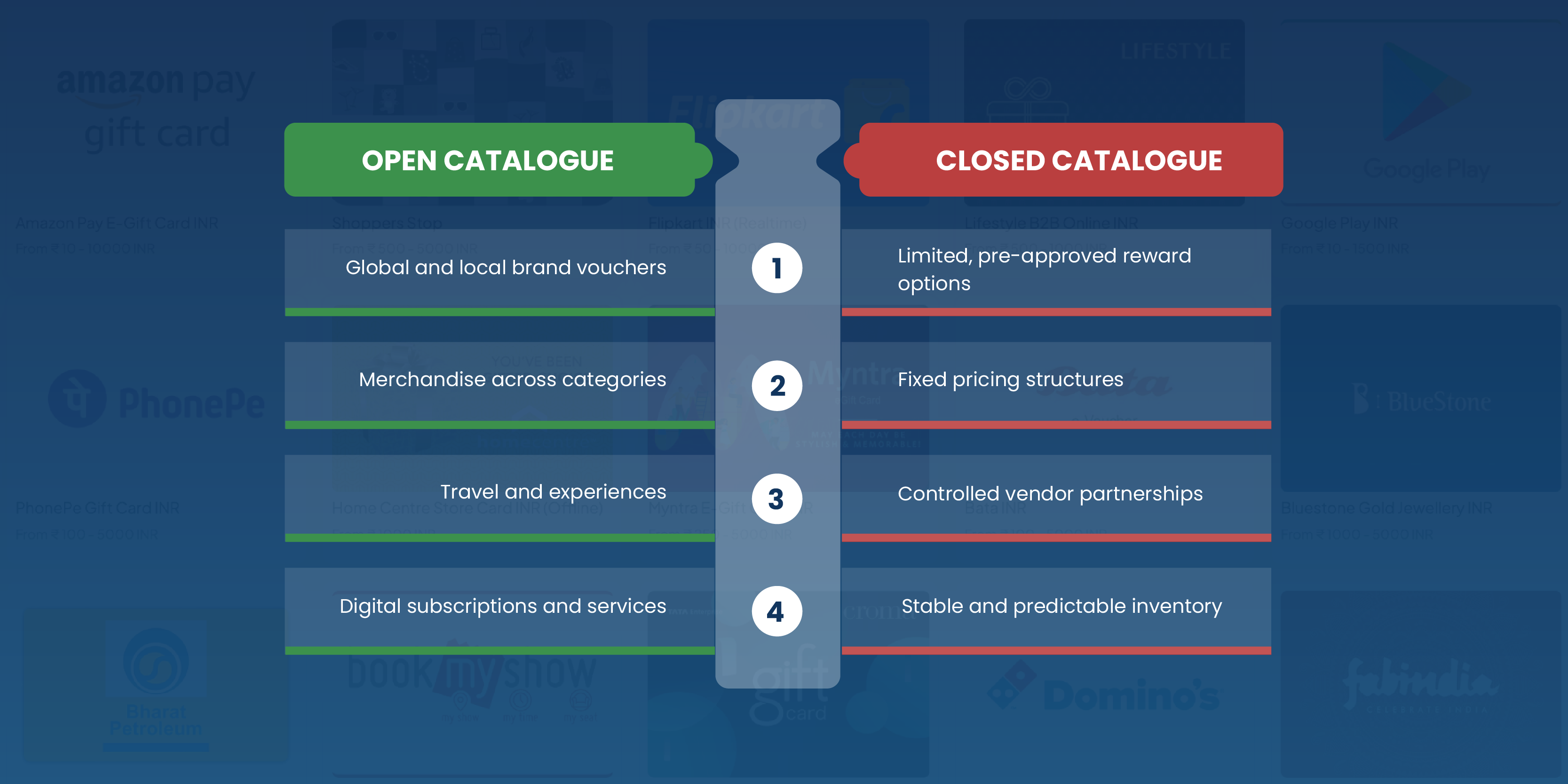
An open reward catalogue gives participants access to a broad marketplace across categories, values, and locations. A closed catalogue limits redemption to a predefined set selected by the organisation. Each model changes the participant experience, administrative workload, cost structure, and level of brand control.
For Marketing Leaders, the decision affects more than fulfilment. It can influence programme participation, perceived value, campaign differentiation, and the organisation’s ability to serve diverse audiences. This article explains the difference between open and closed reward catalogues, compares their strengths, and provides a framework for selecting an open, closed, or hybrid model.
What Is an Open Reward Catalogue?
An open reward catalogue gives participants access to a broad and frequently updated selection of redemption options. Depending on the programme, this may include gift cards, merchandise, flight bookings, hotel bookings, dining, sports, golf, experiences, bus bookings, and concierge services.
The defining characteristic is participant choice. Rather than directing every customer, employee, or channel partner towards the same reward, the programme allows each person to select an option that suits their interests, location, lifestyle, or points balance.
The Incentive Research Foundation reports that people differ substantially in how they prefer to receive rewards and recognition. Its research concludes that offering a choice of award options contributes to programme effectiveness.
Open catalogues can support:
- Global or geographically diverse audiences.
- Programmes with several participant types.
- Long-running loyalty and recognition strategies.
- Frequent redemptions across different points levels.
- Campaigns where personal relevance drives perceived value.
Choice also reduces dependence on a single reward category. IRF research into reward frequency warns that restricted non-cash options can lose motivational impact through repetition. It recommends broad variety and the regular introduction of new reward types, particularly when organisations offer frequent, smaller rewards.
The trade-off involves governance. Marketing teams need controls for budgets, eligibility, geography, availability, taxation, fulfilment, and customer support.
What Is a Closed Reward Catalogue?
A closed reward catalogue restricts participants to a defined group of rewards selected by the programme owner. The organisation may limit the catalogue by category, value, campaign, audience, region, supplier, or business objective.
Closed catalogues prioritise control. Marketing Leaders can determine exactly what participants see and ensure that every available option fits the campaign budget, brand position, compliance policy, or promotional theme.
This structure may suit:
- Short-term promotions with a fixed reward pool.
- Campaigns built around a specific experience or category.
- Regulated organisations with strict approval requirements.
- Programmes that need predictable unit costs.
- Smaller participant groups with similar preferences.
Closed models can simplify forecasting because the organisation controls the range and redemption values. They can also create a more focused campaign narrative. For example, a programme designed to reward exceptional partner performance may present a curated collection of premium merchandise, travel, or experiences rather than a large general marketplace.
However, restriction creates a relevance risk. The Incentive Research Foundation found wide differences in reward preferences and no universal consensus about how people want to receive recognition. A narrow catalogue may therefore work well for some participants while offering little perceived value to others.
A closed catalogue works best when the organisation understands its audience and refreshes the selection before familiarity reduces interest.
How Do Open and Closed Reward Catalogues Compare?
The central difference lies in who controls the final reward decision. In an open catalogue, the participant exercises greater control. In a closed catalogue, the organisation retains greater control.
The Incentive Research Foundation advises programme designers to offer a wide range of non-cash rewards and introduce novelty where rewards occur frequently. Its reviewed research found that restricted tangible reward choices can lose impact as participants become accustomed to them.
This does not make open catalogues universally superior. Excessive choice without clear navigation can complicate redemption. A closed catalogue may create a simpler experience when the audience shares similar needs or when the campaign has one precise purpose.
Marketing Leaders should therefore evaluate relevance, control, and usability together, rather than treating catalogue size as the only measure of quality.
Why Does Reward Choice Matter to Programme Performance?
Reward value depends partly on personal relevance. Two options with the same financial value may create very different levels of interest because participants assess them through their own priorities.
The Incentive Research Foundation found that employees and programme participants differ widely in their preferred rewards and recognition methods. Its study also noted that commonly requested rewards do not always correlate most strongly with engagement or motivation.
Gallup reaches a similar conclusion in employee recognition. It states that the most effective recognition is authentic and individualised according to how each employee wants to receive it. Although customer loyalty and channel incentives involve different relationships, the design principle remains relevant: organisations should avoid assuming that one reward carries equal meaning for everyone.
Choice matters because it can improve:
- Perceived value: Participants can select rewards that feel useful or aspirational.
- Geographical relevance: Different markets can access locally appropriate options.
- Redemption accessibility: Several points levels allow more participants to use their balances.
- Programme longevity: Variety reduces dependence on repeatedly offering the same item.
- Audience coverage: One catalogue can support different life stages, preferences, and participant roles.
IRF research on reward frequency specifically recommends broad choice when programmes use frequent non-cash rewards because limited selections can produce satiation.
Marketing Leaders should not confuse more choice with better choice. Catalogue relevance, search, filtering, availability, redemption simplicity, and fulfilment quality all influence the final experience.
Which Catalogue Is Better for Employee Recognition, Channel Incentives, and Customer Loyalty?
The right catalogue model depends on the programme audience and the behaviour the organisation wants to influence.
For employee recognition, Gallup emphasises individualisation, while the Incentive Research Foundation highlights variation in reward preferences. These findings support wider choice for a diverse workforce.
For channel incentives, a hybrid approach often creates the best balance. Sales and Marketing Leaders can control qualification rules, budgets, and reward bands while allowing eligible partners to choose their preferred redemption category.
Customer loyalty programmes usually benefit from flexibility because members differ in spending, points balances, geography, and interests. Rekyndl can support loyalty-led engagement, while Paytives addresses channel partner incentives and payouts.
For recognition programmes, ApplaudIQ connects structured recognition with access to a broader reward ecosystem.
When Is a Hybrid Reward Catalogue the Better Decision?
A hybrid reward catalogue combines a controlled core with a wider layer of participant choice. The organisation can approve categories, price bands, suppliers, regions, or programme-specific collections while still allowing participants to choose within those boundaries.
This model can solve a common design conflict. Finance and procurement teams need predictability, while Marketing Leaders want a relevant and engaging experience.
A hybrid structure might include:
- A curated catalogue for a short promotional campaign.
- A wider marketplace after participants reach a higher points threshold.
- Region-specific options within one global programme.
- Approved reward categories with participant choice inside each category.
- Premium experiences for top tiers and broader everyday rewards for other members.
The existing Reward Store guidance identifies hybrid design as a way to combine catalogue control with flexibility and scalability.
The Incentive Research Foundation’s findings also support this balance. Participants value choice, but programme owners still need a design that reflects audience preferences, delivery conditions, and programme objectives.
Hybrid catalogues become particularly useful when one organisation serves employees, customers, and partners through separate programmes. Each audience can receive different catalogue permissions without requiring an entirely separate reward infrastructure.
The model does require strong configuration. Marketing Leaders should define what remains open, what stays restricted, who approves exceptions, and how catalogue performance will be measured.
How Should Marketing Leaders Choose the Right Reward Catalogue?
Marketing Leaders can use the CHOICE framework to select an appropriate catalogue model.
C: Clarify the Commercial Objective
Determine whether the programme should increase retention, encourage repeat purchases, activate partners, recognise employees, or drive a short-term sales result. A continuing relationship programme usually requires more variety than a single campaign.
H: Identify the Human Audience
Review participant location, role, points balance, preferences, purchasing power, and redemption behaviour. The Incentive Research Foundation recommends understanding the specific participant population rather than relying on broad assumptions.
O: Set Operational Controls
Define budgets, approval limits, expiry rules, taxation responsibilities, security standards, fulfilment expectations, and customer support processes.
I: Assess Integration Requirements
Decide whether the programme needs a ready-to-use storefront, an embedded experience, or an API connection. TRS X offers a pre-built global rewards storefront and integration options designed to support reward distribution at scale.
C: Curate the Right Level of Choice
Avoid both extremes. Too little choice can weaken relevance; too much unstructured choice can slow decisions. Use categories, recommendations, filters, and programme-specific collections.
E: Evaluate Redemption Data
Track redemption rate, catalogue searches, abandoned redemptions, preferred categories, regional availability, points liability, support requests, and repeat engagement.
The best catalogue is the one that supports the commercial objective while giving participants an easy route to a reward they genuinely value.
How Does TRS X Support Open, Closed, and Hybrid Reward Catalogues?
TRS X gives organisations access to a ready-to-use global rewards storefront, instant delivery capabilities, cross-border transaction support, and integration options. The current product page describes a catalogue covering more than 8,000 brands and availability across more than 100 countries.
Marketing Leaders can use this infrastructure to create different catalogue experiences according to programme requirements.
An open model can provide broad access across reward categories and geographies. A closed model can restrict participants to approved options for a specific campaign, budget, or audience. A hybrid configuration can combine a curated selection with wider redemption access at defined tiers or points levels.
The operational value comes from reducing the need to manage separate brand agreements, fulfilment processes, currencies, and regional reward relationships. The TRS X product page positions the platform as a burn partner that helps organisations manage these reward distribution complexities.
Available categories can include gift cards, flight bookings, hotel bookings, dining, sports, golf, experiences, merchandise, bus bookings, and concierge services.
Marketing teams should still define catalogue governance before launch. This includes audience eligibility, reward bands, market availability, brand standards, budget rules, and reporting measures. TRS X provides the storefront and reward infrastructure; the programme strategy determines how participants experience it.
Frequently Asked Questions
What Is an Open Reward Catalogue?
An open reward catalogue gives participants access to a broad marketplace of redemption options across categories, values, and locations. It suits diverse audiences because participants can choose rewards that reflect their own preferences.
What Is a Closed Catalogue?
A closed catalogue contains a limited, pre-approved set of rewards selected by the organisation. It provides stronger budget, procurement, compliance, and campaign control, but may offer less personal relevance.
Which Is Better for Employee Recognition Versus Channel Incentives?
Employee recognition usually benefits from an open or hybrid catalogue because employee preferences vary widely. Channel incentives often suit a hybrid model that combines controlled qualification and reward values with flexible participant choice. Gallup and the Incentive Research Foundation both emphasise the importance of individualised or varied reward experiences.
How Do Open Reward Catalogues Improve Engagement?
Open catalogues improve the likelihood that participants will find a relevant reward. The Incentive Research Foundation identifies reward choice as an important element of effective programmes and recommends variety where organisations use frequent non-cash rewards.
When Should a Business Use a Closed Reward Catalogue?
A business should consider a closed catalogue for a short campaign, fixed budget, regulated audience, or tightly themed promotion. It works best when the audience has similar preferences and the organisation refreshes the available options regularly.
Can The Reward Store Support Both Open and Closed Catalogues?
Yes. TRS X provides a global reward storefront and integration infrastructure that organisations can configure around different programme audiences and controls. Marketing teams can use broad, curated, or hybrid catalogue structures according to their campaign and governance requirements.
Conclusion
Open and closed reward catalogues serve different commercial purposes. Open catalogues prioritise participant choice, personal relevance, and global scalability. Closed catalogues prioritise curation, cost predictability, and policy control. For many organisations, a hybrid model provides the strongest balance by restricting rewards where governance matters and widening choice where engagement matters. As loyalty, recognition, and incentive programmes become more personalised, catalogue strategy will increasingly shape the value participants attach to every point earned.
Sign up for our newsletter for trending top content!


