
How to Build a Culture of Recognition That Outlasts Any Single HR Initiative or Leadership Tenure

Sign up for our newsletter for trending top content!
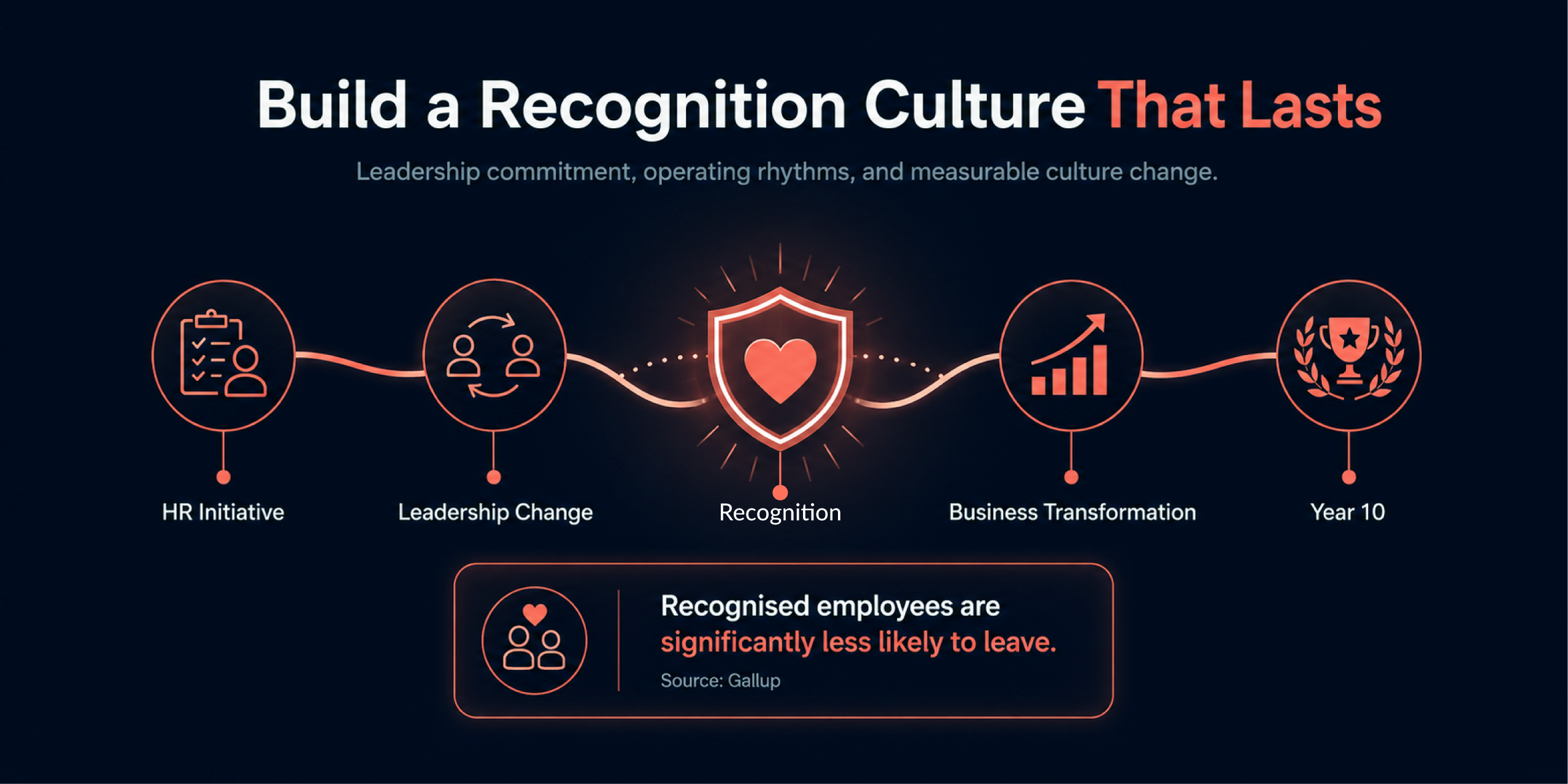
Gallup reports that employees who receive meaningful recognition are significantly less likely to leave their organisation and are more likely to be engaged at work. Yet many recognition initiatives lose momentum within 18 to 24 months because they remain HR-owned campaigns rather than leadership-led cultural practices.
For CXOs, this is not an engagement problem alone. It is a performance, retention, and execution problem. When recognition disappears after a leadership change, merger, restructuring, or budget cycle, employees receive a powerful signal that appreciation was never truly part of the organisation’s operating system.
This article explains how leaders can build a culture of recognition that survives organisational change. It covers leadership commitment, operating rhythms, measurement, fatigue prevention, and long-term culture maturity so recognition becomes a durable organisational capability rather than a temporary initiative.
Why Recognition Programmes Succeed Initially and Then Fade and What Separates the Ones That Don’t
Most recognition programmes begin with executive sponsorship, launch communications, and strong early participation. The decline usually starts when leaders stop modelling the behaviour consistently. O.C. Tanner’s Global Culture Report shows that recognition has the strongest cultural impact when leaders participate visibly and regularly, not merely when technology exists.
Deloitte’s research on culture and employee experience also finds that organisations sustain behavioural change when they embed it into daily work rather than treating it as a standalone HR campaign. Initial enthusiasm often masks a structural weakness: the programme depends on a few champions.
Three patterns typically predict decline:
- Recognition occurs only during annual events.
- Managers receive no accountability for recognition behaviour.
- Recognition data is reviewed by HR but not by business leaders.
By contrast, durable recognition cultures share three characteristics:
SHRM research indicates that organisations with strategic recognition practices report stronger retention and engagement outcomes than those using ad hoc recognition. The difference is not budget size; it is whether leadership treats recognition as a management discipline.
For organisations seeking that shift, provides a structured recognition framework that connects leadership visibility, peer recognition, milestone rewards, and measurable cultural signals in one operating system.
The Leadership Behaviour Gap: What CXOs Do Differently at Organisations Where Recognition Is Genuinely Cultural
Employees watch leaders more closely than policy documents. McKinsey’s research on organisational health shows that visible leadership behaviour strongly influences whether employees adopt desired cultural norms. In recognition cultures, senior leaders make appreciation observable.
High-performing leadership teams typically do four things consistently.
They recognise publicly and specifically
Generic praise rarely changes behaviour. O.C. Tanner finds that meaningful recognition is timely, specific, and linked to organisational values. Effective leaders describe the action, its impact, and why it mattered.
They recognise cross-functional contribution
Bain & Company’s work on collaboration shows that organisations create stronger execution cultures when leaders acknowledge work that helps other teams succeed. This reduces silo behaviour.
They review recognition data alongside business metrics
Leaders in mature organisations discuss recognition participation, manager activity, and inclusion patterns during operating reviews. They treat these signals as indicators of organisational health.
They make recognition a leadership expectation
Gartner research on manager effectiveness highlights that employees’ day-to-day experience depends heavily on direct managers. CXOs therefore set explicit expectations for recognition behaviour and coach leaders who fall behind.
A practical benchmark is frequency. Gallup recommends recognition that is regular enough to reinforce behaviour continuously rather than annually. Many organisations underestimate how quickly appreciation decays when leaders become busy.
Platforms such as help leaders maintain visibility through peer-to-peer recognition, leadership feeds, and integrations with collaboration tools, making recognition easier to sustain without adding administrative burden.
How to Embed Recognition Into Operating Rhythms So It Does Not Depend on HR to Sustain It
Recognition becomes cultural when it appears in the same forums where leaders discuss customers, revenue, quality, and delivery. Deloitte’s Human Capital research consistently shows that culture changes through repeated organisational routines.
A useful design principle is “attach recognition to existing rhythms, not new meetings.”
Recognition Cadence List
- Weekly team reviews: recognise one collaboration or customer impact story.
- Monthly business reviews: highlight cross-functional contributions.
- Quarterly leadership meetings: review recognition trends by function and geography.
- Project retrospectives: recognise learning, innovation, and support behaviours.
- Town halls: connect recognition stories to strategic priorities.
This approach reduces programme fatigue because leaders do not create additional ceremonies.
Mercer’s employee experience research shows that employees perceive culture as more authentic when recognition occurs during normal work interactions rather than special events. Embedding recognition also improves fairness because more contributions become visible.
Technology should support these rhythms, not replace them. HRMS and collaboration integrations allow recognition moments to occur where work already happens. For example, organisations using integrated recognition workflows can trigger milestone rewards automatically while preserving manager involvement in the message and context.
For a deeper operational blueprint, see .
The key governance question for CXOs is simple: If the HR team stopped sending reminders tomorrow, would recognition still occur next week? If the answer is no, the culture is not yet embedded.
Measuring Culture vs Measuring Programme: The Difference Between Participation Rates and Cultural Shift
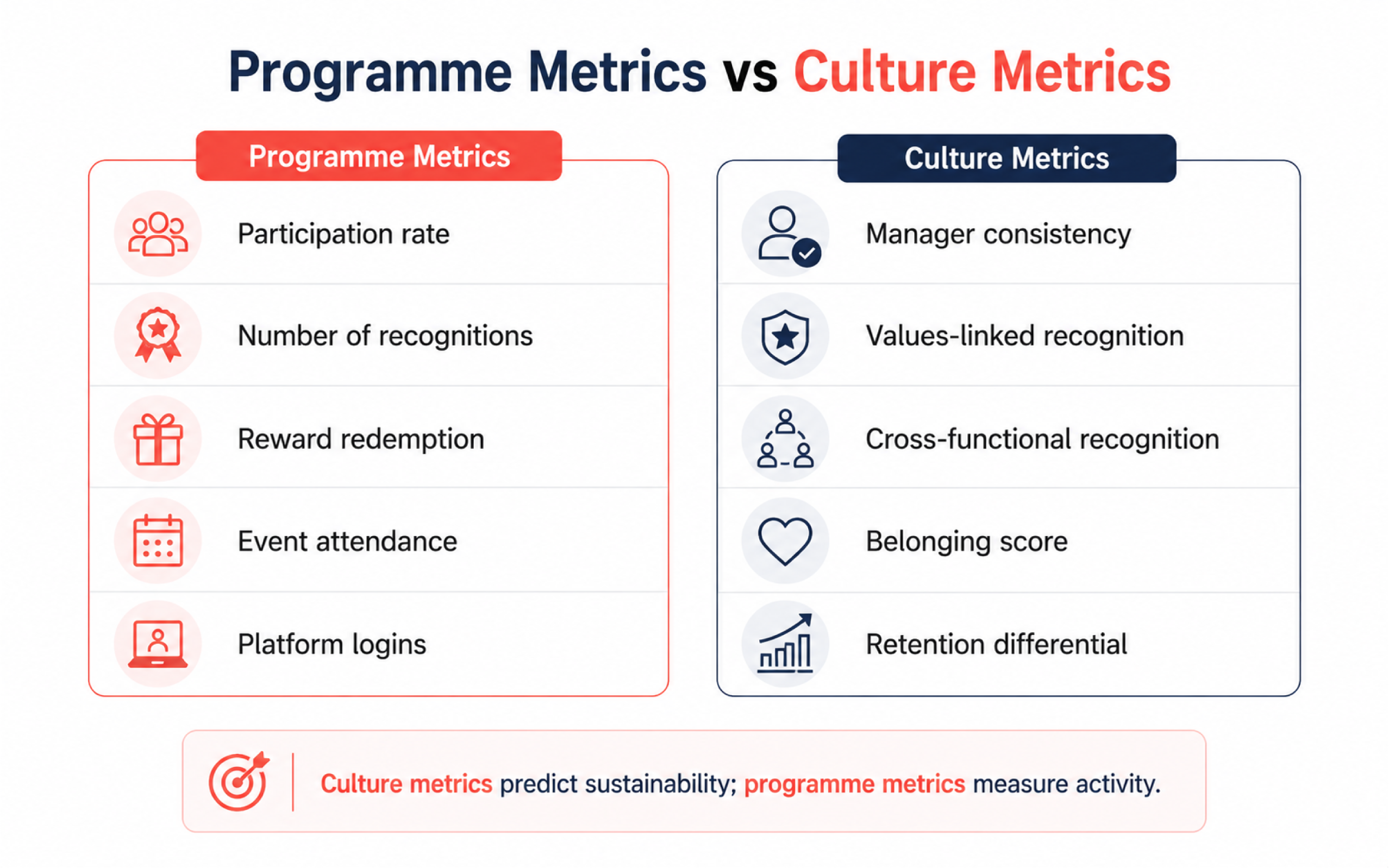
Many executive dashboards stop at participation rates. Participation measures activity; culture measures behavioural adoption. Gartner warns that engagement metrics alone rarely reveal whether cultural norms have changed.
A more useful framework separates programme health from culture health.
Gallup’s workplace research links meaningful recognition with higher engagement and lower turnover, making retention differential a particularly valuable executive metric. If recognised employees stay materially longer than non-recognised employees, recognition is influencing culture, not merely platform usage.
O.C. Tanner recommends analysing recognition quality as well as quantity. Organisations should review whether recognition is:
- timely,
- specific,
- values-linked,
- inclusive across demographic groups, and
- distributed across organisational levels.
Advanced organisations create a Recognition Culture Index that combines participation, manager consistency, inclusion, and employee perception data. This provides a leading indicator of cultural health before turnover or engagement problems appear.
For organisations building executive dashboards, outlines practical KPIs and reporting approaches.
How to Prevent Recognition Fatigue and Why Most Programmes Never Consider It
Recognition fatigue occurs when employees perceive appreciation as routine, automated, or disconnected from real contribution. O.C. Tanner’s research shows that recognition loses impact when organisations over-standardise messages or reward every activity equally.
Most programmes focus on increasing frequency but ignore signal quality. Effective cultures manage both.
Signs of recognition fatigue
- Employees describe recognition as “template-based”.
- Managers send multiple recognitions at month-end to meet targets.
- High performers receive the same recognition as minimal contributors.
- Employees stop sharing recognition stories voluntarily.
- Participation remains high while perceived value declines in surveys.
A simple prevention framework
- Vary the format: Use public praise, private appreciation, peer recognition, leadership recognition, and experiential rewards rather than a single format.
- Increase specificity: Require managers to describe the behaviour and business impact in their own words.
- Differentiate contribution levels: Create tiers for everyday appreciation, exceptional performance, innovation, and customer impact.
- Refresh reward categories: Rotate reward options periodically to maintain novelty and relevance.
- Monitor sentiment, not just volume: Add short pulse questions on whether recognition feels meaningful and fair.
SHRM research indicates that personalisation significantly increases perceived recognition value. The goal is not more recognition; it is more meaningful recognition.
A useful executive rule is “never automate the appreciation message, only the workflow.” Technology can trigger reminders and rewards, but leaders should own the human expression of appreciation.
What Organisational Culture Maturity in Recognition Actually Looks Like at the Three-, Five-, and Ten-Year Mark
CXOs often ask when recognition becomes “part of the culture”. The answer depends on behavioural maturity, not calendar time. Deloitte’s culture research suggests that sustainable cultural norms typically require several years of consistent reinforcement.
The ten-year mark is particularly revealing. Mature organisations can replace a CEO, CHRO, or business head without a collapse in recognition behaviour. The practice persists because employees expect it from one another.
Gallup’s long-term workplace studies show that organisations with sustained engagement practices outperform peers on productivity and retention over time. Recognition contributes to that durability when leaders maintain consistency across economic cycles.
A practical self-assessment for boards and executive teams is:
- Would new employees notice recognition within their first month?
- Would managers continue recognising people without HR reminders?
- Would recognition remain visible during a cost-control period?
- Would employees describe recognition as “how we work here” rather than “a programme”?
If leaders can answer “yes” to all four questions, they are approaching cultural maturity rather than programme maturity.
Frequently Asked Questions
What is the first step in building a lasting culture of recognition?
Start with executive behaviour, not technology. Employees take cues from what senior leaders consistently do, discuss, and reward. Define 3 to 5 recognition behaviours linked to company values and require every executive team member to model them publicly each month.
How long does it take for recognition to become part of organisational culture?
Most organisations see visible behavioural change within 12 to 18 months, but durable cultural adoption usually takes several years of consistent leadership reinforcement. Deloitte’s culture research suggests that sustainable norms emerge through repeated operating rhythms rather than one-time initiatives. Leadership transitions are the real test of maturity.
What metrics should a CXO review every quarter?
Review manager recognition consistency, cross-functional recognition rates, inclusion patterns, retention of recognised employees, and employee perception of recognition quality. Participation rates alone are insufficient because they measure activity rather than cultural change. Combine behavioural metrics with business outcomes.
Can recognition culture survive a CEO or CHRO change?
Yes, if the organisation has embedded recognition into leadership expectations, management routines, onboarding, and performance conversations. Cultures fail after leadership changes when recognition depends on a single champion. Mature organisations distribute ownership across leaders and teams.
How does ApplaudIQ help sustain leadership commitment over time?
ApplaudIQ supports leadership visibility through peer-to-peer recognition, milestone automation, collaboration tool integrations, and executive dashboards that track recognition activity across teams and geographies. It helps organisations embed recognition into daily workflows so appreciation continues even when leadership priorities shift.
Conclusion
A lasting culture of recognition does not emerge from a launch event, a budget line, or a charismatic leader. It emerges when leaders repeatedly model appreciation, embed it into operating rhythms, measure cultural change, and protect meaning from fatigue. Organisations that do this create a recognition capability that survives restructuring, leadership transitions, and economic cycles.
Over the next decade, recognition will increasingly become a board-level indicator of organisational health because it influences retention, collaboration, and execution quality. The organisations that invest now in leadership-led recognition systems will build cultures that remain resilient long after any single initiative ends.
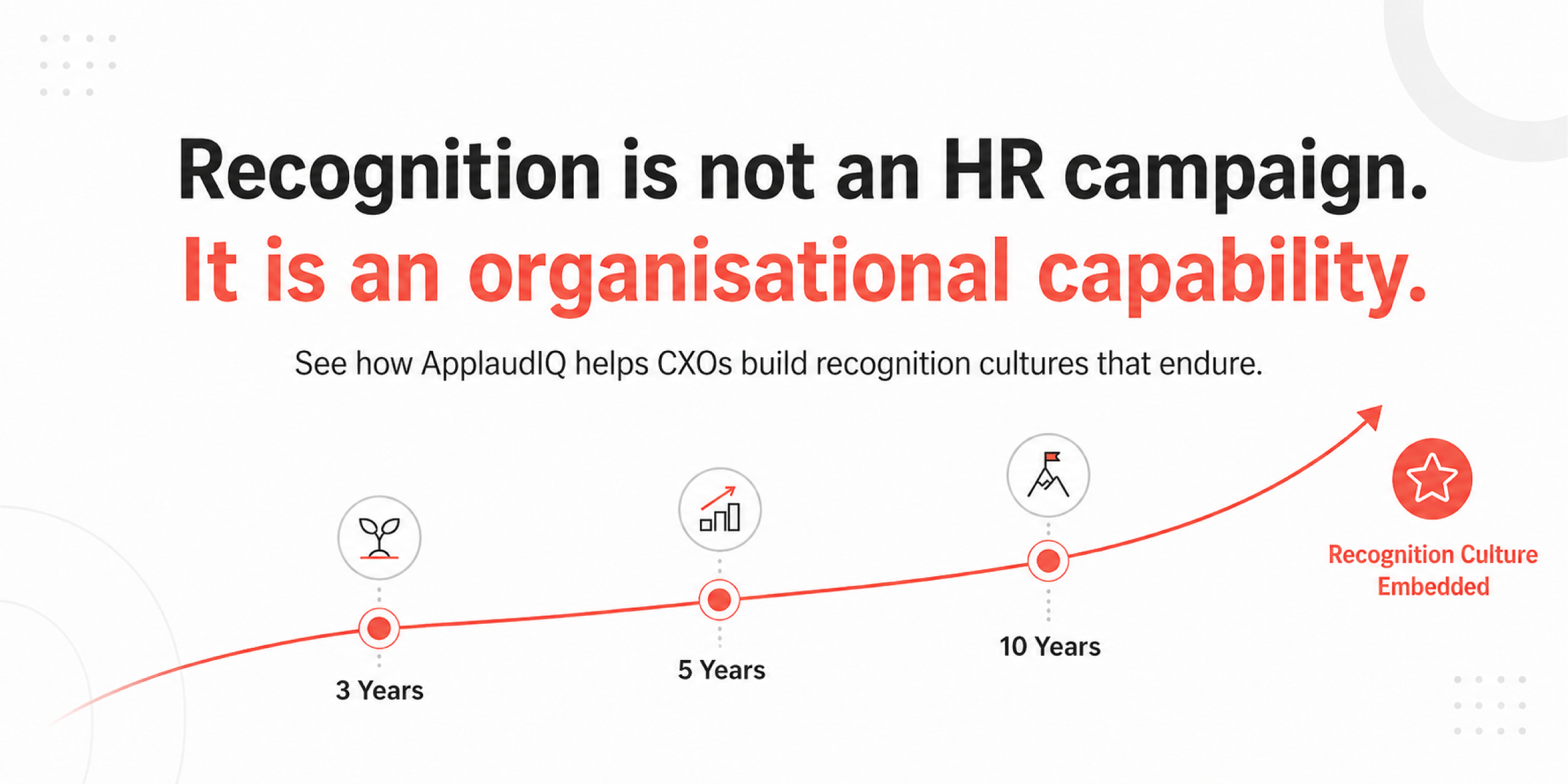
See how ApplaudIQ helps organisations build recognition cultures that last. Explore the CXO solution: https://www.therewardstore.com/applaudiq/solutions/for-cxos
Sign up for our newsletter for trending top content!


