
How to Write a Corporate Gifting RFP That Gets Comparable Quotes From Vendors

Sign up for our newsletter for trending top content!
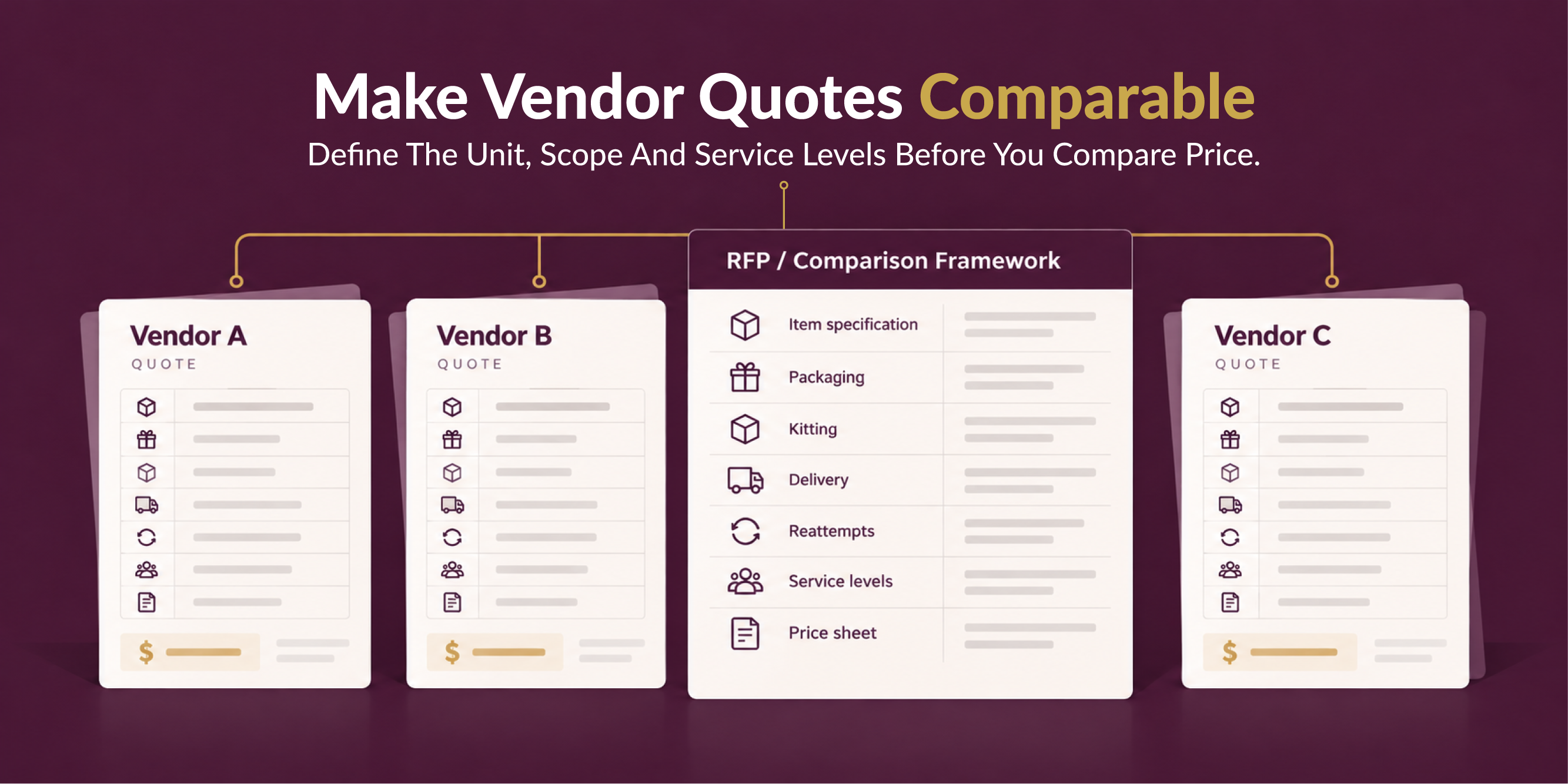
A corporate gifting RFP produces comparable quotes when every vendor prices the same defined unit against the same written specification, delivery scope and service levels, so that the only variables left are the vendor's own price and capability. To achieve this, the request must define what one billed unit contains, state which activities are included and which are charged separately, fix the delivery and reattempt rules, and require responses in a fixed format. A corporate gifting and merchandise partner that receives such a document has no room to interpret scope in its own favour, and the buyer can score price and capability on separate scales.
Why Gifting Quotes Are Almost Never Comparable
Gifting quotes diverge because most requests describe an occasion rather than a deliverable, so each vendor fills the gaps with the assumption that is cheapest for it to perform. A request for proposal (RFP) is a procurement document that states requirements, response format and evaluation criteria so that suppliers can be assessed against the same terms. A gifting RFP usually fails because it names the occasion, such as festive gifting for all staff, but not the unit, the packaging, the kitting scope or the delivery rules.
Why silence becomes a pricing decision
Where the document says nothing, a vendor must choose between pricing the generous reading and risking the loss of the bid, or pricing the narrow reading and recovering the difference through change requests after award. Competitive pressure favours the narrow reading. The quoted price then measures the vendor's interpretation rather than its capability, and the lowest quote is frequently the one that assumed the least.
A diagnostic to run before issuing
Ask a colleague in finance, working alone, to write down what one billed unit contains and what it excludes. If that list differs from the one held by the procurement team, every vendor will produce a third version. The exercise takes minutes and catches the largest gaps before they reach the market.
When a full RFP is the wrong instrument
A full RFP is the wrong choice when the programme is small, when it will run only once, or when the buyer does not yet know what recipients want. The specification would then encode guesses, and vendors would price those guesses. In that situation, issue a request for information (RFI), which is a document that asks suppliers to describe options and approaches without committing to a price. Alternatively, commission a small pilot with one supplier and write the RFP from what the pilot shows.
Writing a Specification That Removes Interpretation
A specification removes interpretation when each item is described by attributes that can be checked on receipt rather than by adjectives, and when the rules for substitution and sampling are fixed before bidding. A specification is a written description of a deliverable that states the attributes an item must have to be accepted.
Describe items by verifiable attributes
Words such as premium or high quality cannot be tested by a goods receipt team. State the material, dimensions, weight range, colour reference, branding method and placement, and, for food hampers, the shelf life that must remain at delivery. Name the compliance documents required where they apply: a Food Safety and Standards Authority of India (FSSAI) licence for food items, declarations under the Legal Metrology (Packaged Commodities) Rules for packaged goods, and Bureau of Indian Standards certification for categories that require it.
Fix the substitution and sample rules
A substitution rule is a contract clause that states when and how a vendor may replace an item that becomes unavailable. Without one, a vendor can replace an item with a cheaper one after award and remain within the literal wording of the quote. Require written approval from a named owner, an equal or higher specification, and no change to the delivery window. Require an approved sample before bulk production, so that the sample becomes the acceptance reference.
Assemble the document in a fixed sequence
The clauses depend on one another, so write them in this order:
- Name the occasion, the recipient groups and the delivery windows.
- Write the item specification with verifiable attributes and substitution rules.
- Define the billed unit and list inclusions and exclusions line by line.
- State the delivery scope, reattempt policy and proof of delivery requirements.
- Set service levels with a measurement method and a remedy for each miss.
- Prescribe one price sheet with identical line items, and require assumptions to be listed separately.
- Publish the scoring matrix and its weights before vendors respond.
Publishing the weights matters because vendors cannot then tailor their emphasis to a hidden formula, and the buyer can later show an auditor that the award followed the stated criteria.
A genuine objection
Tight specifications can flatten proposals. Vendors then compete only on price for identical items, and a curation led programme benefits from a vendor's judgement about what recipients will value. The remedy is to be tight on the unit, scope and service levels, and loose on item selection. Invite one optional alternative proposal from each vendor, scored separately and never allowed to replace the baseline response.
Defining the Unit: What Is Included and What Is Billed Separately
The billed unit should be defined as one gift delivered to and accepted at the recipient's address, with every cost element either named as included or named as a separate line, because any element left unnamed becomes a variation order after award. Unit cost is the total amount payable for one accepted gift, covering every activity between purchase of the item and receipt by the recipient. Kitting is a service that assembles several items, inserts and packaging into one finished gift set before dispatch.
Name each cost element
Treat personalisation data and destination type as separate decisions
Per recipient personalisation depends on a data file, so state the file format and the cut off date for changes. A late correction to names is a common point at which vendors add charges. A single office drop is a freight movement, whereas delivery to individual addresses involves parcel handling, address validation and failed delivery management. These are different services. If the decision is not final, require both to be quoted separately.
An illustration from supplier scope
Cherishd is the corporate physical gifting and branded merchandise business from The Reward Store. Its listed activities include personalisation, kitting and packaging, which illustrates the point: when a supplier performs all three, each is a distinct activity that should appear as a distinct line in the unit definition.
When a corporate gifting and merchandise partner performs several of these activities, the RFP should still ask for each as its own line. A bundled figure cannot be compared with the figure from a vendor that performs only one of them.
Delivery Scope, Reattempt Policy and Service Level Commitments
Delivery scope must state the destination type, the number of dispatch locations, the delivery window and the reattempt rule. Service levels must be written as measurable commitments with a named measurement source and a proportionate remedy. A corporate gifting and merchandise partner can only commit to what the document defines, so every undefined term returns later as a dispute.
Define the reattempt policy
A reattempt policy is a contract clause that states how many times a courier tries again after a failed delivery, who bears the cost, and what happens to a gift that is never delivered. After the courier's own attempt limit, undelivered parcels travel back to the origin warehouse, a movement known as return to origin (RTO). If the RFP is silent, the vendor either absorbs the cost and prices it into the unit, or bills it afterwards. State the maximum number of attempts, who contacts the recipient or the HR operations lead for an alternative address, the holding period before RTO, and whether redispatch is charged.
Write service levels that can be measured
A service level agreement (SLA) is a contract section that sets measurable performance targets, the method of measurement and the remedy for a miss. Define the word delivered precisely, because handed to the recipient, left at a reception desk and scanned by the courier are three different events. Name the measurement source, usually proof of delivery (POD) records matched against the goods receipt note (GRN) and the purchase order in a three way match within the ERP system. Reasonable commitments cover dispatch within the agreed window, personalisation accuracy at receipt, damage at receipt, and response time to recipient queries. The target for each should come from the organisation's own past performance data.
Choose remedies that survive scrutiny
A service credit is a defined reduction in the amount payable when a service level is missed. Credits are usually preferable to a headline penalty, because a punitive clause is priced into the quote as a risk premium, and because Section 74 of the Indian Contract Act, 1872 limits recovery on a stipulated sum to reasonable compensation. Legal counsel should confirm enforceability. The trade off is that a credit proportionate to invoice value does not compensate for a missed festival date, where the loss does not scale with the invoice. For date critical dispatches, pair credits with a right to move the undelivered volume to another supplier.
The Ambiguities Vendors Rely On
Most scope disputes after award trace to a short list of ambiguities, and each one closes with a single clause.
Undefined kitting scope
Kitting is the most common gap, because the word covers anything from placing items in a box to receiving goods from several suppliers, inspecting them, inserting printed cards and sealing tamper evident packs. A vendor that prices placement only will appear far cheaper than one that prices inspection and assembly. Close the gap with a bill of materials, which is a list of every component in the finished gift set with quantities, together with each assembly step, its location and who inspects it.
Silence on delivery reattempts
Vendors that exclude reattempts quote for a single successful delivery, which holds only if every address is correct and every recipient is available. Address quality is the buyer's variable, so split responsibility in the clause: the vendor bears failures caused by courier performance, and the buyer bears failures caused by incorrect address data it supplied.
Other common gaps
A Scoring Matrix That Separates Price From Capability
Capability should be scored on a fixed scale with prices withheld, and price should then be evaluated separately as a total landed cost for one defined scenario, because a single blended score allows a low price to offset a failing capability. A scoring matrix is a table that assigns weighted criteria and a fixed scale so that evaluators rate every response consistently. A gate is a minimum score on a criterion below which a vendor is excluded whatever its other scores.
Score capability first, with prices withheld
Ask vendors to submit a technical envelope and a price envelope. Evaluators score the technical envelope from 0 to 4, where 0 means the point is not addressed, before any price is opened.
Price does not appear as a row. It is reported beside the weighted capability score as a normalised total landed cost, and the two are never multiplied into one number.
Normalise before comparing price
Normalisation is the process of adding every excluded element to each quote at a stated assumption, so that all totals describe the same scope. Apply the same assumption to every vendor, and record it.
A worked scenario
Consider a manufacturing company with plants in several Indian states that sends a festive gift set to every employee. Three vendors respond. Vendor A is the lowest quote, but it prices placement of items in a box only, assumes one delivery attempt and quotes exclusive of tax. Vendor B includes kitting with inspection, allows reattempts and quotes inclusive of tax. Vendor C is the highest quote and includes everything Vendor B does, plus a holding period before return to origin.
The procurement manager adds a kitting line to Vendor A, a reattempt allowance based on the company's own history of address errors, and tax on a consistent basis. Vendor A is no longer the lowest, and Vendor B is. Capability scoring also places Vendor A below the gate for unit definition, because it listed no assumptions. The ranking by raw quote and the ranking by normalised cost differ, which is the evidence that the original quotes were not comparable.
One caveat applies. If the company has its own facility and staff able to perform kitting, Vendor A's exclusion is not a defect. The kitting line should then be removed for every vendor rather than added, because the matrix must reflect the buyer's real constraints.
Where Cherishd Fits as a Corporate Gifting and Merchandise Partner
A corporate gifting and merchandise partner fits after the specification, unit definition, delivery scope and scoring have been agreed, at the point where items are curated, sourced, personalised, packed and delivered. Cherishd, from The Reward Store, supplies gift items and hampers for employee and client gifting occasions, and company branded items for launches, events, onboarding and internal programmes. It provides personalisation, kitting and packaging across large volumes, and delivers to employee and client addresses across India, including multi location dispatch. Its physical gifting offer includes 500+ Indian brands. It does not issue or supply digital gift cards, run loyalty programmes, provide employee recognition software or operate redemption, so it is relevant only where the requirement is physical gifting or branded merchandise.
Frequently Asked Questions
What is the difference between an RFP and an RFQ for corporate gifting?
A request for quotation (RFQ) asks suppliers to price a fixed, fully defined requirement, so the decision turns mainly on price. A request for proposal (RFP) asks suppliers to propose how they would meet a requirement, so it also evaluates approach, capability and service levels. Use an RFQ when the specification is complete and the items are standard. Use an RFP when scope, packaging, delivery and service commitments affect the outcome.
What does kitting mean in corporate gifting and why should it be a separate line item?
Kitting is the assembly of several items, inserts and packaging into one finished gift set before dispatch. It should be a separate line because it ranges from placing items in a box to inspecting them, inserting printed cards and sealing each set. A bundled figure hides that range, so a vendor performing only the minimum appears cheaper than one performing the full process.
What should a delivery reattempt clause say in a corporate gifting contract?
It should state the maximum number of delivery attempts, who contacts the recipient or the HR operations lead for an alternative address, how long an undelivered gift is held before return to origin, and who pays for redispatch. It should also divide responsibility, so the vendor bears failures caused by courier performance and the buyer bears failures caused by incorrect address data it supplied.
Can I include penalty clauses in a gifting contract without vendors raising their quotes?
Rarely. A punitive clause is priced into the quote as a risk premium, so the buyer pays for it whether or not a failure occurs. Service credits tied to measurable service levels and a named measurement source are more likely to be accepted without a premium. Where the dispatch date is critical, add a right to move the undelivered volume to another supplier. Legal counsel should confirm enforceability.
How do I compare gifting quotes when vendors propose different items?
Fix a baseline specification that every vendor must price, then permit one optional alternative proposal that is scored separately. Convert each response to the same unit, adding any excluded element, such as kitting, reattempts or tax, at a stated assumption, so that totals describe the same scope. Score capability first with prices withheld, then open the price sheets. Do not let an alternative replace the baseline response.
Who should own vendor evaluation for employee gifting: procurement or HR?
Procurement should own the process, the contract terms and the price comparison, while the HR operations lead or internal communications lead should own recipient requirements and score item suitability. Finance should confirm tax treatment and invoice validity. Splitting the scoring by competence, with procurement holding the single consolidated matrix, prevents one function from overriding another and leaves a clear audit trail.
What does Cherishd supply for branded merchandise programmes?
Cherishd supplies company branded items for launches, events, onboarding and internal programmes. It provides personalisation, kitting and packaging across large volumes, and delivers to employee and client addresses across India, including multi location dispatch. Its physical gifting offer includes 500+ Indian brands. It does not issue digital gift cards, run loyalty programmes, provide employee recognition software or operate redemption.
Sign up for our newsletter for trending top content!


