
How Should HR Leaders Build a Corporate Gifting RFP Checklist That Delivers Better Employee Experiences?

Sign up for our newsletter for trending top content!
Introduction
Employee gifting has evolved from a seasonal gesture into a strategic component of recognition, engagement, and employer branding. According to O.C. Tanner's Global Culture Report, employees who receive meaningful recognition are significantly more likely to feel connected to their organisation, while Gallup consistently links recognition with higher engagement and lower turnover. Choosing the right corporate gifting partner has therefore become an important procurement decision for HR Leaders, particularly in organisations operating across multiple locations and employee demographics.
This guide explains how to create a comprehensive corporate gifting Request for Proposal (RFP), the evaluation criteria that matter most, which service level agreements (SLAs) vendors should meet, and how HR teams can select a gifting partner capable of supporting long-term employee engagement rather than simply fulfilling orders.
Why Does Your Corporate Gifting RFP Matter More Than Vendor Pricing?
Many HR teams begin vendor selection by comparing catalogue sizes or product pricing. While these factors influence purchasing decisions, they rarely determine the long-term success of a corporate gifting programme. A poorly structured RFP can result in inconsistent delivery, limited personalisation, administrative complexity, and disappointing employee experiences.
According to Deloitte's Human Capital Trends research, employee experience increasingly influences organisational performance because employees compare workplace experiences with the personalised services they receive as consumers. Corporate gifting therefore contributes to the wider employee experience rather than functioning as an isolated procurement activity.
A well-designed RFP should help HR teams assess whether suppliers can support business objectives such as:
- Employee recognition.
- Service awards.
- Onboarding.
- Festival gifting.
- Wellness initiatives.
- Leadership recognition.
- Global gifting campaigns.
Instead of asking only, "How much does gifting cost?", HR Leaders should also ask:
- Can the platform support multiple countries?
- How quickly can gifts be delivered?
- Can employees choose their preferred rewards?
- How are returns and replacements managed?
- Can gifting integrate with existing HR workflows?
This broader evaluation produces stronger outcomes than selecting a supplier based solely on price.
What Should Every Corporate Gifting RFP Include?
An effective RFP gives suppliers enough information to propose a solution while enabling HR teams to compare responses objectively. Standardising evaluation criteria also reduces procurement bias and improves decision quality.
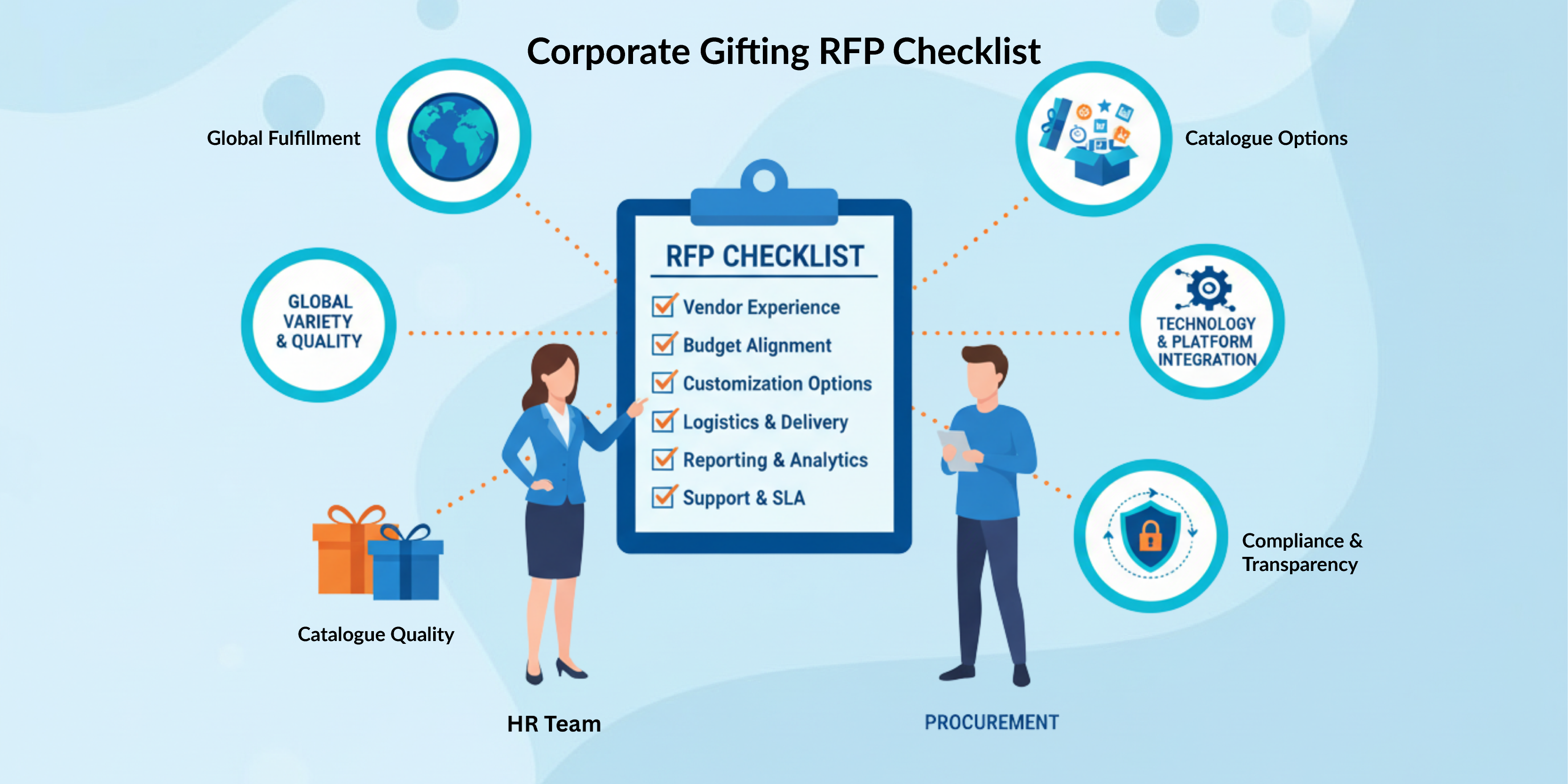
A practical RFP framework includes the following categories:
SHRM recommends aligning employee recognition initiatives with broader business goals rather than treating them as isolated HR activities. The same principle applies to corporate gifting procurement. Every requirement included within an RFP should support measurable objectives such as improving engagement, strengthening retention, increasing participation, or enhancing employer brand perception.
HR Leaders should also request examples of previous enterprise gifting programmes to understand how suppliers manage scale, complexity, and employee experience.
How Should HR Teams Evaluate Corporate Gifting Vendors?
Selecting the lowest-cost supplier often creates hidden operational costs through delayed deliveries, inconsistent quality, fragmented reporting, or manual administration. A structured evaluation framework allows procurement and HR teams to assess total programme value instead of comparing prices alone.
A practical decision matrix may include:
Mercer's research on employee experience highlights that personalisation increasingly influences workforce engagement. Employees value flexibility and choice because preferences differ across generations, regions, and life stages.
HR Leaders should therefore evaluate vendors on their ability to deliver:
- Flexible gifting options.
- Employee choice.
- Global fulfilment.
- Reliable logistics.
- Local compliance.
- Campaign automation.
- Consistent employee support.
Beyond functionality, suppliers should demonstrate operational maturity through documented processes, governance standards, quality assurance, and measurable service performance.
An enterprise gifting programme succeeds when employees receive the right gift, at the right time, through a smooth and reliable experience. Vendor evaluation should reflect this outcome rather than focusing exclusively on procurement costs.
What Service Level Agreements Should HR Teams Include in a Corporate Gifting RFP?
A corporate gifting programme depends on operational consistency as much as product quality. Service Level Agreements (SLAs) establish measurable expectations that protect both HR teams and employees. Without clearly defined SLAs, organisations may experience delivery delays, inconsistent communication, and unresolved service issues that reduce the impact of employee recognition.
HR Leaders should include the following SLA categories in every RFP:
According to Deloitte, trust is built through consistent employee experiences rather than occasional moments of excellence. Reliable fulfilment therefore becomes part of the employee value proposition, especially during milestone celebrations such as work anniversaries, onboarding, promotions, and festive gifting.
HR teams should also request historical service performance, escalation procedures, and business continuity plans. These indicators provide greater confidence than marketing claims alone.
How Can Technology Improve Enterprise Corporate Gifting?
Manual gifting processes become increasingly difficult to manage as organisations grow. HR teams often coordinate employee lists, addresses, budgets, approvals, and delivery schedules using spreadsheets, creating unnecessary administrative effort and increasing the risk of errors.
Technology simplifies gifting by automating routine activities while giving HR better visibility into programme performance.
Key capabilities include:
- Automated gifting workflows.
- HRMS integration.
- Bulk campaign management.
- Budget controls.
- Approval workflows.
- Real time order tracking.
- Employee address collection.
- Delivery notifications.
- Redemption analytics.
- Centralised reporting.
McKinsey's research on digital transformation highlights that automation enables organisations to improve operational efficiency while delivering better customer and employee experiences. The same principle applies to corporate gifting. HR teams spend less time coordinating logistics and more time designing recognition programmes that strengthen engagement.
The Reward Store's enterprise gifting solution combines physical gifting with a connected rewards ecosystem. Organisations can manage employee gifting across locations while providing access to categories such as gift cards from more than 5,000 brands, merchandise, dining vouchers, hotel bookings, flight bookings, sports experiences, concierge services, and curated experiences through one trusted platform.
Why Should HR Leaders Build Long Term Gifting Partnerships Instead of Transactional Supplier Relationships?
Corporate gifting should support employee engagement throughout the year rather than only during festive seasons. A long term partnership enables HR teams to standardise recognition, improve employee experiences, and reduce procurement effort across multiple campaigns.
Gallup consistently reports that employees who receive meaningful recognition are more engaged and more likely to remain with their employer. While recognition includes many elements beyond gifting, timely and relevant gifts reinforce appreciation during important employee milestones.
A strategic gifting partner should help HR teams:
- Develop annual recognition calendars.
- Recommend suitable reward categories for different employee segments.
- Support global fulfilment.
- Improve campaign reporting.
- Maintain consistent service quality.
- Scale gifting as the organisation grows.
Rather than evaluating success by the number of gifts delivered, HR Leaders should monitor broader business outcomes, including employee participation, satisfaction, redemption rates, campaign completion, and feedback.
A supplier that contributes ideas, analytics, and operational improvements creates significantly more value than one that simply fulfils orders. The strongest partnerships evolve alongside changing workforce expectations and organisational priorities.
Frequently Asked Questions
What should a corporate gifting RFP include?
A corporate gifting RFP should define business objectives, employee demographics, geographical coverage, product requirements, technology capabilities, fulfilment expectations, reporting needs, security standards, support services, and pricing structure. Standardised evaluation criteria make supplier comparisons more objective.
How should HR teams evaluate corporate gifting vendors?
HR teams should evaluate vendors using a balanced scorecard that considers fulfilment capability, product quality, catalogue breadth, technology, reporting, scalability, personalisation, customer support, and pricing transparency. Looking beyond cost helps identify partners that can deliver a consistent employee experience.
What SLAs should HR demand from a gifting partner?
Essential SLAs include order processing times, delivery commitments, shipment tracking, replacement policies, customer support response times, reporting frequency, inventory management, and data security standards. These service commitments help ensure reliable programme execution.
Can The Reward Store support enterprise corporate gifting?
Yes. The Reward Store provides enterprise physical gifting solutions supported by a global rewards ecosystem. Organisations can manage physical gifts, gift cards, merchandise, experiences, travel, dining, and concierge services through a single platform designed for enterprise scale.
When should organisations review their gifting partner?
HR teams should formally review gifting partners at least once a year while monitoring service performance throughout the year. Delivery accuracy, employee satisfaction, campaign outcomes, and SLA compliance should all form part of the review process.
Conclusion
A well-structured corporate gifting RFP helps HR Leaders select a strategic partner rather than simply a product supplier. The strongest RFPs evaluate fulfilment capability, technology, employee experience, governance, reporting, and service quality alongside pricing. As employee expectations continue to evolve, organisations will increasingly depend on scalable gifting solutions that combine operational excellence with meaningful recognition. Investing time in the RFP process today creates stronger employee experiences and more effective recognition programmes tomorrow.
Explore how The Reward Store's Physical Gifting solution helps HR teams deliver personalised, enterprise-scale gifting programmes with reliable fulfilment, global reach, and a connected rewards ecosystem.
https://www.therewardstore.com/physical-gifting
Sign up for our newsletter for trending top content!


