
How to Plan and Defend Your Corporate Gifting Budget for the Financial Year: A Guide for Finance and Procurement

Sign up for our newsletter for trending top content!
Introduction
Employee recognition, client retention, and brand visibility all compete for budget allocation. Yet many organisations still treat corporate gifting as an unplanned expense rather than a strategic investment. Research from O.C. Tanner found that organisations investing approximately $250 per employee annually in recognition programmes achieved 21% higher employee engagement than organisations with no recognition investment. Meanwhile, Gallup reports that employees who receive high-quality recognition are 45% less likely to leave their organisation.
For procurement and finance teams, the challenge is not whether to fund gifting. It is determining how much to allocate, where to allocate it, and how to defend that spend during budget reviews. Without a structured approach, organisations often overspend during festive periods, duplicate purchases, miss recognition opportunities, and struggle to demonstrate business value. This guide provides a practical framework for building, forecasting, and defending a corporate gifting budget across the financial year.
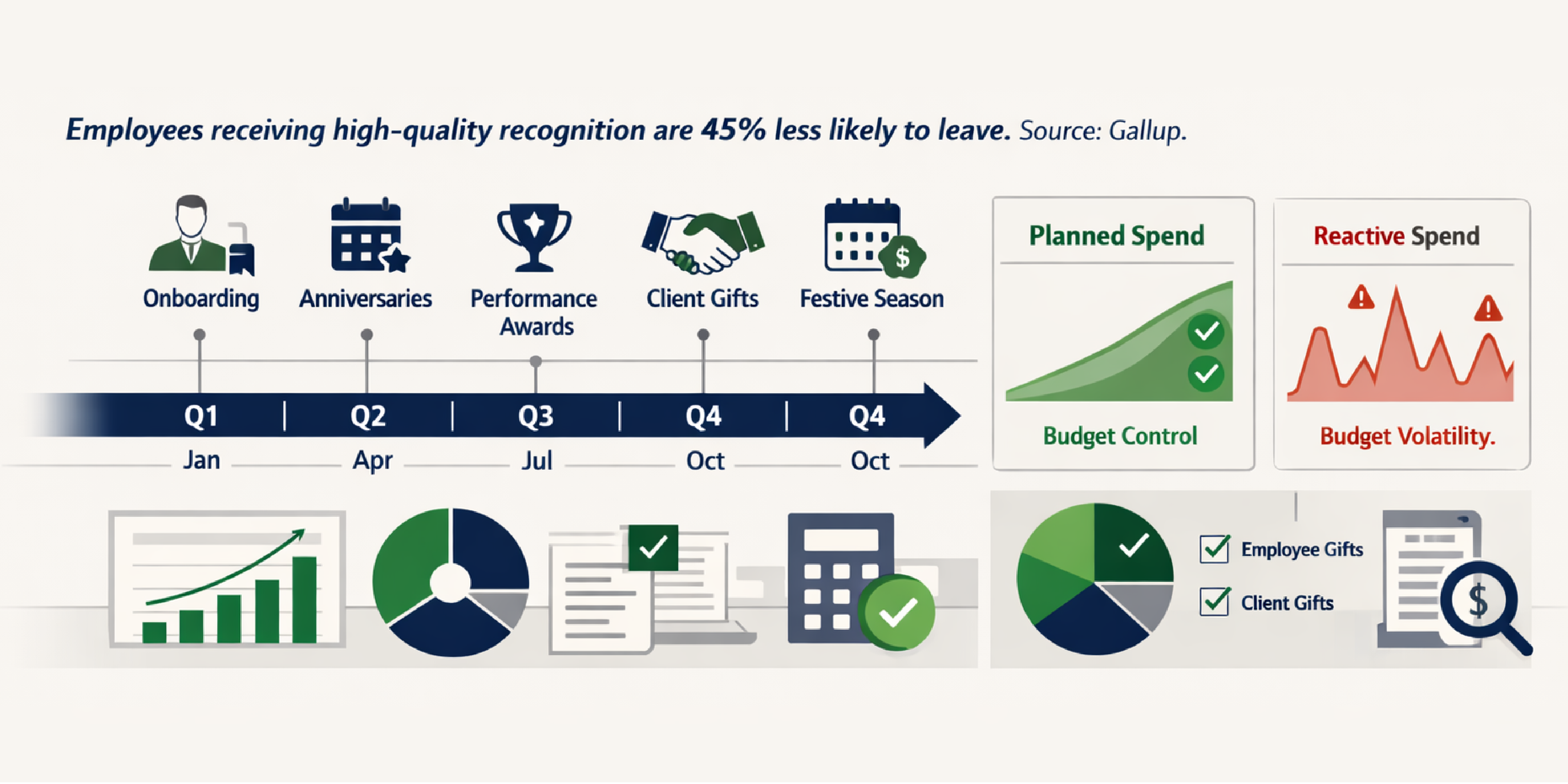
Why Most Corporate Gifting Budgets Are Reactive and the Cost That Creates
Many organisations begin budgeting for corporate gifting only when an event approaches. Diwali arrives, a client milestone appears, or HR requests onboarding gifts for a new hiring wave. Procurement then rushes to source products under tight timelines, often paying premium rates for expedited fulfilment.
This reactive approach creates three measurable risks.
First, costs increase. Last-minute sourcing reduces supplier negotiation power and limits bulk purchasing opportunities.
Second, employee experience suffers. Gallup research shows that meaningful recognition significantly improves engagement, while delayed or poorly executed recognition reduces its effectiveness. Employees who receive high-quality recognition are substantially less likely to leave the organisation.
Third, budget visibility disappears. Finance teams struggle to distinguish between strategic recognition spend and emergency purchases.
The Hidden Cost of Unplanned Gifting
When gifting lacks a defined budget framework, organisations typically encounter:
- Duplicate purchases across departments
- Inconsistent employee experiences
- Uneven client gifting practices
- Increased logistics costs
- Limited reporting on outcomes
A structured annual gifting plan allows procurement teams to negotiate volume pricing, standardise approval processes, and forecast expenditure more accurately.
For organisations managing gifting at scale, partnering with a specialist provider such as The Reward Store's Physical Gifting service can centralise sourcing, branding, packaging, and fulfilment under a single procurement framework, improving budget predictability across the year.
How to Calculate the Right Per-Employee Gifting Budget for Each Occasion Type
The most effective gifting budgets begin with recipient categories and occasion frequency.
Rather than assigning a single annual figure, procurement teams should calculate gifting requirements by event type.
Step 1: Segment Your Employee Gifting Occasions
Common categories include:
- Employee onboarding
- Birthdays
- Work anniversaries
- Performance recognition
- Team milestone celebrations
- Festive gifting
- Retirement recognition
Step 2: Define Gift Tiers
Step 3: Apply Workforce Forecasting
Formula:
Annual Employee Gifting Budget =
(Employee Count × Annual Occasion Cost per Employee)
- New Hire Forecast
- Recognition Reserve
O.C. Tanner research demonstrates that consistent investment in recognition programmes correlates with significantly stronger engagement outcomes. Finance teams therefore benefit from viewing gifting as part of employee experience strategy rather than discretionary spend.
The objective is consistency. Employees notice predictable recognition programmes far more than occasional high-value gifts.
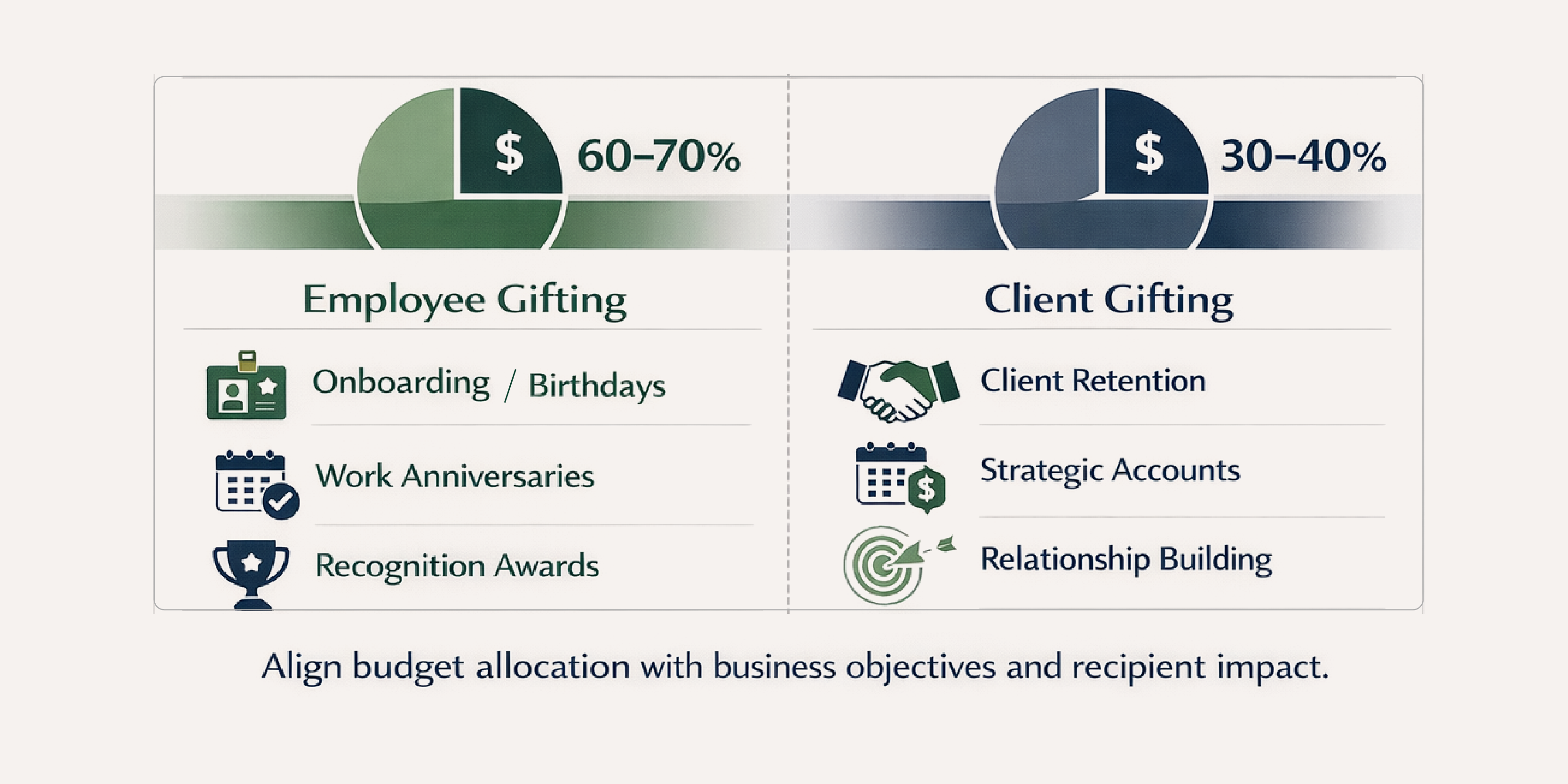
Client Gifting vs Employee Gifting: How to Allocate Across the Two Buckets
One of the most common budgeting mistakes occurs when organisations merge employee and client gifting into a single expenditure pool.
These objectives differ fundamentally.
Employee gifting supports engagement, retention, culture, and recognition.
Client gifting supports relationship development, retention, referrals, and account growth.
Recommended Allocation Framework
Actual allocations depend on industry, sales cycles, and workforce size.
Gallup research consistently links meaningful recognition with stronger engagement and retention outcomes. Employees receiving effective recognition are more likely to feel connected to organisational culture and remain engaged in their roles.
Client gifting, meanwhile, should focus on strategic accounts rather than broad distribution.
A practical segmentation model includes:
Tier 1
High-value accounts and strategic partners.
Tier 2
Growth accounts with expansion potential.
Tier 3
General relationship maintenance.
The Reward Store's Physical Gifting service supports both employee and client gifting programmes through customised branded hampers, premium packaging, personalised messaging, and scalable fulfilment.
This enables procurement teams to maintain budget discipline while delivering consistent brand experiences across both audiences.
The Tax and GST Implications That Should Shape Your Gifting Budget Structure
Finance teams should never evaluate gifting budgets solely on gross spend. Tax treatment can materially influence the true cost of a programme.
In India, GST treatment may vary depending on the nature of the gift, recipient classification, and whether goods are distributed for business promotion, employee welfare, or customer engagement.
Key considerations include:
- Employee gifts exceeding applicable thresholds may trigger tax implications.
- Input tax credit eligibility can vary depending on gift classification.
- Promotional gifting programmes may require separate accounting treatment.
- Documentation and invoice management remain critical for audit readiness.
Procurement Checklist
Before approving any gifting programme:
Because regulations evolve, organisations should obtain advice from qualified tax professionals before finalising annual gifting budgets.
A structured gifting partner can simplify compliance by providing consolidated invoicing, standardised reporting, and clear procurement documentation that supports finance review processes.
How to Build a 12-Month Gifting Calendar That Eliminates Last-Minute Overspend
The strongest gifting budgets begin with a calendar, not a catalogue.
Procurement leaders should map all gifting events before the financial year begins.
Annual Gifting Calendar Framework
Quarter 1
- Employee onboarding forecast
- Service anniversaries
- Client onboarding initiatives
Quarter 2
- Mid-year recognition programmes
- Team achievement celebrations
- Industry event gifting
Quarter 3
- Festive season planning
- Large-scale employee gifting
- Client appreciation campaigns
Quarter 4
- Year-end recognition
- Retirement programmes
- Strategic account gifting
Why Advance Planning Matters
Gallup research shows recognition has the greatest impact when it is timely and meaningful. Delayed recognition reduces its effectiveness and weakens employee engagement outcomes.
A planned calendar allows procurement teams to:
- Consolidate supplier negotiations
- Improve inventory forecasting
- Reduce expedited shipping costs
- Improve budget accuracy
- Create consistent employee and client experiences
The Reward Store's Physical Gifting service supports annual gifting programmes with customised branding, same-day delivery in Bangalore, curated gift categories, personalised inserts, handwritten notes, and scalable fulfilment capabilities that simplify calendar-based execution.
Presenting Your Gifting Budget to Finance: The Data Points That Win Approval
Finance leaders approve budgets when proposals connect spending to measurable business outcomes.
The most persuasive gifting business cases combine workforce data, retention indicators, and operational efficiencies.
Metrics Finance Teams Care About
Gallup research shows employees receiving meaningful recognition are significantly more engaged and less likely to leave their organisations. O.C. Tanner research also demonstrates measurable improvements in engagement when organisations invest consistently in recognition programmes.
Build the Narrative Around Risk Reduction
Rather than presenting gifting as a discretionary employee perk, frame it as:
- Retention support
- Employer brand investment
- Client relationship protection
- Procurement efficiency improvement
- Budget predictability enhancement
This language aligns more closely with finance priorities and strengthens approval likelihood.
For additional planning resources, organisations can explore The Reward Store's Physical Gifting solutions, rewards programmes, and insights available through the company's blog and gifting services pages.
Frequently Asked Questions
What is the best way to calculate a corporate gifting budget?
Start by identifying all gifting occasions across the financial year. Estimate recipient volumes, assign budget tiers for each event type, and include a contingency reserve. Procurement teams should also account for hiring forecasts and client growth plans. Annual planning typically produces more accurate budgets than event-based purchasing.
How much should companies spend on employee gifting annually?
There is no universal figure because budgets vary by workforce size, industry, and recognition strategy. However, O.C. Tanner research indicates that organisations investing consistently in employee recognition achieve stronger engagement outcomes than organisations that do not invest at all. Budget allocation should reflect business objectives and employee demographics.
Can corporate gifting reduce employee turnover?
Recognition alone does not eliminate turnover, but evidence suggests it contributes meaningfully to retention. Gallup research found that employees receiving high-quality recognition were 45% less likely to leave their organisation over a two-year period. Consistent gifting programmes often support broader employee experience initiatives.
Does GST affect corporate gifting budgets in India?
Yes. GST implications vary based on recipient type, gift classification, and business purpose. Finance teams should evaluate gifting programmes alongside tax advisers to ensure compliance and accurate budgeting. Proper documentation remains essential.
How can The Reward Store help with annual gifting budget planning?
The Reward Store's Physical Gifting service helps organisations plan, source, customise, and deliver gifting programmes throughout the year. Procurement teams can consolidate vendors, improve forecasting accuracy, manage branded packaging requirements, and reduce last-minute purchasing challenges through a single gifting partner.
Conclusion
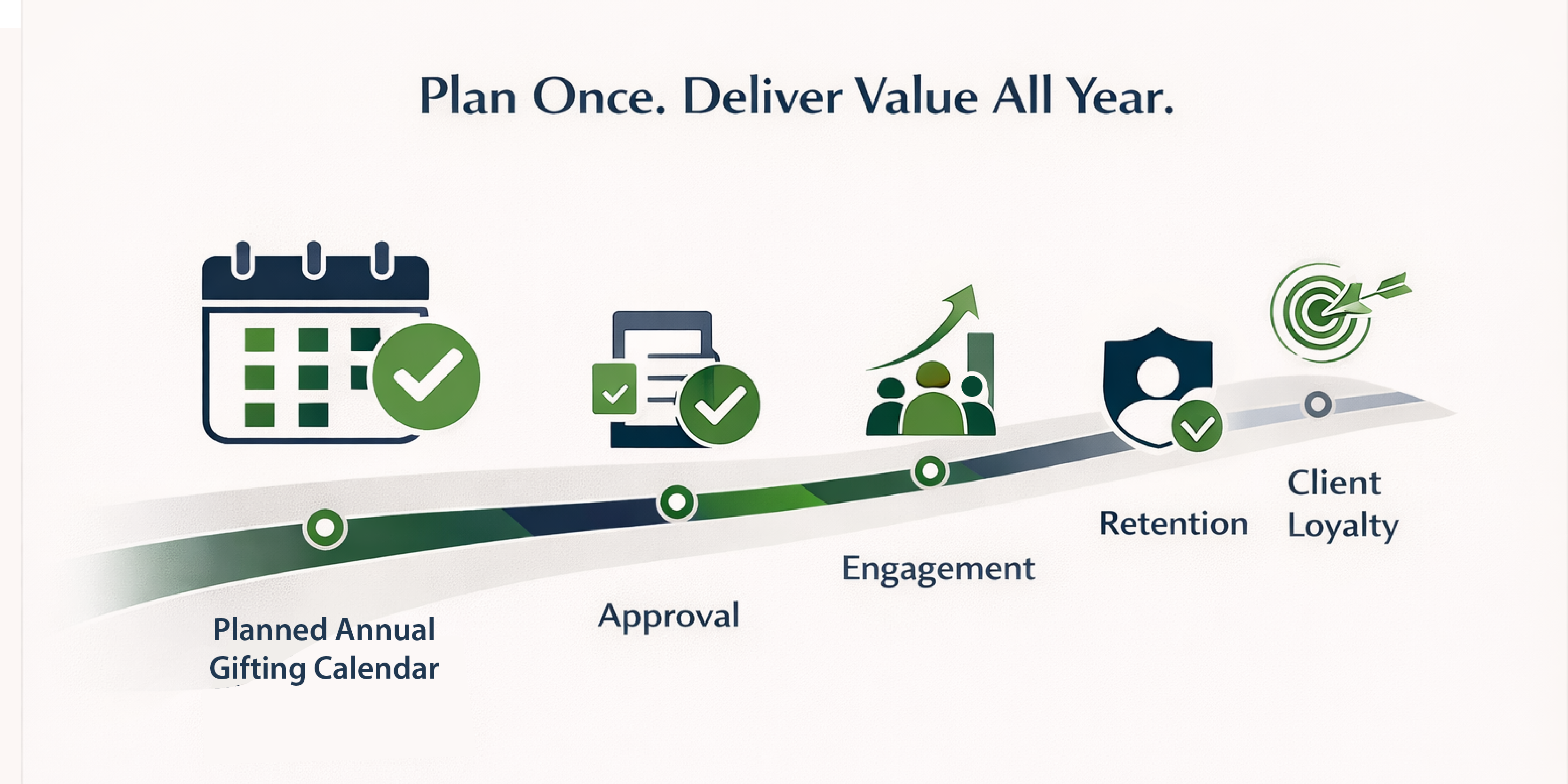
Corporate gifting budgets perform best when organisations treat them as planned investments rather than reactive expenses. A structured approach improves forecasting, strengthens employee and client relationships, and gives finance teams greater visibility into annual expenditure.
As organisations place greater emphasis on retention, engagement, and customer loyalty, gifting programmes will continue to play a strategic role in business planning. The organisations that budget proactively today will manage costs more effectively tomorrow.
Plan your annual gifting budget with expert guidance. Speak to The Reward Store's gifting team.
Sign up for our newsletter for trending top content!


