
How to Handle Gift Warehousing, Kitting and Just in Time Dispatch for Large Employee Bases

Sign up for our newsletter for trending top content!
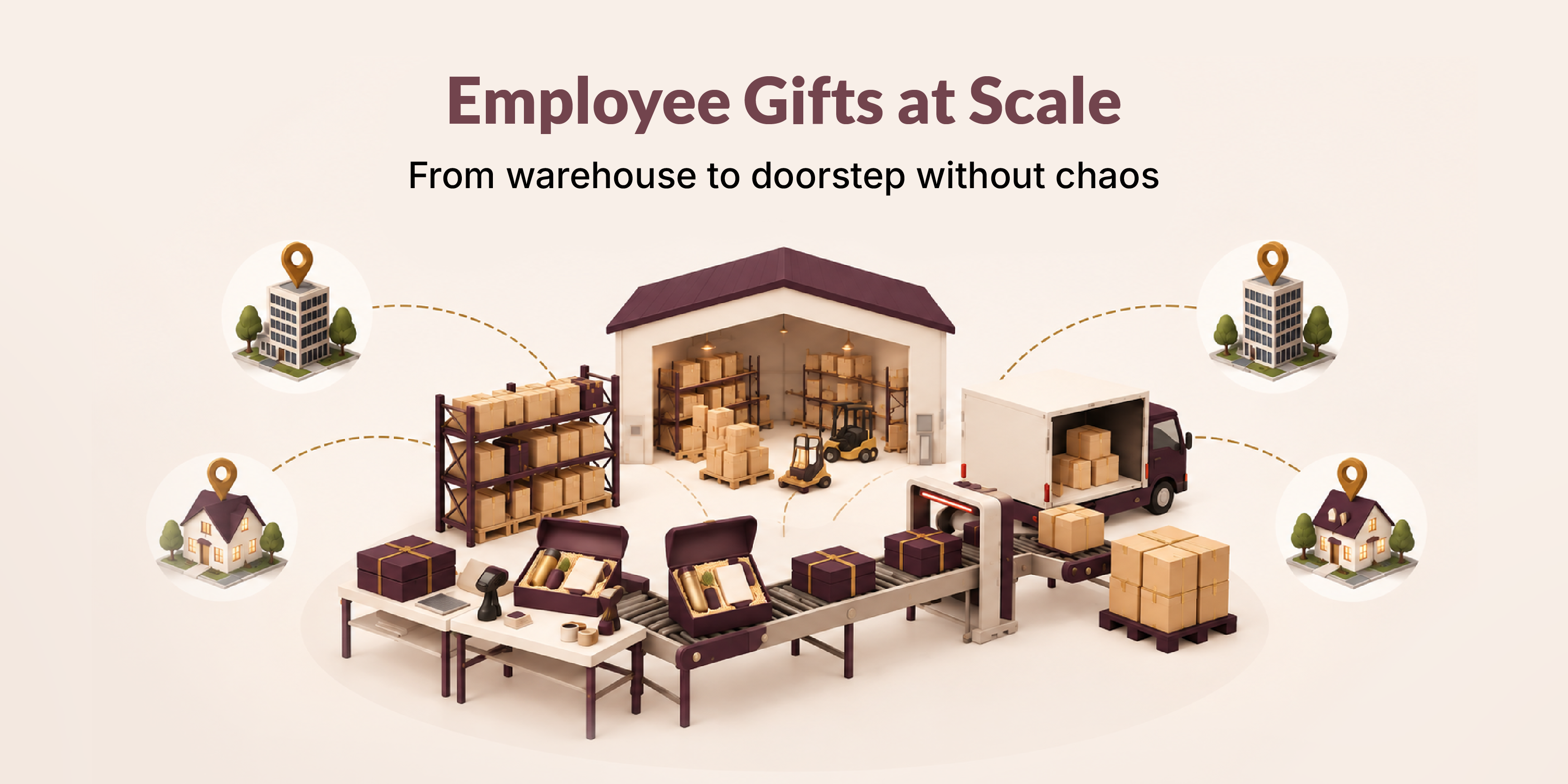
Large scale employee gifting is decided in the warehouse, not the catalogue. Once a programme moves from a few hundred recipients to several thousand, the constraint shifts from sourcing good gift items to storing them correctly, assembling accurate kits, and dispatching in batches that match delivery windows and address quality.
Organisations that treat this as a logistics problem, not a purchasing problem, avoid the failure pattern a corporate gifting and merchandise partner sees repeated: mismatched kits, stalled inventory, and address failures surfacing as a support backlog weeks later.
Where Large Gifting Programmes Actually Break
Large gifting programmes rarely fail at the point of ordering. They fail at three handoffs: intake to storage, storage to kitting, and kitting to dispatch. Each handoff lets the wrong item, quantity, or address enter the pipeline undetected, surfacing only as a query from an employee who never received a gift.
For a Supply Chain Manager, the common mistake is treating warehousing and kitting as an afterthought to procurement. The plan for moving ten thousand items from a supplier's dock to ten thousand desks or homes is often left until the goods arrive, leaving no time to fix a warehouse layout that cannot support the required stock keeping unit (SKU) count. A SKU is the unique code assigned to each distinct item or variant, which is what an inventory system tracks, not the product name.
Where the Threshold Sits
Most organisations feel this shift between two thousand and five thousand recipients, roughly where manual spreadsheet tracking stops matching reality. Below that volume, a single operations lead can visually confirm most kits before dispatch. Above it, confirmation has to be systemic, typically SKU or barcode scanning at each stage.
Bulk Intake, Quality Sampling and Storage Conditions
Bulk intake is the point where an undetected supplier defect becomes a warehouse wide problem, so it needs more structured checking than a delivery note signature. Acceptable Quality Limit (AQL) sampling is a statistical method that inspects a fixed percentage of a batch, not every unit, and uses the defect rate found there to accept or reject the full batch, catching a defective run before it reaches kitting and multiplies across every kit.
The most common failure at intake is not a defective item, it is a quantity discrepancy between the purchase order and the goods received note. A bulk order is often split across multiple shipments, and a team reconciling by eye misses a short shipment until kitting halts mid batch. Reconciling the note line by line against the purchase order, before goods leave quality control, catches this earlier than a physical stock count would.
Storage conditions matter most for hampers containing items with a fixed shelf life. First Expired, First Out (FEFO) is a stock rotation method that dispatches items with the nearest expiry date first, regardless of arrival order, so shorter dated stock does not sit unused until it expires.
Kitting Configuration and Why Variant Counts Multiply Cost
Kitting cost does not scale with the number of recipients, it scales with the number of distinct kit variants, because each variant is effectively a separate small production run inside the warehouse. Kitting is the process of assembling multiple individual items into a single packaged unit dispatched to one recipient, such as combining a branded notebook, a pen, and a welcome card into one box.
Variant counts multiply faster than most planning teams expect, because variables combine independently unless a kitting instruction constrains which combinations are valid. Three gift tiers, four regional variants, and two packaging sizes do not produce nine variants, they produce up to twenty four.
Consider a mid sized information technology services organisation with twelve thousand employees across forty city offices, running a festive season gifting cycle. Three gift tiers by seniority band and four regional festival variants mean the warehouse kits up to twelve configurations, not three or four.
Add a personalised name on each card and every configuration carries a unique insert, so kits must be built to order against a name list, not pre-built and held. This is the same pattern behind personalisation and kitting at volume across large corporate gifting programmes: Cherishd is the corporate physical gifting and branded merchandise business from The Reward Store.
Address Data Hygiene: The Single Largest Source of Failed Delivery
More large scale corporate gift dispatches fail because of address data than anything inside the warehouse, and the fix has to happen before kitting begins, not after a courier reports a failed delivery. A non-delivery report (NDR) is the status a courier returns when a delivery attempt fails, typically citing an incomplete address, an unreachable recipient, or a refused delivery.
Hybrid work has made this worse: an employee's registered office address is often no longer their delivery address, and a home address collected once at onboarding is frequently stale by the time a gifting cycle runs. This is a question a corporate gifting and merchandise partner hears often from HR operations teams ahead of a large run: how much address cleanup is genuinely necessary before dispatch begins.
A Five Step Address Validation Sequence Before Dispatch
- Deduplicate the recipient list against employee ID, not name, since two employees can share a name and one can appear twice under a variation.
- Validate every pin code against a maintained postal index before assigning delivery zones, rather than trusting free text entry.
- Flag addresses updated more than a defined threshold ago, for example ninety days, for reconfirmation, since hybrid work makes addresses stale faster than most HR systems record.
- Separate office delivery lists from home delivery lists explicitly, since one batch containing both produces different failure patterns.
- Run a small sample of the validated list through a test dispatch before committing the full batch, so a systemic data problem is caught on a sample, not the full run.
Holding Inventory Versus Just in Time Dispatch
The decision between holding inventory and dispatching just in time depends on how predictable the recipient list and delivery date are, and how much unclaimed inventory the organisation can tolerate. Held inventory is a model in which finished kits or bulk stock are stored ahead of estimated demand and released on request. Just in time (JIT) dispatch is a model in which items are sourced, kitted and shipped only once a name list is confirmed, minimising warehouse dwell time.
A reasonable objection to holding inventory is that it ties up working capital in items that may never be claimed, a genuine cost just in time avoids. This carries less weight for long shelf life items with a stable forecast, and it does not hold once a distribution date is fixed and simultaneous, such as a company wide town hall moment, because just in time dispatch cannot guarantee thousands of parcels on variable routes all arrive the same day.
Just in time dispatch is the wrong choice whenever every recipient must receive their gift on one fixed date, because courier transit times vary by region and there is no buffer to absorb that variance. Held inventory dispatched several days ahead, with recipients asked not to open the item until the announced date, is more reliable here, even though it costs more and risks unclaimed stock if headcount estimates prove wrong.
Handling Returns, Address Failures and Reattempts at Volume
Returns and address failures are not exceptions handled case by case once volume passes a few thousand units, they are a predictable percentage of any run and need a standing process, not an improvised one. Return to origin (RTO) is the status applied when a courier, after one or more failed attempts, sends a parcel back to the sender rather than continuing to reattempt.
A defined reattempt cap, commonly two attempts, before escalating to HR operations for an updated address, keeps courier cost and reverse logistics closure predictable. Open ended reattempts quietly inflate courier spend and delay reconciling a returned parcel against the dispatch manifest.
Metrics Worth Tracking on Any Large Gifting Run
- Kit accuracy rate: percentage of assembled kits matching the intended configuration on audit.
- First attempt delivery success rate, split by delivery zone.
- Non-delivery reason breakdown: proportion of NDRs from address issues, recipient unavailability, or refusal.
- RTO rate and the average number of days to reverse logistics closure.
- Reattempt to success conversion rate, once an address has been corrected.
- Cost per successfully delivered kit, tracked separately from the gift item cost.
Where Cherishd Fits in This Process
The sequence described above, bulk intake, kitting, address validation and dispatch, is the same sequence any corporate gifting and merchandise partner runs at scale. Cherishd operates within this sequence for physical gifting and branded merchandise, from The Reward Store.
Its scope covers curation, sourcing and supply of gift items and hampers, production and supply of company branded merchandise for launches, events and onboarding, and personalisation, kitting and packaging across large volumes. Delivery covers employee and client addresses across India, including multi location dispatch, drawn from a catalogue of 500 plus Indian brands. It does not issue digital gift cards, run loyalty programmes, or operate redemption.
Frequently Asked Questions
What exactly does kitting mean in a corporate gifting programme?
Kitting is the process of assembling separate items, such as a notebook, a pen, and a card, into a single packaged unit ready for one recipient. Instructions specify which items and quantities go into each variant, so a warehouse team can produce consistent kits without reviewing each recipient's entitlement by hand.
At what volume does gift warehousing and kitting need a structured process rather than manual tracking?
Most organisations notice the shift between two thousand and five thousand recipients, roughly where a single operations lead can no longer visually verify every kit before dispatch. Above that volume, verification needs to be systemic, typically SKU or barcode scanning at each stage.
What is the biggest cause of failed delivery in large scale corporate gift dispatch?
Address data quality causes more failed deliveries than anything inside the warehouse. Free text fields, outdated addresses, and ambiguity between office and home delivery all produce non-delivery reports once a courier attempts the drop. The fix has to happen before kitting begins, through pin code validation and deduplication.
Should an organisation hold gift inventory in advance or dispatch just in time?
It depends on how predictable the recipient list and delivery date are. Held inventory suits stable, repeat programmes and any date fixed, simultaneous distribution, because it removes courier transit variance from the risk. Just in time dispatch suits programmes where the list, variant mix, or timing change late.
How should an organisation handle returns and failed deliveries at volume without overwhelming HR operations?
Treat returns and non-delivery as a predictable percentage of any run, not individual exceptions. Set a fixed reattempt limit, commonly two attempts, before escalating to HR operations for address correction. Track return to origin rate and reattempt to success conversion separately, to see whether the cause is address or courier performance.
Should warehousing and kitting be managed in-house or outsourced to a corporate gifting and merchandise partner?
This depends on frequency and variant complexity. An organisation running one or two large gifting cycles a year, with several kit variants, usually finds outsourcing to a corporate gifting and merchandise partner more efficient than building warehouse capacity that sits idle the rest of the year. Frequent, stable, high volume dispatch may favour in-house operations.
How does Cherishd handle multi location delivery for corporate gifting across India?
Cherishd delivers corporate gifts and branded merchandise directly to employee and client addresses across India, including multi location dispatch. This includes personalisation, kitting and packaging across large volumes before items are sent out. Sourcing draws on a catalogue of 500 plus Indian brands. Digital gift cards, loyalty programmes and redemption are not part of this scope.
Sign up for our newsletter for trending top content!


